
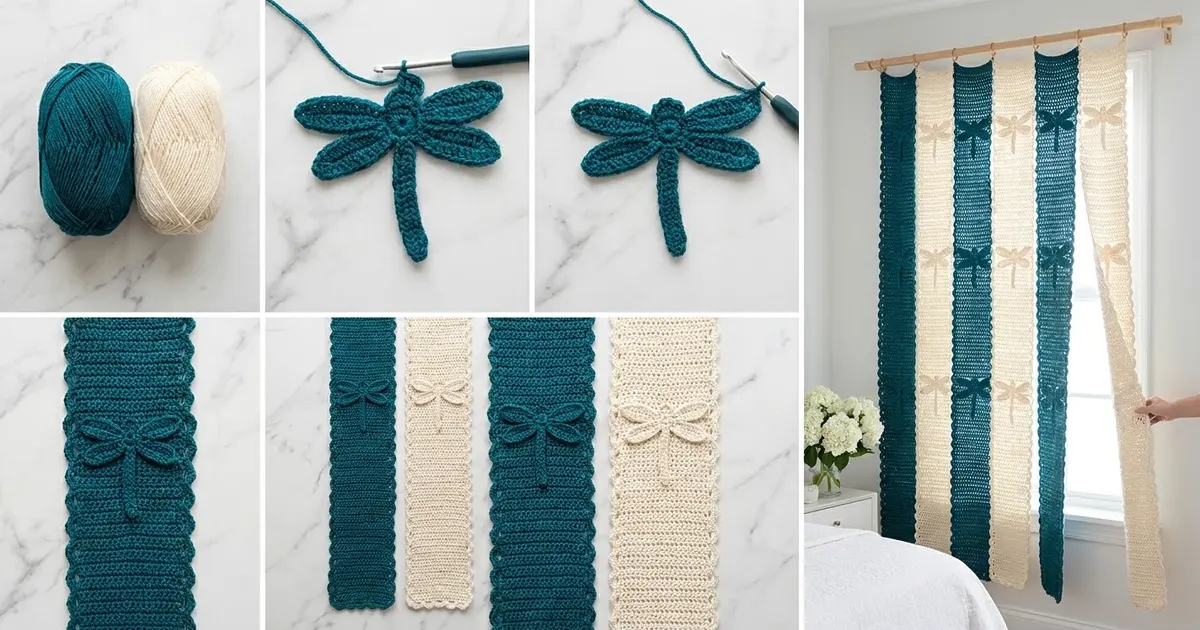
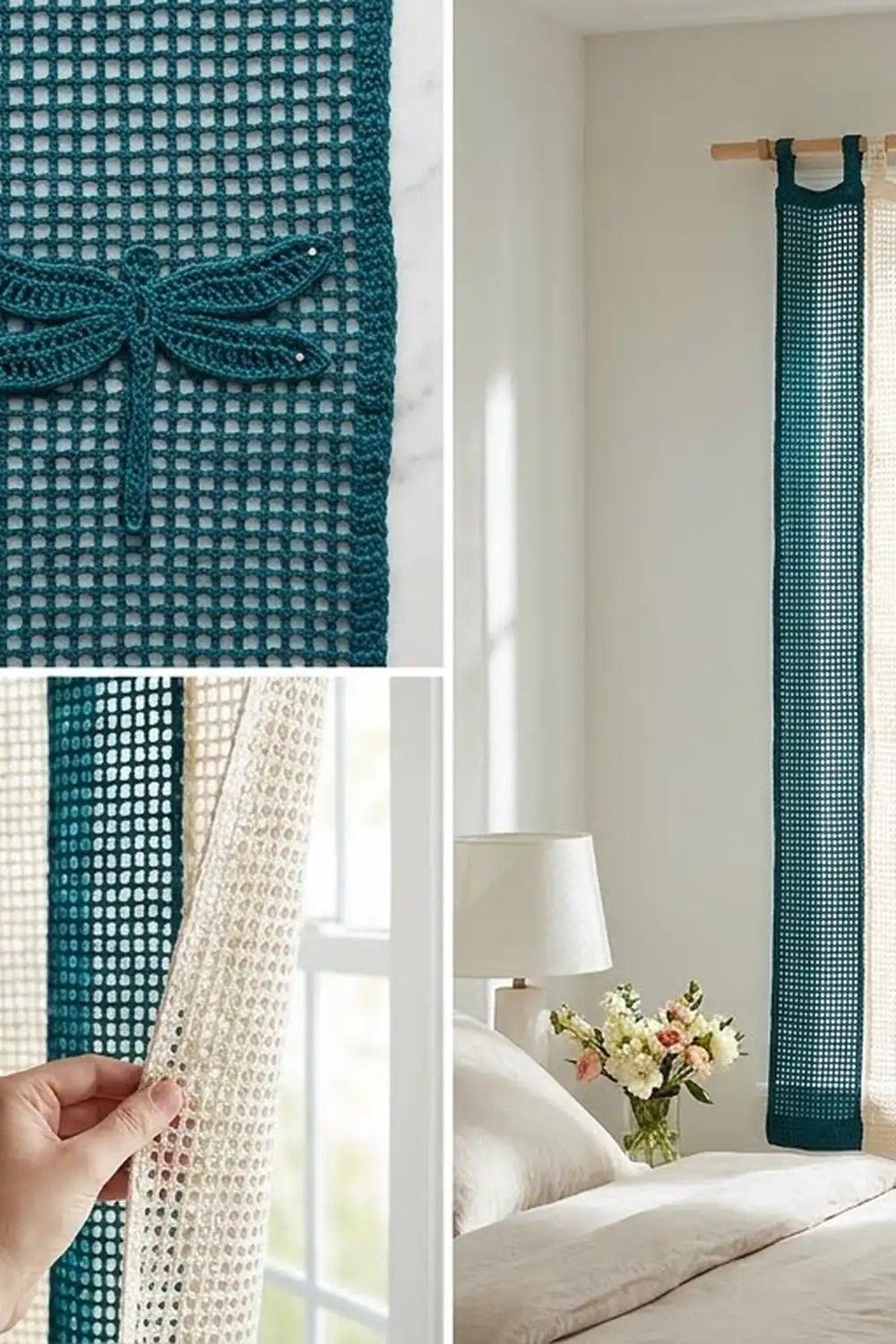
This curtain is made of six tall mesh strips, three in deep teal and three in cream, hung side by side from a curtain rod. Each strip is an open filet-style grid with a column of dragonflies down its center. A small fan sits between the dragonflies, and both ends of each strip finish in scalloped fans.
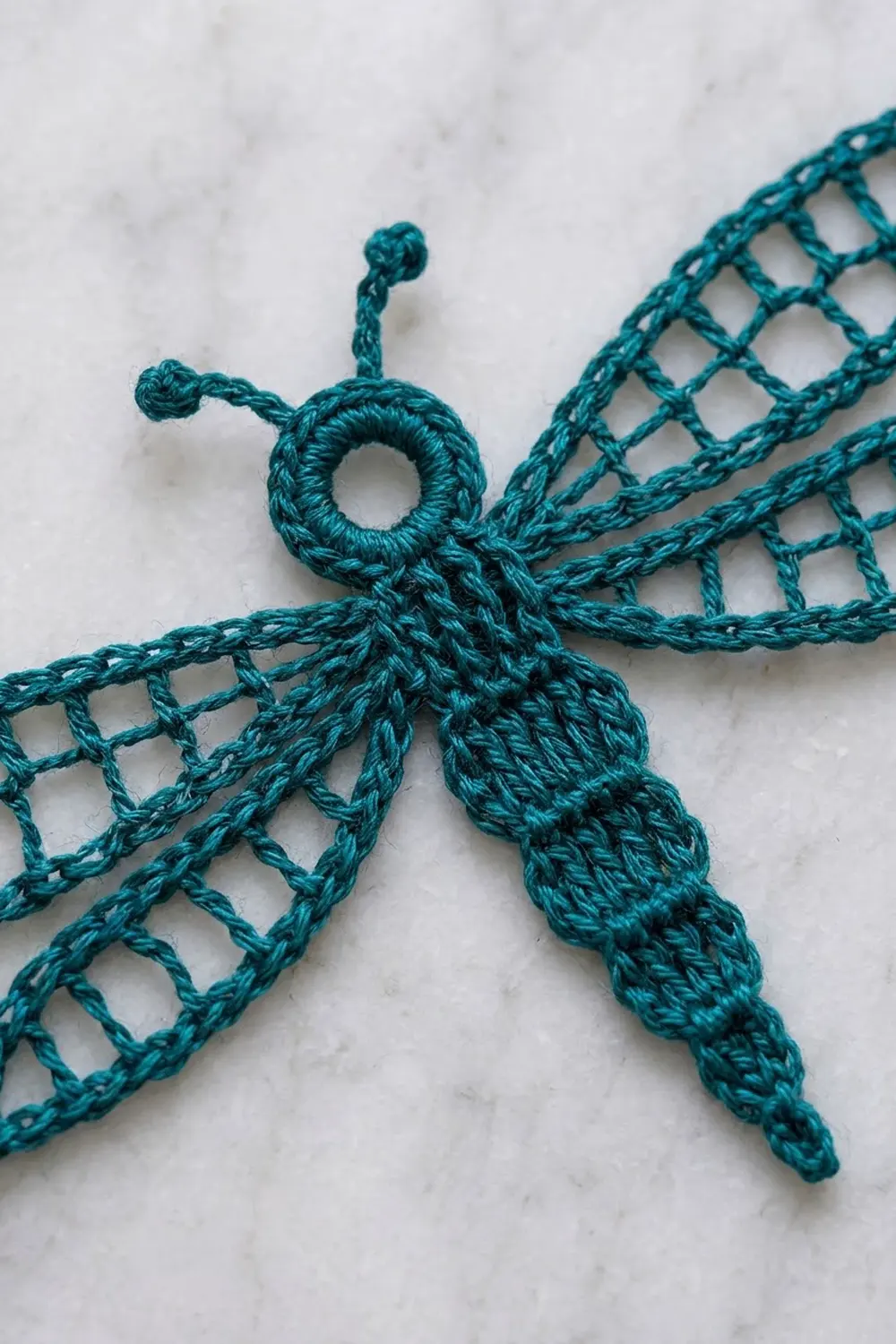
The dragonflies are separate appliqués. Each one has a round head, two knobbed antennae, a segmented body and four pointed wings with open, window-like cells. They match the color of their strip, so they show as soft texture rather than strong contrast. The look is airy, botanical and slightly vintage.
The pattern uses US crochet terms. One finished strip measures 6.8 in (17.3 cm) wide by 55.2 in (140.2 cm) long, and the tabs add about 1.5 in (3.8 cm) of drop. Six strips hung edge to edge cover 40.8 in (103.6 cm).
You work each strip flat from the bottom up in rows of mesh. Then you add a two-round border with fans on the short ends, followed by two hanging tabs. The dragonflies are made separately and sewn on. The strips hang independently, with no side seams.
Finished Size and Construction
- Finished strip size: 6.8 in x 55.2 in (17.3 cm x 140.2 cm)
- Finished curtain width: 40.8 in (103.6 cm), six strips edge to edge
- Skill level: Intermediate
- Terminology: US crochet terms
- Yarn weight: DK (#3) cotton
- Hook: 4.0 mm (G-6)
- Number of pieces: 6 strips and 54 dragonflies (each dragonfly is 1 body plus 4 wings)
- Layout: 6 strips in one row, alternating teal and cream
- Strip size before border: 6 in x 54 in (15.2 cm x 137.2 cm), which is 15 mesh squares by 135 rows
- Border depth: 0.4 in (1.0 cm) on the long sides, 0.6 in (1.5 cm) on the short ends
- Dragonfly size: 5.8 in (14.7 cm) wingspan, 4 in (10.2 cm) long including antennae
Materials
Choose a smooth DK cotton. Mercerized cotton gives crisp mesh lines, holds the wing cells open and resists sagging in long strips. Avoid fuzzy or stretchy yarns.
- Teal: 400 g, about 880 m (960 yd), for 3 strips and 27 dragonflies
- Cream: 400 g, about 880 m (960 yd), for 3 strips and 27 dragonflies
These quantities include a margin of about 15 percent for swatching and differences in tension.
Tools:
– 4.0 mm (G-6) crochet hook
– Tapestry needle
– Rust-proof pins and a blocking surface at least 60 in (152.4 cm) long
– Spray bottle and measuring tape
– Stitch markers
– Curtain rod up to 1 in (2.5 cm) in diameter
Abbreviations (US Terms)
- ch = chain
- sl st = slip stitch
- sc = single crochet
- hdc = half double crochet
- dc = double crochet
- sc2tog = single crochet 2 together
- sk = skip
- sp = space
- st(s) = stitch(es)
- BLO = back loop only
Special stitch – picot: Ch 3, then sl st in the 3rd ch from the hook. This makes the round knob at the end of each antenna.
Mesh square: One dc plus one ch-2 sp, closed by the next dc.
Gauge and Checkpoints
Mesh gauge: 10 mesh squares and 10 rows = 4 in (10.2 cm), blocked. Each square is 0.4 in (1.0 cm) wide and tall.
Border gauge: 20 sc = 4 in (10.2 cm), and 1 sc row = 0.2 in (0.5 cm).
Before you start, make a test piece: work Rows 1 to 18 of the strip, which includes one fan row, and make one complete dragonfly.
Checkpoints:
– After Row 1: 6 in (15.2 cm) wide
– After Row 15: 6 in (15.2 cm) tall
– After Row 75: 30 in (76.2 cm) tall
– After Row 135: 54 in (137.2 cm) tall, still 6 in (15.2 cm) wide
– One wing: 2.6 in (6.6 cm) long and 1.2 in (3.0 cm) wide
If your test piece is too big, go down to a 3.75 mm (F-5) hook. If it’s too small, go up to a 4.5 mm (7) hook. Row height matters most, because any error repeats 135 times.
Strip (Make 6: 3 Teal, 3 Cream)
Every row has 16 dc and 15 ch-2 sps, for 46 sts. Fan rows are the exception.
Foundation: Ch 48.
Row 1: Dc in the 6th ch from the hook (the skipped 5 ch count as 1 dc plus a ch-2 sp), *ch 2, sk 2 ch, dc in next ch; rep from * 13 more times. (16 dc, 15 ch-2 sps; 46 sts)
Row 2: Ch 3 (counts as dc throughout), turn, *ch 2, dc in next dc; rep from * across, working the last dc in the 3rd ch of the skipped ch-5. (16 dc, 15 ch-2 sps; 46 sts)
Row 3 (fan row): Ch 3, turn, (ch 2, dc in next dc) 7 times, 7 dc in next ch-2 sp, dc in next dc, (ch 2, dc in next dc) 7 times, working the last dc in the top of the turning ch. (23 dc, 14 ch-2 sps; 51 sts)
The fan fills the 8th square, which is the center column, with 7 open squares on each side.
Row 4: Ch 3, turn, (ch 2, dc in next dc) 7 times, ch 2, sk the 7 fan dc, dc in next dc, (ch 2, dc in next dc) 7 times. (16 dc, 15 ch-2 sps; 46 sts)
Rows 5 to 17: Repeat Row 2. (46 sts each)
Rows 18 to 135: Continue the 15-row repeat. Rows 18, 33, 48, 63, 78, 93, 108 and 123 are fan rows, worked like Row 3 (51 sts). Each fan row is followed by a closing row worked like Row 4 (46 sts). All other rows are worked like Row 2 (46 sts).
That makes 9 repeats and 9 fans. Don’t fasten off. Continue straight to the border.
Dragonfly (Make 54: 27 Teal, 27 Cream)
Head and Body
Rnd 1 (head): Make a magic ring, ch 1, 8 sc in the ring, sl st to the first sc. Pull the ring tight. (8 sc)
Row 1 (thorax): Ch 1, sc in next 3 sc, turn. (3 sc)
Rows 2 to 4: Ch 1, sc BLO in each sc, turn. (3 sc)
Row 5: Ch 1, sc2tog, sc in next sc, turn. (2 sc)
Rows 6 to 14: Ch 1, sc BLO in each sc, turn. (2 sc)
Row 15: Ch 1, sc2tog. (1 sc) Fasten off.
The back-loop rows leave a ridge on each row, which creates the segmented abdomen. The body measures 3.5 in (8.9 cm) including the head.
Antennae: Join yarn in a head sc opposite the thorax, ch 5, picot, sl st in each of the 5 ch, sl st in next head sc, ch 5, picot, sl st in each of the 5 ch. Fasten off. Each antenna is 0.5 in (1.3 cm) long.
Wing (Make 4 per Dragonfly)
Foundation: Ch 12.
Rnd 1: Sc in 2nd ch from hook, hdc in next ch, dc in next ch, (ch 1, sk 1 ch, dc in next ch) 3 times, hdc in next ch, 3 sc in last ch for the tip. Rotate to work along the other side of the foundation: hdc in next ch, dc in next ch, (ch 1, sk 1 ch, dc in next ch) 3 times, hdc in next ch, 2 sc in last ch (the one holding the first sc), sl st to first sc. (7 sts + 3 tip sc + 8 sts = 18 sts, plus 6 ch-1 sps)
The ch-1 sps sit on both sides of the center chain and form the open wing cells.
Rnd 2 (outline): Ch 1, sc in each st and each ch-1 sp around, working 3 sc in the center sc of the tip, sl st to first sc. (24 sc worked 1 per existing st or sp, plus 2 extra at the tip = 26 sc)
Fasten off, leaving a 10 in (25.4 cm) tail. The wing is a pointed oval measuring 2.6 in x 1.2 in (6.6 cm x 3.0 cm).
Assemble the Dragonfly
Sew 2 wings to each side of the thorax. Attach the upper wings at Row 2, angled slightly toward the head, and the lower wings at Row 4, angled slightly toward the tail. The wingspan should measure 5.8 in (14.7 cm).
Make All Pieces
| Color | Strips | Bodies | Wings |
|---|---|---|---|
| Teal | 3 | 27 | 108 |
| Cream | 3 | 27 | 108 |
Layout (left to right, room side):
[ Teal ][ Cream ][ Teal ][ Cream ][ Teal ][ Cream ]
   1       2        3       4        5       6
Each strip carries 9 dragonflies in its own color.
Joining: Appliqué and Hanging
The strips aren’t seamed together. Each one hangs from the rod on its own tabs, so any strip can be drawn aside. Joining here means sewing the dragonflies onto the mesh.
Placement: Center each dragonfly on square 8 within its 15-row repeat. The tail tip goes on repeat row 5, the thorax over rows 11 and 12, and the top of the head on row 13, with the antennae reaching into row 14. Each fan then sits between two dragonflies.
Stitch-to-stitch tacking: Use the wing tails to tack each dragonfly at 10 points:
– 4 wingtips, each caught to the dc post nearest square 1 or square 15
– 4 points at the middle of each wing’s outer edge
– 1 point at the head and 1 at the tail tip, each caught to a center column dc
Run the yarn between tacks along the back of the outline sc.
Tension: Tacks should hold the dragonfly against the mesh without pulling. If a square puckers, loosen that tack.
Size checkpoint: The mesh must still lie flat and measure 6 in (15.2 cm) wide across every dragonfly.
Border
Border gauge is 20 sc = 4 in (10.2 cm). Continue from Row 135 with the right side facing. Side counts below don’t include corner stitches, which are listed separately.
Rnd 1: Ch 1, then work down the first long side.
– Long sides: Work 2 sc around each row-end post. (135 x 2 = 270 sc per side)
– Bottom end: Working into the foundation chain, sc in the ch at the base of each dc and 1 sc in each ch-2 sp. (16 + 15 = 31 sc)
– Top end: Sc in each dc and 1 sc in each ch-2 sp. (16 + 15 = 31 sc)
– Corners: Ch 1 at each corner.
Sl st to first sc. (270 + 31 + 270 + 31 = 602 sc, plus 4 corner ch-1 sps)
Rnd 2: Ch 1.
– Long sides: Sc in each sc. (270 sc per side)
– Corners: Work 3 sc in each corner ch-1 sp. (12 sc total)
– Short ends: Sc in first sc, *sk 2 sc, 7 dc in next sc, sk 2 sc, sc in next sc; rep from * 4 more times. (5 fans; 6 sc + 35 dc = 41 sts per end)
Sl st to first sc. (270 + 270 + 41 + 41 + 12 = 634 sts)
Why the math works: Each long side has 135 rows at 0.4 in (1.0 cm) each, which is 54 in (137.2 cm). At 5 sc per inch, 2 sc per row gives 270 sc, which also measures exactly 54 in (137.2 cm). On each short end, 31 sc divides as 1 sc plus 5 repeats of 6 sts, so every fan comes out complete. The 31 sc measure 6.2 in (15.7 cm) over a 6 in (15.2 cm) edge. The fans draw in that slight fullness, and blocking sets it flat.
Hanging tabs (top end only): The top end has 6 sc around its 5 fans. Join yarn in the 2nd sc, ch 18, sl st in the same sc, work 24 sc into the loop, sl st in the same sc, and fasten off. Repeat in the 5th sc. Each tab measures 3.6 in (9.1 cm) around, fits a rod up to 1 in (2.5 cm) in diameter and adds 1.5 in (3.8 cm) of drop.
Final Blocking
- Weave in all ends.
- Soak the strip in cool water for 10 minutes, then roll it in a towel to press out the water. Don’t wring it.
- Pin the long sides straight, 6.8 in (17.3 cm) apart.
- Pin the length to 55.2 in (140.2 cm), working from the center outward.
- Pin each end fan into an even scallop.
- Open out the wings and pin each wingtip so the cells stay open.
- Leave to dry completely, then unpin and measure again.
Final Quality-Control Checklist
- Each strip measures 6.8 in x 55.2 in (17.3 cm x 140.2 cm).
- Each strip has 135 rows, 9 fans and 9 centered dragonflies.
- Each long side has 270 sc, and each short end has 5 even fans.
- Each wing has 26 outline sc and open cells.
- No mesh squares pucker under the tacks.
- The tabs match in size and hang level.
- The strips alternate teal and cream across the rod.
Troubleshooting
Strip narrows: You’re probably missing the last dc in the turning chain. Count 16 dc on every row.
Strips differ in length: Re-block them to match, or check your row height against the checkpoints.
Fan bulges: Make sure the closing row skips all 7 fan dc.
Wings curl: Work Rnd 2 more loosely, or block the wings firmly.
Edges ripple: Go down half a hook size for the border.
Strip hangs crooked: Check that both tabs have 18 ch and 24 sc.
Care
Hand wash in cool water with mild detergent, then dry flat and pinned to size. Don’t tumble dry.
Final Notes
Every measurement follows from the 0.4 in (1.0 cm) mesh square. Fifteen squares make the 6 in (15.2 cm) width, and 135 rows make the 54 in (137.2 cm) length. The border brings each strip to 6.8 in x 55.2 in (17.3 cm x 140.2 cm), and six strips span 40.8 in (103.6 cm). Check your gauge early, count your stitches on every row and keep the dragonfly tacks light.
Happy crocheting!