
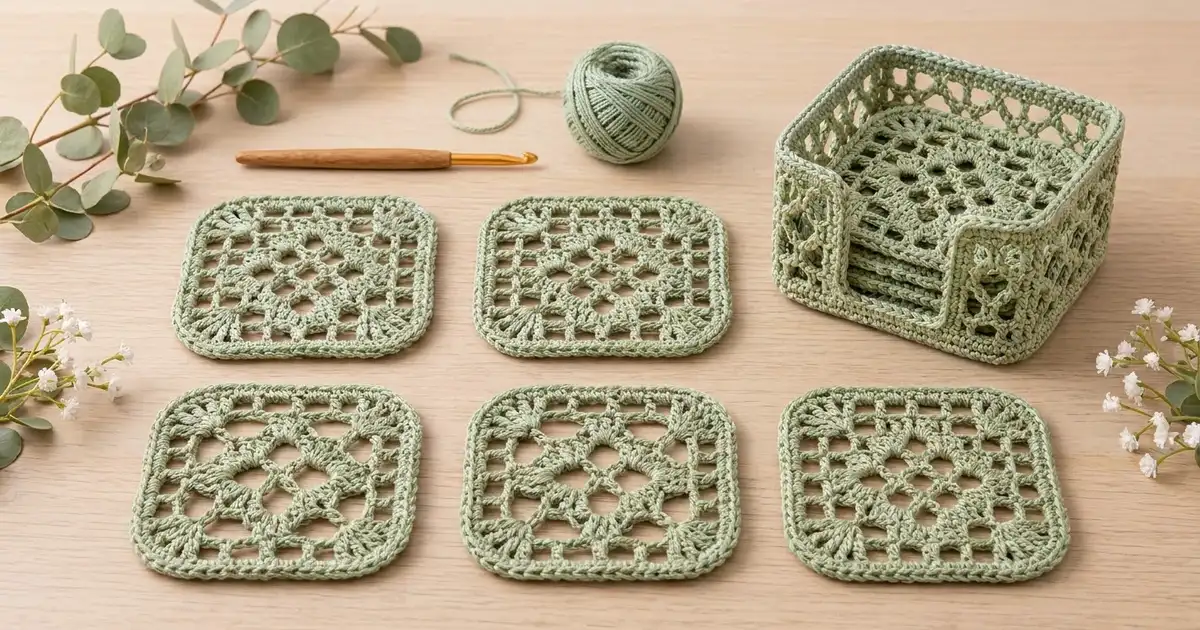
The Sage Lattice Coaster Set is six lacy square coasters plus a matching holder with openwork walls. Each coaster starts as a small eight-point star, grows into a rounded square with little fans at the corners, and finishes with a ring of mesh windows and a firm single crochet rim.
The whole set uses one color, a soft sage green, in fingering-weight cotton. Cotton makes the pieces crisp, absorbent, and easy to wash, and one color keeps the look calm and modern on any table.
This pattern uses US crochet terms. Each finished coaster measures 4.5 in (11.4 cm) square. The holder is 5.25 in (13.3 cm) square and 2 in (5.1 cm) tall.
Construction is simple. Each coaster is worked in joined rounds from the center out. For the holder, you crochet a square base in rows, make one long wall strip, and join the strip to the base with single crochet. The two ends of the strip leave an opening at the front.
Finished Size and Construction
- Coaster size: 4.5 in (11.4 cm) square
- Coaster size before border: 4.25 in (10.8 cm) square
- Border depth: 0.125 in (0.3 cm) on each side
- Holder: 5.25 in (13.3 cm) square base, walls 2 in (5.1 cm) tall
- Skill level: Intermediate
- Terminology: US
- Yarn weight: Fingering (1), mercerized cotton
- Hook: 2.75 mm (US C/2)
- Number of pieces: 6 coasters, 1 holder base, 1 holder wall strip
- Layout: The coasters are separate pieces that stack inside the holder; they are not joined to each other.
Materials
Yarn: Use a fingering-weight mercerized cotton with about 170 m per 50 g. Mercerized cotton shows off the mesh windows and holds a crisp edge. Avoid acrylic, because it doesn’t absorb moisture and won’t block flat.
- Sage Green: 70 g (about 238 m / 260 yd)
- Coasters: about 5 g (17 m) each, 30 g (102 m) for six
- Holder: about 25 g (85 m)
These quantities include a margin of about 15 g (51 m) for your gauge swatch and tension differences.
Tools:
– 2.75 mm (US C/2) crochet hook
– Tapestry needle
– 4 locking stitch markers
– Scissors
– Blocking mat and rustproof pins
– Spray bottle
– Ruler or tape measure
Abbreviations (US Terms)
- ch – chain
- sl st – slip stitch
- sc – single crochet
- dc – double crochet
- sp(s) – space(s)
- sk – skip
- st(s) – stitch(es)
- RS / WS – right side / wrong side
- Rnd – round
Special stitch – Corner shell: (2 dc, ch 2, 2 dc) in the same corner space.
Gauge and Checkpoints
Border gauge: 31 sc = 4 in (10.2 cm), which is about 7.75 sc per inch.
Make one coaster before you start the set and check it at each stage:
- After Rnd 3: circle measures 2.25 in (5.7 cm) across.
- After Rnd 4: square measures 3 in (7.6 cm) side to side.
- After Rnd 5: 3.75 in (9.5 cm).
- After Rnd 6: 4.25 in (10.8 cm), which is the size before border.
- After Rnd 8: 4.5 in (11.4 cm).
If your coaster is too big, go down to a 2.5 mm hook. If it’s too small, go up to a 3.0 mm hook. A difference of 0.25 in (0.6 cm) per coaster matters, because the coasters have to fit inside a 5.25 in (13.3 cm) holder with a little room to spare.

Coaster Pattern (make 6)
Rnd 1 (RS): Make a magic ring. Ch 3 (counts as dc), 15 dc in ring, then sl st to the top of the beginning ch-3. (16 dc)
Rnd 2: Ch 3 (counts as dc), dc in next st, ch 3. Dc in each of next 2 sts, ch 3; repeat from * 6 more times. Sl st to the top of the beginning ch-3. (16 dc in 8 pairs, 8 ch-3 sps)*
These eight spokes are the points of the star.
Rnd 3: Sl st in next dc and into the first ch-3 sp. Ch 3 (counts as dc), then (dc, ch 2, 2 dc) in the same sp and ch 1. Work a corner shell in the next ch-3 sp, ch 1; repeat from * 6 more times. Sl st to the top of the beginning ch-3. (32 dc, 8 ch-2 sps, 8 ch-1 sps)*
Checkpoint: 2.25 in (5.7 cm) across. The piece is still round.
Rnd 4 (squaring round): Sl st in next dc and into the first ch-2 sp. Ch 3 (counts as dc), then (2 dc, ch 3, 3 dc) in the same sp. This is the first corner fan. Then:
- Ch 2, sc in next ch-1 sp, ch 2.
- (2 dc, ch 2, 2 dc) in next ch-2 sp. This is the mid-side shell.
- Ch 2, sc in next ch-1 sp, ch 2.
- *(3 dc, ch 3, 3 dc) in next ch-2 sp, ch 2, sc in next ch-1 sp, ch 2, (2 dc, ch 2, 2 dc) in next ch-2 sp, ch 2, sc in next ch-1 sp, ch 2; repeat from * 2 more times.
- Sl st to the top of the beginning ch-3.
(40 dc, 8 sc, 4 corner ch-3 sps, 4 mid-side ch-2 sps, 16 ch-2 link sps)
Checkpoint: 3 in (7.6 cm) square. Place a marker in each corner ch-3 sp.
Rnd 5 (conversion round): Sl st in next 2 dc and into the corner ch-3 sp. Ch 3 (counts as dc), then (dc, ch 2, 2 dc) in the same sp. Work each side as follows:
- Dc in each of next 3 dc.
- 2 dc in the ch-2 link.
- Dc in the sc.
- 2 dc in the ch-2 link.
- Dc in each of next 2 dc.
- 3 dc in the mid-side ch-2 sp.
- Dc in each of next 2 dc.
- 2 dc in the ch-2 link.
- Dc in the sc.
- 2 dc in the ch-2 link.
- Dc in each of next 3 dc.
- Work a corner shell in the corner ch-3 sp.
Repeat around, leaving out the last corner shell. Sl st to the top of the beginning ch-3.
Count per side, from corner space to corner space: 2 + 3 + 2 + 1 + 2 + 2 + 3 + 2 + 2 + 1 + 2 + 3 + 2 = 27 dc. That includes the 2 corner-shell dc at each end. (108 dc, 4 corner ch-2 sps)
Checkpoint: 3.75 in (9.5 cm).
Rnd 6 (mesh round): Sl st in next dc and into the corner ch-2 sp. Ch 3 (counts as dc), then (dc, ch 2, 2 dc) in the same sp. Work each side as follows: dc in the first dc of the side, then *ch 1, sk 1 dc, dc in next dc; repeat from * 12 more times, which brings you to the last dc before the corner. Work a corner shell in the corner sp. Repeat around, leaving out the last corner shell, and sl st to join.
Per side: 2 corner dc + 14 mesh dc + 13 ch-1 windows + 2 corner dc = 31 sts, not counting the corner spaces. The 27 stitches of Rnd 5 become 14 posts and 13 windows (14 + 13 = 27). (72 dc, 52 ch-1 sps, 4 corner ch-2 sps)
Checkpoint: 4.25 in (10.8 cm). This is the size before border.
Continue with the Border section below.
Holder Base (make 1)
Row 1: Ch 40. Sc in 2nd ch from hook and in each ch across, then turn. (39 sc)
Rows 2–44: Ch 1, sc in each st across, turn. (39 sc)
Checkpoint: 5 in (12.7 cm) square. Add or remove rows until the piece is square.
Edging round: Ch 1. Work as follows:
- Sc in each of the 39 sts across the last row, then ch 2 at the corner.
- Work 39 sc evenly down the 44 row-ends, skipping about every 9th row-end, then ch 2.
- Work 39 sc across the foundation chain, then ch 2.
- Work 39 sc up the remaining row-ends, then ch 2.
- Sl st to the first sc.
(156 sc: 39 per side, plus 4 corner ch-2 sps) Fasten off.
Checkpoint: 5.25 in (13.3 cm) square. Choose one side to be the front.
Holder Wall Strip (make 1)
Row 1: Ch 150. Sc in 2nd ch from hook and in each ch across, then turn. (149 sc)
Row 2 (mesh): Ch 4 (counts as dc + ch 1), sk 1 st, dc in next st. Ch 1, sk 1, dc in next st; repeat from * across, then turn. (75 dc, 74 ch-1 sps = 149 sts)*
Row 3 (lattice): Ch 1, sc in first dc. Ch 5, sk next 3 sts, sc in next st; repeat from * 36 more times, then turn. (38 sc, 37 ch-5 loops)* The math: 1 + (37 × 4) = 149.
Row 4 (lattice): Ch 5 (counts as dc + ch 2), sc in first ch-5 loop. Ch 5, sc in next loop; repeat from * 35 more times. Ch 2, dc in last sc, then turn. (37 sc, 36 ch-5 loops, 2 ch-2 end sps)* Rows 3 and 4 are offset by half a loop, so together they form the diamonds.
Row 5 (closing): Ch 1. Sc in the first dc, sc in the ch-2 sp, and sc in the next sc. 3 sc in next loop, sc in next sc; repeat from * 35 more times. Sc in the ch-2 sp and sc in the 3rd ch of the turning ch, then turn. (149 sc)* The math: 3 + (36 × 4) + 2 = 149.
Row 6 (mesh): Repeat Row 2. (149 sts)
Row 7 (rim): Ch 1, sc in each dc and each ch-1 sp across. (149 sc) Don’t fasten off.
End edges: Turn the strip and work 14 sc evenly down the short end to the foundation chain. Fasten off. Join yarn at the other top corner and work 14 sc down that end. Fasten off.
Checkpoint: the strip is 2 in (5.1 cm) tall.
Make All Pieces
Total for the set:
- 6 coasters (about 30 g / 102 m of Sage Green)
- 1 holder base and 1 wall strip (about 25 g / 85 m of Sage Green)
How the holder is laid out, seen from above (each wall section is labeled with the number of base stitches it’s joined to):
+---------- BACK (39) ----------+
|                               |
LEFT (39)    6 coasters    RIGHT (39)
|              stacked          |
|                               |
+-F(10)-+  OPEN (19)  +-F(10)---+
Joining
Method: Single crochet join, worked through both layers with the WS facing each other and the wall on the outside.
Stitch-to-stitch logic: Each foundation stitch of the wall gets one sc into one base stitch. At each corner, 3 wall stitches go into the corner ch-2 space.
Count along the front edge of the base and mark the 10th sc in from each front corner. Start at the left marker and join in this order:
| Section | Base sts used | Wall sts used |
|---|---|---|
| Left front segment | 10 | 10 |
| Front-left corner sp | 1 sp | 3 |
| Left side | 39 | 39 |
| Back-left corner sp | 1 sp | 3 |
| Back | 39 | 39 |
| Back-right corner sp | 1 sp | 3 |
| Right side | 39 | 39 |
| Front-right corner sp | 1 sp | 3 |
| Right front segment | 10 | 10 |
Wall total: 10 + 3 + 39 + 3 + 39 + 3 + 39 + 3 + 10 = 149, which matches the strip exactly. The 19 center front stitches are left unjoined (39 − 20 = 19). That leaves an opening of about 2.5 in (6.4 cm).
Tension: Keep the joining stitches the same size as the fabric. If they’re too tight, the walls lean inward. If they’re too loose, the corners sag.
Size checkpoint: The holder’s inside measures just under 5.25 in (13.3 cm), with about 0.25 in (0.6 cm) of room around a finished coaster.
Border
Border gauge: 31 sc = 4 in (10.2 cm).
Rnd 7: Join to any corner ch-2 sp of Rnd 6 and ch 1. Work 3 sc in each corner sp. Along each side, sc in each dc and each ch-1 sp: 2 + 14 + 13 + 2 = 31 sc per side. Sl st to join. (4 × 31 + 4 × 3 = 136 sc)
Rnd 8 (rounding trim): Ch 1. Sc in each st around, but work 2 sc in the center sc of each 3-sc corner. Sl st to join and fasten off. (136 sts worked 1-per-stitch + 4 extra = 140 sc)
Per side, each of the 2 corner sc counts as part of its own side: 1 + 1 + 31 + 1 + 1 = 35 sc per side, and 4 × 35 = 140 with no corner stitches counted twice. Working only 2 sc at each corner, instead of 3, rounds the corners off softly.
Why the math works: 35 sts ÷ 7.75 sts per inch = 4.5 in (11.4 cm). The 0.25 in (0.6 cm) of growth splits evenly between two sides, so the border is 0.125 in (0.3 cm) deep on each side.
Holder border: Wall Row 7 and the end edges already form the holder’s rim, so no extra rounds are needed.
Final Blocking
- Weave in all ends along the solid rounds, never through the mesh windows.
- Pin each coaster to 4.5 in (11.4 cm) square on the blocking mat.
- Push a pin into each mesh window along the edge so the windows stay square.
- Shape each corner into a soft curve. Don’t pin it to a sharp point.
- Mist until damp and let dry completely.
- Lightly dampen the holder and stuff it with a 5 in (12.7 cm) box or a folded towel. Let it dry upright so the walls stand straight.
Final Quality-Control Checklist
- Every coaster measures 4.5 in (11.4 cm), with no more than 0.125 in (0.3 cm) difference between them.
- Rnd 8 has 35 sc per side, 140 in total.
- The star center lies flat and all eight spokes are open.
- Every mesh window along the edges is square.
- The holder has 149 joined stitches and a 19-stitch front opening.
- The walls stand at 2 in (5.1 cm) all around.
- All six coasters slide in and out easily.
Troubleshooting
Center ruffles: Your Rnd 2 chains are too long. Go down to ch 2 between pairs.
Coaster cups: Your Rnd 4 chains are too tight. Loosen the ch-2 links.
Corners pull to a point: On Rnd 8, check that you worked 2 sc in each corner, not 3.
Mesh doesn’t fit the side: Recount Rnd 5. Each side must have exactly 27 dc.
Walls lean outward: Tighten your join stitches or block over a smaller form.
Strip comes out short or long: Recheck Row 3. It needs exactly 37 loops.
Care
Hand wash in cool water, then press out the water in a towel and dry flat in shape. Mercerized cotton can also go through a gentle machine wash in a laundry bag; reshape it while damp.
Final Notes
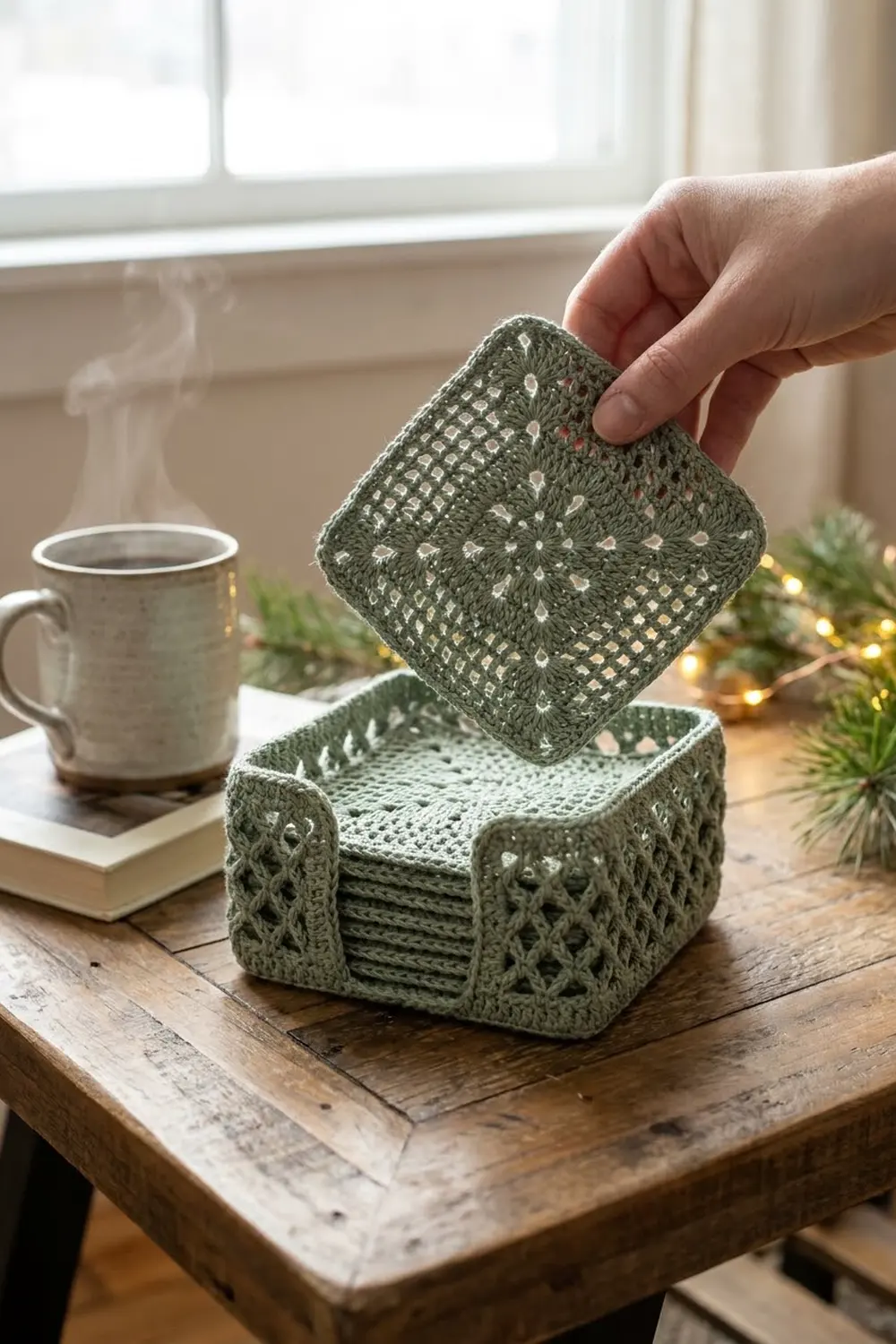
The measurements build on each other. The 16-stitch star becomes 27 dc per side on Rnd 5. Those 27 stitches become a mesh of 14 posts and 13 windows, giving 31 per side on Rnd 6. The border brings each coaster to 35 sc per side, or 4.5 in (11.4 cm). The holder’s 39-stitch sides and 149-stitch wall strip give the coasters exactly enough room. Check each stage and the whole set will fit together neatly.
Happy crocheting!