

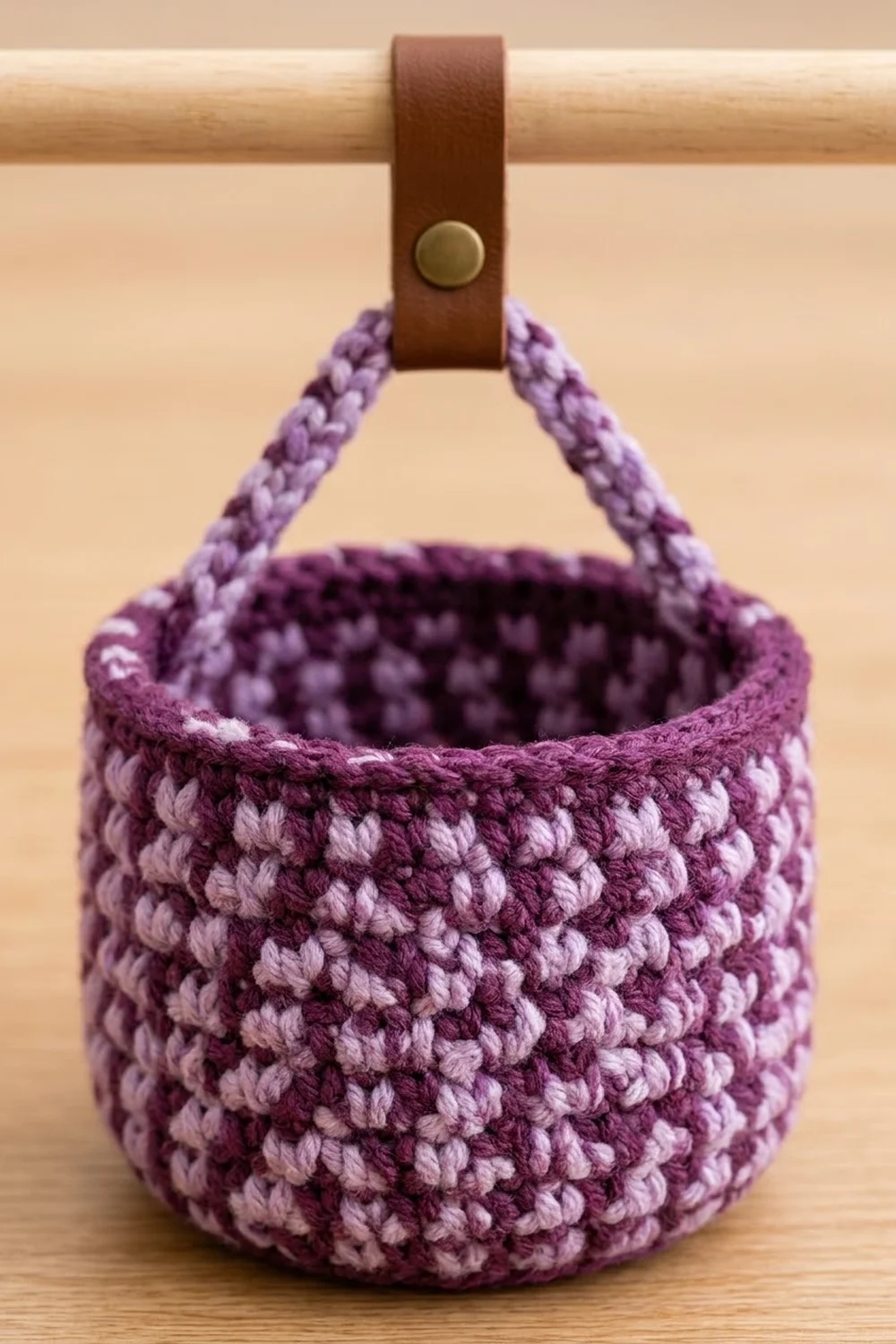
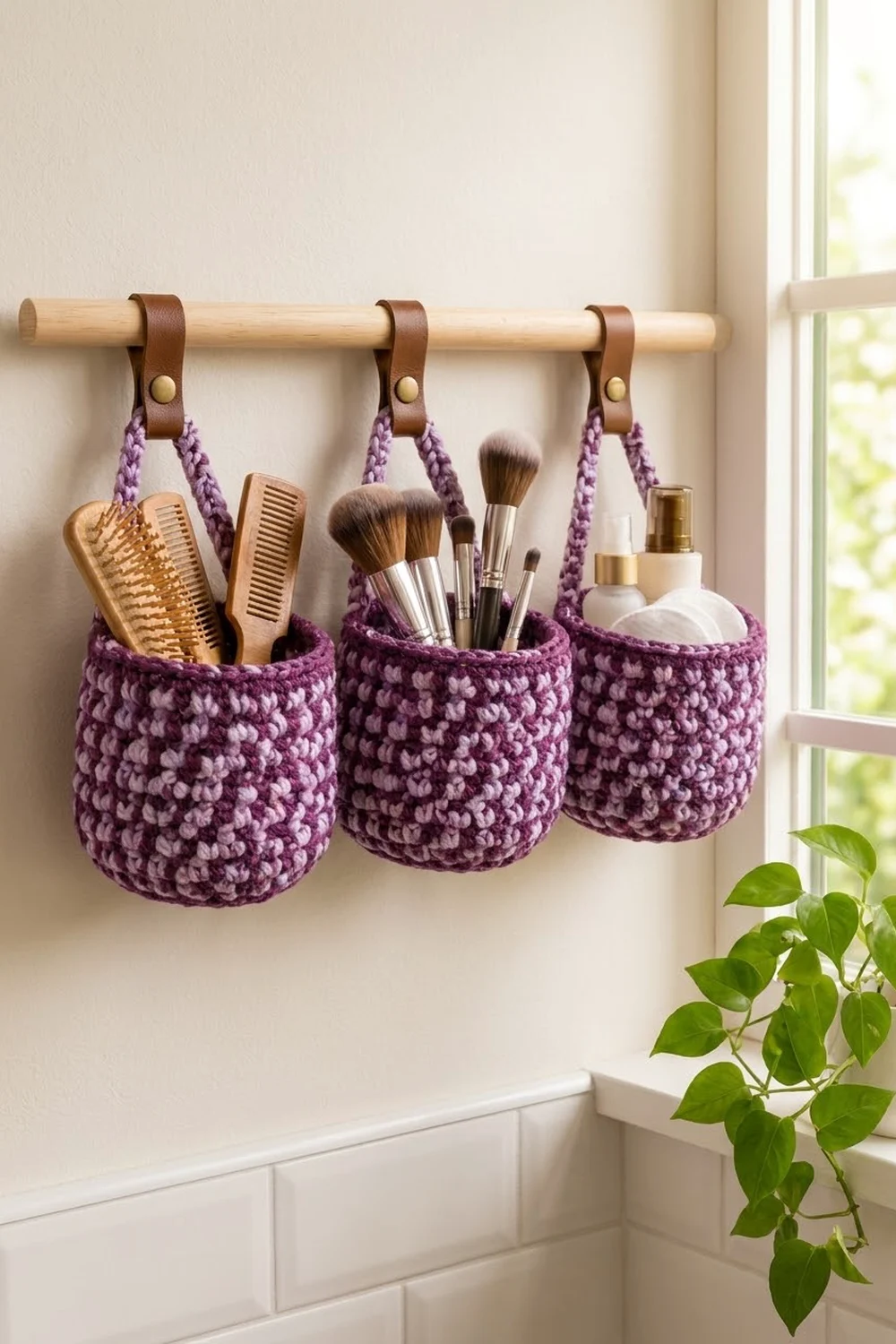
These little hanging baskets bring calm order to a bathroom shelf, a vanity wall, or a desk corner. Each one is a small, rounded cup worked in a two-color speckle and hung from its own crocheted cord. All three cords loop through leather straps on a wooden dowel.
The palette is deep plum and soft lavender. The body is a dense tapestry single crochet that alternates the two colors stitch by stitch, so the surface reads as a scattered speckle rather than a stripe. A solid plum ring outlines the base, and a solid plum rolled rim finishes the top edge.
This pattern uses US crochet terms. Each finished basket measures about 4.75 in (12.1 cm) across the base, 5.25 in (13.3 cm) across the widest point, and 4 in (10.2 cm) tall.
The construction is simple. You work a flat circular base in joined rounds, then turn the wall up with a back-loop round. Next you work speckled sides with a gentle belly and finish with a two-round rim. A slip-stitch cord in both colors becomes the handle, and the finished baskets hang from leather straps on a dowel.
Finished Size and Construction
- Finished size (each basket): 4.75 in (12.1 cm) base diameter, 5.25 in (13.3 cm) at the belly, 4 in (10.2 cm) tall
- Skill level: Easy-intermediate (tapestry color changes)
- Terminology: US
- Yarn weight: Worsted (#4) cotton
- Hook: 4.0 mm (G-6)
- Number of pieces: 3 baskets + 3 handle cords (6 crocheted pieces)
- Layout: 3 baskets in a row on 1 dowel, centers 6 in (15.2 cm) apart
- Piece size before rim: 60 stitches around, 3.5 in (8.9 cm) wall height
- Rim depth: 2 rounds, 0.5 in (1.3 cm)
- Handle cord: 40 slip stitches, about 10 in (25.4 cm) long
Materials
Choose a smooth, firm worsted cotton or cotton blend. Cotton holds the basket shape well and stands up to damp bathroom air. Avoid fuzzy or very soft acrylic, which lets the walls slump.
- Color A – Plum: 150 g, about 255 m (279 yd)
- Color B – Lavender: 110 g, about 190 m (208 yd)
These quantities cover all three baskets and three cords. They include a margin of roughly 10–15% for gauge differences and the gauge test.
Tools:
- 4.0 mm (G-6) crochet hook
- Stitch markers (at least 3)
- Tapestry needle
- Scissors
- Measuring tape
- 3 leather straps, 0.75 in (1.9 cm) wide and 6 in (15.2 cm) long, each with a snap or rivet
- 1 wooden dowel, 0.75 in (1.9 cm) thick and 18 in (45.7 cm) long
- 2 small wall hooks or brackets for the dowel
- A jar about 5 in (12.7 cm) across for blocking
Abbreviations (US Terms)
- ch – chain
- sc – single crochet
- sl st – slip stitch
- 2 sc in next – increase: 2 single crochet in the same stitch
- sc2tog – single crochet 2 together (decrease)
- BLO – back loop only
- rev sc – reverse single crochet
- A / B – Color A (plum) / Color B (lavender)
- st(s) – stitch(es)
Tapestry sc (special technique): Work each sc in the color shown. To change color, work the stitch before the change until 2 loops remain on the hook, then finish the last yarn over with the new color. Carry the unused color along the top of the previous round and work over it, so it stays hidden inside the stitches.
Speckle pattern: Alternate A and B every stitch (A, B, A, B…). Start every round with the color that was NOT used for the first stitch of the previous round. Every round has an even count, so the alternation always closes cleanly at the join.
Rev sc: Work from left to right. Insert the hook in the next stitch to the right, yarn over, pull up a loop, yarn over, and pull through both loops.
Gauge and Checkpoints
Gauge: 16 sts and 16 rounds = 4 in (10.2 cm) in tapestry sc, worked in joined rounds. One round is 0.25 in (0.6 cm) tall.
Test one complete base (Rounds 1–10) before you commit to all three baskets. It is your gauge swatch, and it becomes the first basket if it measures correctly.
Checkpoints:
- After Round 5 (30 sts): the base is about 2.4 in (6.1 cm) across.
- After Round 10 (60 sts): the base is 4.75 in (12.1 cm) across.
- After Round 16 (60 sts): the wall is 1.5 in (3.8 cm) tall from the turning ridge.
- After Round 21 (66 sts): the belly is 5.25 in (13.3 cm) across when gently pressed round.
- After Round 26: the total wall height is 4 in (10.2 cm).
If your base is too big: go down to a 3.5 mm hook, or carry the unused strand slightly snugger.
If your base is too small or cups upward: go up to a 4.5 mm hook. A slight cup is normal with tapestry sc. If the center rises more than 0.25 in (0.6 cm), your tension is too tight.
Basket Base
Join every round with a sl st to the first sc. The ch 1 at the start of each round does not count as a stitch. Carry the unused color throughout.
Round 1: Make a magic ring with A. Ch 1, work 6 sc in the ring in speckle pattern (A, B, A, B, A, B). Join. (6 sts)
Round 2: Ch 1, 2 sc in each st around, keeping the color alternation stitch by stitch. Join. (12 sts)
Round 3: Ch 1, sc in next st, 2 sc in next st; repeat from * 6 times. Join. (18 sts)*
Round 4: Ch 1, sc in next 2 sts, 2 sc in next st; repeat from * 6 times. Join. (24 sts)*
Round 5: Ch 1, sc in next 3 sts, 2 sc in next st; repeat from * 6 times. Join. (30 sts)*
Round 6: Ch 1, sc in next 4 sts, 2 sc in next st; repeat from * 6 times. Join. (36 sts)*
Round 7: Ch 1, sc in next 5 sts, 2 sc in next st; repeat from * 6 times. Join. (42 sts)*
Round 8: Ch 1, sc in next 6 sts, 2 sc in next st; repeat from * 6 times. Join. (48 sts)*
Round 9: Ch 1, sc in next 7 sts, 2 sc in next st; repeat from * 6 times. Join. (54 sts)*
Round 10 (solid outline): Using A only and carrying B, ch 1, sc in next 8 sts, 2 sc in next st; repeat from * 6 times. Join. (60 sts)*
In the speckle increase rounds, the two stitches of each increase are always different colors. Rounds 1–9 make the radial speckle, and Round 10 makes the solid plum ring around the edge.
Basket Sides
Round 11 (turning ridge): Using A only, ch 1, sc in BLO of each st around. Join. (60 sts)
The unworked front loops form a crisp ridge, and from here the fabric rises into a wall.
Rounds 12–16: Ch 1, sc in each st around in speckle pattern. Join. (60 sts each round)
Round 17 (belly increase): Ch 1, sc in next 9 sts, 2 sc in next st; repeat from * 6 times, in speckle pattern. Join. (66 sts)*
Rounds 18–21: Ch 1, sc in each st around in speckle pattern. Join. (66 sts each round)
Round 22 (shoulder decrease): Ch 1, sc in next 9 sts, sc2tog; repeat from * 6 times, in speckle pattern. Join. (60 sts)*
Each sc2tog counts as one stitch and takes one color.
Rounds 23–24: Ch 1, sc in each st around in speckle pattern. Join. (60 sts each round)
At the end of Round 24, cut B and leave a 4 in (10.2 cm) tail to weave in. The wall now measures 3.5 in (8.9 cm) from the turning ridge. Work the rim (Rounds 25–26, below) to complete the basket.
Make All Pieces
Make 3 baskets (Rounds 1–26) and 3 handle cords.
- Per basket: about 40 g A and 30 g B
- Per cord: about 3 g A and 3 g B
Handle cord: Holding one strand of A and one strand of B together, ch 41. Sl st in the back bump of the 2nd ch from hook and in each ch across. (40 sl sts) Fasten off, leaving 8 in (20.3 cm) tails at both ends. The two strands twist into a marled, braid-like cord about 10 in (25.4 cm) long.
Layout (front view):
=====[S]==========[S]==========[S]=====   dowel, 18 in (45.7 cm)
      |            |            |         cords
    [B1]         [B2]         [B3]        baskets
S = leather strap; B = basket. The strap centers sit at 3 in (7.6 cm), 9 in (22.9 cm), and 15 in (38.1 cm) from the left end of the dowel.
Joining
Here, joining means attaching each cord to its basket and each basket to the dowel. The baskets are not joined to each other.
Marking the anchor points: Place a marker in Round 25 at the join stitch, which becomes the center back. Count 15 sts to the left and 15 sts to the right, and place a marker at each spot. These two markers are 30 sts apart, exactly half of the 60-stitch rim, so the cord ends sit directly opposite each other at the sides.
Attaching the cord: Slide the cord through the leather strap first. Lay one cord end over the outside of the wall at a marker, overlapping 1 in (2.5 cm) of cord down over Rounds 22–25. Use that end’s tails to whipstitch both edges of the cord to the wall, one cord stitch to one basket stitch. Repeat at the second marker, then weave the tails inside.
Tension: Sew firmly, but don’t pull the wall inward. The rim should stay round. If it puckers, loosen the stitches and sew again.
Hanging: Wrap each strap around the dowel and close the snap just below it, with the cord resting in the fold under the snap. Space the straps as shown in the layout.
Size checkpoint: Each cord peaks about 3.5 in (8.9 cm) above the rim. The centers are 6 in (15.2 cm) apart and each basket is 5.25 in (13.3 cm) wide, so there is a 0.75 in (1.9 cm) gap between neighbors.
Rim (Border)
Rim gauge: Same as the body, 16 sts = 4 in (10.2 cm). The rim adds 2 rounds, 0.5 in (1.3 cm).
Round 25: Using A only, ch 1, sc in each st around. Join. (60 sts)
Round 26: With A, ch 1, rev sc in each st around. Join and fasten off. (60 sts)
Weave in all ends on the inside.
Why the math works: The rim has 60 stitches, the same count as the base outline (Round 10). The belly adds 6 sts in Round 17 and removes the same 6 in Round 22, so the opening matches the base. At 4 sts per inch, 60 sts make 15 in (38.1 cm) around, or 4.75 in (12.1 cm) across. The rev sc round adds no stitches. It rolls the edge into a firm cord so the opening doesn’t flare. The wall is 16 rounds tall (Rounds 11–26), and at 0.25 in (0.6 cm) per round that gives 4 in (10.2 cm).
Final Blocking
- Weave in every remaining end before blocking.
- Mist the basket lightly with water until it is damp, not soaked.
- Slip it over the jar, or stuff it firmly with a towel.
- Press the base flat and pinch the turning ridge into a clean edge.
- Smooth the belly evenly and roll the rim slightly outward with your fingers.
- Check that the base is 4.75 in (12.1 cm) across and the height is 4 in (10.2 cm).
- Let it dry completely, at least 24 hours, before attaching the cord.
- Steam the cords lightly if they twist too much.
Final Quality-Control Checklist
- Each base has 60 sts and lies flat.
- The turning ridge runs evenly all the way around.
- The speckle alternates every stitch, with no doubled colors.
- The belly rounds have 66 sts, and the rim rounds have 60 sts.
- The carried strand can’t be seen from the outside.
- All three baskets match in height, 4 in (10.2 cm), within 0.25 in (0.6 cm).
- The cords are equal in length, about 10 in (25.4 cm).
- The cord ends are sewn securely at opposite sides of the rim.
- The straps are evenly spaced along the dowel.
Troubleshooting
Lavender peeks through the plum stitches. The carried strand is too loose or sits too high. Hold it snug against the top of the round below.
The base ruffles. Your gauge is loose. Go down a hook size or tighten your hand.
The base cups like a bowl. Your gauge is tight, or the carried strand is pulling. Go up a hook size and keep the carried strand relaxed.
You get vertical stripes instead of speckle. You forgot to switch the starting color. Start each round with the color you didn’t use to start the previous one.
The walls slump. Use firmer cotton or a smaller hook, or block the basket over a jar.
The basket tilts when hung. The cord ends are not opposite each other. Re-count 30 sts between the anchor points.
Care
Hand wash in cool water and lay flat to dry, reshaping over a jar. Remove the leather straps before washing.
Final Notes
The measurement chain is simple:
– 16 sts and 16 rounds make 4 in (10.2 cm).
– The 60-stitch base is 4.75 in (12.1 cm) across.
– The 66-stitch belly is 5.25 in (13.3 cm) across.
– The 60-stitch rim matches the base.
– The 16-round wall is 4 in (10.2 cm) tall.
Check the base first, and every other measurement follows from it.
Happy crocheting!