
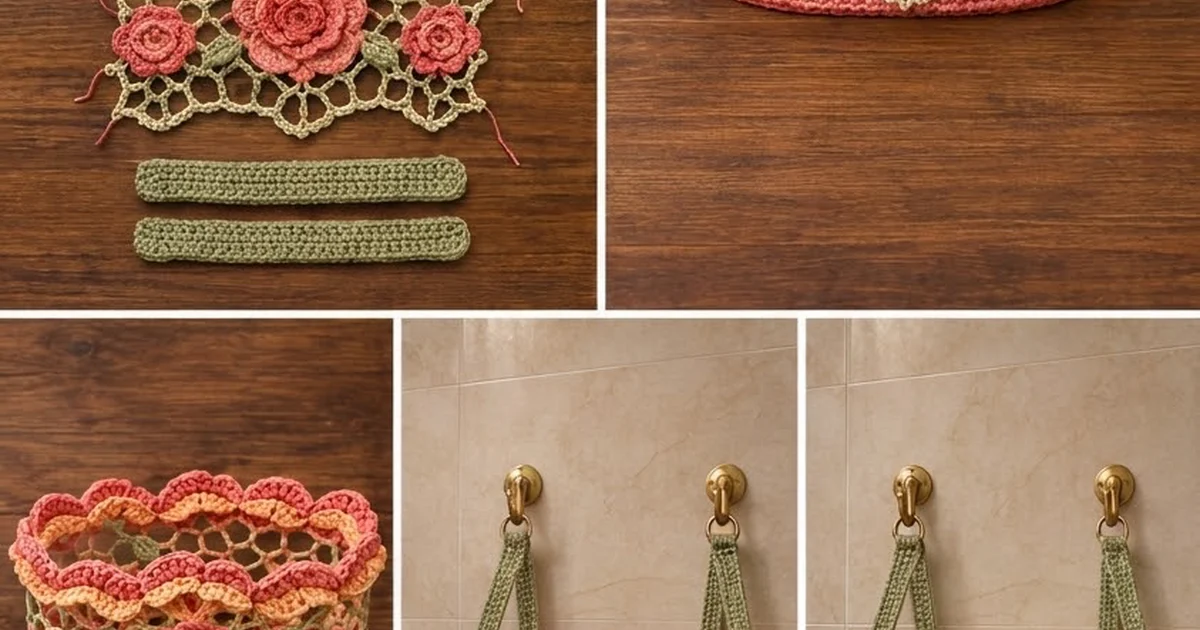
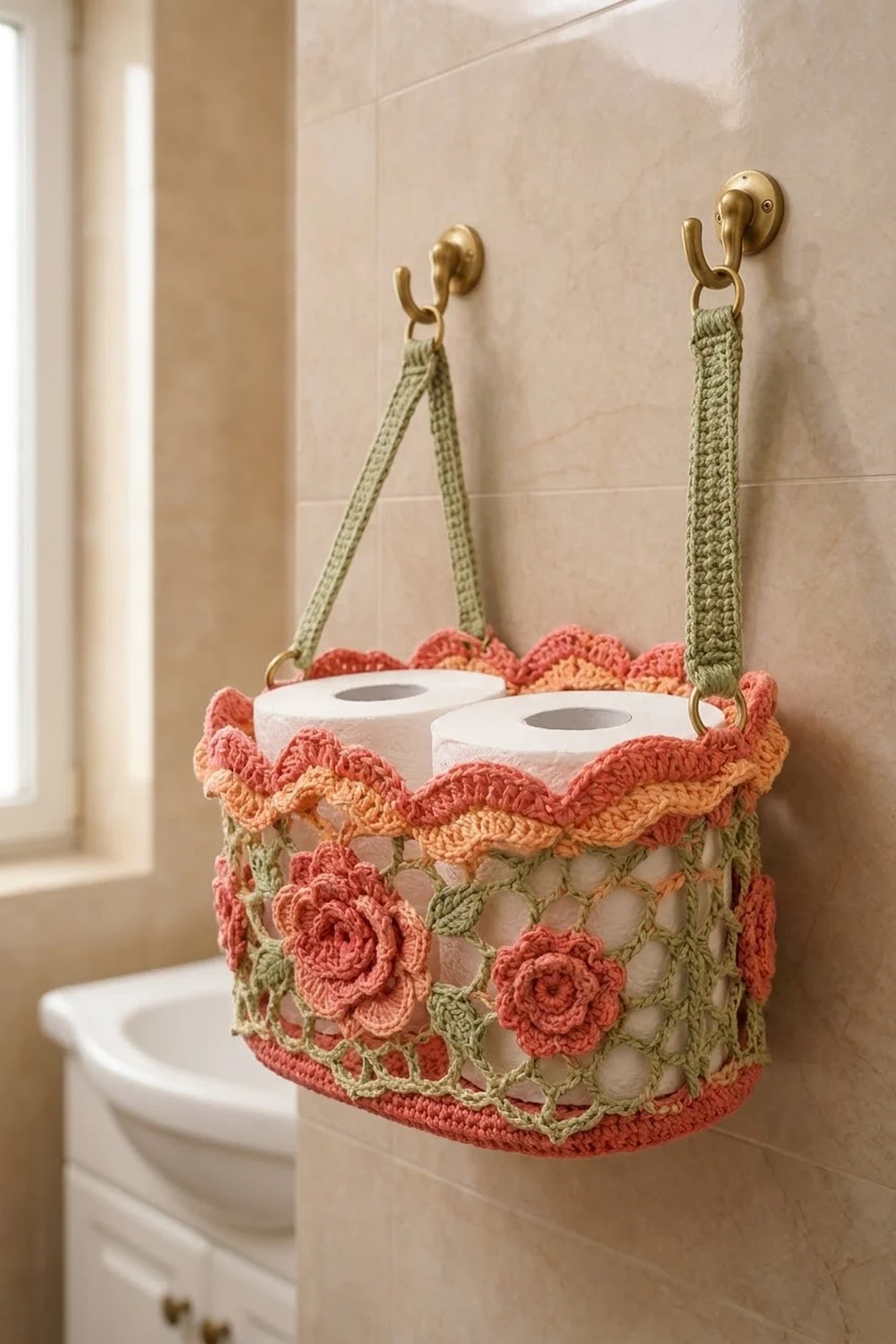
This hanging basket has a sturdy coral oval base, an open sage lace wall, coral roses across the front and back, and a ruffled two-layer rim in coral and peach. Two sage straps with brass D-rings hang it from a pair of wall hooks. It holds two standard toilet rolls side by side.
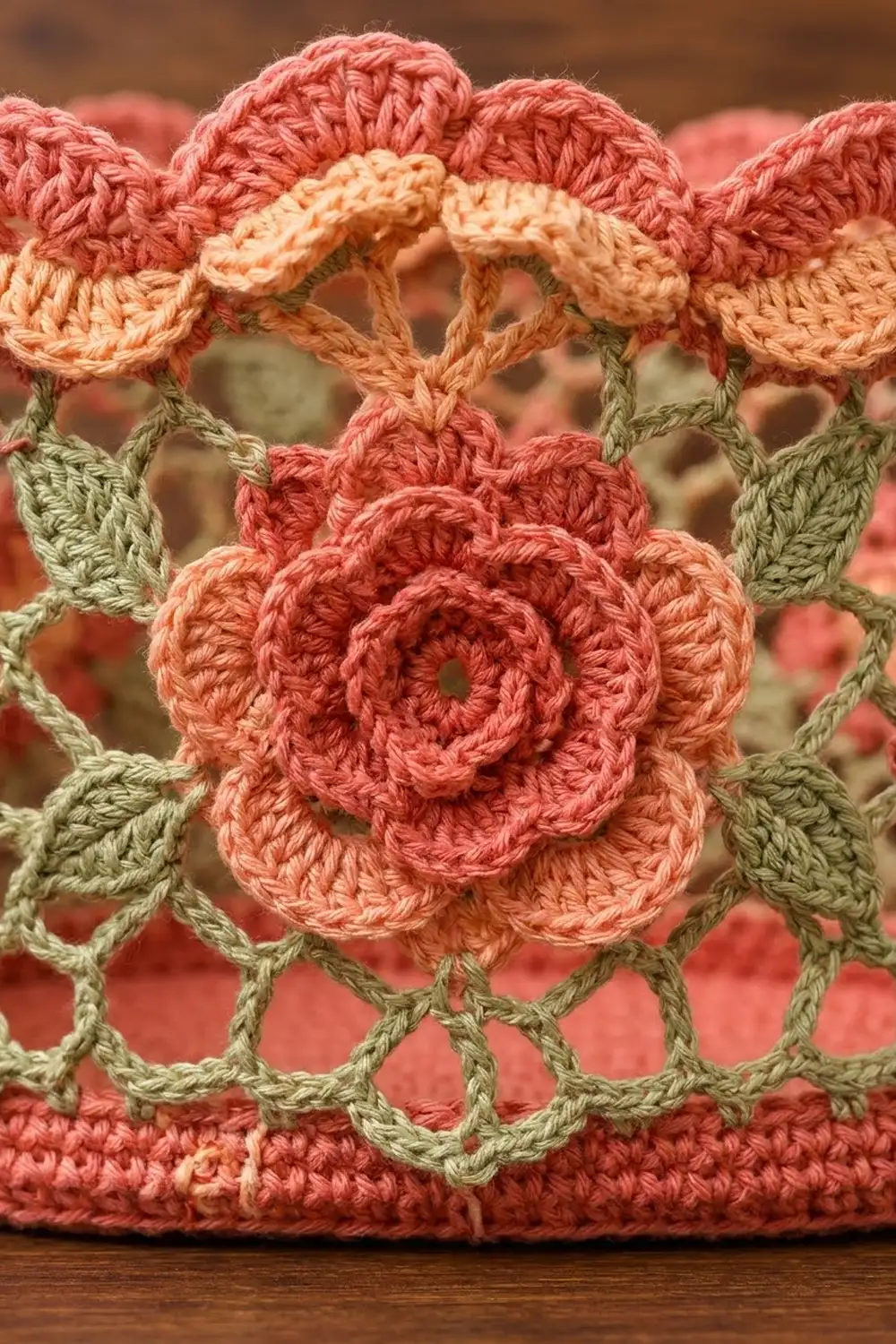
The colors are warm and soft. Coral is used for the base, the roses and the back scallops. Peach is for the front scallops. Sage is for the mesh, leaves and straps. The look is cottage-style and a little vintage, but the construction is simple and tidy.
All instructions use US crochet terms. The finished basket is about 10 in (25.4 cm) long, 4.5 in (11.4 cm) deep and 5.75 in (14.6 cm) tall, not counting the straps. Each strap is 8 in (20.3 cm) long before folding.
You will make one oval base, two flat lace side panels, two large and four small roses, twelve leaves and two straps. Sew the roses and leaves onto the flat panels first. Then seam the panels into a tube, crochet the tube onto the base, and finish with a scalloped rim worked all the way around.
Finished Size and Construction
- Finished size: 10 in (25.4 cm) long x 4.5 in (11.4 cm) deep x 5.75 in (14.6 cm) tall
- Skill level: Intermediate
- Terminology: US
- Yarn weight: DK / light (#3) cotton
- Hook: 3.5 mm (E-4)
- Number of pieces: 5 main pieces (1 base, 2 side panels, 2 straps), plus 6 roses and 12 leaves sewn on as appliqués
- Layout: front and back panels joined at the two curved ends and set on the oval base
- Base size: 10 x 4.5 in (25.4 x 11.4 cm) flat, with a solid wall band 0.75 in (1.9 cm) tall
- Panel size: 12.8 x 4 in (32.5 x 10.2 cm) each
- Size before border: 25.6 in (65.0 cm) around, 128 stitches
- Border (rim) depth: about 1 in (2.5 cm)
Materials
Use a smooth mercerized or combed cotton in DK weight. Cotton keeps the basket’s shape, doesn’t stretch much under the weight of the rolls, and copes well with bathroom humidity. Don’t use acrylic for the base, because it sags over time.
- Coral: 100 g, about 240 m (262 yd), for the base, roses, back scallops and joining round
- Peach: 25 g, about 60 m (66 yd), for the front scallops
- Sage: 75 g, about 180 m (197 yd), for the panels, leaves, straps and assembly
The quantities include a margin of about 15% for gauge swatches and tails.
Tools:
- 3.5 mm (E-4) crochet hook
- 2 metal D-rings, 1.25 in (3.2 cm) inner width
- 2 wall hooks
- Tapestry needle
- 8 locking stitch markers
- Rust-proof pins and a blocking mat
- Tape measure and scissors
Abbreviations (US Terms)
- ch: chain
- sl st: slip stitch
- sc: single crochet
- hdc: half double crochet
- dc: double crochet
- tr: treble crochet
- sk: skip
- sp: space
- BLO / FLO: back loop only / front loop only
- st(s): stitch(es)
Special stitch: back post single crochet (bpsc). Insert the hook from the back of the work, around the post of the stitch named, and out to the back again. Yarn over, pull up a loop, then yarn over and pull through both loops. This stitch anchors each new layer of petals behind the one before.
Gauge and Checkpoints
Gauge: 20 sc x 22 rounds or rows = 4 in (10.2 cm) with a 3.5 mm hook.
Test one piece first. Make the base through Round 6 and measure it before going further. Every later size depends on this gauge of 5 stitches per inch.
Checkpoints:
- Base after Round 6: about 8 x 2.4 in (20.3 x 6.1 cm)
- Base after Round 12: 10 x 4.5 in (25.4 x 11.4 cm)
- Panel after Row 1: 12.8 in (32.5 cm) wide
- Panel after blocking: 12.8 x 4 in (32.5 x 10.2 cm)
- Large rose: 2.75 in (7.0 cm) across; small rose: 1.75 in (4.4 cm) across
Too big? Go down to a 3.25 mm hook. Too small? Go up to a 3.75 mm hook. The base and the panels must match each other, because both depend on 128 stitches covering the same 25.6 in (65.0 cm).
Oval Base (Coral)
Work in joined rounds. Join each round with a sl st to the first sc, then ch 1 to start the next round. The ch 1 does not count as a stitch.
Ch 31.
Round 1: Sc in 2nd ch from hook, sc in next 28 ch, 3 sc in last ch. Working along the other side of the chain, sc in next 28 ch, 2 sc in last ch (the same ch as the first sc). Join. (62 sts: 28 on each straight side, 3 at each end)
Round 2: Sc in next 28 sts, [2 sc in next st] 3 times, sc in next 28 sts, [2 sc in next st] 3 times. Join. (68 sts)
Round 3: Sc in next 28 sts, [sc in next st, 2 sc in next st] 3 times, sc in next 28 sts, [sc in next st, 2 sc in next st] 3 times. Join. (74 sts)
Rounds 4–12: Sc in next 28 sts, [sc in next (R − 2) sts, 2 sc in next st] 3 times, sc in next 28 sts, then work the bracket 3 times again. R is the round number. Each end gains 3 sts per round.
| Round | Sts per end | Total sts |
|---|---|---|
| 4 | 12 | 80 |
| 5 | 15 | 86 |
| 6 | 18 | 92 |
| 7 | 21 | 98 |
| 8 | 24 | 104 |
| 9 | 27 | 110 |
| 10 | 30 | 116 |
| 11 | 33 | 122 |
| 12 | 36 | 128 |
Round 12 check: 28 + 36 + 28 + 36 = 128.
Round 13 (turning round): Sc in BLO of each st around. Join. (128 sts) The unused front loops make a crisp fold between the floor and the wall.
Rounds 14–16: Sc in each st around. Join. (128 sts)
The wall band is now 0.75 in (1.9 cm) tall. Fasten off.
Lace Side Panels (Sage): Make 2
Each panel is worked flat in rows.
Ch 65.
Row 1: Sc in 2nd ch from hook and in each ch across. Turn. (64 sc)
Row 2: Ch 1, sc in first sc, [ch 4, sk 2 sts, sc in next st] 21 times. Turn. (21 ch-4 loops, 22 sc) Check: 1 + (21 x 3) = 64 sts used.
Row 3: Ch 5 (counts as dc + ch 2), sc in first ch-4 loop, [ch 4, sc in next loop] 20 times, ch 2, dc in last sc. Turn. (20 full loops + 2 half loops)
Row 4: Ch 1, sc in first dc, [ch 4, sc in next ch-4 loop] 20 times, ch 4, sc in 3rd ch of beginning ch-5. Turn. (21 loops, 22 sc)
Rows 5–8: Repeat Rows 3 and 4 twice. Row 8 ends with 21 loops and 22 sc.
Row 9: Ch 1, sc in first sc, [2 sc in next loop, sc in next sc] 21 times. (64 sc) Check: 1 + (21 x 3) = 64.
Fasten off, leaving a 24 in (61.0 cm) tail for the side seam.
The seven mesh rows (Rows 2–8) measure 3.5 in (8.9 cm). With the two sc rows, the blocked panel is 4 in (10.2 cm) tall.
Roses (Coral)
Large rose: make 2.
Round 1: Magic ring, ch 1, 10 sc in ring. Join. (10 sc)
Round 2: Ch 1, sc in first st, ch 3, sk 1, [sc in next st, ch 3, sk 1] 4 times. Join. (5 ch-3 sps)
Round 3: In each ch-3 sp, work (sc, hdc, 3 dc, hdc, sc). Join. (5 petals)
Round 4: Working behind the petals, ch 1, bpsc around first Round 2 sc, ch 5, [bpsc around next Round 2 sc, ch 5] 4 times. Join. (5 ch-5 sps)
Round 5: In each ch-5 sp, work (sc, hdc, 5 dc, hdc, sc). Join. (5 petals)
Round 6: Working behind the petals, ch 1, bpsc around first Round 4 bpsc, ch 6, [bpsc around next Round 4 bpsc, ch 6] 4 times. Join. (5 ch-6 sps)
Round 7: In each ch-6 sp, work (sc, hdc, 7 dc, hdc, sc). Join. (5 petals) Fasten off, leaving a 12 in (30.5 cm) tail.
The large rose is 2.75 in (7.0 cm) across.
Small rose: make 4. Work Rounds 1–5 of the large rose. Fasten off, leaving a 12 in (30.5 cm) tail. The small rose is 1.75 in (4.4 cm) across.
Gently twist the Round 3 petals inward so the center looks like a tight bud.
Leaves (Sage): Make 12
Ch 8.
Sl st in 2nd ch from hook, sc in next ch, hdc in next ch, dc in next 2 ch, hdc in next ch, sc in last ch. Ch 2 for the tip. Working along the other side of the chain, sc in next ch, hdc in next ch, dc in next 2 ch, hdc in next ch, sc in next ch, sl st in last ch. Fasten off, leaving an 8 in (20.3 cm) tail.
Each leaf is 1.25 in (3.2 cm) long.
Straps (Sage): Make 2
Ch 7, leaving a 16 in (40.6 cm) starting tail.
Row 1: Sc in 2nd ch from hook and in each ch across. Turn. (6 sc)
Rows 2–39: Ch 1, sc in each st. Turn. (6 sc)
Row 40 (hanging hole): Ch 1, sc in next 2 sts, ch 2, sk 2, sc in next 2 sts. Turn. (4 sc + ch-2 sp)
Row 41: Ch 1, sc in next 2 sts, 2 sc in ch-2 sp, sc in next 2 sts. Turn. (6 sc)
Rows 42–44: Ch 1, sc in each st. Turn. (6 sc) Fasten off.
Each strap is 1.2 x 8 in (3.0 x 20.3 cm).
Slide the Row 1 end through a D-ring, fold it up 1 in (2.5 cm), and whipstitch the fold flat with the starting tail. The hole at the top slips over the wall hook.
Make All Pieces
- Coral: 1 base, 2 large roses, 4 small roses
- Sage: 2 panels, 12 leaves, 2 straps
- Peach: no separate pieces; it is used only in the rim
Appliqué layout for each panel (64 sts wide, read left to right):
[ leaf ][ SMALL ROSE ][ leaf ][ LARGE ROSE ][ leaf ][ SMALL ROSE ][ leaf ]
          leaf below                          leaf below
Center the large rose over st 32 of the panel. Center each small rose 3.5 in (8.9 cm) from the center of the large rose, a little lower on the panel. That gives six leaves per panel: one on each side of the large rose and two around each small rose.
Pin the roses so they sit about 0.25 in (0.6 cm) above Row 1. Use the tails to sew each rose down around its Round 1 and behind its outer petals into the mesh. Sew each leaf down its center line. Keep the stitches hidden behind the petals.
Wet-block both panels flat to 12.8 x 4 in (32.5 x 10.2 cm) before joining.
Joining
Side seams: Place the panels right sides together. Use the long sage tail to whipstitch one short edge to the other, matching row to row (9 rows on each side). Repeat on the other short edge to make a tube 25.6 in (65.0 cm) around.
Marking the base: Lay the base flat. Place a marker in the center stitch of Round 16 at each curved end. Count to make sure there are 64 sts between the markers on each side.
Panel to base: Turn the tube right side out and slide it over the base wall. Panel Row 1 sits on top of base Round 16, and each side seam lines up with a marker. With coral, join with a sc at one seam, going through a Round 16 stitch and the matching free loop of the panel’s foundation chain. Sc through both layers in every stitch around, one base stitch to one panel stitch. Join. (128 sc: 64 per panel)
Tension: Keep this round at gauge. If you join too tightly, the wall pulls inward. If you join too loosely, the ridge turns wavy.
Size checkpoint: The basket should stand up on its own and measure 25.6 in (65.0 cm) around at the join.
Border: Two-Layer Scalloped Rim
Border gauge: each scallop uses a 4-stitch repeat, which is 0.8 in (2.0 cm). The rim starts on panel Row 9: 2 panels x 64 sts = 128 sts.
Round 1 (coral): Join at a side seam. Ch 1, sc in each st around. Join. (128 sc: 64 per panel)
Round 2 (peach, front layer): Join peach in FLO of the first st. Work in FLO throughout: sc in next st, sk 1, 5 dc in next st, sk 1; repeat from * 32 times in total. Join. (32 shells: 16 per panel; 192 sts)
Round 3 (coral, back layer): Join coral with a sc in BLO of the 3rd st of Round 1, behind the first peach shell. Work in BLO throughout: sk 1, 7 tr in next st (behind a peach sc), sk 1, sc in next st (behind a peach shell); repeat from * 32 times in total. On the last repeat, skip the final sc and join to the first sc instead. (32 shells: 16 per panel; 256 sts)
Why the math works: 128 divides evenly by 4, which gives 32 repeats. Each 64-stitch panel takes exactly 16, so the seams fall between scallops and no repeat gets cut off. Rounds 2 and 3 are both worked into Round 1, one in the front loops and one in the back loops. The coral treble shells stand behind and above the shorter peach shells, offset by 2 sts, so each peach shell peeks out between two coral scallops.
The finished rim is about 1 in (2.5 cm) deep.
Final Blocking
- Soak the basket in cool water for 10 minutes. Press the water out; don’t wring it.
- Roll it in a towel to remove more moisture.
- Fill the basket with a towel-wrapped box or two toilet rolls to hold it at 10 x 4.5 in (25.4 x 11.4 cm).
- Pin the scallops outward so every shell fans out evenly.
- Open the roses by hand and smooth each layer of petals.
- Let it dry completely, about 24 hours, before you attach the straps.
Attaching the straps: With sage, wrap the curved side of each D-ring 10 times to the inside of the basket at a side seam, going through rim Round 1 and panel Row 9. Secure the yarn and weave in the ends.
Final Quality-Control Checklist
- The base is 10 x 4.5 in (25.4 x 11.4 cm) and lies flat.
- Base Round 16, the joining round and rim Round 1 each have 128 sts.
- Each panel is 12.8 x 4 in (32.5 x 10.2 cm), with 21 loops on every full-loop row.
- The side seams sit at the centers of the curved ends.
- There are 32 peach shells and 32 coral shells, evenly offset.
- The roses and leaves are secure, with no stitching showing.
- The straps are 8 in (20.3 cm) long before folding, and the D-rings feel firm.
- All ends are woven in.
Troubleshooting
Base ruffles: You have too many increases or are crocheting too loosely. Recount the ends against the table.
Base cups: The end increases are too tight. Go up half a hook size for Rounds 4–12.
Panel too narrow: Check that Row 1 has 64 sc and that you skip only 2 sts per loop.
Mesh slants: Make sure you work the turning ch-5 and the end dc on every half-loop row.
Rim flares too much: Work 6 tr instead of 7 in Round 3, keeping the same repeat.
Basket leans when hung: Move the D-rings so each one sits exactly on a side seam.
Care
Hand wash in cool water with mild soap, reshape the basket, and dry it flat with a roll inside. Don’t put it in the dryer.
Final Notes
The measurements build in a short chain. A gauge of 20 sc to 4 in (10.2 cm) gives a base of 128 sts measuring 25.6 in (65.0 cm) around. Two panels of 64 sts match that exactly, the joining round keeps 128 sts, and the rim divides those 128 sts into 32 scallops. If your gauge is right at the base, every later piece will fit.
Happy crocheting!