
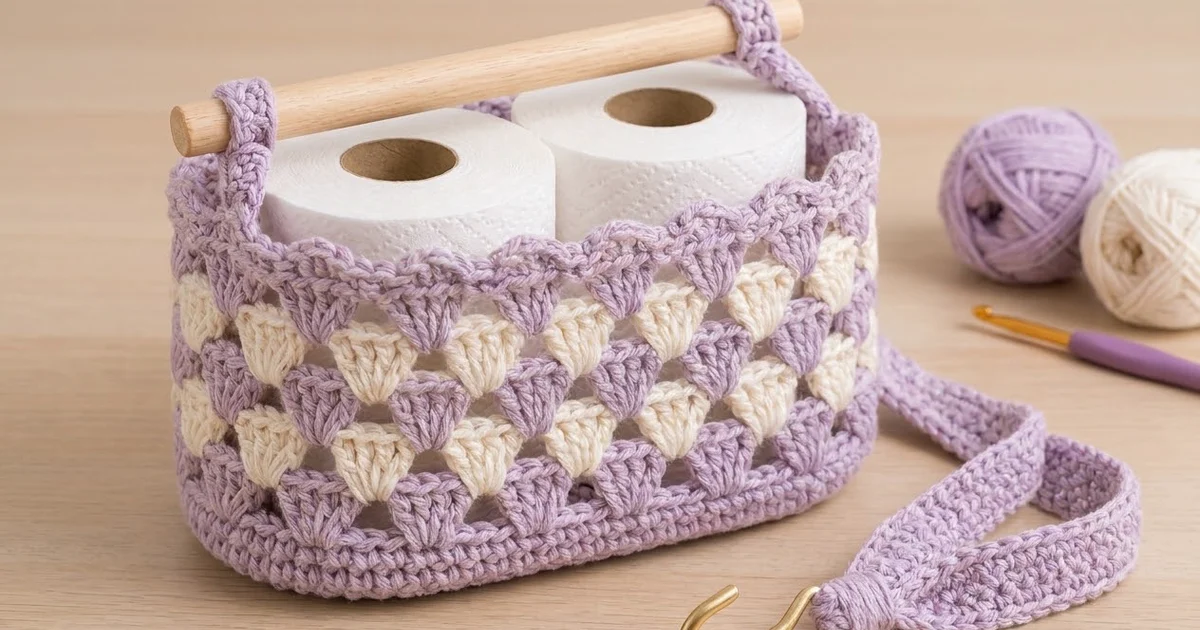
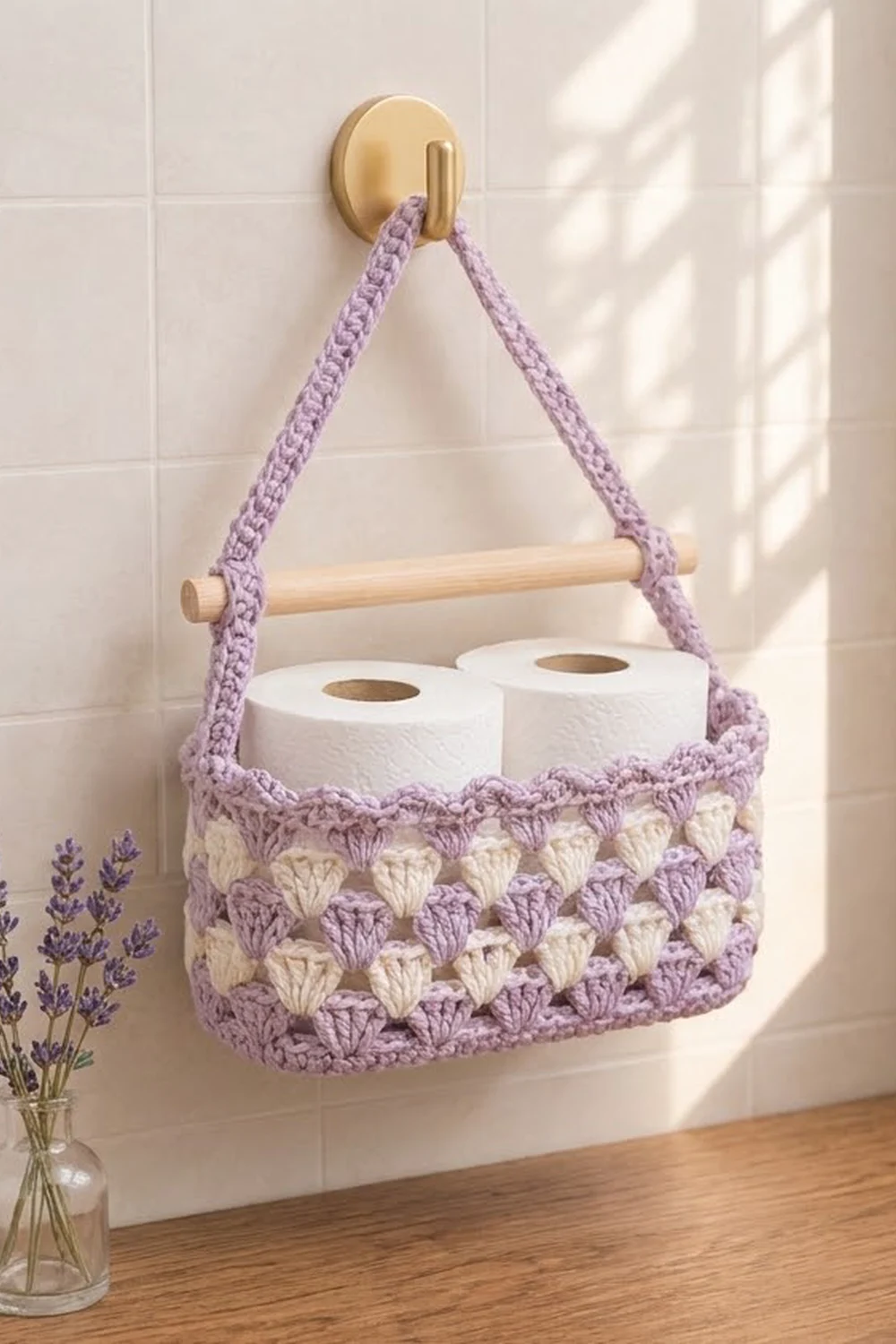
This hanging basket holds two spare toilet paper rolls side by side and turns them into a small decoration for the bathroom. It has a solid lavender oval base and sides made of alternating cream and lavender shell rounds. A scalloped lavender rim finishes the top edge, and a single lavender strap wraps around a wooden dowel and rises to a point that hangs from a wall hook.
The style is soft, cottage-like, and practical. The shells look like small downward-pointing triangles with open gaps between them, so the stripes look light rather than heavy. Two colors keep it simple: lavender for the base, three shell rounds, the rim, and the strap, and cream for four shell rounds.
The pattern uses US crochet terms. The finished basket measures about 10.75 in long x 5 in wide x 5.25 in tall (27.3 x 12.7 x 13.3 cm). When it hangs, the whole piece is about 14.75 in (37.5 cm) from the top of the strap to the bottom of the base.
Construction overview: you crochet the oval base in joined rounds of double crochet, turn the edge upward with a back-loop single crochet round, and then work seven shell rounds straight up. Two rim rounds level and scallop the top. Then you work the strap directly off the rim and sew it to the opposite end, so the basket is one continuous piece.
Finished Size and Construction
- Finished size: 10.75 in long x 5 in wide x 5.25 in tall (27.3 x 12.7 x 13.3 cm)
- Hanging height: about 14.75 in (37.5 cm), from hook to base
- Skill level: Easy / advanced beginner
- Terminology: US crochet terms
- Yarn weight: Worsted (#4) cotton
- Hook: 5.0 mm (H-8)
- Number of pieces: 1 (the strap is worked off the rim and sewn down at the far end)
- Layout: One oval basket with one strap over a dowel
- Base size: 10.75 x 5 in (27.3 x 12.7 cm)
- Height before rim: about 4.5 in (11.4 cm)
- Rim (border) depth: about 0.75 in (1.9 cm)
- Strap: 1.25 in (3.2 cm) wide, 26 in (66.0 cm) long before folding
Materials
Use a smooth worsted-weight cotton or cotton blend with about 85 m per 50 g. Cotton holds its shape well, washes easily, and gives the shells clear edges. Acrylic also works, but the basket will be softer and may sag a little.
- Lavender: 65 g / 110 m (base, 3 shell rounds, rim, strap)
- Cream: 25 g / 40 m (4 shell rounds)
Tools:
- 5.0 mm (H-8) crochet hook
- Wooden dowel, 12 in (30.5 cm) long, 1/2 in (1.3 cm) diameter
- 2 stitch markers
- Tapestry needle
- Scissors
- Wall hook for hanging
These quantities include about 20% extra to cover differences in gauge and weaving in ends.
Abbreviations (US Terms)
- ch – chain
- sl st – slip stitch
- sc – single crochet
- hdc – half double crochet
- dc – double crochet
- BLO – back loop only
- sk – skip
- sp – space
- st(s) – stitch(es)
- rep – repeat
- Rnd – round
Special stitch – Shell: 5 dc worked into the same stitch or space. A shell always counts as 5 stitches in this pattern.
Gauge and Checkpoints
- Double crochet: 14 dc and 8 rounds = 4 in (10.2 cm)
- Single crochet (strap): 16 sc and 18 rows = 4 in (10.2 cm)
- Shell round: about 0.6 in (1.5 cm) tall
The base doubles as your gauge swatch. Work Rnds 1–5 and measure before you start the sides. If the base measures correctly, the shells will fit.
Checkpoints (base, measured flat):
- After Rnd 1: 1 in x 6.75 in (2.5 x 17.1 cm)
- After Rnd 2: 2 in x 7.75 in (5.1 x 19.7 cm)
- After Rnd 3: 3 in x 8.75 in (7.6 x 22.2 cm)
- After Rnd 4: 4 in x 9.75 in (10.2 x 24.8 cm)
- After Rnd 5: 5 in x 10.75 in (12.7 x 27.3 cm)
Checkpoints (sides): about 2 in (5.1 cm) tall after Rnd 9, and 4.5 in (11.4 cm) tall after Rnd 13.
If your base is too big, go down to a 4.5 mm hook. If it is too small, go up to a 5.5 mm hook. Don’t add or remove stitches, because the shell repeat depends on exactly 100 stitches.
If the curved ends ruffle, go down half a hook size. If they cup upward, go up half a hook size.
Base
Use lavender. Each round is joined and starts at the center of the first short end (End A). Mark the first stitch of each round. The ch 2 at the start of a round does not count as a stitch.
Foundation: Ch 24.
Rnd 1: 3 dc in 3rd ch from hook (End A), dc in next 20 ch, 6 dc in last ch (End B). Rotate and work along the other side of the chain: dc in next 20 ch, then 3 dc in the same ch as the first 3 dc. Join with sl st to first dc. (52 sts: 6 at each end, 20 along each side)
Rnd 2: Ch 2, 2 dc in each of next 3 sts, dc in next 20, 2 dc in each of next 6, dc in next 20, 2 dc in each of last 3. Join. (64 sts)
Rnd 3: Ch 2, (2 dc in next st, dc in next) 3 times, dc in next 20, (2 dc in next, dc in next) 6 times, dc in next 20, (2 dc in next, dc in next) 3 times. Join. (76 sts)
Rnd 4: Ch 2, (2 dc in next, dc in next 2) 3 times, dc in next 20, (2 dc in next, dc in next 2) 6 times, dc in next 20, (2 dc in next, dc in next 2) 3 times. Join. (88 sts)
Rnd 5: Ch 2, (2 dc in next, dc in next 3) 3 times, dc in next 20, (2 dc in next, dc in next 3) 6 times, dc in next 20, (2 dc in next, dc in next 3) 3 times. Join. (100 sts: 30 per end, 20 per long side)
Each round adds 6 stitches at each end, or 12 per round in total, which keeps the oval flat.
Rnd 6 (turning round): Ch 1, sc BLO in each st around. Join to first sc. (100 sc) Fasten off.
The unused front loops leave a neat ridge around the base, and the fabric now turns upward.
Sides
Now work 7 shell rounds without increases. Every round has 20 shells (100 sts), so the sides rise straight. Fasten off at the end of each round and join the next color as directed.
Rnd 7 (cream): Join cream with sl st in the first sc of Rnd 6 (center of End A). Ch 3 (counts as dc), 4 dc in same st. Sk 4 sts, shell in next st. Rep from * 18 more times. Join with sl st to top of ch 3. (20 shells, 100 dc)
Check: the 11th shell should sit in the 51st stitch, at the center of End B. Mark both center shells.
Rnd 8 (lavender): Join lavender with sl st in the sp between the last and first shells. Ch 3, 4 dc in same sp. Shell in each remaining sp between shells around. Join. (20 shells, 100 dc)
Rnd 9 (cream): Work as Rnd 8. (20 shells)
Rnd 10 (lavender): Work as Rnd 8. (20 shells)
Rnd 11 (cream): Work as Rnd 8. (20 shells)
Rnd 12 (lavender): Work as Rnd 8. (20 shells)
Rnd 13 (cream): Work as Rnd 8. (20 shells, 100 dc)
The odd-numbered rounds line up, so the Rnd 13 shells sit directly above the Rnd 7 shells, with one shell centered on each short end. Each shell is 5 sts, or about 1.43 in (3.6 cm), wide. Its narrow base and wide top give the triangle look.
Border (Rim)
Border gauge: the two rim rounds add about 0.75 in (1.9 cm) of height.
Rnd 14 (lavender, trim round): Join lavender with sc in the first dc of the shell centered on End A. Sc in next 4 dc, then hdc in the sp between shells. Sc in each of next 5 dc, hdc in next sp. Rep from * 18 more times. Join with sl st to first sc.
Count: 100 sc (1 per existing dc) + 20 hdc (1 per gap) = 120 sts.
By section, each short end has 6 shell groups (30 sc + 6 hdc = 36 sts), and each long side has 4 groups (20 sc + 4 hdc = 24 sts). Check: 36 + 24 + 36 + 24 = 120.
The hdc fill the V-shaped dips between shells, which levels the edge.
Rnd 15 (scallops): The joining sl st sits in the first sc. Sk next sc, 5 dc in next sc (center of the group), sk 2 sc, sl st in next hdc. Sk 2 sc, 5 dc in next sc, sk 2 sc, sl st in next hdc. Rep from * 18 more times. Fasten off. (20 scallops: 6 per short end, 4 per long side)
Why the math works: each repeat of Rnd 15 uses exactly 6 stitches: 2 skipped, 1 for the scallop, 2 skipped, and 1 for the sl st. 120 ÷ 6 = 20 scallops, one above every shell of Rnd 13, so the rim matches the stripes below with nothing left over. The 1st scallop is centered on End A and the 11th on End B.
Strap
Use lavender, working to the sc gauge of 16 sc and 18 rows = 4 in (10.2 cm).
Row 1: Join lavender with sl st in the first dc of the scallop centered on End A. Ch 1, sc in same st and in each of next 4 dc. (5 sc)
Rows 2–117: Ch 1, turn, sc in each st across. (5 sc)
The strap should measure 26 in (66.0 cm). Fasten off and leave a 12 in (30.5 cm) tail.
Attach: Check that the strap isn’t twisted, then whipstitch Row 117 to the 5 dc of the scallop centered on End B.
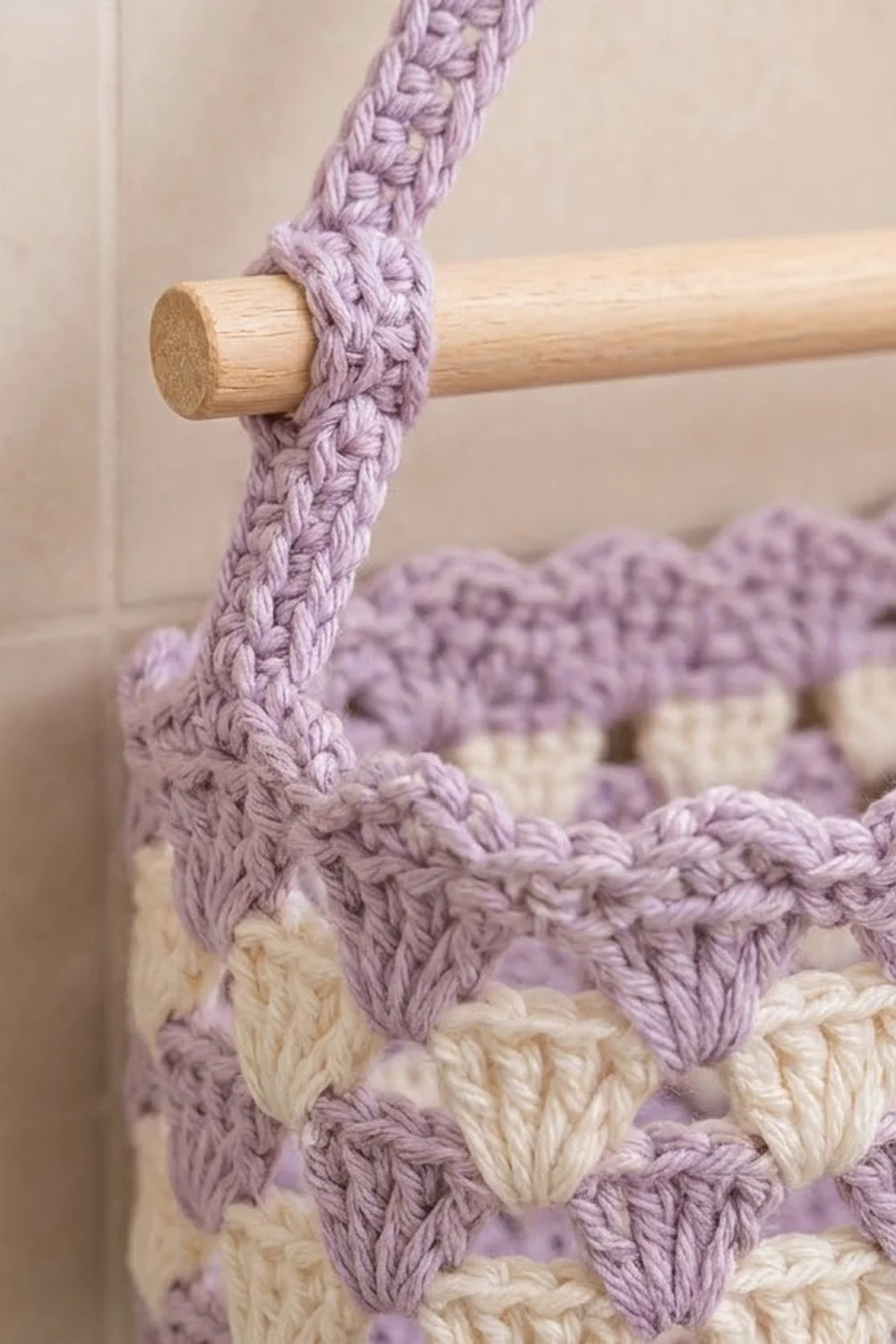
Dowel sleeves:
- End A side: Rows 1–11 form the drop from the rim, about 2.4 in (6.1 cm). Lay the dowel across Row 12 and fold Rows 12–19 around it toward the back. Whipstitch the top edge of Row 11 to the bottom edge of Row 20 across all 5 sts. The sleeve uses about 1.75 in (4.4 cm).
- End B side: Count back from Row 117: Rows 117–107 form the drop. Fold Rows 106–99 around the other end of the dowel, then whipstitch Row 107 to Row 98.
- Center the basket so the dowel extends about 0.75 in (1.9 cm) past each sleeve.
The remaining Rows 20–98 (79 rows, about 17.6 in / 44.7 cm) form the triangle. Row 59 is the exact center and goes over the wall hook. Each side of the triangle is about 8.8 in (22.4 cm), and the hook sits about 7 in (17.8 cm) above the dowel.
Final Blocking
- Weave in all ends on the inside, following stitches of the same color.
- Spray the basket until it is damp but not dripping.
- Fill it with a folded towel or a small box about 10.75 x 5 in (27.3 x 12.7 cm) so the sides stand straight.
- Shape each Rnd 15 scallop into a rounded fan.
- Lay the strap flat and smooth it to 1.25 in (3.2 cm) wide.
- Let it dry completely, at least 24 hours, before hanging.
Final Quality-Control Checklist
- The base measures 10.75 x 5 in (27.3 x 12.7 cm) and lies flat.
- Rnd 6 shows a clean ridge around the base edge.
- Every shell round has 20 shells.
- From bottom to top, the shell colors go cream, lavender, cream, lavender, cream, lavender, cream.
- Rnd 14 has 120 sts and Rnd 15 has 20 scallops.
- The strap scallops sit exactly at the center of each short end.
- The strap is not twisted, and both sleeves hold the dowel snugly.
- The basket hangs level, 2.4 in (6.1 cm) below the dowel on both sides.
- Two standard rolls fit side by side.
Troubleshooting
- Base ruffles: The ends have too much fabric. Go down half a hook size.
- Base cups: The ends are too tight. Go up half a hook size.
- Sides lean outward: Your shells are too loose. Tighten your tension or go down 0.5 mm for Rnds 7–13.
- Sides pull inward: Your shells are too tight. Relax your tension, especially when working into the spaces.
- Shell count is off: Count the spaces, not the stitches. There must be 20 spaces between shells.
- Rim waves: Recount Rnd 14. It must have 120 sts.
- Basket tilts: Make sure the strap is sewn to the center scallop at each end and that both drops are 11 rows.
- Dowel slips: Add a second line of whipstitches along the sleeve seam.
Care
Remove the dowel, hand wash in cool water, and reshape the basket over a towel to dry flat. Don’t tumble dry, because the strap may stretch.
Final Notes
Each stage builds on the one before it. A 100-stitch base measuring 10.75 x 5 in (27.3 x 12.7 cm) supports 20 shells per round. Seven shell rounds bring the sides to 4.5 in (11.4 cm). The trim round turns 100 dc into 120 sts, which divide evenly into 20 scallops for a total height of 5.25 in (13.3 cm). The 26 in (66.0 cm) strap gives two 2.4 in (6.1 cm) drops, two 1.75 in (4.4 cm) sleeves, and a hanging triangle about 7 in (17.8 cm) tall. If you check your measurements at each stage, the basket will hang level and hold two rolls.
Happy crocheting!