

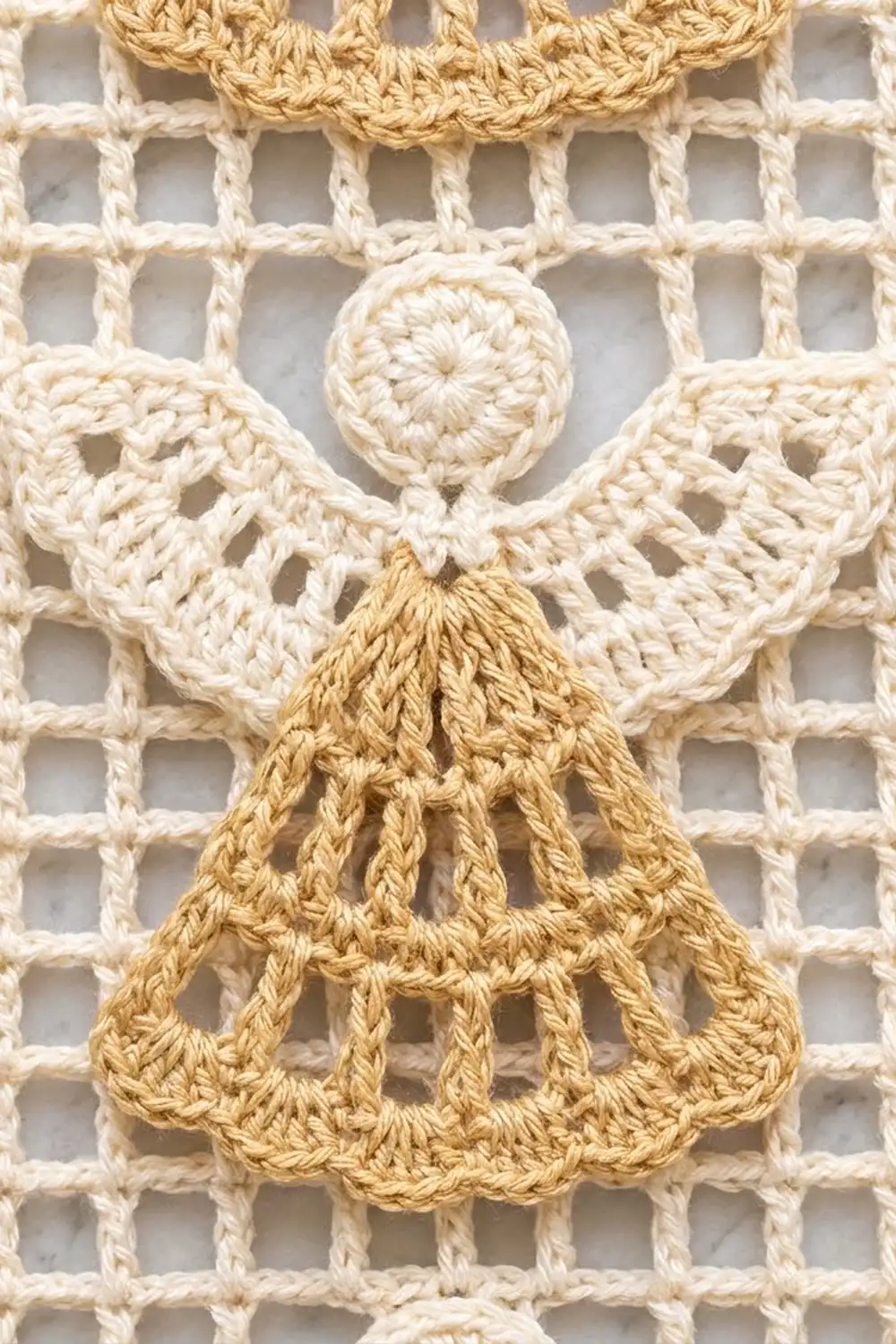
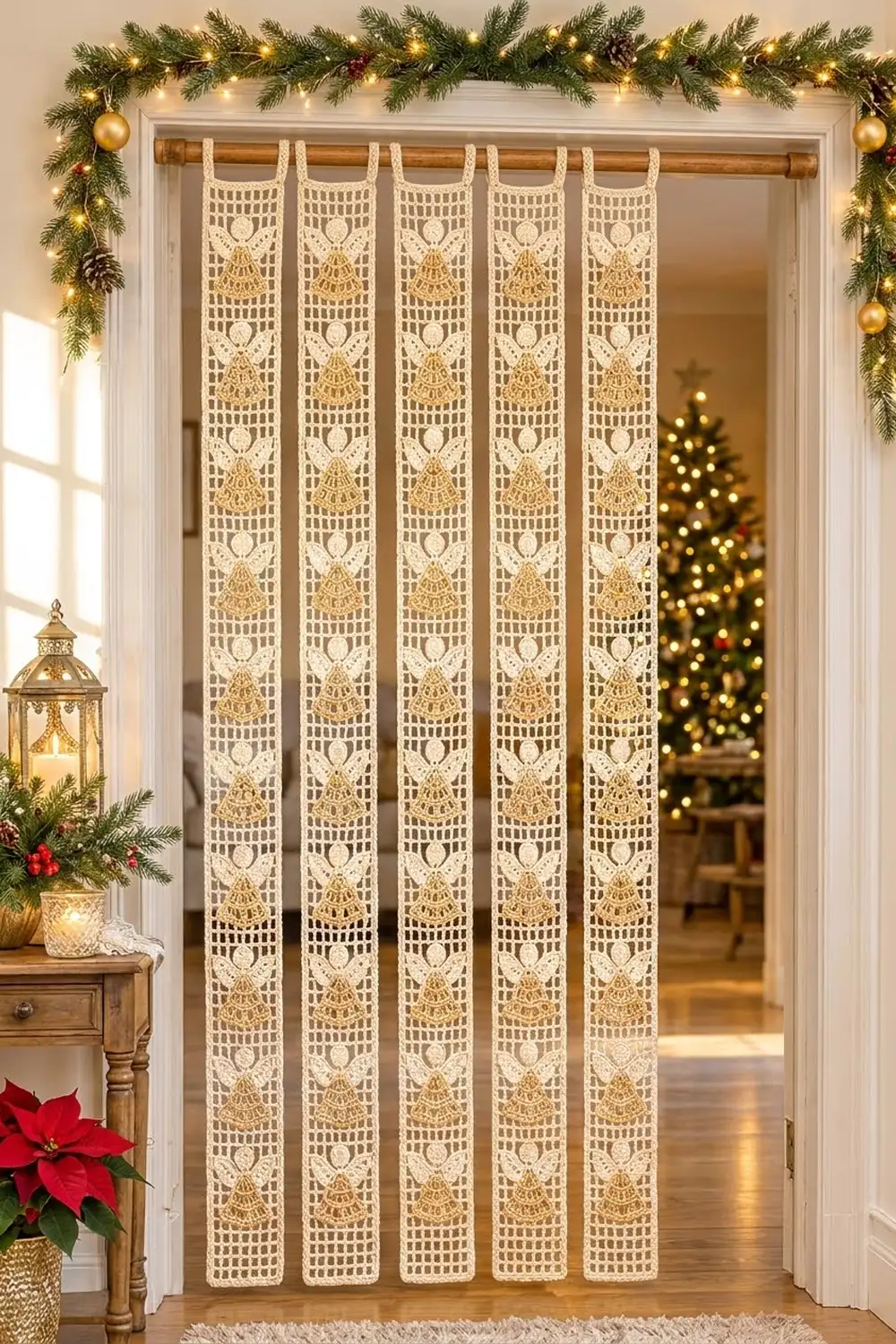
This door curtain is made of seven separate, long strips of open filet mesh. Each strip has a column of twelve little angels. Each angel is a three-layer appliqué: lacy ivory wings at the back, a golden lace skirt in the middle, and a round ivory head on top.
There are only two colors, ivory and warm gold, so the curtain looks light and festive. Hung in a doorway, the strips let light through and sway when someone walks past.
The pattern uses US crochet terms. Each finished strip measures 6 in (15.2 cm) wide and 76.5 in (194.3 cm) long. Its two hanging loops drop about 2 in (5.1 cm), so the total hanging length is 78.5 in (199.4 cm).
You crochet each mesh strip in rows, then add a single-crochet border and two hanging loops. The angel parts are made separately and sewn on in layers. The strips are never sewn to each other.
Finished Size and Construction
- Finished strip size: 6 in (15.2 cm) x 76.5 in (194.3 cm), plus loops
- Skill level: Intermediate
- Terminology: US
- Yarn weight: DK (#3) cotton
- Hook: 3.5 mm (E-4)
- Number of pieces: 7 strips and 84 angels (each angel has 1 head, 2 wings and 1 skirt)
- Layout: 7 strips hung side by side, with 12 angels stacked in each strip
- Size before border: 5.5 in (14.0 cm) x 76 in (193.0 cm), which is 11 squares x 152 rows
- Border depth: 0.25 in (0.6 cm) on every edge
- Angel size: about 4.5 in (11.4 cm) from wing tip to wing tip and 4.1 in (10.4 cm) tall
- Curtain width: 7 x 6 in = 42 in (106.7 cm) with the strips touching
Materials
Use a smooth, mercerized DK cotton. It shows the mesh squares clearly, holds the angel shapes, and doesn’t stretch much while hanging. The amounts below assume about 115 m per 50 g ball.
- Ivory (mesh, border, loops, heads, wings): 900 g / 2070 m (18 balls)
- Gold (skirts): 200 g / 460 m (4 balls)
Tools:
- 3.5 mm (E-4) crochet hook
- Tapestry needle
- Stitch markers
- Rust-proof pins and blocking mats
- Spray bottle and measuring tape
- Curtain rod or tension rod up to 1.25 in (3.2 cm) in diameter
The yarn amounts include a margin of about 10% for gauge differences and sewing tails.
Abbreviations (US Terms)
- ch – chain
- sl st – slip stitch
- sc – single crochet
- hdc – half double crochet
- dc – double crochet
- tr – treble crochet
- sk – skip
- sp(s) – space(s)
- st(s) – stitch(es)
- tch – turning chain
- RS – right side
Mesh square: 1 dc plus the ch-2 next to it. Each mesh row has 12 dc and 11 ch-2 sps: 12 + 22 = 34 sts, which makes 11 open squares.
Shell: 5 dc in the same st.
Gauge and Checkpoints
Mesh gauge: 2 squares and 2 rows = 1 in (2.5 cm).
Border gauge: 6 sc = 1 in (2.5 cm).
Use the start of your first strip as the test piece. Work Rows 1–12 and one full angel, then check:
- Checkpoint 1: Row 1 is 5.5 in (14.0 cm) wide.
- Checkpoint 2: Rows 1–12 are 6 in (15.2 cm) tall.
- Checkpoint 3: The head is 1.1 in (2.8 cm) across, and each wing is 2.1 in (5.3 cm) long. The skirt is 2.75 in (7.0 cm) wide at the hem and 3.25 in (8.3 cm) tall.
- Checkpoint 4: After Row 152, the strip is 76 in (193.0 cm) long when laid flat and not stretched.
If your mesh is too big, use a hook 0.25–0.5 mm smaller. If it’s too small, use a hook 0.25–0.5 mm bigger. If the width is right but the rows are too tall, pull up less on each dc. A width difference of up to 0.25 in (0.6 cm) is fine, but the length matters more because all seven strips should end at the same height.
Mesh Strip (make 7)
With ivory, ch 38.
Row 1 (RS): Dc in the 8th ch from the hook. The skipped chs count as a dc, a ch-2 and the base of the first square. *Ch 2, sk 2 ch, dc in next ch; rep from * 9 more times. (12 dc and 11 ch-2 sps = 34 sts, 11 squares)
Row 2: Ch 5 (counts as dc and ch 2), turn. Dc in the next dc, *ch 2, dc in next dc; rep from * across. Work the last dc in the 5th ch of the skipped chains from Row 1. (34 sts, 11 squares)
Rows 3–152: Ch 5 (counts as dc and ch 2), turn. Dc in the next dc, *ch 2, dc in next dc; rep from * across. Work the last dc in the 3rd ch of the tch. (34 sts and 11 squares in every row)
Fasten off. The strip is divided into these zones:
- Rows 1–4: plain bottom margin, 2 in (5.1 cm)
- Rows 5–148: twelve angel blocks of 12 rows each, 6 in (15.2 cm) per block, 72 in (182.9 cm) total
- Rows 149–152: plain top margin, 2 in (5.1 cm)
Check: 4 + (12 x 12) + 4 = 152 rows. Put a marker on the first row of each block (Rows 5, 17, 29 and so on, up to Row 137).
Angel Appliqués (make 84)
Head (ivory)
Rnd 1: Make a magic ring, ch 1, 6 sc in the ring, sl st to the first sc. (6 sc)
Rnd 2: Ch 1, 2 sc in each st around, sl st to the first sc. (12 sc)
Rnd 3: Ch 1, *sc in next st, 2 sc in next st; rep from * 5 more times, sl st to the first sc. (18 sc)
Fasten off and leave a 10 in (25.4 cm) tail. The head is 1.1 in (2.8 cm) across.
Wing (ivory, make 2 per angel)
Ch 12.
Row 1: Sc in the 2nd ch from the hook, hdc in the next 2 ch, dc in the next 3 ch, tr in the next 5 ch. (11 sts)
Row 2: Ch 1, turn, sc in the first tr, *ch 4, sk 1 st, sc in next st; rep from * 4 more times. (6 sc, 5 ch-4 loops)
Fasten off and leave a 10 in (25.4 cm) tail at the sc end. The narrow sc end is the shoulder, and the wide tr end is the feathered tip. Each wing is 2.1 in (5.3 cm) long.
Skirt (gold)
Ch 4.
Row 1: 2 dc in the 4th ch from the hook (the skipped chs count as a dc). (3 sts)
Row 2: Ch 3 (counts as dc throughout), turn, dc in the first st, dc in the next st, 2 dc in the top of the tch. (5 dc)
Row 3: Ch 3, turn, dc in the first st, ch 1, sk 1, dc in next st, ch 1, sk 1, 2 dc in the top of the tch. (7 sts: 5 dc and 2 ch-1 sps)
Row 4: Ch 3, turn, dc in the first st, dc in each of the next 5 sts, 2 dc in the top of the tch. (9 dc)
Row 5: Ch 3, turn, dc in the first st, ch 1, sk 1, dc in next st; rep from * 2 more times, ch 1, sk 1, 2 dc in the top of the tch. (11 sts: 7 dc and 4 ch-1 sps)
Row 6: Ch 3, turn, dc in the first st, dc in each of the next 9 sts, 2 dc in the top of the tch. (13 dc)
Row 7 (scallop hem): Ch 1, turn, sc in the first st, sk 1, shell in next st, sk 1, sc in next st; rep from * 2 more times. (3 shells and 4 sc; this uses all 13 sts: 1 + 3 x 4)
Fasten off and leave a 14 in (35.6 cm) tail. Rows 3 and 5 make the open lace bands. The finished skirt is 2.75 in (7.0 cm) wide at the hem and 3.25 in (8.3 cm) tall.
Attaching Each Angel
Center each angel on the 6th of the 11 squares, so 5 squares sit on each side. Work with the RS of the strip facing you and Row 152 at the top.
- Pin the skirt so the hem sits on the 2nd row of the block. The narrow top should reach about the 8th row.
- Slip both wings under the skirt. The shoulders meet at the center line just below the top of the skirt, and the tips angle up and out to the 10th row.
- Pin the head so it covers the top 0.25 in (0.6 cm) of the skirt. Its top edge should reach the 10th row. Check: 3.25 + 1.1 − 0.25 = 4.1 in (10.4 cm) of total height.
Sew the pieces on in this order: wings, then skirt, then head. Use the matching tail to whipstitch each piece to the mesh bars. Tack each wing’s ch-4 tips, the sc stitches between the skirt’s shells, and all of Rnd 3 of the head. Weave each tail through the back of its own piece.
Make All Pieces
- Ivory: 7 mesh strips, 84 heads and 168 wings
- Gold: 84 skirts
Make all of one part before starting the next. Before sewing, lay out 12 angel sets per strip so you can spot any size differences.
Rod:  ==oo===oo===oo===oo===oo===oo===oo==
       S1   S2   S3   S4   S5   S6   S7
       A12  A12  A12  A12  A12  A12  A12   Rows 137-148
       ...  ...  ...  ...  ...  ...  ...
       A2   A2   A2   A2   A2   A2   A2    Rows 17-28
       A1   A1   A1   A1   A1   A1   A1    Rows 5-16
S = strip, A = angel, o = hanging loop.
Joining
The strips aren’t joined to each other. Each one hangs from the rod on its own two loops. The only joining in this project is sewing the appliqués to the mesh.
Stitch-to-stitch logic: Each sewing stitch goes through one mesh bar (a dc post or a ch-2) and one edge stitch of the appliqué. Don’t skip bars under the appliqué’s edge, and don’t stack sewing stitches in one bar.
Tension: Sew loosely enough that the squares behind each angel stay square. If they pull into diamonds, the stitching is too tight.
Size checkpoint: Once all 12 angels are on, the strip should still be 5.5 in (14.0 cm) wide at every block and 76 in (193.0 cm) long. If any block is narrower than 5.25 in (13.3 cm), unpick that angel and sew it on again more loosely.
Border and Hanging Loops
Border gauge: 6 sc = 1 in (2.5 cm). The mesh has 2 rows per inch, so 3 sc in each row-end gives exactly 6 sc per inch.
Border Rnd (RS): With ivory, join in the last dc of Row 152 and ch 1.
- Top edge: 3 sc in the same st (corner). Sc in each dc and 2 sc in each ch-2 sp across to the last st (32 sc). 3 sc in the last st (corner).
- First long side: 3 sc in each row-end (456 sc).
- Bottom edge: 3 sc in the first foundation ch (corner), sc in each of the next 32 ch, 3 sc in the 34th ch (corner).
- Second long side: 3 sc in each row-end (456 sc). Sl st to the first sc.
This is a trim round. Here is how the count breaks down:
- Top: 34 sc (1 per existing st, with 2 per ch-2 sp) + 4 extra corner sc = 38
- Bottom: 34 sc (1 per foundation ch) + 4 extra corner sc = 38
- Each long side: 152 row-ends x 3 = 456
- Total: 38 + 38 + 456 + 456 = 988 sc
To count by side, include the center sc at each end of the side as its 2 corner stitches. That gives 36 sts for the top, 36 for the bottom and 460 for each long side. Check: 36 + 36 + 460 + 460 − 4 shared corners = 988.
Why the math works: The long sides get exactly the border gauge, so they don’t ruffle or pull in. The top has 34 sc over 5.5 in (14.0 cm), which is slightly loose, so the hanging edge doesn’t pinch under the strip’s weight. The border adds 0.25 in (0.6 cm) on every edge, so the strip becomes 6 in (15.2 cm) by 76.5 in (194.3 cm).
Hanging loops: Number the 36 top-edge sts from one corner sc (st 1) to the other (st 36).
- Loop 1: Join ivory in st 3, ch 24, sl st in st 8. Ch 1, turn, work 28 sc into the loop, sl st in st 3. Fasten off.
- Loop 2: Join ivory in st 29, ch 24, sl st in st 34. Ch 1, turn, work 28 sc into the loop, sl st in st 29. Fasten off.
Sts 3–8 and 29–34 are mirror images on the 36-st edge. Each loop drops about 2 in (5.1 cm) and fits a rod up to 1.25 in (3.2 cm) in diameter.
Final Blocking
- Weave in all the remaining ends.
- Lay a strip RS up on the mats. If your mats are short, block it in sections.
- Mist it until it’s damp but not soaked.
- Pin the long edges straight, 6 in (15.2 cm) apart, with a pin every 2 in (5.1 cm).
- Square up each mesh opening to 0.5 in (1.3 cm).
- Spread the wing tips, open the lace bands and round out each shell.
- Let it dry completely, then measure: 6 in (15.2 cm) x 76.5 in (194.3 cm).
- Repeat for the other strips, then hang them all and check that the bottom edges line up.
Final Quality-Control Checklist
- Every mesh row has 11 squares, and every strip has 152 rows.
- Each strip has 12 angels on the center square, in the same rows on every strip.
- On each angel, the wings are at the bottom, the skirt is in the middle and the head is on top.
- No tails show through the open squares.
- The border has 988 sc, with 3 sc at each corner.
- The loops are anchored at sts 3–8 and 29–34.
- Each strip is 6 in (15.2 cm) x 76.5 in (194.3 cm).
Troubleshooting
Squares are tall and narrow: Pull up less on each dc or use a smaller hook.
The strip slants: You’re missing the last dc in the tch. Count 12 dc in every row.
The skirt curls: Work Rows 2, 4 and 6 more loosely, or use a hook 0.5 mm bigger for the skirts.
Wings flop forward: Tack every ch-4 tip to the mesh, not just the shoulder.
Long sides ruffle: Your sc are bigger than the border gauge. Work 2 sc in each row-end on both sides (304 sc per side instead of 456), and keep the count the same on both sides.
Strips are different lengths: Block the longer one again, or remove rows in pairs from the top margin and redo the border.
Care
Hand wash in cool water with mild soap, roll the strip in a towel to remove water, and pin it flat to size to dry. Don’t hang the strips while they’re wet, because the weight will stretch the mesh.
Final Notes
Here is how the measurements add up. With 2 squares per inch, 11 squares make a 5.5 in (14.0 cm) width, and 152 rows make 76 in (193.0 cm) of length. That length holds twelve 6 in (15.2 cm) angel blocks plus two 2 in (5.1 cm) margins. The border adds 0.25 in (0.6 cm) on every edge, for a 6 in x 76.5 in (15.2 cm x 194.3 cm) strip. The loops bring the hanging length to 78.5 in (199.4 cm), and seven strips make a curtain 42 in (106.7 cm) wide.
Happy crocheting!