
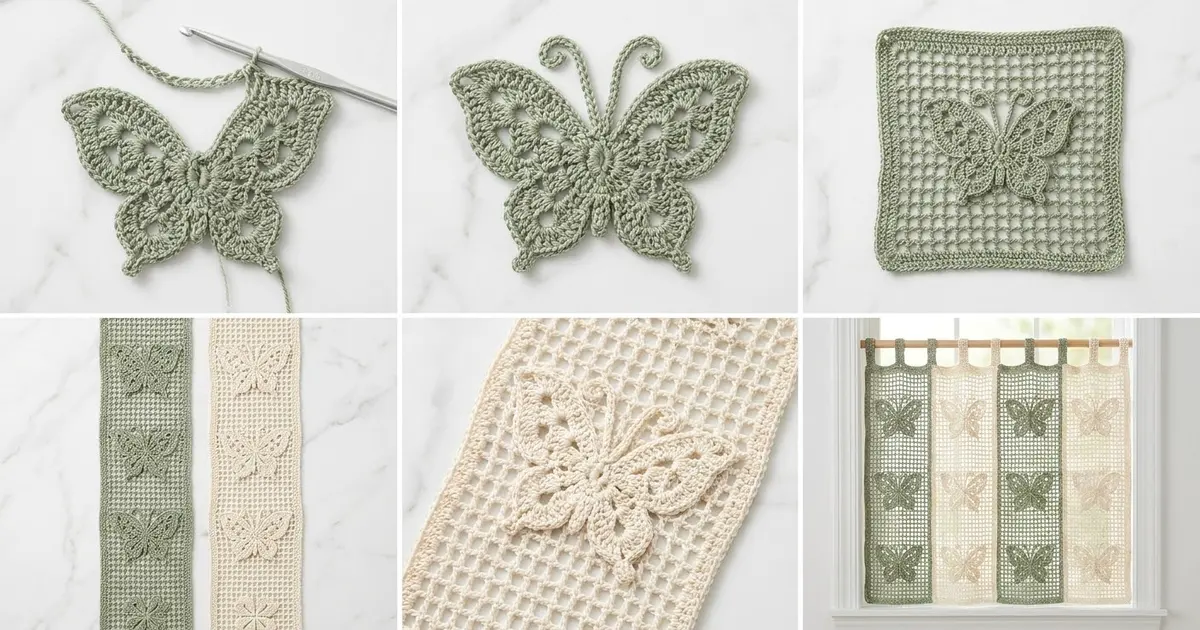
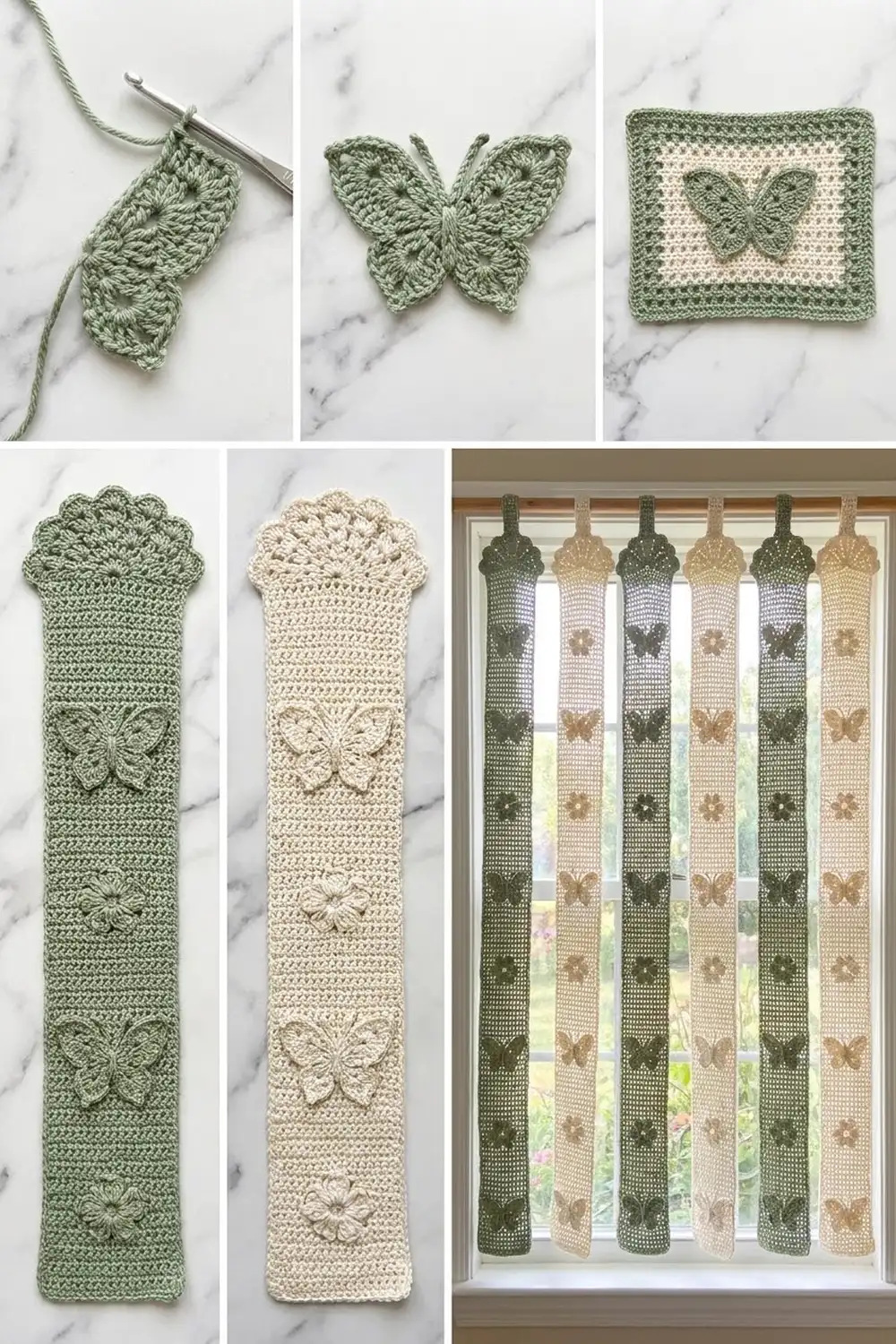
The Garden Flutter curtain is made of tall, narrow lace strips that hang side by side from a rod. Each strip has an open filet mesh background with a column of raised butterflies down the center. Small four-petal flowers sit between the butterflies, and fan scallops run across the top.
The sample alternates soft sage green and warm cream, with three strips in each color. The butterflies and flowers match their own strip, so each strip is tone-on-tone and the whole window looks striped. The look is cottage-garden lace that still lets the light through.
This pattern uses US crochet terms. Each finished strip measures 4.5 in (11.4 cm) wide by 47 in (119.4 cm) long, not counting the hanging tabs. Six strips cover 27 in (68.6 cm) of rod.
Each strip is worked in rows of filet mesh, then edged with single crochet, a fan header and two hanging tabs. You make the butterflies and flowers separately and sew them on. The strips are not seamed together.
Finished Size and Construction
- Finished strip size: 4.5 in x 47 in (11.4 cm x 119.4 cm), tabs not included
- Tab drop: about 1.75 in (4.4 cm) above the fans
- Full curtain width: 6 strips x 4.5 in = 27 in (68.6 cm)
- Skill level: Intermediate
- Terminology: US
- Yarn weight: Fingering (#1) mercerized cotton
- Hook: 2.75 mm (US C-2)
- Number of pieces: 6 strips, 54 butterflies, 60 flowers (plus one test block)
- Layout: 6 strips in one row, alternating colors, not joined
- Strip size before border: 4 in x 46 in (10.2 cm x 116.8 cm), 8 mesh squares wide, 92 rows long
- Border depth: 0.25 in (0.6 cm) on the sides and bottom; 0.25 in (0.6 cm) plus 0.5 in (1.3 cm) of fans at the top
Materials
Use a smooth, mercerized fingering-weight cotton. It gives crisp mesh and clear butterflies, and it keeps its shape while hanging. Avoid fuzzy or stretchy fibers, because long strips grow under their own weight.
- Sage green: 300 g, about 1,020 m (six 50 g balls of about 170 m each)
- Cream: 300 g, about 1,020 m (six 50 g balls of about 170 m each)
These amounts include about a 20% margin for the test block, swatching and sewing tails.
Tools:
- 2.75 mm (US C-2) crochet hook
- Tapestry needle
- Rust-proof pins
- Blocking mats and tape measure
- Scissors and spray bottle
- Curtain rod, up to 1 in (2.5 cm) in diameter
Abbreviations (US Terms)
- ch – chain
- sl st – slip stitch
- sc – single crochet
- dc – double crochet
- tr – treble crochet
- dtr – double treble crochet
- sk – skip
- sp – space
- RS – right side
Special stitch – 2-dc cluster: [Yarn over, insert hook in ring, pull up a loop, yarn over, draw through 2 loops] twice, yarn over, draw through all 3 loops on hook.
Filet mesh square: one dc post, ch 2, and the next dc post. Each square is 3 stitches wide, and neighboring squares share a post.
Gauge and Checkpoints
Gauge: 4 mesh squares and 4 mesh rows = 2 in (5.1 cm) square, after blocking. One square is 0.5 in (1.3 cm) wide and tall.
Test one piece first. Before you start the strips, make one test block. Ch 27, work Row 1, work Rows 2–11 as mesh rows, then work one solid row the same way as Row 92 (12 rows). Work Border Round 1 with 24 sc on each long side and 25 sc on each short side. Sew 1 butterfly in the center and 1 flower at the top and bottom.
Checkpoints:
- After Row 1: 4 in (10.2 cm) wide.
- Test block: 4 in x 6 in (10.2 cm x 15.2 cm) before the border, 4.5 in x 6.5 in (11.4 cm x 16.5 cm) after.
- One butterfly: 3.5 in (8.9 cm) wide and 3.5 in (8.9 cm) tall including antennae.
- One flower: about 0.75 in (1.9 cm) across.
- Strip after Row 11: 5.5 in (14.0 cm) long.
- Strip before border: 4 in x 46 in (10.2 cm x 116.8 cm).
If your block is too big, go down to a 2.5 mm hook. If it is too small, go up to 3 mm. Getting the width right matters most, because the fan header needs exactly 25 stitches to fill 4 in (10.2 cm).
Strip (Make 3 in Green, 3 in Cream)
Foundation: Ch 27.
Row 1 (RS, solid row): Dc in 4th ch from hook (the skipped ch count as the first dc) and in each ch across. Turn. (25 dc)
Row 2 (first mesh row): Ch 5 (counts as dc and ch 2), sk next 2 dc, dc in next dc, ch 2, sk next 2 dc, dc in next dc 7 times, working the last dc in the top of the turning ch. Turn. (9 dc posts + 8 ch-2 sps = 25 sts; 8 squares)
Row 3 (mesh row): Ch 5 (counts as dc and ch 2), dc in next dc, ch 2, dc in next dc 6 times, ch 2, dc in 3rd ch of turning ch-5. Turn. (9 dc posts + 8 ch-2 sps = 25 sts)
Rows 4–91: Repeat Row 3. (25 sts in each row)
Rows 2–91 are 90 mesh rows, or 9 repeats of 10 rows. Each repeat is 5 in (12.7 cm) long and holds one butterfly.
Row 92 (solid row): Ch 3 (counts as dc), 2 dc in next ch-2 sp, dc in next dc 8 times, working the last dc in the 3rd ch of the turning ch-5. Do not turn. (1 + 8 x 3 = 25 dc)
Checkpoint: 92 rows, 4 in x 46 in (10.2 cm x 116.8 cm). Do not fasten off. Go on to the border.
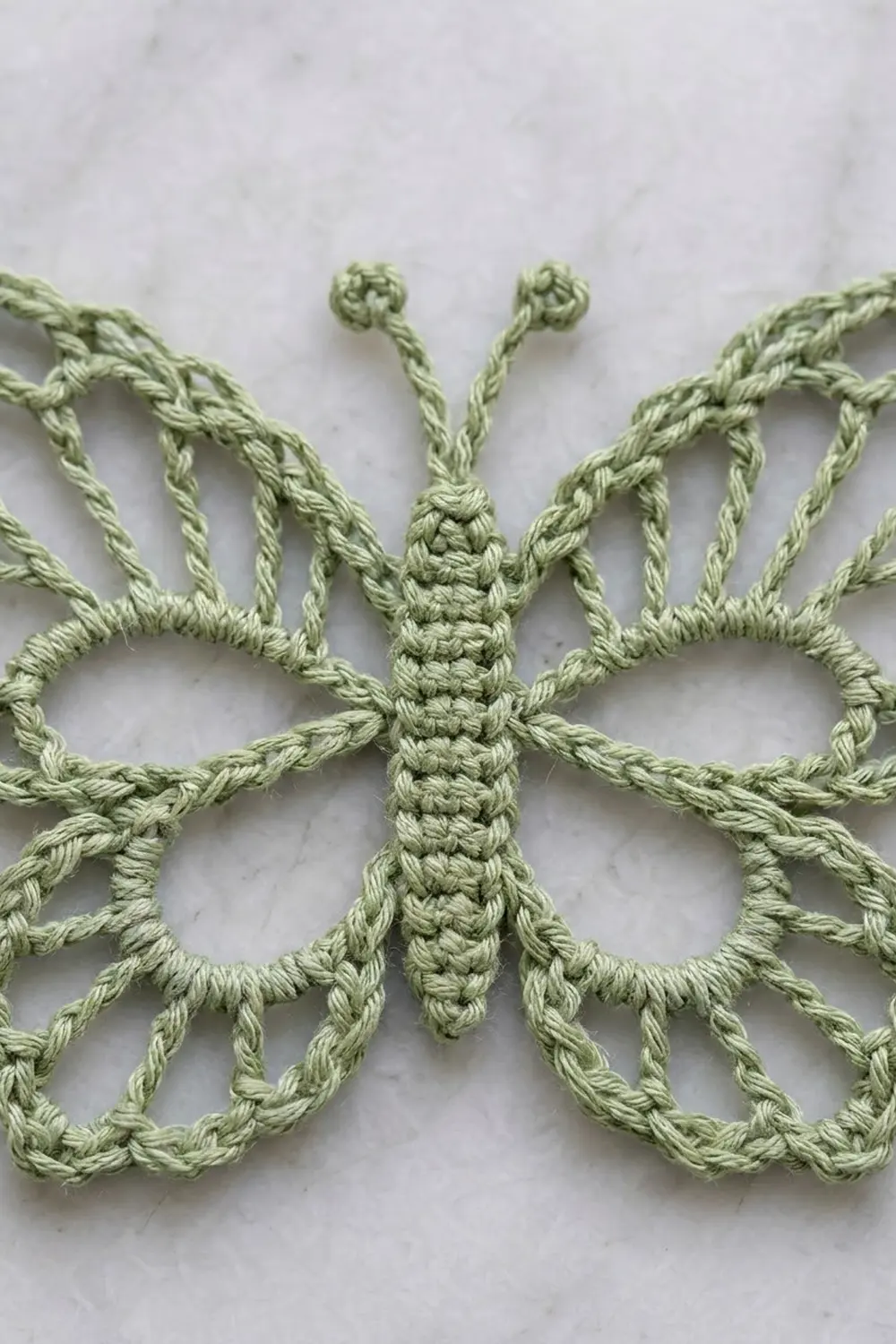
Butterfly (Make 27 in Green, 27 in Cream)
Body
Ch 4.
Row 1: Sc in 2nd ch from hook and in next 2 ch. Turn. (3 sc)
Rows 2–12: Ch 1, sc in each sc across. Turn. (3 sc in each row)
The body measures about 1.5 in x 0.5 in (3.8 cm x 1.3 cm). Fasten off.
Upper Wings (Make 2 per Butterfly, One on Each Side)
Row 1 (spokes): Join yarn in the row-end of Row 10. Ch 5 (counts as dtr), ch 3, dtr in same row-end 5 times. Turn. (6 dtr, 5 ch-3 sps)
Row 2: Ch 1, sc in first dtr, 4 sc in next ch-3 sp, sc in next dtr 5 times. Turn. (1 + 5 x 5 = 26 sc)
Row 3: Ch 1, sc in first sc, ch 6, sk next 4 sc, sc in next sc 5 times. Turn. (6 sc, 5 ch-6 loops)
Row 4: Ch 1, sc in first sc, 8 sc in next ch-6 loop, sc in next sc 5 times. (6 + 40 = 46 sc) Fasten off, leaving a 6 in (15.2 cm) tail.
Lower Wings (Make 2 per Butterfly, One on Each Side)
Row 1 (spokes): Join yarn in the row-end of Row 4. Ch 4 (counts as tr), ch 2, tr in same row-end 3 times. Turn. (4 tr, 3 ch-2 sps)
Row 2: Ch 1, sc in first tr, 3 sc in next ch-2 sp, sc in next tr 3 times. Turn. (1 + 3 x 4 = 13 sc)
Row 3: Ch 1, sc in first sc, ch 5, sk next 3 sc, sc in next sc 3 times. Turn. (4 sc, 3 ch-5 loops)
Row 4: Ch 1, sc in first sc, 7 sc in next ch-5 loop, sc in next sc 3 times. (4 + 21 = 25 sc) Fasten off, leaving a 6 in (15.2 cm) tail.
The dtr and tr fans make the spokes inside each wing, and the covered loops make the scalloped outer edge.
Antennae
Join yarn in the first sc of Row 12. Ch 10, sl st in 4th ch from hook to form a curled tip, sl st in each of the remaining 6 ch, sl st in same sc. Sl st in each of the next 2 sc. Make a second antenna from this last sc the same way. Fasten off.
Checkpoint: 3.5 in (8.9 cm) wide and 3.5 in (8.9 cm) tall.
Flower (Make 30 in Green, 30 in Cream)
Ch 4, sl st in first ch to form a ring.
Round 1: Ch 3, 2-dc cluster in ring, ch 3, sl st in ring 4 times. (4 petals) Fasten off, leaving an 8 in (20.3 cm) tail.
Checkpoint: about 0.75 in (1.9 cm) across.
Make All Pieces
Each strip uses 9 butterflies and 10 flowers in its own color.
| Color | Strips | Butterflies | Flowers |
|---|---|---|---|
| Sage green | 3 | 27 | 30 |
| Cream | 3 | 27 | 30 |
| Total | 6 | 54 | 60 |
Layout across the rod (left to right):
[ G ] [ C ] [ G ] [ C ] [ G ] [ C ]
 S1    S2    S3    S4    S5    S6
G = sage green strip, C = cream strip
Joining
The strips are not seamed to each other. In this pattern, joining means sewing the appliqués onto each strip.
Center line: The 5th dc post of each mesh row, counted from either side, forms the center line of the strip.
- Flowers: Center one flower on the center line at the top of Rows 1, 11, 21, 31, 41, 51, 61, 71, 81 and 91. (10 flowers)
- Butterflies: Center one butterfly in each 10-row repeat (Rows 2–11, 12–21 and so on). The body sits on the center line and the antennae point toward the top. (9 butterflies) This leaves about 0.75 in (1.9 cm) between each pair of wing tips and the nearest flower.
Method: Pin each piece, then sew it with matching yarn. Whipstitch the whole body to the center post. Tack each wing at its base and at each outer loop. Tack each flower at its center and petal tips.
Tension: Sew loosely and keep the strip flat on a table. If the mesh puckers, the stitches are too tight.
Size checkpoint: After sewing, the strip still measures 4 in x 46 in (10.2 cm x 116.8 cm).
Border
Border gauge: 4 sc per inch along the long sides (2 sc per dc row-end), and 25 sc across 4 in (10.2 cm) on the short sides.
Round 1: Continue from the end of Row 92. Ch 1, then work 2 sc in each row-end down the long side. (92 x 2 = 184 sc) Ch 2 for the corner. Sc in each free loop of the foundation ch. (25 sc) Ch 2. Work 2 sc in each row-end up the other long side. (184 sc) Ch 2. Sc in each dc of Row 92. (25 sc) Ch 2, sl st in first sc. Fasten off.
The round totals 184 + 25 + 184 + 25 = 418 sc, plus 4 corner ch-2 sps. The corner chains are not included in the side counts.
Checkpoint: 4.5 in x 46.5 in (11.4 cm x 118.1 cm).
Fan Header (top edge only): With RS facing, join yarn in the first sc of the top side, just after the corner ch-2 sp. Sc in same sc, sk next 2 sc, 7 dc in next sc, sk next 2 sc, sc in next sc 4 times. Fasten off. (4 fans; 5 sc + 28 dc)
Why the math works: Each fan repeat uses 6 stitches. Four repeats use 24, and the first sc makes 25. That equals the 25 sc on the top side, so the fans end evenly at both corners. On the long sides, one dc row is about as tall as 2 sc, so 2 sc per row-end keeps the edges flat.
Hanging Tabs (2 per strip): The fan header’s sc sit at stitches 1, 7, 13, 19 and 25. Join yarn in stitch 7. Ch 30, sl st in same sc. Ch 1, work 36 sc into the loop, sl st in base sc. Fasten off. Repeat at stitch 19.
Each loop is about 3.75 in (9.5 cm) around. It hangs about 1.75 in (4.4 cm) and fits a rod up to 1 in (2.5 cm) in diameter.
Finished strip: 4.5 in x 47 in (11.4 cm x 119.4 cm), or 48.75 in (123.8 cm) with tabs.
Final Blocking
- Weave in all ends.
- Lay one strip RS up on blocking mats.
- Spray it until evenly damp.
- Pin the long sides straight and 4.5 in (11.4 cm) apart.
- Pin the length to 47 in (119.4 cm).
- Pin each fan into a smooth arc.
- Shape the wings and petals with your fingers.
- Let it dry completely before unpinning.
- Block all six strips to the same size.
Final Quality-Control Checklist
- Each strip has 92 rows of 25 sts.
- Border Round 1 has 184 sc on each long side and 25 sc on each short side.
- Each strip measures 4.5 in x 47 in (11.4 cm x 119.4 cm).
- Each strip has 4 fans, 2 tabs, 9 butterflies and 10 flowers.
- All appliqués sit on the center line, with the antennae pointing up.
- The mesh lies flat behind every appliqué.
- The colors alternate green and cream.
Troubleshooting
Squares look tall and narrow. Loosen your ch-2s slightly, or pull up shorter loops on your dc.
Strip stretches when hung. Re-block it. For future strips, leave out one 10-row repeat.
Fans don’t fit. Recount the top side. It must have exactly 25 sc.
Wings curl. Work Row 4 with a hook one size larger.
Long sides ripple. Work exactly 2 sc in every row-end.
Want it longer? Each extra 10-row repeat adds 5 in (12.7 cm), 20 sc on each long border side, 1 butterfly and 1 flower.
Care
Hand wash in cool water with mild soap, roll in a towel and dry flat. Re-block before hanging again.
Final Notes
All the measurements come from one mesh square of 0.5 in (1.3 cm). Eight squares give a strip 4 in (10.2 cm) wide. Ten rows make one 5 in (12.7 cm) butterfly repeat, and 9 repeats plus 2 solid rows make 46 in (116.8 cm). The border brings each strip to 4.5 in x 47 in (11.4 cm x 119.4 cm), and six strips fill 27 in (68.6 cm) of rod.
Check your test block, keep your counts steady, and the curtain will hang evenly.
Happy crocheting!