
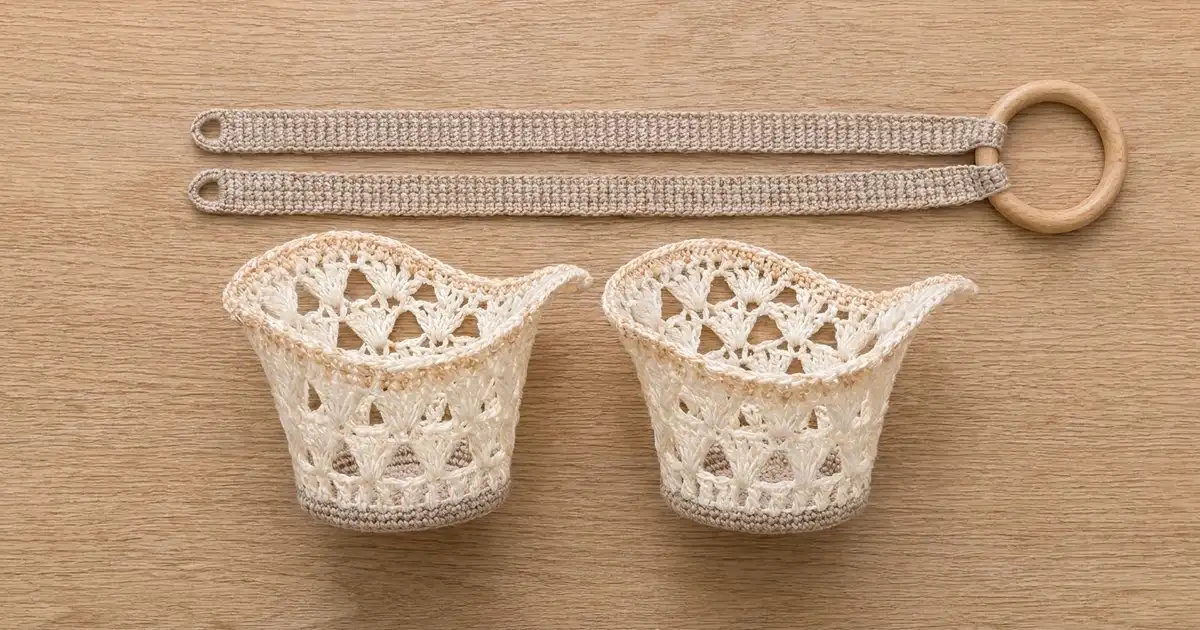
This two-tier hanging basket pairs open cream lace with a sturdy taupe base and straps. Each basket has a flared shell-pattern wall, and its rim sweeps up on one side into a soft spout edged in peach. It hangs from a wooden ring on a wall hook and holds two standard toilet paper rolls, washcloths or small toiletries.
The palette is calm and neutral: cream for the lace, peach for the rim edging, and taupe for the bases, bottom bands and straps. The look is farmhouse with a vintage-doily feel. The structure is practical: solid single crochet where strength matters, and lace where it shows.
This pattern uses US crochet terms. Each basket measures 5 in (12.7 cm) across the base. It is 4.6 in (11.7 cm) tall on the low side and 6.1 in (15.5 cm) tall at the spout peak. The straps hang 16 in (40.6 cm) below the ring fold.
Construction overview:
- Crochet a flat round base with a short wall.
- Work the lace panel flat, shaping the spout with short rows.
- Seam the panel into a ring and join it to the base.
- Add the rim edging.
- Sew both baskets to two straps looped over a wooden ring.
Finished Size and Construction
- Finished size (each basket): 5 in (12.7 cm) base diameter; 4.6 in (11.7 cm) tall on the low side; 6.1 in (15.5 cm) at the spout
- Top opening: about 6 in (15.2 cm) across after blocking
- Overall hanging length: 16 in (40.6 cm) below the ring, plus 0.75 in (1.9 cm) strap eyelets
- Skill level: Intermediate
- Terminology: US
- Yarn weight: DK / light worsted (weight 3) cotton
- Hook: 4.0 mm (G-6)
- Number of pieces: 6 crocheted pieces (2 bases, 2 lace panels, 2 straps) plus 1 wooden ring
- Layout: 2 baskets stacked vertically between 2 straps
- Panel size before seaming: 16 in (40.6 cm) wide at the bottom edge, 3.4 in (8.6 cm) tall at Row 8
- Size before rim edging: 4.2 in (10.7 cm) tall on the low side
- Rim edging depth: 0.4 in (1.0 cm)
Materials
Use a firm mercerized or combed cotton in DK weight. Cotton holds the lace open and keeps the base from sagging under a full roll. Avoid acrylic or very soft blends, because the spout will droop.
- Cream (A): 100 g / 230 m (lace panels)
- Taupe (B): 100 g / 230 m (bases, joining rounds, straps)
- Peach (C): 20 g / 46 m (rim edging)
All quantities include a margin of about 20% for gauge swatches and differences in tension.
Tools:
- 4.0 mm (G-6) crochet hook
- Wooden ring, 3 in (7.6 cm) diameter
- Wall hook with screws and anchors
- Tapestry needle
- Stitch markers (4–6)
- Rust-proof pins
- A jar, can or bowl about 5 in (12.7 cm) across, for blocking
- Optional: fabric stiffener or starch spray
Abbreviations (US Terms)
- ch – chain
- sl st – slip stitch
- sc – single crochet
- dc – double crochet
- sc2tog / sc3tog – single crochet 2 / 3 together
- BLO – back loop only
- sp – space
- st(s) – stitch(es)
- RS / WS – right side / wrong side
- rev sc – reverse single crochet (crab stitch)
Special stitches:
- Shell: 5 dc in the same stitch.
- Large shell: 7 dc in the same stitch.
- Reverse sc: working left to right (if you’re right-handed), insert the hook in the next stitch to the right, yarn over, pull up a loop, yarn over, and pull through both loops.
Gauge and Checkpoints
- Single crochet: 18 sts and 20 rows = 4 in (10.2 cm), which is 4.5 sts and 5 rows per inch.
- Lace: each shell row is 0.5 in (1.3 cm) tall.
Make one complete basket before you start the second. Measure at each stage:
- Base after Rnd 12: 5 in (12.7 cm) across, lying flat.
- Base after Rnd 15: circumference 16 in (40.6 cm).
- Panel after Row 3: bottom edge 16 in (40.6 cm) wide.
- Panel after Row 8: 3.4 in (8.6 cm) tall.
- Panel after Row 11: 4.9 in (12.4 cm) tall at the peak.
If your piece is too big: go down 0.5 mm. If it’s too small: go up 0.5 mm. The base and panel must match each other at 72 stitches. If only one of them measures differently, change the hook for that piece only.

Base (make 2, Color B)
Work in continuous spiral rounds and mark the first stitch of each round.
Rnd 1: Magic ring, 6 sc in ring. (6 sts)
Rnd 2: 2 sc in each st. (12 sts)
Rnd 3: (sc in next st, 2 sc in next st) 6 times. (18 sts)
Rnd 4: (sc in next 2, 2 sc in next) 6 times. (24 sts)
Rnd 5: (sc in next 3, 2 sc in next) 6 times. (30 sts)
Rnd 6: (sc in next 4, 2 sc in next) 6 times. (36 sts)
Rnd 7: (sc in next 5, 2 sc in next) 6 times. (42 sts)
Rnd 8: (sc in next 6, 2 sc in next) 6 times. (48 sts)
Rnd 9: (sc in next 7, 2 sc in next) 6 times. (54 sts)
Rnd 10: (sc in next 8, 2 sc in next) 6 times. (60 sts)
Rnd 11: (sc in next 9, 2 sc in next) 6 times. (66 sts)
Rnd 12: (sc in next 10, 2 sc in next) 6 times. (72 sts)
Checkpoint: 5 in (12.7 cm) across. Twelve rounds at 0.2 in (0.5 cm) each give a radius of about 2.4 in (6.1 cm), and the magic ring and edge stitches make up the rest.
Rnd 13: Sc in BLO of each st. (72 sts) This turns the edge upward.
Rnds 14–15: Sc in each st. (72 sts)
Don’t fasten off. Put the live loop on a marker. The wall is now 0.6 in (1.5 cm) tall, and the joining round will bring it to 0.8 in (2.0 cm).
Lace Panel (make 2, Color A)
The panel is worked flat. It has 73 stitches so that the first and last stitches can overlap inside the seam, which leaves 72 working stitches around the ring.
Foundation: Ch 74.
Row 1 (RS): Sc in 2nd ch from hook and in each ch across, turn. (73 sc)
Row 2 (ladder): Ch 4 (counts as dc + ch 1), sk next st, dc in next st, ch 1, sk 1, dc in next st; rep from * across, turn. (37 dc, 36 ch-1 sps = 73 sts)
Row 3: Ch 1, sc in first dc, sc in ch-1 sp, sc in next dc; rep from * 36 times, working the last sc in the 3rd ch of the turning ch, turn. (73 sc)
Checkpoint: bottom edge 16 in (40.6 cm).
Row 4: Ch 1, sc in first st, sk 2, shell in next st, sk 2, sc in next st; rep from * 12 times, turn. (12 shells, 13 sc = 73 sts)
Row 5: Ch 3 (counts as dc), 2 dc in first sc, sc in 3rd dc of next shell, shell in next sc; rep from * 11 times, sc in 3rd dc of last shell, 3 dc in last sc, turn. (11 shells, 2 half shells of 3 dc, 12 sc = 73 sts)
This row offsets the shells, and the gaps between the fans become the triangle openings.
Row 6 (growth row): Ch 1, sc in first dc, large shell in next sc, sc in 3rd dc of next shell; rep from * 11 times, large shell in next sc, sc in top of turning ch, turn. (12 large shells, 13 sc = 97 sts)
Going from 5-dc shells to 7-dc shells makes the wall flare outward.
Row 7: Ch 3, 3 dc in first sc, sc in 4th dc of next shell, large shell in next sc; rep from * 11 times, sc in 4th dc of last shell, 4 dc in last sc, turn. (11 large shells, 2 half shells of 4 dc, 12 sc = 97 sts)
Row 8: Ch 1, sc in first dc, large shell in next sc, sc in 4th dc of next shell; rep from * 11 times, large shell in next sc, sc in top of turning ch, turn. (12 large shells, 13 sc = 97 sts)
Checkpoint: 3.4 in (8.6 cm) tall. Don’t fasten off.
Spout Shaping (short rows)
The spout rises at the edge where Row 9 begins, and that edge sits beside the seam.
Row 9 (RS): Ch 3, 3 dc in first sc, (sc in 4th dc of next shell, large shell in next sc) 4 times, sc in 4th dc of next shell, turn. Leave the remaining 60 sts of Row 8 unworked. (4 large shells, 1 half shell, 5 sc = 37 sts)
Row 10: Sl st in first 5 sts (ending in the 4th dc of the shell), ch 1, sc in same st, (large shell in next sc, sc in 4th dc of next shell) 3 times, turn. Leave 8 sts of Row 9 unworked. (3 large shells, 4 sc = 25 sts, not counting sl sts)
Row 11: Sl st in first 5 sts, ch 1, sc in same st, (large shell in next sc, sc in 4th dc of next shell) 2 times. Leave 4 sts of Row 10 unworked. Fasten off. (2 large shells, 3 sc = 17 sts, not counting sl sts)
Checkpoint: 4.9 in (12.4 cm) at the peak.
Strap (make 2, Color B)
Foundation: Ch 6.
Row 1: Sc in 2nd ch from hook and in each ch across, turn. (5 sc)
Rows 2–80: Ch 1, sc in each st, turn. (5 sc)
Checkpoint: 16 in (40.6 cm) long and 1.1 in (2.8 cm) wide.
Row 81 (eyelet): Ch 1, sc2tog, sc in next st, sc2tog, turn. (3 sts)
Row 82: Ch 1, sc3tog, ch 6, sl st in same st to form a loop. Fasten off. (1 st + loop)
The tapered tip and loop make the 0.75 in (1.9 cm) eyelet.
Make All Pieces
| Piece | Quantity | Color |
|---|---|---|
| Base | 2 | B (taupe) |
| Lace panel | 2 | A (cream), edged in C (peach) |
| Strap | 2 | B (taupe) |
| Wooden ring | 1 | — |
Layout (front view):
          ( wooden ring )
       strap A       strap B
          |  [Basket 1]  |
          |   3.3 in gap |
          |  [Basket 2]  |
       eyelet         eyelet
Joining
A. Seam the panel. With the RS facing out, overlap the first and last stitches of Rows 1–8. Whipstitch through both edge stitches with Color A. Rows 9–11 stay free above the seam. Keep the tension snug but not puckered, so the seam is the same height as the fabric beside it.
B. Join the panel to the base. Pick up the live taupe loop of the base. Slide the panel ring over the base wall with the RS out and the foundation edge down.
Rnd 16: Sc through the next base stitch and the next foundation chain loop together; repeat around. (72 sc) Join with sl st and fasten off.
The join is 1-to-1: 72 base stitches meet 72 foundation loops (73 minus the overlapped pair). Hold the panel slightly relaxed, because a tight join pulls the bottom band inward.
Checkpoint: bottom circumference 16 in (40.6 cm), taupe band 0.8 in (2.0 cm) tall.
C. Attach the straps (after the Border).
- Fold the top 1.5 in (3.8 cm) of one strap over the wooden ring and whipstitch it down. Do the same with the second strap beside the first.
- Place the baskets so the straps sit on opposite sides and both spouts face the same direction.
- Measure down from the ring fold:
- 2 in (5.1 cm) to the top rim of Basket 1
- 4.6 in (11.7 cm) for Basket 1
- a 3.3 in (8.4 cm) gap
- 4.6 in (11.7 cm) for Basket 2
- Total: 16 in (40.6 cm)
- Whipstitch each strap to the taupe band and to the rim across the strap’s full width.
Checkpoint: both baskets hang level, with rims parallel to the floor.
Border (Rim Edging)
Border gauge: 4.5 sc per inch along stitch tops, and 2 sc into each shell-row end.
Join Color C in the first free stitch of Row 8 beside the seam, on the side away from the spout.
Rnd 1: Ch 1, then sc around the top edge as follows:
- 60 sc across the free sts of Row 8
- 2 sc in the inner row-end of Row 9
- 5 sc in the Row 10 sl sts
- 2 sc in the inner row-end of Row 10
- 4 sc in the unworked sts of Row 10
- 2 sc in the inner row-end of Row 11
- 17 sc across the top of Row 11
- 2 sc in the seam-side row-end of Row 11
- 5 sc in the Row 11 sl sts
- 2 sc in the seam-side row-end of Row 10
- 8 sc in the unworked sts of Row 9
- 2 sc in the seam-side row-end of Row 9
Join with sl st to the first sc. (111 sc)
Rnd 2: Ch 1, rev sc in each st around. (111 rev sc) Join and fasten off.
Why the math works:
- Along stitch tops, each stitch gets one sc, so the edging is exactly as long as the fabric.
- Each shell row is 0.5 in (1.3 cm) tall. At 4.5 sts per inch, 2 sc cover 0.44 in (1.1 cm), which is close enough to keep the steps flat without ruffling.
- Total: 60 + 2 + 5 + 2 + 4 + 2 + 17 + 2 + 5 + 2 + 8 + 2 = 111.
Final Blocking
- Weave in all ends along stitches of the matching color.
- Soak each basket in cool water for 10 minutes, then press the water out in a towel.
- Slide the basket over a 5 in (12.7 cm) jar or can, base on top.
- Ease the lace upward so the opening flares to about 6 in (15.2 cm).
- Pin the spout so its tip curls slightly outward.
- Open each triangle gap with your fingers so all the shells sit evenly.
- Optional: mist with stiffener or starch.
- Let everything dry completely, at least 24 hours, before you attach the straps.
- Block the straps flat, pinned to 16 in (40.6 cm).
Final Quality-Control Checklist
- Base lies flat at 5 in (12.7 cm)
- 72 stitches in the joining round of both baskets
- Panel seam lined up and hidden on the inside
- 12 large shells around Row 8
- Spout reaches 6.1 in (15.5 cm) total height
- 111 stitches in both edging rounds
- Both baskets within 0.25 in (0.6 cm) of the same height
- Straps the same length, with folds stitched securely
- Baskets hang level
Troubleshooting
Base cups up: Your tension is tight. Go up a hook size for Rnds 1–12.
Base ruffles: Your tension is loose. Go down a hook size, and check that you add only 6 stitches per round.
Panel too short for the base: Recount Row 1 (73 sc) and compare the widths. Adjust your hook size.
Lace looks crowded: Block over a larger form, or use 5-dc shells in Rows 6–8 for a straighter wall.
Spout flops: Use stiffener, or add a second rev sc round along Row 11 only.
Edging ripples: Work 1 sc instead of 2 in each row-end.
Basket tilts: Re-sew the straps so both meet the rim at the same height.
Care
Hand wash in cool water with mild soap, press dry in a towel, and reshape over a jar to dry. Reapply stiffener if the spout gets soft.

Final Notes
Here is the measurement chain:
- The base reaches 72 stitches, 5 in (12.7 cm) across and 16 in (40.6 cm) around.
- The panel’s 73 stitches overlap to 72, matching the base exactly.
- The shells grow from 5 to 7 dc, flaring the top to about 6 in (15.2 cm).
- Three short rows give the spout a 6.1 in (15.5 cm) peak.
- The 111-stitch edging finishes the rim.
- The 16 in (40.6 cm) straps space everything evenly.
Happy crocheting!