
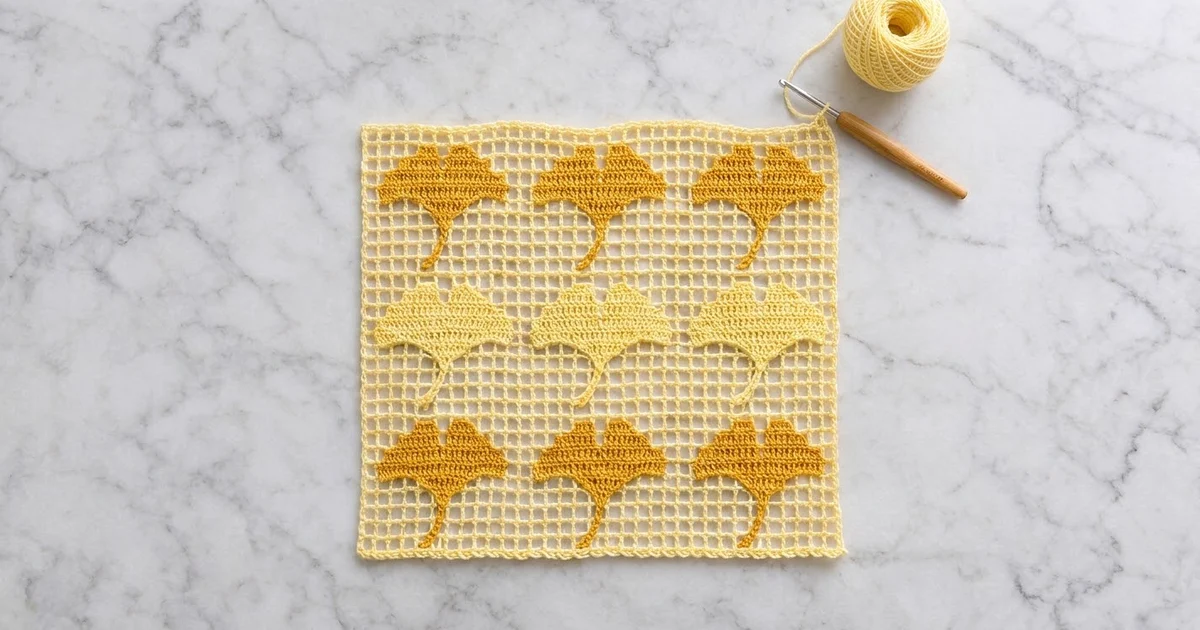
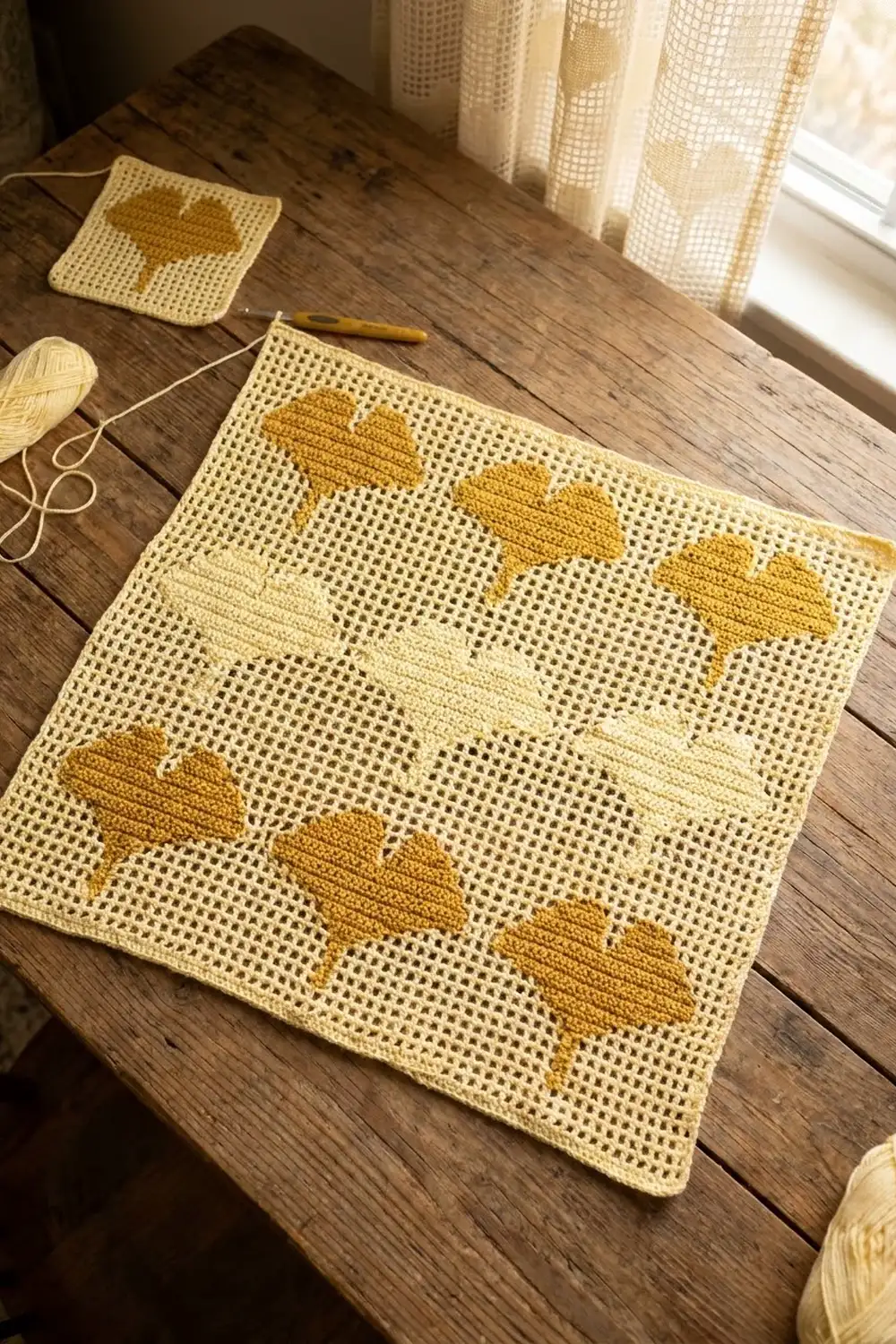
This panel turns a simple open mesh into a quiet botanical piece. Nine ginkgo leaves, each with a fan-shaped top, a soft center notch and a thin curved stem, sit in three even rows on a pale butter-yellow filet ground.
The top and bottom rows of leaves are worked in mustard gold. The middle row is worked in the mesh color, so those leaves read as tone-on-tone shapes in pale yellow. Together they give a gentle gold–cream–gold rhythm that works well as a wall hanging, table panel or window panel.
The pattern uses US crochet terms. The finished panel measures 15.6 x 14.4 in (39.6 x 36.6 cm) after a two-round border and blocking.
Construction is straightforward. You work one rectangle in rows of filet blocks (open blocks and filled blocks) from the bottom up. Gold leaves are added with simple color changes, and a two-round single crochet border finishes the edges. There is no joining.
Finished Size and Construction
- Finished size: 15.6 x 14.4 in (39.6 x 36.6 cm)
- Skill level: Intermediate (filet basics plus simple color changes)
- Terminology: US crochet terms
- Yarn weight: Sport weight (fine, 2) cotton
- Hook: 3.0 mm (US C/2 or D/3, depending on brand)
- Number of pieces: 1 (worked in one piece)
- Layout: 37 blocks wide x 34 rows tall; 3 bands of 3 leaves
- Piece size before border: 14.8 x 13.6 in (37.6 x 34.5 cm)
- Single leaf size: 9 blocks x 10 rows = 3.6 x 4 in (9.1 x 10.2 cm)
- Border depth: 0.4 in (1.0 cm), 2 rounds of sc
Materials
Pick a smooth mercerized or matte cotton in sport weight. Cotton gives crisp mesh squares and keeps the leaves flat. Avoid fuzzy yarns, which blur the open blocks.
- Color A, pale butter yellow (mesh, middle leaves, border): 50 g / 155 m
- Color B, mustard gold (top and bottom leaves): 20 g / 62 m
These quantities are based on a yarn of about 155 m per 50 g and include a margin of roughly 15–20%.
Tools:
- 3.0 mm crochet hook
- 6 small yarn bobbins (or clothespins) for color B
- Tapestry needle
- Stitch markers
- Rust-proof pins and a blocking mat
- Spray bottle
- Measuring tape
Abbreviations (US Terms)
- ch – chain
- sk – skip
- sc – single crochet
- dc – double crochet
- sp – space
- st(s) – stitch(es)
- RS / WS – right side / wrong side
- O – open block
- F – filled block
Special stitches (filet blocks):
Each block is 3 stitches wide and shares its edge dc with the next block. Counting every chain as a stitch, a row of 37 blocks has 37 x 3 + 1 = 112 sts.
- Open block over open block: ch 2, dc in next dc.
- Open block over filled block: ch 2, sk 2 dc, dc in next dc.
- Filled block over open block: 2 dc in ch-2 sp, dc in next dc.
- Filled block over filled block: dc in each of next 3 dc.
- Row start: ch 5 (counts as dc + ch 2), sk first ch-2 sp or 2 dc, dc in next dc. Every row starts and ends with an open block, so this is always correct.
- Row end: the final dc goes in the 3rd ch of the turning ch-5.
Color change: work the last dc before the new color until 2 loops remain, then finish it with the new color. Carry the unused color inside the dc of the filled blocks only.
Gauge and Checkpoints
Gauge: 10 blocks and 10 rows = 4 in (10.2 cm) in filet mesh, after light steaming. One block measures 0.4 in (1.0 cm) square.
Test one piece first. Before starting the panel, work a single-leaf square that is 13 blocks wide (ch 45, then follow the panel’s Row 1 method) with 2 open blocks on each side of one leaf. It should measure 5.2 in (13.2 cm) wide. If it does, your hook and tension are right.
Checkpoints:
- After Row 1: 14.8 in (37.6 cm) wide.
- After Row 11 (first leaf band): 4.4 in (11.2 cm) tall.
- After Row 22 (second leaf band): 8.8 in (22.4 cm) tall.
- After Row 34: 13.6 in (34.5 cm) tall.
- After the border: 15.6 x 14.4 in (39.6 x 36.6 cm).
Too big? Go down 0.25 mm in hook size, or tighten your chain-2 spaces. Loose chains are the usual cause of wide filet.
Too small? Go up 0.25 mm. If only the height is short, pull up each dc slightly taller before yarning over.
Blocks not square? If they are taller than wide, try a slightly smaller hook for the dc only. If they are wider than tall, loosen the dc.
Panel Pattern
Chart Logic
The panel is 37 blocks across, laid out like this:
2 O margin | leaf (9) | 3 O gap | leaf (9) | 3 O gap | leaf (9) | 2 O margin
Check: 2 + 9 + 3 + 9 + 3 + 9 + 2 = 37 blocks.
Vertically there are 34 rows:
- Row 1: open
- Rows 2–11: Leaf Band 1 (color B)
- Row 12: open
- Rows 13–22: Leaf Band 2 (color A)
- Row 23: open
- Rows 24–33: Leaf Band 3 (color B)
- Row 34: open
Check: 1 + 10 + 1 + 10 + 1 + 10 + 1 = 34 rows.
The layout is symmetrical from side to side, so each row reads the same from either end. Only the stem placement changes with direction, and that is what gives the stems their slight bend.
Foundation and Row 1
With A, ch 117.
Row 1 (RS): Dc in 9th ch from hook (the skipped chains count as dc, ch 2 and the skipped base chains of the first block). Then ch 2, sk 2 ch, dc in next ch 36 times. Turn.
Count: 37 open blocks, 112 sts.
Leaf Rows
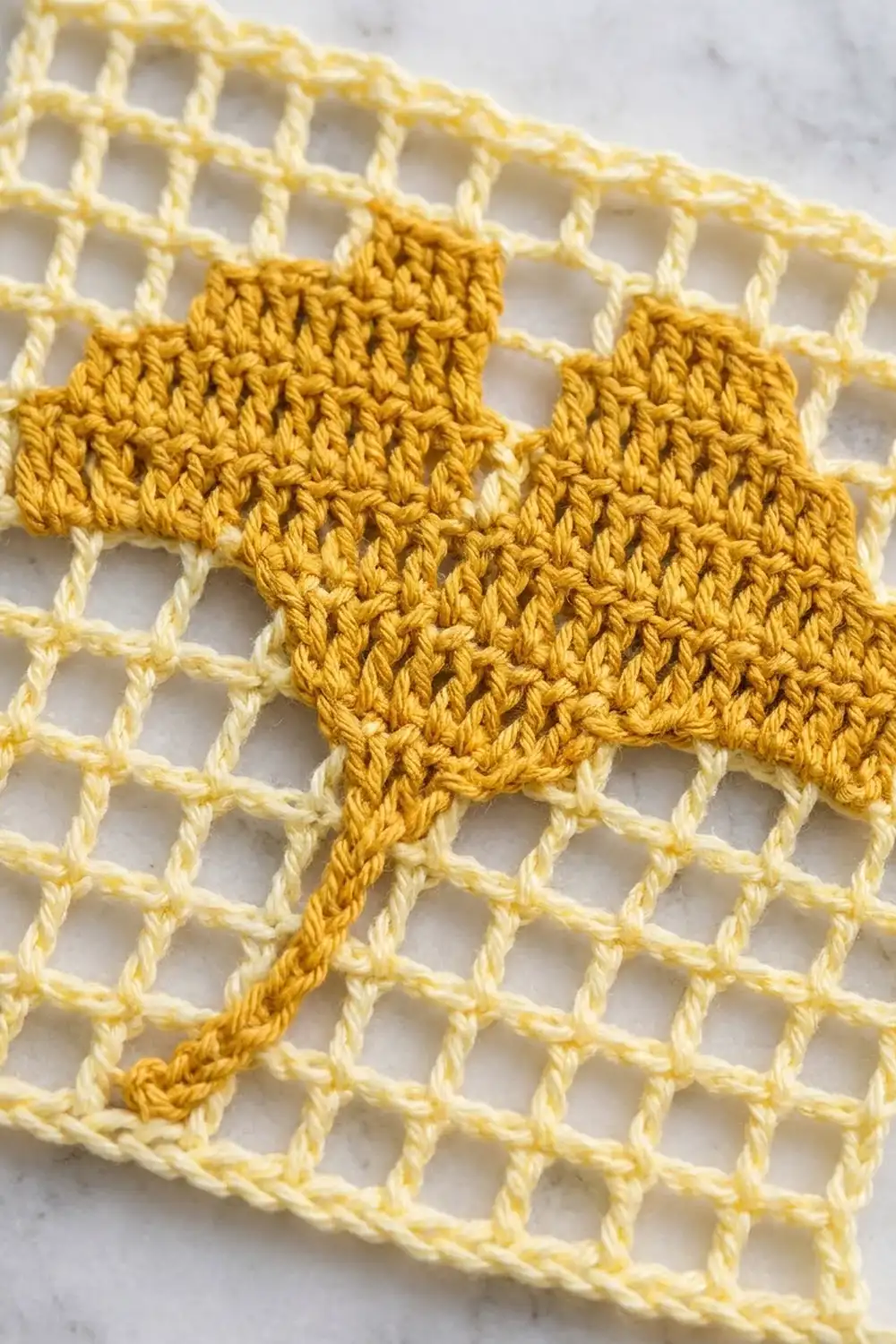
Each leaf section is 9 blocks wide. Read every leaf row from the start of that row, and work it the same way in all three leaf positions. The full row is: 2 O, leaf row, 3 O, leaf row, 3 O, leaf row, 2 O.
- Leaf Row 1: 5 O, 1 F, 3 O (stem base, offset)
- Leaf Row 2: 4 O, 1 F, 4 O (stem moves to center)
- Leaf Row 3: 4 O, 1 F, 4 O
- Leaf Row 4: 3 O, 3 F, 3 O (fan begins)
- Leaf Row 5: 2 O, 5 F, 2 O
- Leaf Row 6: 1 O, 7 F, 1 O
- Leaf Row 7: 9 F
- Leaf Row 8: 9 F
- Leaf Row 9: 4 F, 1 O, 4 F (center notch opens)
- Leaf Row 10: 1 O, 3 F, 1 O, 3 F, 1 O (scalloped top)
Filled blocks per leaf: 1 + 1 + 1 + 3 + 5 + 7 + 9 + 9 + 8 + 6 = 50.
Every leaf row still has 37 blocks and 112 sts.
Rows 2–11: Leaf Band 1 (Gold)
Wind 3 small bobbins of B, one for each leaf.
Row 2 (WS): Row start, work the 2 O margin, then Leaf Row 1. Change to B for the filled block and back to A after it. Work the 3 O gap, then the next leaf, and continue across. Turn.
Rows 3–11: Work Leaf Rows 2–10 in the same way, using B for every F block inside a leaf. Turn at the end of each row.
Bobbin handling: leave each B bobbin on the WS where you finished with it. If the next row needs B one block further out, carry it behind the work as a short float. The float should be no longer than 1 block (0.4 in / 1.0 cm), and you work the first B dc over it. Never carry B through the chain-2 spaces.
At the end of Row 11, cut B, leaving 4 in (10.2 cm) tails.
Checkpoint: 37 blocks, 112 sts; height 4.4 in (11.2 cm).
Row 12: With A, 37 O. Turn. (112 sts)
Rows 13–22: Leaf Band 2 (Pale Yellow)
Work Leaf Rows 1–10 as for Band 1, but make every F block in A. No color changes are needed. This band starts on a RS row, so the stem base leans the opposite way to the gold leaves. That small reversal adds movement across the panel.
Checkpoint after Row 22: 112 sts; height 8.8 in (22.4 cm).
Row 23: With A, 37 O. Turn. (112 sts)
Rows 24–33: Leaf Band 3 (Gold)
Repeat Rows 2–11 exactly, with 3 fresh B bobbins.
Row 34: With A, 37 O. Do not fasten off; you will go straight into the border.
Checkpoint: 34 rows, 112 sts; 14.8 x 13.6 in (37.6 x 34.5 cm).
Weave in all B tails along the dc of the filled blocks, staying inside the gold areas.
Border
Border gauge: 3 sc per block along every edge, which is 7.5 sc per inch (3 sc per 1.0 cm). Each sc round adds 0.2 in (0.5 cm) of depth.
In this border, the counts for each side do not include the 3-sc corner groups. Corners are counted separately.
Round 1
With RS facing and A, ch 1. Work all four edges in the same round:
- Top edge (Row 34): 3 sc in first st (corner), sc in each of next 110 sts, working each ch as a st. Then 3 sc in last st (corner).
- Side edge: 3 sc around each of the 34 row-end posts. This is 102 sc.
- Bottom edge: working into the free loops of the foundation chain, 3 sc in corner ch, sc in each of next 110 ch, 3 sc in last corner ch.
- Second side: 3 sc around each of the 34 row-end posts. This is 102 sc.
Sl st to first sc.
Count: top 110, bottom 110, sides 102 each, plus 4 corners x 3 = 436 sc.
Round 2
Ch 1. Work sc in each sc, with 3 sc in the center sc of each corner group. Sl st to first sc. Fasten off.
Count: top 112, bottom 112, sides 104 each (each side gains 1 sc from each corner’s outer stitch), plus 4 corners x 3 = 444 sc. Check: 436 + 8 = 444.
Why the Math Works
Each block is 0.4 in (1.0 cm) wide and contains 3 sts. Each row is also 0.4 in (1.0 cm) tall. Working 3 sc per block across and 3 sc per row-end down the sides gives the same density on all four edges, so the border neither ruffles nor pulls.
Two rounds add 0.4 in (1.0 cm) on every side:
- Width: 14.8 + 0.8 = 15.6 in (39.6 cm)
- Height: 13.6 + 0.8 = 14.4 in (36.6 cm)
Final Blocking
- Weave in all remaining ends on the WS, inside dc posts, not along chains.
- Soak the panel in cool water for 10 minutes, then press out the water in a towel. Do not wring it.
- Lay it flat on a blocking mat, RS up.
- Pin the four corners to 15.6 x 14.4 in (39.6 x 36.6 cm).
- Pin along each edge every 2 in (5.1 cm), keeping the border straight.
- Gently square up the mesh with your fingers so every block is 0.4 in (1.0 cm) and the rows run level.
- Open the leaf notches and ease the scalloped tops into shape.
- Leave it to dry completely, at least 12 hours.
Final Quality-Control Checklist
- Panel measures 15.6 x 14.4 in (39.6 x 36.6 cm).
- Every row has 37 blocks; no extra or missing dc at the edges.
- Nine leaves in three bands: gold, pale yellow, gold.
- Each leaf has a center notch, a 9-block widest row and a 1-block stem.
- No B floats longer than 1 block; no B visible in open spaces.
- Border lies flat, with 444 sc and square corners.
- All tails secured inside filled blocks or dc posts.
Troubleshooting
Edges slant inward. You are likely missing the last dc in the turning chain. Place a marker in the 3rd ch of each ch-5.
Leaf looks lopsided. Recount the open blocks before the leaf in that row. One block off shifts the whole fan.
Gold shows through the pale mesh. Your carried strand is too loose or is crossing a chain space. Keep B inside the filled dc only.
Mesh squares are rectangles. Adjust the dc height or chain tension as described in the gauge section, then re-steam the panel.
Border ruffles. You worked more than 3 sc per row-end. Rip back and keep to exactly 102 sc per side.
Border cups. Your sc tension is too tight. Go up 0.5 mm for the border only.
Care
Hand wash cold with a mild detergent and dry flat, re-pinning to size if needed. Steam lightly from the WS. Do not press directly on the leaves.
Final Notes
The measurement chain is simple:
- 1 block = 0.4 in (1.0 cm).
- 37 blocks = 14.8 in (37.6 cm) wide.
- 34 rows = 13.6 in (34.5 cm) tall.
- Two border rounds add 0.4 in (1.0 cm) per side, for a finished 15.6 x 14.4 in (39.6 x 36.6 cm) panel.
If your test square hits gauge and you check the size after each leaf band, the leaves will line up and the border will lie flat.
Happy crocheting!