
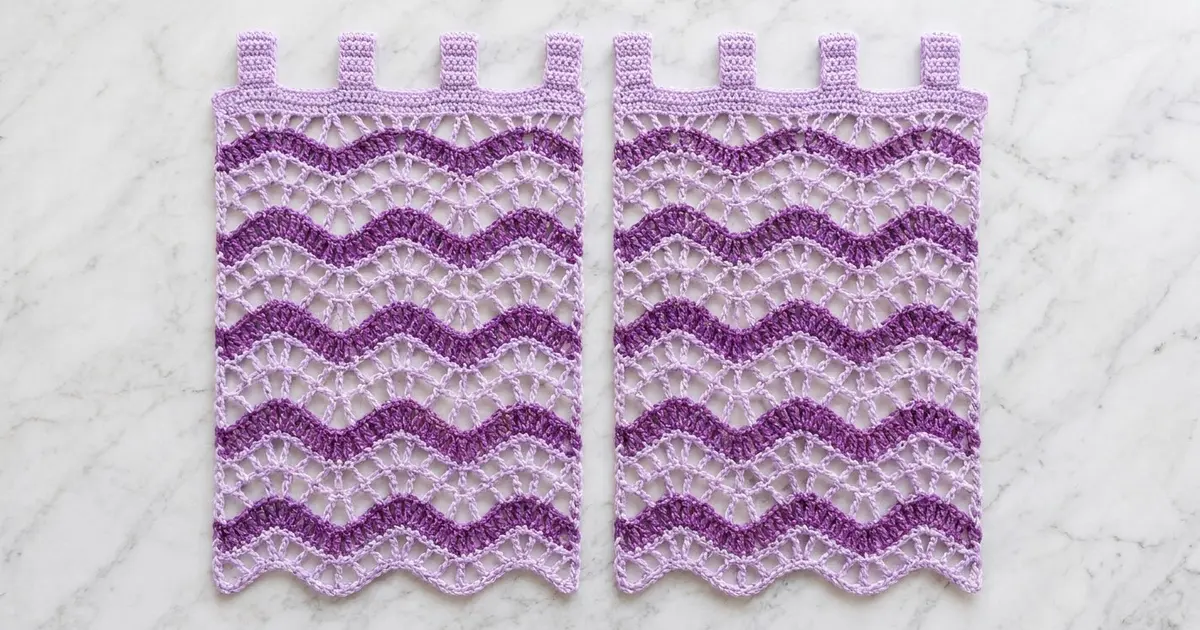
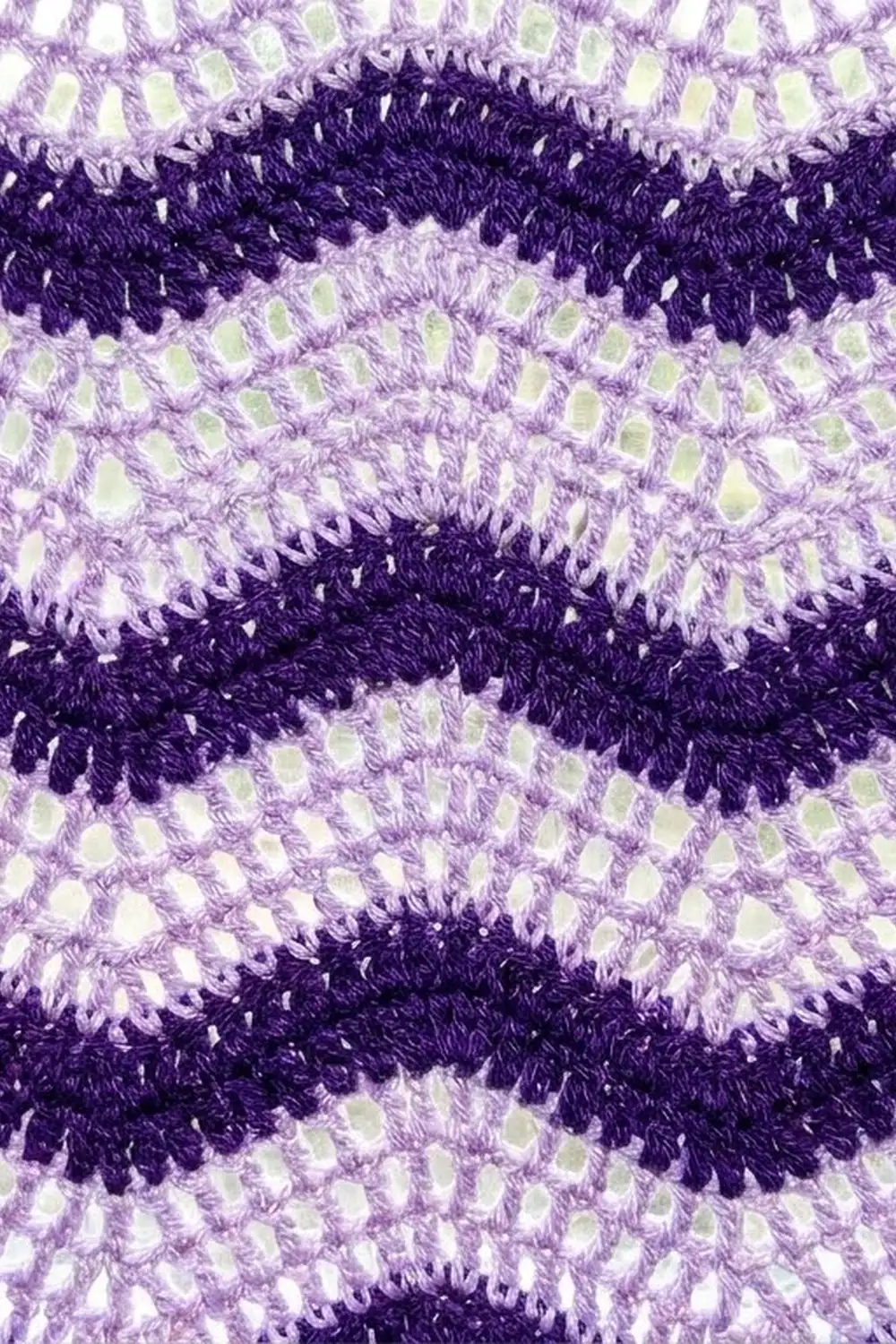
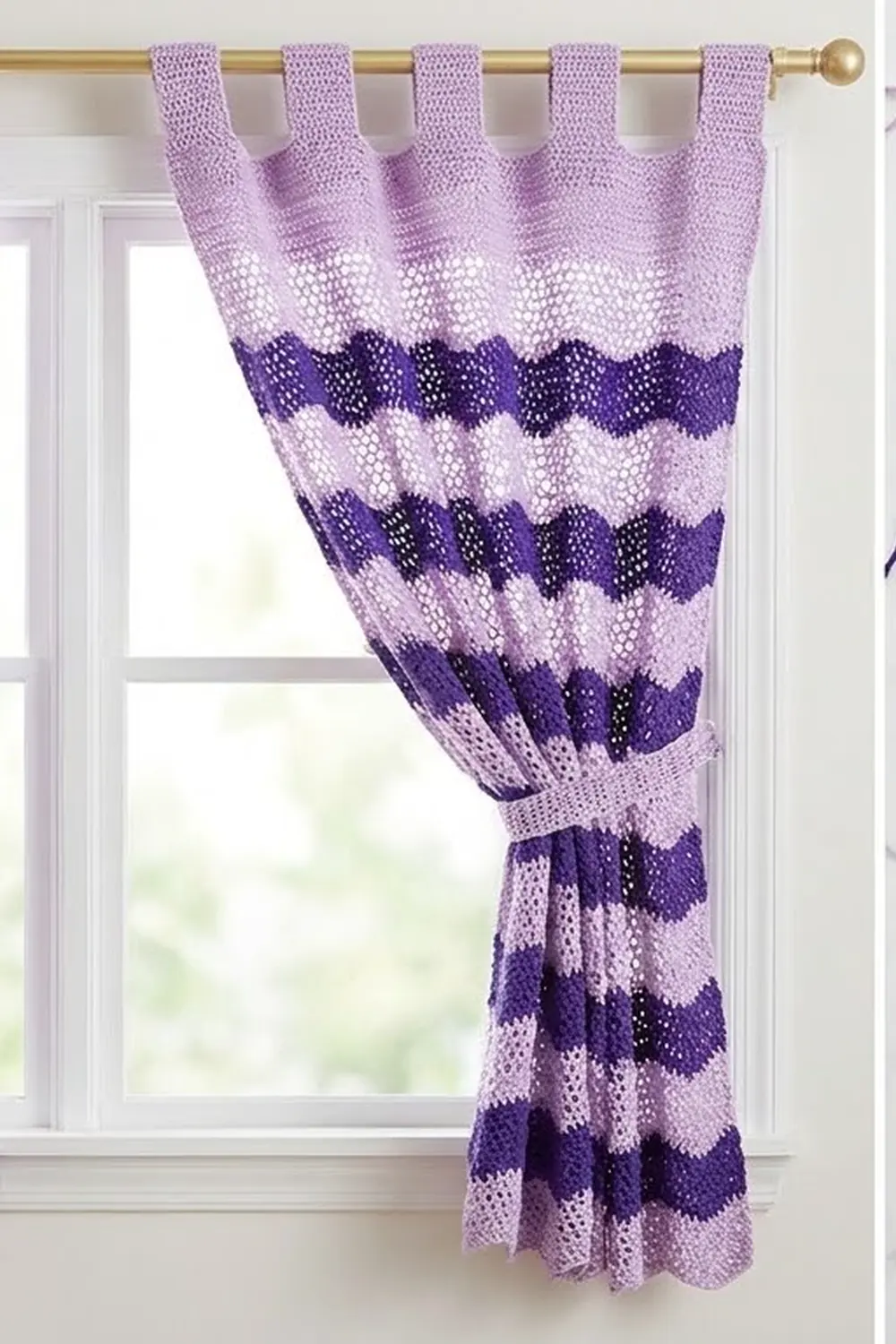
Lavender Tide is a soft wave-ripple curtain panel. Wide bands of airy lilac mesh alternate with slim, solid deep violet waves, so light comes through the lilac sections while the purple stripes give the panel structure.
The look is fresh and a little vintage, and it suits a bedroom, a sunroom or a living room window. Only two colors are used: light lilac and deep violet. All instructions use US crochet terms.
Each finished panel measures 40.5 in (102.9 cm) wide by 76.5 in (194.3 cm) long, plus tab loops that add 3 in (7.6 cm) above the panel. Hanging length from the top of the rod is 79.5 in (201.9 cm). The photo shows a pair, so make two identical panels.
Construction is simple. You work the ripple flat in rows from the bottom up, then work one leveling row and a straight single-crochet top band. One round of single crochet borders the panel, and six tabs are worked straight off the top edge.
Finished Size and Construction
- Finished panel size: 40.5 x 76.5 in (102.9 x 194.3 cm)
- Hanging length including tabs: 79.5 in (201.9 cm)
- Skill level: Intermediate
- Terminology: US
- Yarn weight: DK (light worsted, #3), cotton or cotton blend
- Hook: 4.0 mm (US G-6)
- Number of pieces: 2 identical panels, not joined
- Layout: panels hang side by side on one rod
- Size per panel before border: 40 x 76 in (101.6 x 193.0 cm)
- Border depth: 0.25 in (0.6 cm), 1 round
- Tabs: 6 per panel, each 2.7 in (6.9 cm) wide
Materials
Choose a smooth mercerized cotton or a cotton/linen blend in DK weight. Cotton drapes well, holds the wave shape after blocking, and doesn’t attract much dust. Avoid fuzzy yarns, because they blur the mesh.
Amounts below assume about 230 m per 100 g.
Per panel:
– Light lilac (A): 500 g (1150 m)
– Deep violet (B): 300 g (690 m)
For the pair:
– Light lilac (A): 1000 g (2300 m)
– Deep violet (B): 600 g (1380 m)
All quantities include a margin of about 15% for swatching and yarn changes. Buy all balls of each color from the same dye lot.
Tools:
– 4.0 mm (US G-6) hook
– 4.5 mm (US 7) hook (optional, for the top band)
– Stitch markers
– Tapestry needle
– Scissors
– Tape measure
– Blocking mats or a clean floor, plus rustproof pins
Abbreviations (US Terms)
- ch: chain
- sl st: slip stitch
- sc: single crochet
- hdc: half double crochet
- dc: double crochet
- tr: treble crochet
- sk: skip
- st(s): stitch(es)
- sp: space
- RS / WS: right side / wrong side
- rep: repeat
Special stitches:
– dc2tog (edge decrease): [Yarn over, insert hook in next st, pull up a loop, yarn over, pull through 2 loops] twice, yarn over, pull through all 3 loops. Makes 1 st from 2.
– dc3tog (valley): Work as dc2tog, but over 3 sts, then pull through all 4 loops. Makes 1 st from 3.
– Peak: 3 dc in the same st. Makes 3 sts from 1.
Counting rule: In mesh rows, every ch-1 space counts as 1 stitch. Work into it exactly as you would into a stitch.
Gauge and Checkpoints
Pattern gauge: one wave repeat (12 sts, peak to peak) = 2.5 in (6.4 cm) wide, and 6 rows = 3 in (7.6 cm) tall, measured along a side edge.
Single-crochet gauge (top band): about 4.8 sc and 4 rows per inch (2.5 cm).
Test swatch: Make one small swatch before starting the panel. Ch 27. Work Row 1, then Rows 2–4, then one stripe repeat (6 rows), all exactly as written below, using 2 wave repeats instead of 16. Each row has 25 sts.
Swatch checkpoint: 5 in (12.7 cm) wide and 5 in (12.7 cm) tall after light steaming.
- If the swatch is too big, go down 0.5 mm.
- If it is too small, go up 0.5 mm.
A difference of 0.25 in (0.6 cm) across 2 repeats adds up to 2 in (5.1 cm) across the full panel, so match the gauge carefully.
Panel checkpoints:
– After Row 1: 40 in (101.6 cm) side to side.
– After Row 4: 2 in (5.1 cm) tall.
– After Row 34: 17 in (43.2 cm) tall.
– After Row 148: 74 in (188.0 cm) tall.
– After the top band: 40 x 76 in (101.6 x 193.0 cm).
The Panel
The panel is 16 wave repeats wide and has 193 sts in every row. Each row has 16 peaks and 15 valleys, with half-valley edges.
Foundation
With A, ch 195.
Row 1 (RS, solid): Dc2tog over 3rd and 4th ch from hook. The 2 skipped chs do not count as a st. Dc in next 4 ch, 3 dc in next ch, dc in next 4 ch, dc3tog over next 3 ch; rep from * 14 more times. Dc in next 4 ch, 3 dc in next ch, dc in next 4 ch, dc2tog over last 2 ch. (193 sts)*
Row 1 count check: 1 + (15 x 12) + 11 + 1 = 193.
Row Types
Solid Row: Ch 2 (does not count as a st), turn. Dc2tog over first 2 sts. Dc in next 4 sts, 3 dc in next st, dc in next 4 sts, dc3tog over next 3 sts; rep from * 14 more times. Dc in next 4 sts, 3 dc in next st, dc in next 4 sts, dc2tog over last 2 sts. (193 sts)*
Mesh Row: Ch 2 (does not count as a st), turn. Dc2tog over first 2 sts. [Dc in next st, ch 1, sk next st] twice, 3 dc in next st, [ch 1, sk next st, dc in next st] twice, dc3tog over next 3 sts; rep from * 14 more times. [Dc in next st, ch 1, sk next st] twice, 3 dc in next st, [ch 1, sk next st, dc in next st] twice, dc2tog over last 2 sts. (193 sts: 129 dc-based sts + 64 ch-1 sps)*
The mesh row is symmetrical, so it reads the same from either end. Peaks always land on the center dc of the previous peak, and valleys always cover a dc, the previous valley and another dc. New posts sit in the ch-1 spaces below, so the mesh is offset like brickwork.
Body
Rows 2–4 (A): Work Mesh Row 3 times. (193 sts each row)
At the end of Row 4, change to B on the last yarn over.
Stripe repeat (6 rows):
– Rows 1–2 (B): Work Solid Row twice. Change to A on the last yarn over.
– Rows 3–6 (A): Work Mesh Row 4 times. Change to B on the last yarn over (skip this change after the final repeat).
Work the stripe repeat 24 times in total, ending with Row 148. This gives 24 violet waves. Stripes always change at the same edge, so carry the unused color loosely up the side instead of cutting it. The border will cover the carried strands.
Checkpoint: 74 in (188.0 cm) tall at the side edge, 193 sts.
Leveling Row and Top Band
Row 149 (RS, A, leveling): Ch 4 (counts as tr), turn. Dc in next 2 sts, hdc in next 2 sts, sc in next 3 sts, hdc in next 2 sts, dc in next 2 sts, tr in next st; rep from * 15 more times. (193 sts: 1 + 16 x 12)*
The short stitches sit on the peaks and the trebles fill the valleys, so the top edge becomes straight.
Rows 150–155 (A): Ch 1, turn, sc in each st across. (193 sc)
Fasten off.
Checkpoint: 76 in (193.0 cm) tall and 40 in (101.6 cm) wide.
Make All Pieces
Make 2 identical panels, each using 500 g (1150 m) of A and 300 g (690 m) of B.
Layout on the rod:
[ Panel 1 ]   [ Panel 2 ]
 6 tabs        6 tabs
The panels are not joined; each one hangs separately. Block them together so they end up the same length.
Border and Tabs
Border gauge: along the top and bottom, 1 sc per st (about 4.8 sc per inch). Along the sides, 2 sc per dc-height row end and 1 sc per sc row end (4 sc per inch). The corner ch-1 spaces are not included in any side count.
Border Rnd 1 (RS, A): With RS facing, join A with sc in first st of Row 155 at the top right corner.
- Top: Sc in each st across. (193 sc) Ch 1 for the corner.
- Side: Work 1 sc in each of the 6 sc row ends, 2 sc in the leveling-row end, and 2 sc in each of the 148 dc row ends. (6 + 2 + 296 = 304 sc) Ch 1 for the corner.
- Bottom: Work into the free loops of the foundation chain, copying Row 1’s shaping. Work sc2tog over the 2 chs under the edge dc2tog. Work 1 sc in each ch under a single dc, 3 sc in each ch under a peak, and sc3tog over the 3 chs under each dc3tog. (193 sc) Ch 1 for the corner.
- Second side: Work as for the first side. (304 sc) Ch 1, sl st to first sc.
(Total: 994 sc + 4 ch-1 corner sps)
Why the math works: The top and bottom each have 193 sc because every row has 193 sts, and the bottom copies Row 1 stitch for stitch. Each side has 304 sc spread over 76 in (193.0 cm), which is 4 sc per inch. That matches the side-edge row height, so the edges lie flat without ruffling or pulling in. The corner chains sit outside the side counts, so no corner is counted twice.
Tabs (make 6): With RS facing, count the 193 top-edge sc of the border. Mark tabs over sts 1–13, 37–49, 73–85, 109–121, 145–157 and 181–193. This leaves gaps of 23 sts between tabs.
For each tab, join A in the first marked st and work 24 rows:
- Row 1: Ch 1, sc in the same st and the next 12 sts. (13 sc)
- Rows 2–24: Ch 1, turn, sc in each sc. (13 sc)
Fasten off, leaving a 12 in (30.5 cm) tail. Fold the tab to the WS and whipstitch its last row to the WS just below the base of the tab.
Each tab is a 6 in (15.2 cm) strip that folds into a 3 in (7.6 cm) loop. The loop fits rods up to 1.5 in (3.8 cm) in diameter. Gaps between tabs are 4.8 in (12.2 cm).
Final Blocking
- Weave in all ends along stitch columns, not across the mesh.
- Soak the panel in cool water with a little wool wash for 15 minutes.
- Press out the water without wringing. Roll the panel in towels to remove excess.
- Lay it flat on mats or a clean floor.
- Pin the side edges straight to 76.5 in (194.3 cm).
- Pin the top edge straight to 40.5 in (102.9 cm).
- Pin each of the 16 bottom wave points so they are evenly spaced 2.5 in (6.4 cm) apart.
- Gently open the mesh with your fingers so the posts stand upright.
- Leave the tabs unpinned.
- Let the panel dry completely. Block the second panel to exactly the same pin positions.
Final Quality-Control Checklist
- Every row has 193 sts, with 16 peaks and 15 valleys.
- Peaks line up vertically from the bottom edge to Row 148.
- There are 24 violet stripes, each 2 rows deep.
- The top band is straight and level, with no dips over the valleys.
- Side edges are straight, with carried strands fully covered by the border.
- Border counts are 193 / 304 / 193 / 304.
- Six tabs are evenly spaced and folded to the WS.
- Both panels match in size within 0.5 in (1.3 cm).
Troubleshooting
- Waves drift sideways: A peak missed the center dc. Count back to the last correct row and rip out to there.
- Panel narrows as it grows: An edge dc2tog was replaced by a skipped st, or a valley was worked as dc4tog. Recount the row to 193.
- Mesh looks like stripes, not a brick pattern: You are skipping ch-1 spaces instead of working into them. Every ch-1 space counts as a st.
- Top band pulls in: Switch to the 4.5 mm hook for Rows 150–155.
- Side edges ruffle: Work 3 sc per 2 dc row ends instead of 4, and adjust evenly so the count still totals 304.
- Tabs twist: Make sure each tab’s last row is sewn down flat and square.
Care
Hand wash cool or machine wash cold on a gentle cycle in a mesh laundry bag. Dry flat and re-pin the wave points if needed. Do not tumble dry.
Final Notes
The measurement chain is short and reliable. A 5 in (12.7 cm) swatch confirms 2.5 in (6.4 cm) per wave and 3 in (7.6 cm) per 6 rows. That gives 40 in (101.6 cm) across 16 waves and 74 in (188.0 cm) over 148 rows. The leveling row and top band add 2 in (5.1 cm), for 76 in (193.0 cm). The border brings each panel to 40.5 x 76.5 in (102.9 x 194.3 cm), and the tabs add 3 in (7.6 cm) above the rod line.
Check your count at every stripe and the waves will stay lined up from hem to rod.
Happy crocheting!