

These lace curtain panels have three coral hibiscus flowers each, set in an airy burgundy mesh. Every flower has a burgundy star center, open fan petals, a crisp burgundy outline, and a knotted stamen across one petal. When you hang them at a window, light comes through both the mesh and the petals.
The palette uses just two colors, coral and deep burgundy, in mercerized sport-weight cotton. The style is vintage filet-inspired lace with a garden feel. The pattern uses US crochet terms.
Each finished panel measures 10 x 26 in (25.4 x 66.0 cm). The pattern makes a pair, so you’ll crochet six blocks in total.
You’ll work each flower in the round from the center out, then square it off with mesh rounds to make an 8 in (20.3 cm) block. You join three blocks in a vertical strip, and a three-round border finishes each panel.
Finished Size and Construction
- Finished panel size: 10 x 26 in (25.4 x 66.0 cm), with the border
- Skill level: Intermediate
- Terminology: US crochet terms
- Yarn weight: Sport (#2), mercerized cotton
- Hook: 3.25 mm (US D/3)
- Number of pieces: 6 hibiscus blocks, 3 per panel
- Layout: each panel is 1 block wide x 3 blocks tall
- Block size: 8 x 8 in (20.3 x 20.3 cm)
- Size before border: 8 x 24 in (20.3 x 61.0 cm)
- Border depth: 1 in (2.5 cm) on every side
Materials
Pick a smooth, mercerized cotton. It shows the stitches clearly, blocks well, and keeps its shape in a sunny window. Avoid fuzzy or very stretchy yarns, because they blur the mesh.
- Color A, Coral: 60 g, about 180 m (197 yd)
- Color B, Burgundy: 140 g, about 420 m (459 yd)
Tools:
- 3.25 mm (US D/3) crochet hook
- Tapestry needle
- Scissors
- Rust-proof pins and blocking mats
- Spray bottle
- Tape measure
These quantities include a margin of about 15% for gauge differences and swatching.
Abbreviations (US Terms)
- ch – chain
- sl st – slip stitch
- sc – single crochet
- hdc – half double crochet
- dc – double crochet
- tr – treble crochet
- dtr – double treble crochet
- sk – skip
- sp(s) – space(s)
- st(s) – stitch(es)
- RS – right side
Special stitches
- Point: ch 6, sl st in 2nd ch from hook, sc in next ch, hdc in next ch, dc in next 2 ch.
- Knob: ch 4, then work (yo, insert hook in 4th ch from hook, yo, pull up a loop, yo, draw through 2 loops) 3 times, yo, draw through all 4 loops, sl st in same ch.
- Picot: ch 3, sl st in 3rd ch from hook.
- Fan: (3 dc, picot, 2 dc) all in the same loop.
Gauge and Checkpoints
Make one complete block first and measure it before you start the rest. With lace, checking the measurement after key rounds works better than a swatch:
- After Rnd 3 (flower center): 1.75 in (4.4 cm) across.
- After Rnd 8 (outlined flower): 6 in (15.2 cm) from petal tip to petal tip.
- After Rnd 13 (finished block): 8 x 8 in (20.3 x 20.3 cm) after light blocking. That’s 39 sc per side, or about 19.5 sc per 4 in (10.2 cm).
If your block is bigger than 8 in (20.3 cm), go down a hook size. If it’s smaller, go up a hook size. Keep the chain loops in Rnds 9–12 relaxed and even. Tight chains will make the block cup, and loose chains will make it ruffle.
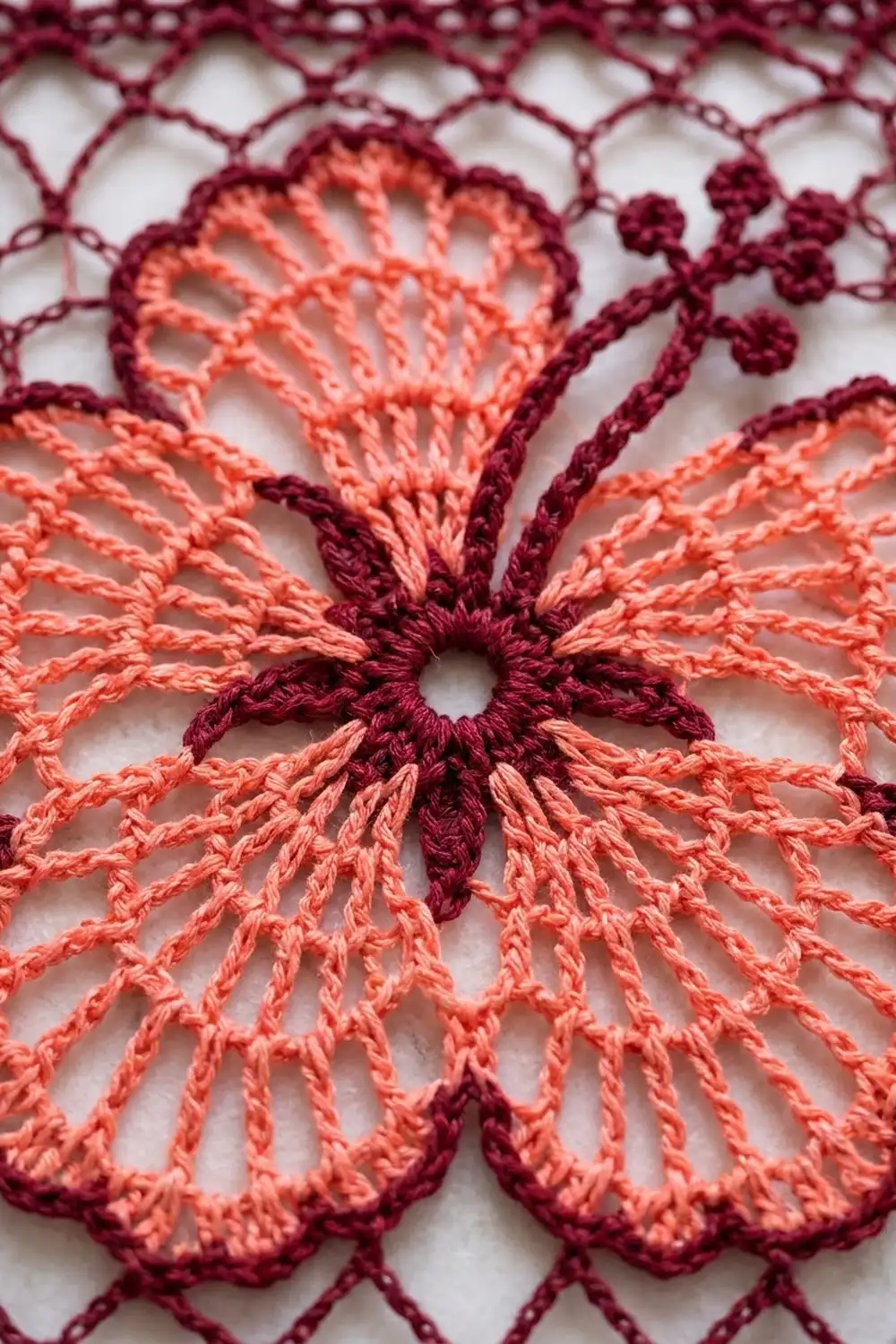
Hibiscus Block (make 6)
Flower Center (Color B)
Rnd 1: Make a magic ring. Ch 4 (counts as dc + ch 1), then work (dc, ch 1) 9 times in the ring. Join with a sl st in the 3rd ch of the beginning ch-4. Pull the ring closed, leaving a small open center. (10 dc, 10 ch-1 sps)
Rnd 2: Ch 1, sc in same st, sc in next ch-1 sp, sc in next dc, sc in next ch-1 sp; repeat from * around. Join. (20 sc)
Rnd 3 (conversion round): Ch 1, sc in next 3 sc, (sc, point, sc) in next sc; repeat from * 4 more times. Join. (20 sts worked 1 per st + 5 extra sc = 25 sc, plus 5 points)
Each point should lie flat and point outward. Fasten off B.
Petals (Color A)
Each petal sits on 5 sc: the sc just after a point, the 3 sc between points, and the sc just before the next point. The points stay free on the front.
Rnd 4: Join A with an sc in the sc just after any point. Ch 3, sk 1 sc, (dc, ch 3, dc) in next sc, ch 3, sk 1 sc, sc in next sc (before the point), sk the point, sc in next sc (after the point); repeat from * around, leaving off the last sc on the final repeat. Join to the first sc. (10 sc, 10 dc, 15 ch-3 sps; per petal: 2 sc, 2 dc, 3 ch-3 sps)
Rnd 5: Ch 1. Sc in first sc of petal, ch 1, (dc, ch 1) 2 times in next ch-3 sp, (dc, ch 1) in next dc, (dc, ch 1) 3 times in next ch-3 sp, (dc, ch 1) in next dc, (dc, ch 1) 2 times in next ch-3 sp, sc in next sc; repeat from * around. Join. (45 dc, 10 sc, 50 ch-1 sps; per petal: 9 dc, 2 sc, 10 ch-1 sps)
Rnd 6: Ch 1. Sc in first sc, ch 2, (tr, ch 2) in each of next 9 dc, sc in next sc; repeat from * around. Join. (45 tr, 10 sc, 50 ch-2 sps; per petal: 9 tr, 10 ch-2 sps)
The tr stitches spread out like the ribs of a fan.
Rnd 7: Ch 1. Sc in first sc, (ch 3, sc in next tr) 9 times, ch 3, sc in next sc; repeat from * around. Join. (55 sc, 50 ch-3 sps; per petal: 11 sc, 10 ch-3 sps) Fasten off A.
Petal Outline (Color B)
Rnd 8: Join B with an sc in the first sc of any petal. (3 sc in next ch-3 sp, sc in next sc) 10 times, sc in first sc of next petal; repeat from * around, leaving off the last sc on the final repeat. Join. (205 sc; 41 sc per petal)
The two sc that meet between petals form the notch that separates them. Checkpoint: 6 in (15.2 cm) from tip to tip.
Stamen (Color B)
Leave an 8 in (20.3 cm) tail and ch 22 for the stem. At the tip, work (ch 5, knob, sl st in each of the 4 ch back to the stem) 3 times. Sl st in the next 6 stem ch, then work (ch 4, knob, sl st in each of the 3 ch back) once. Sl st in the next 4 stem ch, then work (ch 4, knob, sl st in each of the 3 ch back) once. Sl st in each remaining stem ch. (5 knobs)
Sew the base of the stem to the center ring. Then sew the stem diagonally across the upper right petal, so the 3 tip knobs sit just inside the burgundy outline.
Squaring the Block (Color B)
Number the 41 sc of each petal from sc 1 to sc 41.
Rnd 9: Ch 1, sc in sc 1 of a petal. Ch 7, sk 9, sc in sc 11, ch 7, sk 9, sc in sc 21, ch 7, sk 9, sc in sc 31, ch 7, sk 10, sc in sc 1 of the next petal; repeat from * around, ending with a sl st in the first sc instead of the last sc. (20 sc, 20 ch-7 loops)
Rnd 10: Sl st in the first 3 ch of the next loop, which becomes a corner. Ch 5 (counts as dtr), ch 5, dtr in same loop. Ch 4, tr in next loop, ch 4, dc in next loop, ch 4, dc in next loop, ch 4, tr in next loop, ch 4, (dtr, ch 5, dtr) in next loop; repeat from * around, ending with ch 4, sl st in the top of the beginning ch-5. (8 dtr, 8 tr, 8 dc = 24 sts; 4 corner ch-5 sps, 20 ch-4 sps, 5 per side)
Rnd 11: Sl st in next 2 ch. Ch 1, (sc, ch 5, sc) in corner sp. (Ch 5, sc in next ch-4 sp) 5 times, ch 5, (sc, ch 5, sc) in next corner sp; repeat from * around, ending with ch 5, sl st in first sc. (28 sc; 24 side loops, 6 per side, plus 4 corner loops)
Rnd 12: Sl st in next 3 ch. Ch 1, (sc, ch 5, sc) in corner loop. (Ch 5, sc in next loop) 6 times, ch 5, (sc, ch 5, sc) in next corner loop; repeat from * around, ending with ch 5, sl st in first sc. (32 sc; 28 side loops, 7 per side, plus 4 corner loops)
Rnd 13: Sl st in next 2 ch. Ch 1, 3 sc in corner loop. 5 sc in each of the next 7 loops, 3 sc in next corner loop; repeat from * around, leaving off the last corner. Join. (152 sc)
The middle sc of each 3-sc corner group is the corner stitch. Count each side from corner st to corner st, including both corners: 1 + 1 + 35 + 1 + 1 = 39 sc. To check: 4 x 39 − 4 shared corners = 152. Fasten off and weave in ends.
Checkpoint: 8 x 8 in (20.3 x 20.3 cm).
Make All Pieces
- Make 6 hibiscus blocks in total.
- Color A per block: Rnds 4–7.
- Color B per block: Rnds 1–3, Rnds 8–13, and the stamen.
Layout for each panel (make 2):
[ Block 1 ]   top
[ Block 2 ]
[ Block 3 ]   bottom
Turn every block the same way, with the stamen in the upper right, so both panels match.
Joining
Join the blocks with B using a slip stitch seam:
- Hold Block 1 and Block 2 with right sides together, lining up the bottom edge of Block 1 with the top edge of Block 2.
- Starting at the corner sts, insert the hook through both loops of both layers. Sl st in each st across, matching stitch to stitch. (39 sl sts)
- Fasten off. Join Block 3 below Block 2 the same way.
Each seam uses exactly 39 sl sts from corner to corner, so no stitches are added or lost. Keep your tension the same as for your sc. A tight seam puckers, and a loose one leaves gaps.
Checkpoint: each joined strip measures 8 x 24 in (20.3 x 61.0 cm).
Border
Border gauge: the same as the block edge, 39 sc = 8 in (20.3 cm). That means 117 sc fit along a 24 in (61.0 cm) long side.
Starting counts:
- Long sides: 3 blocks x 39 sts = 117 sts.
- Short sides: 1 block x 39 sts = 39 sts.
Each side count already includes that side’s 2 outer corner sts. The block corners at the seams count as ordinary edge stitches.
Rnd 1 (conversion round): With the right side facing, join B in the top right corner st. Ch 1, then work (sc, ch 2, sc) in each of the 4 outer corner sts and sc in every other edge st. Join. (308 sts worked 1 per st + 4 extra sc = 312 sc, plus 4 corner ch-2 sps)
Counted per side, including the sc on each side of the corners:
- Long sides: 117 sc each.
- Short sides: 39 sc each.
Rnd 2 (mesh): Sl st in the first sc of a long side. Ch 1, sc in same sc. (Ch 3, sk 1, sc in next sc) 58 times, ending in the last sc of the side. Ch 5, sk corner sp, sc in first sc of next side, (ch 3, sk 1, sc in next sc) 19 times. Ch 5, sk corner sp, sc in first sc of next side; repeat from * once, ending with a sl st in the first sc. (158 sc; 58 ch-3 loops per long side, 19 per short side, plus 4 corner ch-5 loops)
Rnd 3 (edging): Sl st in the first ch-3 loop. Ch 1.
- Long sides: (sc, ch 3, sc) in each of the 58 loops.
- Corners: (2 sc, ch 3, 2 sc) in each corner loop.
- Short sides: sc in loop 1, fan in next loop, sc in next loop; repeat from * across, ending with an sc in loop 19.
Join and fasten off. (Long sides: 58 picot loops each. Short sides: 10 sc + 9 fans each. Corners: 4 sc + ch-3 each.)
Why the math works: a mesh row that starts with an sc and then repeats (ch 3, sk 1, sc) needs an odd number of stitches: 1 + (2 x the number of loops). Both sides fit, since 117 = 1 + 2 x 58 and 39 = 1 + 2 x 19. The 19 short-side loops alternate sc and fan, which gives 9 centered fans with an sc at each end. The border adds 1 in (2.5 cm) on every side, so the finished panel is 10 x 26 in (25.4 x 66.0 cm).
Final Blocking
- Weave in every end along stitches of the same color.
- Soak the panel in cool water for 10 minutes. Roll it in a towel and press out the water. Don’t wring it.
- Lay the panel right side up on the mats and pin it to 10 x 26 in (25.4 x 66.0 cm).
- Pin out each corner loop, each fan tip, and each petal so the outlines curve cleanly.
- Set the stamen knobs in place and spray them lightly.
- Let the panel dry completely, about 24 hours, before you unpin it.
- To hang a panel, weave the curtain rod over and under every 2 loops of Border Rnd 2 along the top edge.
Final Quality-Control Checklist
- [ ] Each block has 39 sc per side and 152 sc in total.
- [ ] Each block measures 8 x 8 in (20.3 x 20.3 cm).
- [ ] Every stamen sits in the upper right of its block.
- [ ] Each seam has 39 sl sts and lies flat.
- [ ] Border Rnd 1 has 117 / 39 / 117 / 39 sc per side.
- [ ] Border Rnd 2 has 58 / 19 / 58 / 19 loops per side.
- [ ] Both panels measure 10 x 26 in (25.4 x 66.0 cm).
- [ ] All ends are woven in securely.
Troubleshooting
- Petals cup upward: your tr stitches are too short or your chains are too tight. Loosen the ch-2 spaces in Rnd 6.
- Petals ruffle: your chains are too loose. Go down a hook size for Rnds 6–7.
- Block won’t square up: recount Rnd 10. The corners need dtr stitches and the middle of each side needs dc stitches.
- Mesh sags: your ch-5 loops are uneven. Make them the same size and block firmly.
- Panel is too narrow or too short: check that each block measures 8 in (20.3 cm) before joining. Small differences add up over 3 blocks.
- Fans flare: work the fans more tightly, or go down a hook size for Border Rnd 3 only.
Care
Hand wash in cool water with mild soap and lay flat to dry. If the lace relaxes over time, pin it back to 10 x 26 in (25.4 x 66.0 cm).
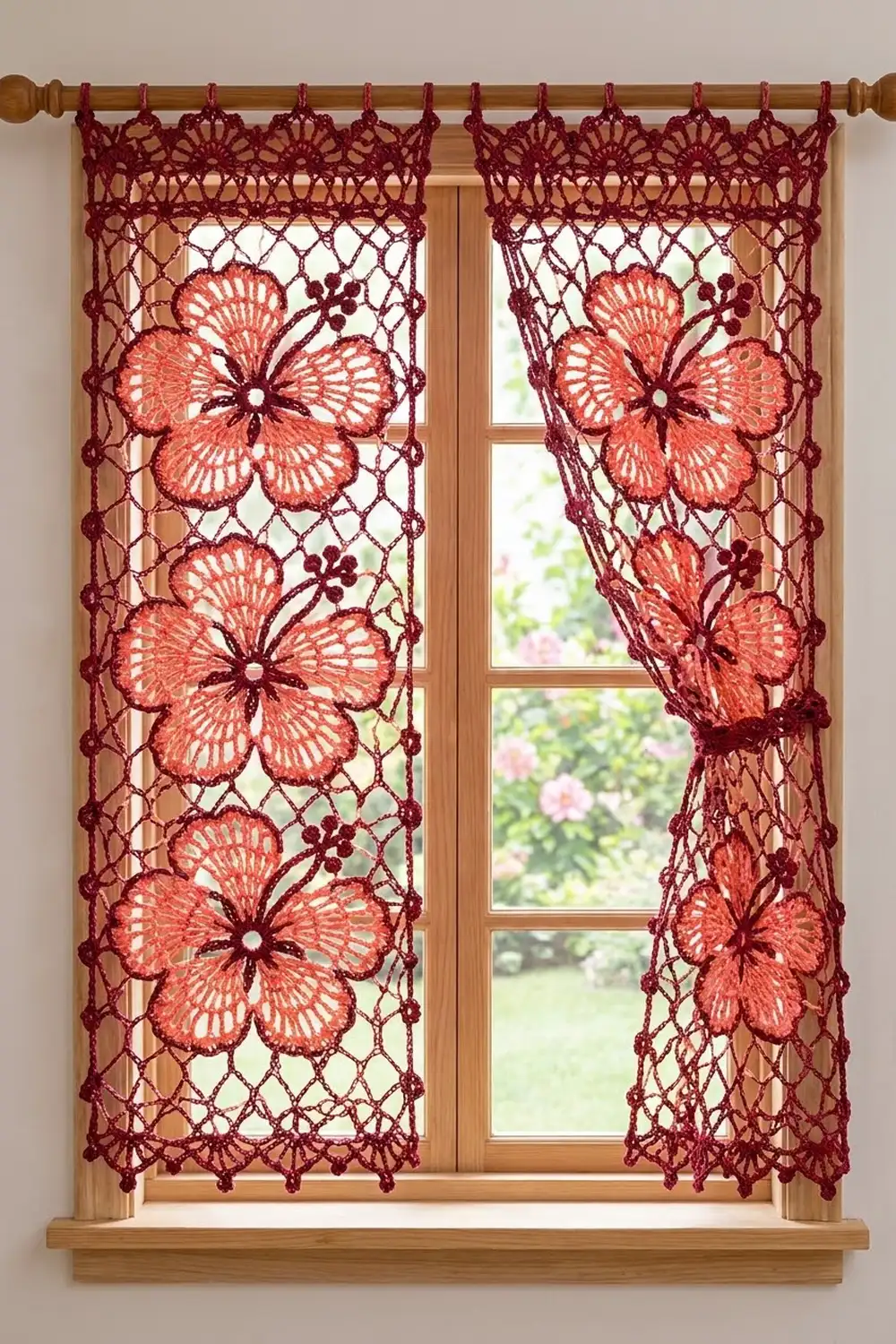
Final Notes
Here’s how the measurements build from the center out:
- Flower center: 1.75 in (4.4 cm)
- Outlined flower: 6 in (15.2 cm)
- Squared block: 8 in (20.3 cm), with 39 sc per side
- Three-block strip: 8 x 24 in (20.3 x 61.0 cm), with 117 sts on each long side
- Bordered panel: 10 x 26 in (25.4 x 66.0 cm)
If each stage matches its checkpoint, both panels will hang straight and match each other.
Happy crocheting!