
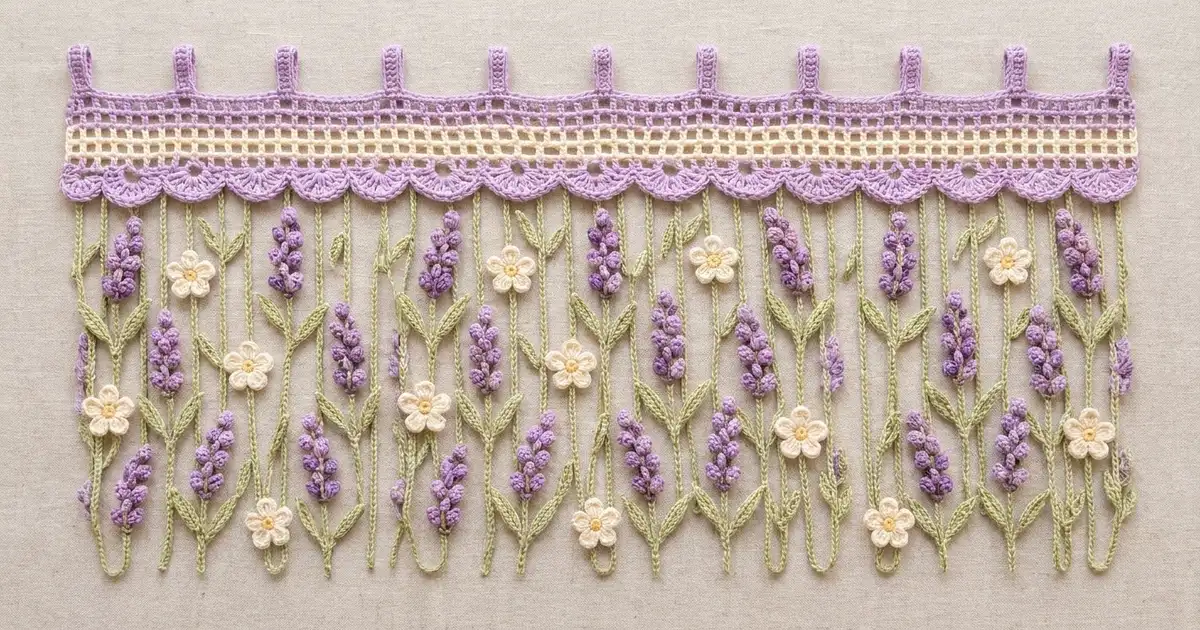
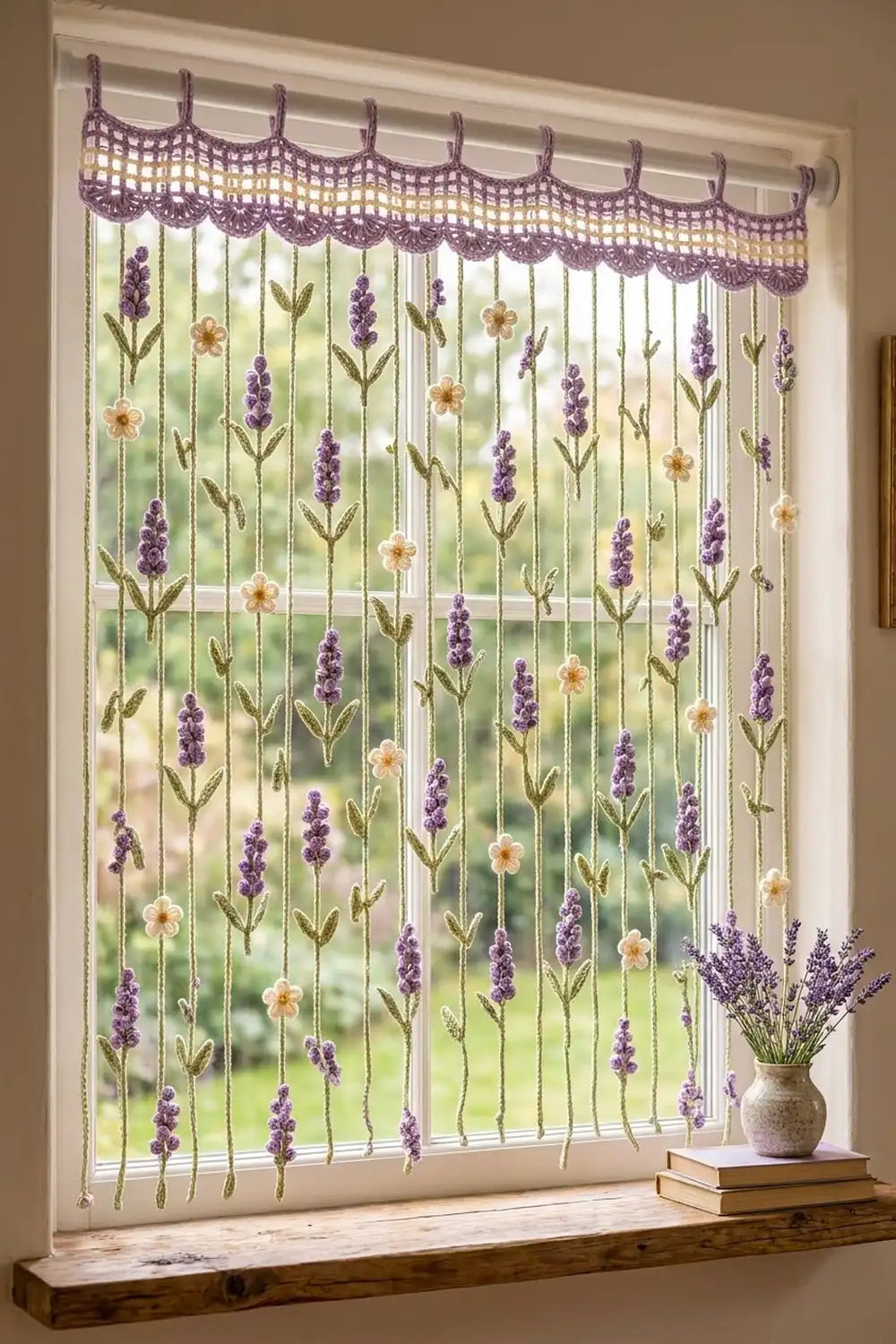
This curtain looks like a row of lavender stems in front of a window. It has a lacy filet header with lavender and cream mesh and a soft scalloped lower edge. Sage-green cords hang from the header and carry bobble lavender spikes, pointed leaves, and small cream daisies with pale-yellow centers.
The colors are calm and cottage-style: lavender, sage, cream, and a little butter yellow. Light shows through the open mesh and between the cords, so the curtain decorates a window without blocking it.
The pattern uses US crochet terms. The finished curtain is 36 in (91.4 cm) wide and 47.5 in (120.7 cm) long from the top of the header to the ends of the cords. The hanging tabs add another 1.5 in (3.8 cm) above that.
You work the header flat in rows, add the scallop edge and the tabs, and then chain the cords directly off the scallops. You make the lavender spikes, leaves, and daisies separately and sew them on last.
Finished Size and Construction
- Finished size: 36 in (91.4 cm) wide × 47.5 in (120.7 cm) long, plus 1.5 in (3.8 cm) tabs
- Skill level: Intermediate
- Terminology: US crochet terms
- Yarn weight: DK (light worsted, #3) cotton or cotton blend
- Hook: 4.0 mm (US G-6)
- Number of pieces: 1 header band with 30 cords worked onto it, plus 60 lavender spikes, 120 leaves, and 15 daisies sewn on
- Layout: one header across the top, with 30 cords hanging from it at 1.2 in (3.0 cm) intervals
- Header size: 36 in (91.4 cm) × 3.5 in (8.9 cm)
- Size before border: 36 in (91.4 cm) × 2.75 in (7.0 cm), measured after Row 6
- Border depth: scallops add 0.75 in (1.9 cm) at the bottom; tabs add 1.5 in (3.8 cm) at the top
Materials
Use a smooth, mercerized or matte cotton in DK weight. Cotton keeps the mesh crisp and the cords straight, and it doesn’t fade much in sunlight. Avoid fuzzy yarns, because they hide the bobbles and make the cords look messy.
- Lavender: 150 g / 360 m (header, scallops, tabs, lavender spikes)
- Sage green: 200 g / 480 m (cords, leaves)
- Cream: 50 g / 120 m (2 header mesh rows, daisy petals)
- Pale yellow: 10 g / 24 m (daisy centers)
Tools:
– 4.0 mm (US G-6) crochet hook
– Tapestry needle
– Scissors
– Stitch markers (at least 30)
– Measuring tape
– Blocking mats and rust-proof pins
– Spray bottle
All quantities include a margin of about 20% for a test swatch and small differences in tension.
Abbreviations (US Terms)
- ch – chain
- sl st – slip stitch
- sc – single crochet
- hdc – half double crochet
- dc – double crochet
- sk – skip
- sp – space
- st(s) – stitch(es)
- bb – bobble
Special stitch – bobble (bb): (Yarn over, insert hook in the stitch, yarn over and pull up a loop, yarn over and pull through 2 loops) 3 times in the same stitch. Then yarn over and pull through all 4 loops on the hook.
Filet mesh: each mesh square is 1 dc + ch 1. The ch 1 skips 1 stitch from the row below.
Gauge and Checkpoints
Gauge: 10 mesh squares (20 sts) = 4 in (10.2 cm) wide, and 4 mesh rows = 2 in (5.1 cm) tall. Single crochet works to the same gauge: 5 sc = 1 in (2.5 cm). For the chain: 9 ch = 2 in (5.1 cm), measured relaxed.
Test one piece first. Before you start the header, make one lavender spike, one leaf, and one daisy.
– The spike should be 1.75 in (4.4 cm) long.
– The leaf should be 1.5 in (3.8 cm) long.
– The daisy should be 1.75 in (4.4 cm) across.
Then make a mesh swatch 12 squares wide and 6 rows tall.
Checkpoints:
– After Row 1: 36 in (91.4 cm) wide.
– After Row 2: 0.75 in (1.9 cm) tall.
– After Row 5: 2.25 in (5.7 cm) tall.
– After Row 6: 2.75 in (7.0 cm) tall.
– After Row 7: 3.5 in (8.9 cm) tall, with each scallop 1.2 in (3.0 cm) wide.
Too big? Go down 0.5 mm in hook size. Too small? Go up 0.5 mm. Always change the hook, not the stitch counts, because the scallop and cord spacing depends on the 181-stitch width.
Header Band
Start with lavender.
Foundation: Ch 182.
Row 1 (lavender): Sc in the 2nd ch from the hook and in each ch across. Turn. (181 sc)
Row 2 (lavender): Ch 4 (counts as dc + ch 1). Sk next sc, dc in next sc. Ch 1, sk next sc, dc in next sc; repeat from * across. Fasten off and turn. (91 dc + 90 ch-1 sps = 181 sts; 90 mesh squares)
Row 3 (cream): Join cream in the first dc. Ch 4 (counts as dc + ch 1), dc in next dc. Ch 1, dc in next dc; repeat from * across, ending with dc in the 3rd ch of the turning ch. Turn. (181 sts; 90 squares)
Row 4 (cream): Repeat Row 3. Fasten off cream. (181 sts; 90 squares)
Row 5 (lavender): Join lavender and repeat Row 3. Turn. (181 sts; 90 squares)
Row 6 (lavender, solid row): Ch 3 (counts as dc). Dc in next ch-1 sp, dc in next dc; repeat from * across, ending in the 3rd ch of the turning ch. Turn. (91 dc worked in dc + 90 dc worked in ch-1 sps = 181 dc)
The header now measures 36 in (91.4 cm) × 2.75 in (7.0 cm).
Border: Scallop Edge, Side Edges, and Tabs
Border gauge: each scallop uses 6 stitches of Row 6, so each scallop is 1.2 in (3.0 cm) wide. Each tab is placed every 15 stitches, which is 3 in (7.6 cm).
Row 7 – Scallops (lavender, bottom edge): Ch 1, sc in the first dc. Sk 2 dc, 7 dc in next dc, sk 2 dc, sc in next dc; repeat from * 29 more times. Do not fasten off. (30 scallops: 30 × 7 dc = 210 dc, plus 31 sc = 241 sts)
Why the math works: Each repeat uses 6 stitches of Row 6. 30 repeats use 180 stitches, and the first sc uses 1 more, for a total of 181. The edge therefore ends exactly on the last stitch. The 4th dc of each 7-dc fan is the scallop tip, and you’ll attach the cords there.
Side edges (lavender): Continue with the same loop. Ch 1 and turn the work 90 degrees to work up the short side toward the top corner.
– Work 2 sc around the post of each dc row-end (Rows 6, 5, 4, 3, 2).
– Work 1 sc in the row-end of Row 1.
That gives 11 sc on the short side. The scallop’s end sc already covers the corner, so don’t add an extra corner stitch.
Top edge with tabs: Work across the free loops of the foundation chain.
– Sl st in the first loop, then make a tab.
– Sl st in each of the next 15 loops. The 15th sl st is the next tab position; make a tab there. Repeat from * 11 more times. The last tab falls on the 181st loop.
– Totals: 181 sl st and 13 tabs. 12 gaps × 15 = 180, plus the first stitch = 181.
Tab: Ch 16 and sl st into the same loop to form a ring. Work 20 sc into the ring, then sl st into the same foundation loop. Each tab holds a rod up to 1 in (2.5 cm) in diameter.
Second side edge: After the last tab, ch 1 and work down the second short side with 11 sc, as for the first side. Sl st to the first sc of Row 7 and fasten off.
Make All Pieces
Lavender spike (make 60, lavender):
1. Ch 8, leaving a 10 in (25.4 cm) tail.
2. Side A: Bb in the 2nd ch from the hook (this is the tip). Sl st in next ch, bb in next ch; repeat from * 2 more times. (4 bb, 3 sl st)
3. Side B: Ch 1 and rotate to work along the free loops of the chain. Bb in next ch, sl st in next ch; repeat from * 2 more times. (3 bb, 3 sl st)
4. Sl st into the top of the tip bobble. (7 bb in total)
5. Fasten off. The spike measures 1.75 in (4.4 cm) × 0.75 in (1.9 cm).
The bobbles are staggered from side to side, which gives the bumpy, clustered look of real lavender.
Leaf (make 120, sage green):
1. Ch 8.
2. First side: Sc in the 2nd ch from the hook, then hdc, dc, dc, hdc, sc in the next ch, and sl st in the last ch. (7 sts)
3. Second side: Ch 1 and rotate to work along the opposite side of the chain. Work sc, hdc, dc, dc, hdc, sc, sl st. (7 sts)
4. Fasten off, leaving a 6 in (15.2 cm) tail.
The leaf is pointed at both ends and measures 1.5 in (3.8 cm) × 0.5 in (1.3 cm).
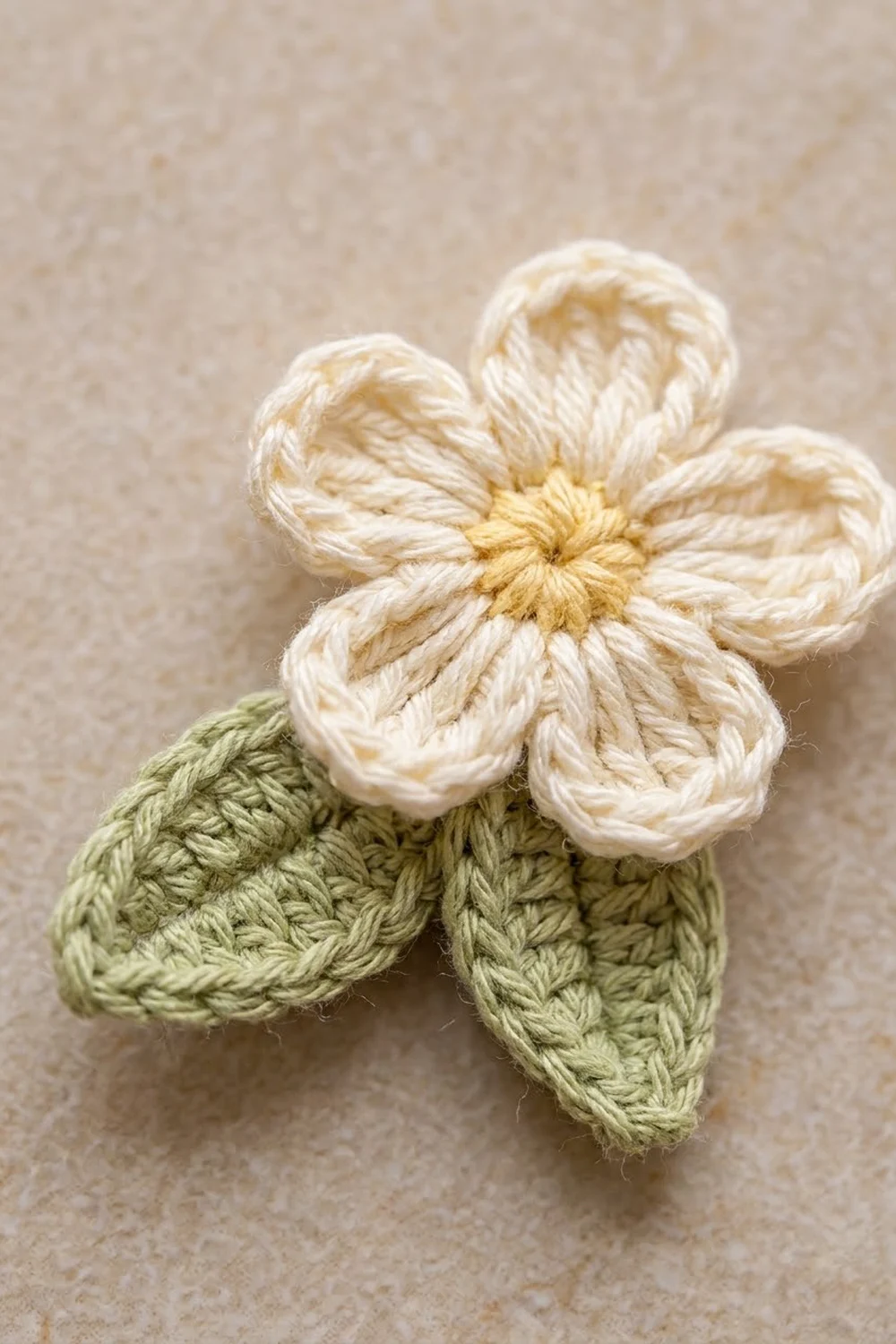
Daisy (make 15):
– Rnd 1 (pale yellow): Make a magic ring. Work 10 sc in the ring and sl st to join. Fasten off. (10 sc)
– Rnd 2 (cream): Join cream in any sc. Ch 2, 2 dc in same sc, 2 dc in next sc, ch 2, sl st in same sc, sl st in next sc; repeat from * 4 more times. (5 petals of 4 dc each = 20 dc)
The last sl st lands in the joining sc. Fasten off, leaving a 10 in (25.4 cm) tail. The daisy measures 1.75 in (4.4 cm) across.
Quantities per color:
– Lavender: 60 spikes
– Sage: 120 leaves and 30 cords
– Cream and yellow: 15 daisies
Layout grid. Measure each position from the top of the cord, just below the scallop. S = spike, L = leaf pair, D = daisy.
Cord:      1    2    3    4    5   ...   29   30
 8 in      S+L  .    S+L  .    S+L ...   S+L  .
14 in      .    S+L  .    S+L  .   ...   .    S+L
20 in      D    .    D    .    D   ...   D    .
32 in      S+L  .    S+L  .    S+L ...   S+L  .
38 in      .    S+L  .    S+L  .   ...   .    S+L
The heights in cm are:
– 8 in = 20.3 cm
– 14 in = 35.6 cm
– 20 in = 50.8 cm
– 32 in = 81.3 cm
– 38 in = 96.5 cm
Odd-numbered cords carry 2 spikes, 2 leaf pairs, and 1 daisy. Even-numbered cords carry 2 spikes and 2 leaf pairs.
Joining: Cords and Appliqués
Cords (sage green, worked directly on the header):
1. With the right side facing, join sage with a sl st in the 4th dc (the tip) of the first scallop.
2. Ch 198, which is 44 in (111.8 cm) at 4.5 ch per inch (2.5 cm).
3. Sl st in the back bump of the 2nd ch from the hook and in each back bump up the chain. (197 sl st)
4. Sl st into the same scallop tip. Fasten off and weave in the ends.
5. Repeat at the tip of each of the remaining 29 scallops. (30 cords, 1.2 in / 3.0 cm apart)
The first cord sits 0.6 in (1.5 cm) in from the edge. That’s because the first scallop tip is the 4th stitch of Row 6.
Tension: Keep the slip stitches loose enough that the cord doesn’t pucker. Tight slip stitches will shorten the cord. After you finish each cord, hang it and check that it measures 44 in (111.8 cm).
Appliqués: Place the pieces using the layout grid.
1. Sew each spike so its base sits on the cord and its tip points up.
2. Sew one leaf on each side of the cord, 1 in (2.5 cm) below the spike base, angled upward in a V.
3. Sew each daisy flat on the cord through the yellow center.
4. Use the yarn tails and small running stitches. Go through the cord’s back bumps so nothing shows from the front.
Size checkpoint: Hang the curtain. It should measure 36 in (91.4 cm) wide and 47.5 in (120.7 cm) from the top of the header to the ends of the cords.
Final Blocking
- Weave in all remaining ends, then lay the curtain flat, right side up, on the blocking mats.
- Pin the header to 36 in (91.4 cm) × 3.5 in (8.9 cm). Put one pin in each scallop tip and one at each tab base.
- Straighten the mesh so that every square is square.
- Lay each cord straight down, 1.2 in (3.0 cm) apart. Pin the end of each cord at 44 in (111.8 cm).
- Shape the leaves into points, open the daisy petals, and pinch the bobbles into rounded shapes.
- Spray until damp, not soaked.
- Let it dry completely, at least 24 hours, before you unpin it.
Final Quality-Control Checklist
- Header has 90 mesh squares in each of Rows 2–5.
- Row 6 has 181 dc.
- Row 7 has 30 scallops and 241 sts.
- Each short side has 11 sc.
- There are 13 tabs, 3 in (7.6 cm) apart.
- There are 30 cords, each 44 in (111.8 cm) long.
- 60 spikes, 120 leaves, and 15 daisies are attached as shown in the grid.
- No tails, knots, or stitches show from the front.
- Finished size is 36 in (91.4 cm) × 47.5 in (120.7 cm).
Troubleshooting
- Mesh squares lean or look rectangular: Your ch-1s are too tight. Loosen the chains, or go up a hook size.
- Last scallop doesn’t fit: Recount Row 6; it must have 181 dc.
- Header ripples: Row 6 has extra stitches. Work exactly 1 dc per ch-1 sp.
- Cords curl into spirals: Block them with a steamed, pinned stretch, or loosen your slip stitches.
- Cords are different lengths: Frog the long cords and redo them, or trim back to 44 in (111.8 cm) and secure the end.
- Bobbles look flat: Close every bobble firmly, and make sure a sl st locks each one.
- Daisy cups: Loosen the ch-2s at the base of the petals.
Care
Hand wash in cool water with mild soap. Press out the water in a towel, then lay the curtain flat and pin it back to size to dry. Don’t wring or hang it while it’s wet; the weight of the water will stretch the cords.
Final Notes
Every measurement in this pattern builds on the one before it:
– 20 sts = 4 in (10.2 cm), so 181 sts make a 36 in (91.4 cm) header.
– 181 sts divide into 30 scallops of 6 sts, each 1.2 in (3.0 cm) wide.
– 30 scallop tips give 30 evenly spaced cords.
– 198 ch make each cord 44 in (111.8 cm) long.
– A 3.5 in (8.9 cm) header plus 44 in (111.8 cm) cords gives the finished 47.5 in (120.7 cm) length.
Check your gauge at the start, check each checkpoint as you go, and the curtain will hang straight.
Happy crocheting!