
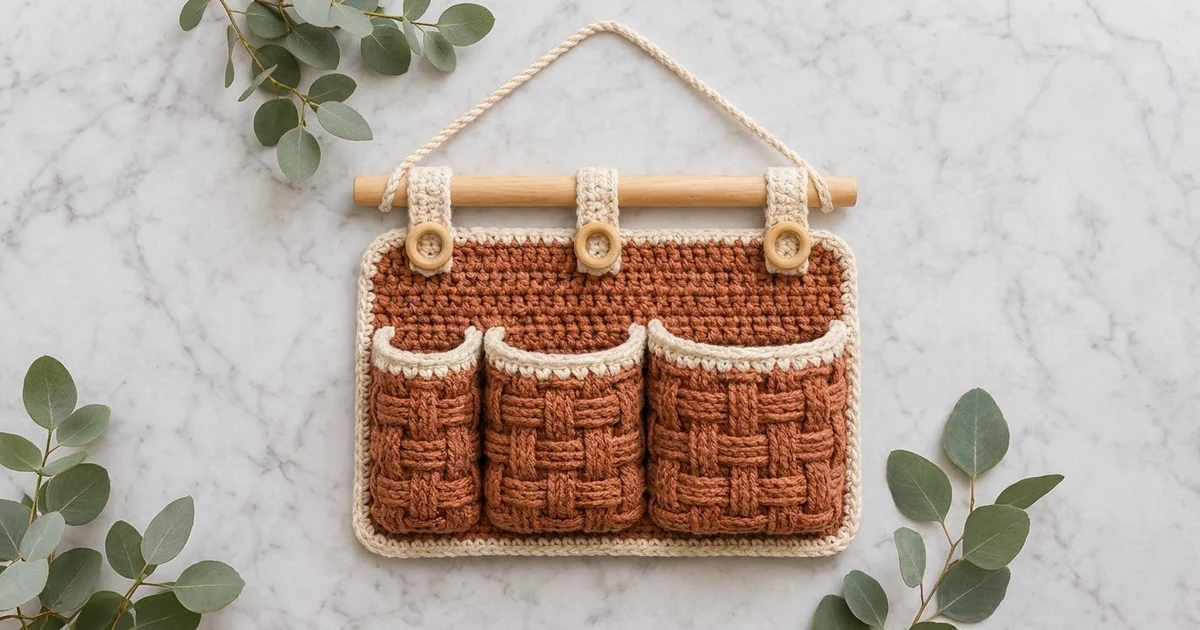
This wall organizer pairs a smooth terracotta back panel with three raised basketweave pockets. Cream rims and a cream border outline every edge. Three cream tabs with wooden rings hold it on a wooden dowel, and a twisted cord hangs it from a hook or peg.
The palette is warm and earthy, with terracotta for the body and cream for the trim. The style is rustic and modern, so it fits an entryway, potting bench, craft corner, or nursery wall. The pockets come in three widths (small, medium, large), so tall tools, flat items, and bulky spools can all fit side by side.
This pattern uses US crochet terms. The finished panel measures 15.5 x 9.5 in (39.4 x 24.1 cm), not counting the dowel and hanging cord.
The construction is simple. You work the back panel in rows of single crochet, then add one terracotta edging round. Each pocket starts as an oval base worked in rounds. Its walls rise in basketweave post stitches, and a cream rim finishes the top. Three small strips become hanging tabs. Finally, you sew the pockets on, add two cream border rounds, and attach the tabs, dowel, and cord.
Finished Size and Construction
- Finished panel size: 15.5 x 9.5 in (39.4 x 24.1 cm)
- Skill level: Intermediate (post stitches, rounds, seaming)
- Terminology: US
- Yarn weight: Worsted (#4)
- Hook: 5 mm (H-8)
- Number of pieces: 7 (1 back panel, 3 pockets, 3 tabs)
- Layout: 3 pockets in one row across the lower panel; 3 tabs along the top edge
- Back panel before edging: 14 x 8 in (35.6 x 20.3 cm)
- Size before cream border: 14.5 x 8.5 in (36.8 x 21.6 cm)
- Border depth: 0.5 in (1.3 cm) per edge
- Pocket flattened widths: 3 in (7.6 cm), 4 in (10.2 cm), 5 in (12.7 cm)
- Pocket height: 5.25 in (13.3 cm)
Materials
Yarn: Use a smooth worsted-weight cotton or cotton blend. Cotton keeps the basketweave texture crisp and stops the pockets from sagging. Avoid fuzzy or very stretchy yarns, because they blur the post stitches.
- Terracotta (Color A): 100 g, about 170 m (186 yd)
- Cream (Color B): 50 g, about 85 m (93 yd)
Both quantities include a margin of about 25 percent to cover the gauge test, seaming, and differences in tension.
Tools and hardware:
- 5 mm (H-8) crochet hook
- Tapestry needle
- Scissors and stitch markers
- Wooden dowel, 0.5 in (1.3 cm) diameter, 18 in (45.7 cm) long
- 3 wooden rings, 1.25 in (3.2 cm) outer diameter
- Cream cotton cord, 3–5 mm thick, 30 in (76.2 cm) long
- Blocking mat and rust-proof pins
Abbreviations (US Terms)
- ch – chain
- sl st – slip stitch
- sc – single crochet
- dc – double crochet
- BLO – back loop only
- FPdc – front post double crochet
- BPdc – back post double crochet
- st(s) – stitch(es)
- rep – repeat
- Rnd – round
FPdc: Yarn over and insert the hook from front to back to front around the post of the stitch below. Yarn over and pull up a loop, then (yarn over, pull through 2 loops) twice. The stitch is pushed toward you.
BPdc: Yarn over and insert the hook from back to front to back around the post of the stitch below, then finish like a regular dc. The stitch is pushed away from you.
Gauge and Checkpoints
- Single crochet (panel, border, tabs): 16 sc x 18 rows = 4 in (10.2 cm)
- Basketweave (pocket walls): 16 sts x 8 rnds = 4 in (10.2 cm)
Make the small pocket first. It’s the quickest piece, and it tests both gauges: sc in the base and basketweave in the walls. If it measures 3 in (7.6 cm) wide flattened and 5.25 in (13.3 cm) tall, your gauge is correct.
Checkpoints:
- Small pocket base after Rnd 2: about 3 x 1.25 in (7.6 x 3.2 cm)
- Small pocket after Rnd 12: about 4.75 in (12.1 cm) tall
- Back panel after Row 18: 14 in (35.6 cm) wide, 4 in (10.2 cm) tall
- Back panel after Row 36: 14 x 8 in (35.6 x 20.3 cm)
If your pieces are too big, go down 0.5 mm in hook size. If they’re too small, go up 0.5 mm. Width matters most, because the pocket widths have to add up to the panel width.
Back Panel
With Color A, ch 57.
Row 1: Sc in 2nd ch from hook and in each ch across. Turn. (56 sc)
Rows 2–36: Ch 1 (does not count as a st), sc in each st across. Turn. (56 sc)
Check: 14 x 8 in (35.6 x 20.3 cm). Don’t fasten off.
Edging Rnd 1 (trim round, Color A): Ch 1 and work around all four edges.
- Top: 2 sc in first st (corner), sc in next 54 sts, 2 sc in last st (corner). Count: 56 sts worked one-to-one + 2 extra = 58 sc.
- Left side: Working into the row ends, (sc in next 8 row ends, skip 1) 4 times. Count: 32 sc over 36 row ends.
- Bottom: Working into the opposite side of the foundation ch, 2 sc in first ch (corner), sc in next 54 ch, 2 sc in last ch (corner). Count: 56 + 2 extra = 58 sc.
- Right side: (Sc in next 8 row ends, skip 1) 4 times. (32 sc)
Join with sl st to the first sc. (180 sc: 58 + 32 + 58 + 32)
Fasten off. The panel now measures 14.5 x 8.5 in (36.8 x 21.6 cm).
Pockets (Make 3)
All three pockets have the same structure. Only the starting chain and the stitch counts change.
| Starting ch | Rnd 1 | Rnd 2 onward | Flattened width | |
|---|---|---|---|---|
| Small | 9 | 18 | 24 | 3 in (7.6 cm) |
| Medium | 13 | 26 | 32 | 4 in (10.2 cm) |
| Large | 17 | 34 | 40 | 5 in (12.7 cm) |
Below, n means the starting chain minus 1: 8 (small), 12 (medium), or 16 (large).
Oval Base
With Color A, ch (n + 1).
Rnd 1: Sc in 2nd ch from hook, sc in next (n − 2) ch, 3 sc in last ch. Working along the opposite side of the foundation, sc in next (n − 2) ch, 2 sc in last ch (the same ch as the first sc). Join with sl st to the first sc. (2n + 2 sts: 18 / 26 / 34)
Rnd 2 (growth): Ch 1, 2 sc in first st, sc in next (n − 2) sts, 2 sc in each of next 3 sts, sc in next (n − 2) sts, 2 sc in each of last 2 sts. Join. (2n + 8 sts: 24 / 32 / 40)
Check: the bases are 3, 4, and 5 in (7.6, 10.2, and 12.7 cm) long and about 1.25 in (3.2 cm) wide.
Walls
Rnd 3 (turning ridge): Ch 1, sc in BLO of each st around. Join. (24 / 32 / 40) This ridge turns the work upward.
Rnd 4: Ch 2 (does not count as a st), dc in each st around. Join to the first dc. (24 / 32 / 40)
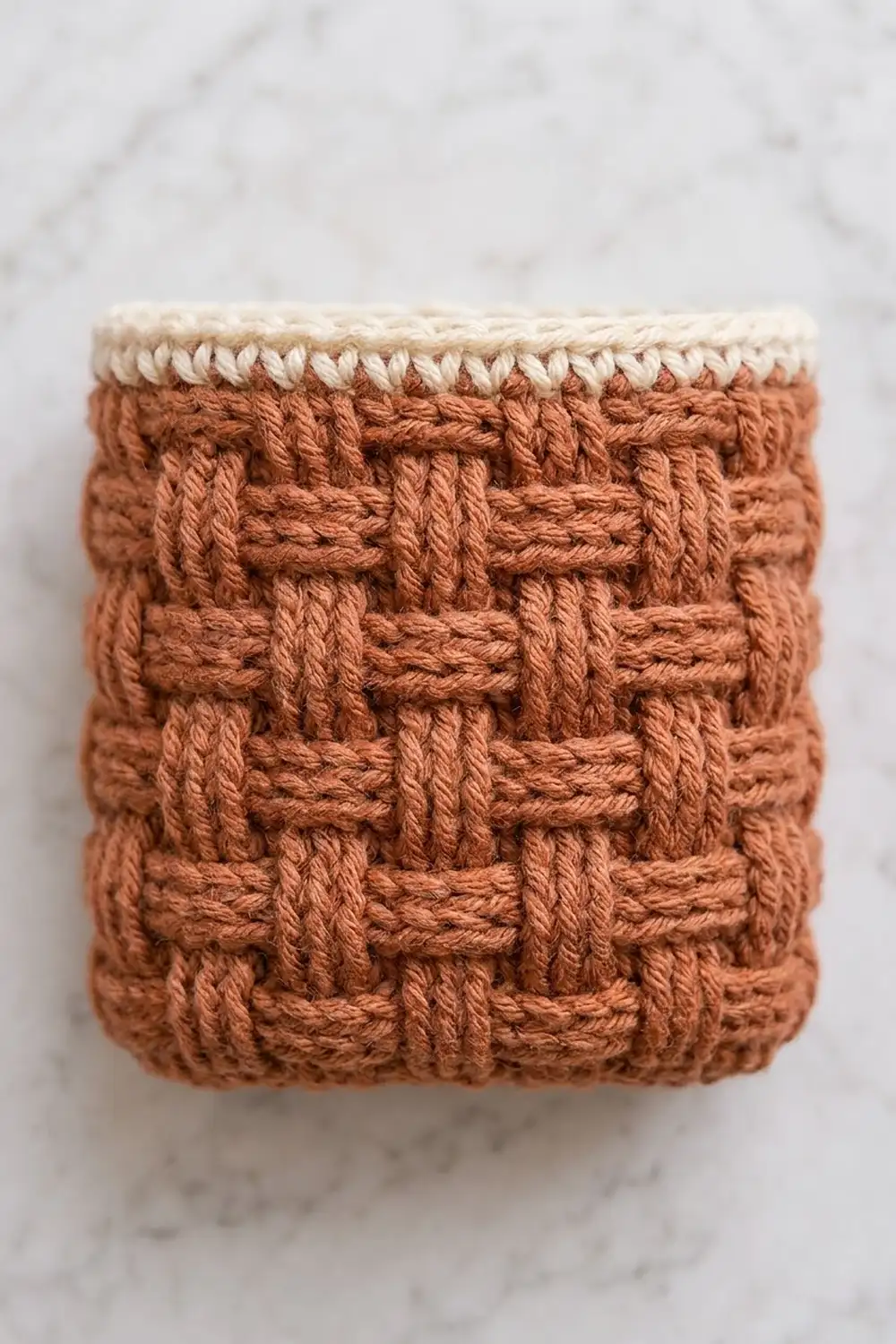
Rnds 5–6: Ch 2 (does not count), *FPdc around next 4 sts, BPdc around next 4 sts; rep from * around. Join to the first st. (24 / 32 / 40)
Rnds 7–8: Ch 2, *BPdc around next 4 sts, FPdc around next 4 sts; rep from * around. Join. (24 / 32 / 40)
Rnds 9–10: Rep Rnds 5–6.
Rnds 11–12: Rep Rnds 7–8.
Each block is 4 sts wide and 2 rnds tall, and the blocks alternate like a checkerboard. Every count is a multiple of 8, so each round ends on a complete repeat. Check: the walls are about 4.75 in (12.1 cm) tall. Fasten off Color A.
Cream Rim
Rnd 13: Join Color B in any st. Ch 1, sc in each st around. Join. (24 / 32 / 40)
Rnd 14: Ch 1, sc in each st around. Join. (24 / 32 / 40)
Fasten off and weave in the ends. Each pocket is 5.25 in (13.3 cm) tall.
Hanging Tabs (Make 3)
With Color B, ch 5.
Row 1: Sc in 2nd ch from hook and in each ch across. Turn. (4 sc)
Rows 2–18: Ch 1, sc in each st across. Turn. (4 sc)
Fasten off, leaving a 12 in (30.5 cm) tail for sewing. Each tab measures 1 x 4 in (2.5 x 10.2 cm).
Make All Pieces
- Color A: 1 back panel with edging Rnd 1, and 3 pocket bodies (Rnds 1–12)
- Color B: 3 pocket rims (Rnds 13–14), 3 tabs, and the panel border (worked after joining)
Layout across the panel’s 56 stitches (left to right):
Tabs:      [T]               [T]                  [T]
          +--------------------------------------------+
          |             open upper panel               |
          |  [SMALL]  [ MEDIUM ]  [    LARGE    ]      |
          +--------------------------------------------+
Sts:      2 |  12  | 2 |   16   | 2 |     20     | 2
Margin 2 + small 12 + gap 2 + medium 16 + gap 2 + large 20 + margin 2 = 56 sts, which matches the panel width exactly.
Joining
Lay the panel right side up with the foundation edge toward you. Mark these stitches on Row 3:
- Small pocket: sts 3–14 (12 sts)
- Medium pocket: sts 17–32 (16 sts)
- Large pocket: sts 35–54 (20 sts)
Stitch-to-stitch logic: The back half of each pocket holds exactly half of its round count: 12, 16, or 20 sts. The pockets and the panel are both worked at 4 sts per inch, so each back half matches its marked panel stitches one-to-one.
- Flatten each pocket so the round joins sit at the back.
- With Color A, whipstitch the back half of Rnd 3 to the marked stitches on Row 3, one pocket stitch to one panel stitch.
- Whipstitch up both side folds of the pocket to the base of the rim.
- Tack the back half of rim Rnd 14 to the panel one-to-one. It lands near Row 27.
Tension: Keep the sewing snug but not tight, because pulling too hard puckers the panel. Take small bites so the yarn stays hidden.
Checkpoint: The panel still lies flat at 14.5 x 8.5 in (36.8 x 21.6 cm). The gaps between pockets and the margin at each side are 0.5 in (1.3 cm).
Tabs: Fold one tab over the dowel. Sew its back end to the back of the top edge and its front end to the front. Center one tab on the panel, and center the other two 1.5 in (3.8 cm) in from each side. Sew them on after the border is done. Tack a ring flat to the front of each tab, wrapping cream yarn over the edge of the ring. Tie the cord around each end of the dowel just outside the outer tabs.
Border
Border gauge: 16 sc = 4 in (10.2 cm). Each sc round adds about 0.25 in (0.6 cm) to each edge.
Counting rule: In this border, corner stitches are counted separately from the side counts. A corner group is the set of stitches worked at a corner, and the side counts are the stitches between the corner groups. After edging Rnd 1, each corner group is 2 sc. The top and bottom each have 54 sts between corners, and the sides each have 32: (4 x 2) + (2 x 54) + (2 x 32) = 180.
Border Rnd 2 (Color B): Join Color B in the first st of any corner group and ch 1. At each corner, work 2 sc in each of the 2 corner sts, so the corner group becomes 4 sts. Along the edges, sc in each st: 54 top, 32 side, 54 bottom, 32 side. Join. (188 sc: 16 + 108 + 64)
Border Rnd 3 (Color B): Ch 1. At each corner, sc in the 1st st, 2 sc in each of the next 2 sts, and sc in the 4th st, so the corner group becomes 6 sts. Along the edges, sc in each st (54 / 32 / 54 / 32). Join. (196 sc: 24 + 108 + 64)
Fasten off. The finished panel measures 15.5 x 9.5 in (39.4 x 24.1 cm).
Why the math works: Straight edges don’t need to grow, so their counts stay fixed. The 54 top sts and 32 side sts match the 4-sts-per-inch gauge over 13.5 in (34.3 cm) and 8 in (20.3 cm). Each corner adds 2 sts per round, 8 per round in total. That’s enough for a soft, rounded curve that lies flat without cupping or ruffling.
Final Blocking
- Lightly mist the piece. You can also spray-starch the pockets for extra structure.
- Pin the panel flat at 15.5 x 9.5 in (39.4 x 24.1 cm) and keep the edges straight.
- Fill each pocket with a folded towel so the walls stand upright and the oval bases open out.
- Use your fingers to nudge the basketweave blocks into even columns.
- Let everything dry completely, which takes about 24 hours.
- Attach the tabs, rings, dowel, and cord as described in Joining.
Final Quality-Control Checklist
- The panel measures 15.5 x 9.5 in (39.4 x 24.1 cm) and lies flat.
- The border corners curve evenly with no ripples.
- Each pocket wall shows 4 clean bands of blocks.
- The rims are level, and all three pockets are the same height.
- The gaps between pockets are equal at 0.5 in (1.3 cm).
- No seaming yarn shows on the front.
- The tabs are evenly spaced and the organizer hangs level.
- All tails are woven in securely.
Troubleshooting
The panel edges are wavy: Recount the edging to 32 sts per side.
The corners cup: Your border is too tight. Go up 0.5 mm for the border rounds only.
The basketweave looks flat: Insert the hook fully around each post, not through the top loops.
The blocks drift diagonally: Start each post round in the first stitch, not in the join.
The pockets sag forward: Tack the rims more firmly, or block them with starch.
The organizer hangs crooked: Adjust the cord knots until the dowel is level.
Care
Spot clean, or hand wash in cool water after removing the dowel and rings. Reshape and dry flat.

Final Notes
Here is the full chain of measurements. The 56-stitch panel measures 14 x 8 in (35.6 x 20.3 cm). The terracotta edging brings it to 14.5 x 8.5 in (36.8 x 21.6 cm), and the two cream rounds finish it at 15.5 x 9.5 in (39.4 x 24.1 cm). The pockets take up 12 + 16 + 20 panel stitches, and the margins and gaps fill the remaining 8 exactly. Check your gauge on the small pocket first, and every other piece will fit.
Happy crocheting!