

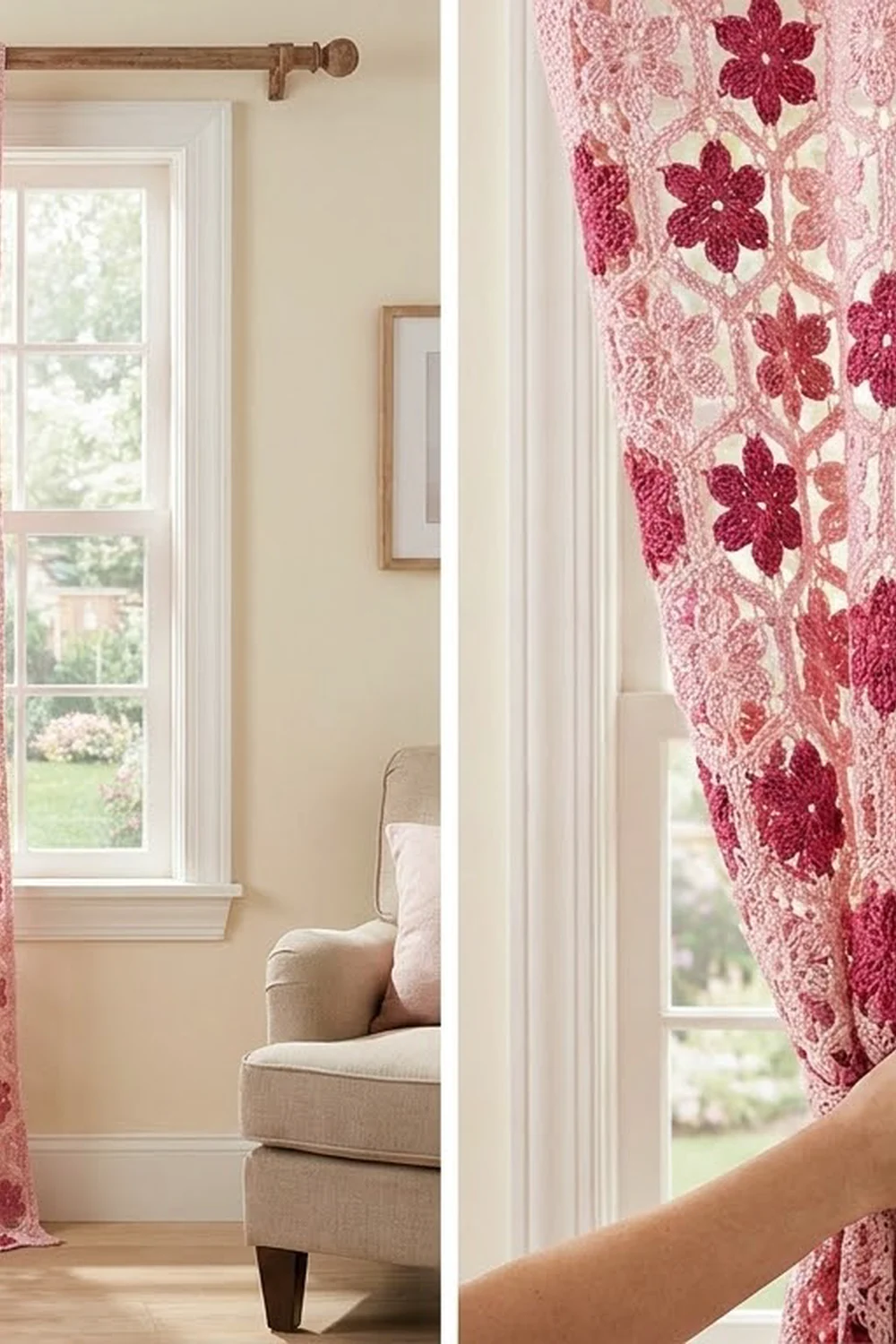
These lace curtains are made from small hexagon motifs. Each one holds a six-petal flower inside an airy pink frame. Raspberry and light pink flowers alternate across each panel, so the fabric looks like a scattered bloom print with light coming through.
The palette is two cotton shades. Deep raspberry is used for half of the flower centers. Soft light pink is used for everything else: the other flowers, all the frames, the half-hexagon edge fillers, the border, and the hanging tabs.
This pattern uses US crochet terms. After the border, each panel measures 27 x 70 in (68.6 x 177.8 cm) from point to point. It hangs about 73 in (185.4 cm) from the top of the tabs.
Construction is modular:
1. Crochet full hexagons in the round and half-hexagons in rows.
2. Sew them together in offset rows.
3. Add a two-round border.
4. Work tab loops along the top points.
Finished Size and Construction
- Finished panel size: 27 x 70 in (68.6 x 177.8 cm), point to point
- Hanging length with tabs: about 73 in (185.4 cm)
- Skill level: Intermediate
- Terminology: US
- Yarn weight: DK (#3) cotton
- Hook: 4.0 mm (US G-6)
- Number of pieces: 82 per panel (68 full hexagons and 14 half-hexagons), so 164 for the pair
- Layout per panel: 15 offset rows. Odd rows have 5 full hexagons. Even rows have 4 full hexagons with a half-hexagon at each end.
- Full motif size: 6 in (15.2 cm) point to point, 5.2 in (13.2 cm) flat to flat, 3 in (7.6 cm) per side
- Panel size before border: 26 x 69 in (66.0 x 175.3 cm)
- Border depth: 0.5 in (1.3 cm)
Materials
Use a smooth mercerized or combed DK cotton, about 120 m per 50 g. Cotton keeps the petals crisp and the lace lines clean, and it hangs without stretching.
- Light pink: 750 g / 1,800 m (fifteen 50 g balls)
- Raspberry: 200 g / 480 m (four 50 g balls)
These amounts are for both panels. They include about a 15% margin for gauge differences and seaming.
Tools:
– 4.0 mm (US G-6) crochet hook
– Tapestry needle
– Stitch markers
– Rustproof pins and a large blocking surface
– Spray bottle
– Measuring tape
Abbreviations (US Terms)
- ch: chain
- sl st: slip stitch
- sc: single crochet
- hdc: half double crochet
- dc: double crochet
- tr: treble crochet
- sk: skip
- sp: space
- sc2tog / sc3tog: single crochet 2 (or 3) together
- st(s): stitch(es)
Special stitch – Petal: Work (2 sc, 2 hdc, 3 dc, ch 2, 3 dc, 2 hdc, 2 sc) in the same sp. That’s 14 sts plus 1 ch-2 tip.
Gauge and Checkpoints
Base gauge: 20 sc = 4 in (10.2 cm), or 5 sc per inch.
Make and block one full hexagon and one half-hexagon before you commit to all 164 pieces.
- After Rnd 3 (flower): 3.5 in (8.9 cm) from one petal tip to the opposite tip
- After Rnd 5 (full motif): 6 in (15.2 cm) point to point and 5.2 in (13.2 cm) flat to flat
- Half-hexagon: 6 in (15.2 cm) along the straight edge
If your motif is too big, switch to a 3.75 mm hook. If it’s too small, switch to a 4.5 mm hook. Change the hook, not the stitch counts: every seam depends on 15 sc per side.
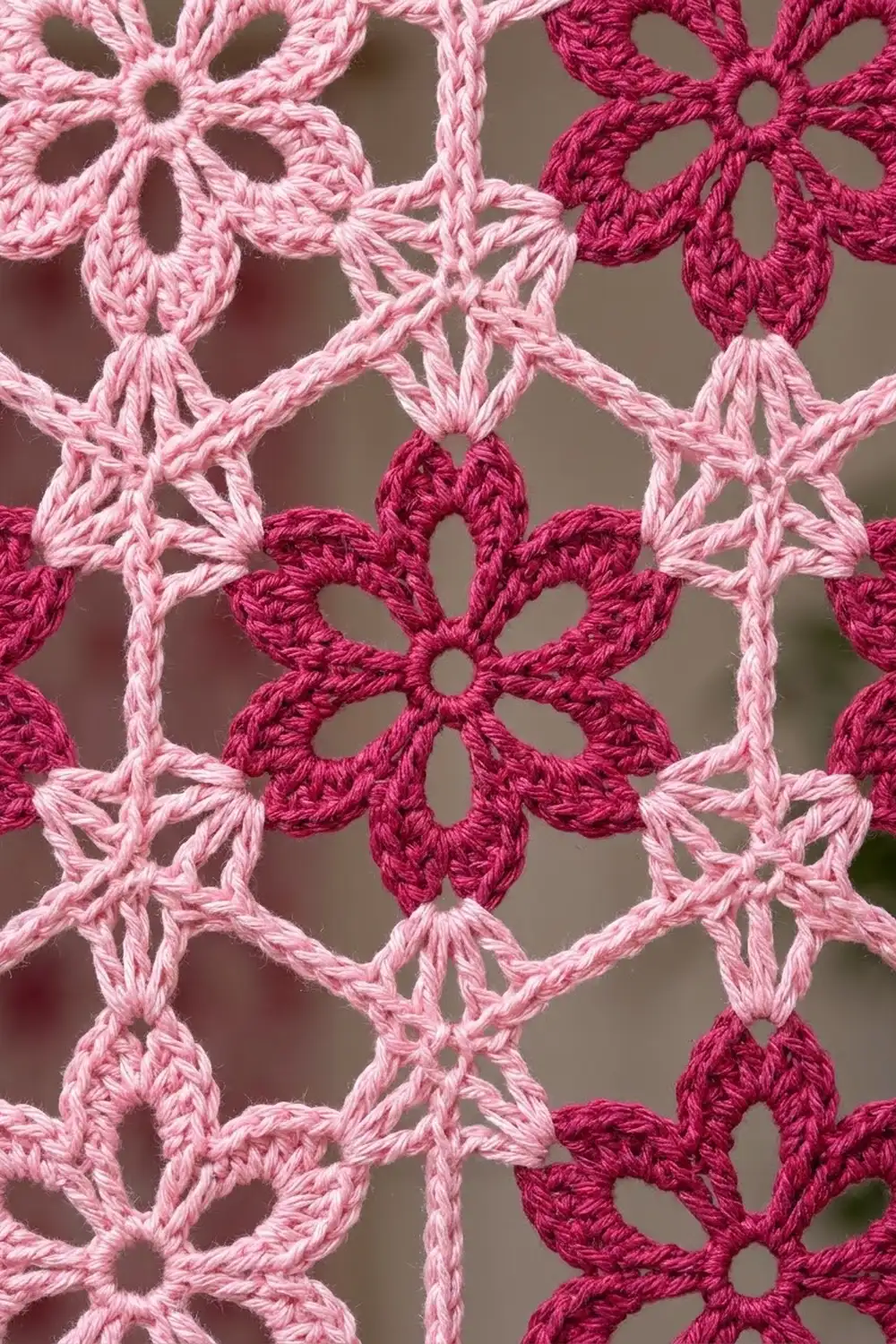
Full Hexagon Motif
Make 76 with raspberry centers and 60 with light pink centers. The frames are all light pink.
Rnd 1 (center color): Ch 6 and join with a sl st to form a ring. Ch 1, then work 12 sc in the ring. Join to the first sc. (12 sc)
Rnd 2: Ch 1, then sc in the first sc, ch 7, sk 1. Sc in the next sc, ch 7, sk 1. Repeat from * 5 times. Join to the first sc. (6 sc, 6 ch-7 loops)
Rnd 3: Sl st into the first ch-7 loop. Work a Petal in each ch-7 loop around. Join to the first sc and fasten off. (84 sts, 6 ch-2 tips)
All 14 Petal stitches sit on the chain, which leaves the open teardrop eye in each petal.
Rnd 4 (light pink): Join in any ch-2 tip. Ch 4 (counts as tr), then work (tr, ch 3, 2 tr) in the same tip, ch 7. (2 tr, ch 3, 2 tr) in the next tip, ch 7. Repeat from * 5 times. Join to the top of the ch-4. (24 tr, 6 ch-3 corner sps, 6 ch-7 sps)
The tr fans carry each petal tip out to a frame corner, which forms the “Y” spokes.
Rnd 5: Sl st in the next tr and into the ch-3 sp. Ch 1, then work (2 sc, ch 4, 2 sc) in the same sp. Sc in the next 2 tr, 7 sc in the ch-7 sp, sc in the next 2 tr, (2 sc, ch 4, 2 sc) in the next ch-3 sp. Repeat from * 4 times.
To finish, sc in the next 2 tr, work 7 sc in the ch-7 sp, and sc in the last 2 tr. These are the same tops you slipped across at the start. Join and fasten off. (90 sc, 6 ch-4 corner loops)
Side count: Each side has exactly 15 sc between corner loops (2 + 2 + 7 + 2 + 2). The ch-4 loops are not part of that count.
Half-Hexagon Edge Filler
Make 28, all in light pink. Each one is the right half of a pointy-top hexagon, cut through its top and bottom points. It has three framed sides and one straight edge.
Row 1: Make a magic ring. Ch 1, work 7 sc in the ring, and turn. (7 sc)
Row 2: Ch 4, sc in the next sc, ch 7, sk 1, sc in the next sc, ch 7, sk 1, sc in the next sc, ch 4, then sl st in the last sc. Turn. (3 sc, 2 ch-7 loops, 2 ch-4 half loops)
Row 3: Ch 5 (counts as dc plus a ch-2 tip). In the first ch-4 loop, work (2 dc, 2 hdc, 2 sc). Work a Petal in each ch-7 loop. In the last ch-4 loop, work (2 sc, 2 hdc, 3 dc), then ch 2 and sl st into the Row 2 sl st. Turn. (2 full petals, 2 half petals, 4 ch-2 tips)
Row 4: Ch 4 (counts as tr), tr in the first ch-2 tip, ch 7. (2 tr, ch 3, 2 tr) in the next tip, ch 7. Repeat from * once more. Work 2 tr in the turning-chain tip. Turn. (12 tr, 2 ch-3 sps, 3 ch-7 sps)
Row 5: Ch 1, then work 2 sc around the post of the first tr. Sc in the next 2 tr, 7 sc in the ch-7 sp, sc in the next 2 tr, then (2 sc, ch 4, 2 sc) in the ch-3 sp. Repeat this side once more. For the last side, sc in the next 2 tr, 7 sc in the ch-7 sp, sc in the last 2 tr, and 2 sc around the post of the turning ch. (45 sc, which is 3 sides of 15, plus 2 ch-4 loops)
Straight edge: Rotate the piece without turning it. Work 29 sc along the straight edge in this order:
– 5 sc in the end of Row 4
– 3 sc in the end of Row 3
– 4 sc in the end of Row 2
– 1 sc in the end of Row 1
– 3 sc over the ring
– 1, 4, 3, and 5 sc in the matching row ends on the way back
Join to the first sc of Row 5 and fasten off. (29 sc)
Checkpoint: The straight edge should be 6 in (15.2 cm), which is the same as one full hexagon’s point-to-point height.
Make All Pieces
For each panel, make:
– 38 hexagons with raspberry flowers (R)
– 30 hexagons with light pink flowers (P)
– 14 half-hexagons (h)
For the pair, make 76 R, 60 P, and 28 h.
Layout (one panel, top to bottom):
Row 1:   R  P  R  P  R
Row 2:  h  P  R  P  R  h
Row 3:   R  P  R  P  R
Row 4:  h  P  R  P  R  h
...repeat...
Row 15:  R  P  R  P  R
Odd rows: 8 rows x 5 hexagons = 40. Even rows: 7 rows x 4 hexagons = 28, plus 14 halves.
Joining
Lay the panel out right side up. Each even-row hexagon nests between two hexagons in the row above it. Place the half-hexagons with their straight edges facing out.
Method: Hold adjoining sides with wrong sides together. Whipstitch through the back loops only, using light pink.
Stitch logic: Every shared side matches 15 sc to 15 sc, one stitch to one stitch. Seam from the sc next to one corner loop to the sc next to the other. Where three pieces meet, take 2 stitches through all three ch-4 loops to close the gap. Don’t seam the straight edges of the half-hexagons. They become the panel’s long sides.
Tension: Match the tension of your crochet. Seams that are too tight pucker the lace, and seams that are too loose leave gaps at the corners.
Size checkpoint: The panel should measure 26 in (66.0 cm) across, 69 in (175.3 cm) from top point to bottom point, and 66 in (167.6 cm) along each straight side.
Border
Border gauge: 5 sc per inch, the same as the motif sides.
Each long side has:
– 8 full-hexagon sides (15 sc each)
– 7 half-hexagon straight edges (29 sc each)
– 14 junction loops between them
The top and bottom edges each have 10 slanted sides (15 sc each), 5 points, and 4 valleys.
Rnd 1 (light pink): Join at the top right corner loop. Work around the panel as follows:
– In each of the 4 corner loops and each of the 10 top and bottom point loops, work (sc, ch 2, sc).
– Sc in every edge sc.
– Work 1 sc in each side junction loop.
– At each valley, skip the joined loops and sc2tog over the last sc of one side and the first sc of the next.
Counts for Rnd 1:
– Each long side: 323 sc worked one per stitch (120 + 203), plus 14 junction sc and 2 corner sc = 339 sc
– Top and bottom (each): 142 sc worked one per stitch, plus 4 sc2tog (worked over 8 sts), 10 point sc, and 2 corner sc = 158 sc and 5 ch-2 sps
– Total: 994 sc and 14 ch-2 sps
Rnd 2: Sc in each sc. Work (sc, ch 2, sc) in every ch-2 sp. At each valley, work an sc3tog centered on the valley sc2tog.
Counts for Rnd 2:
– Each long side: 339 sc worked one per stitch, plus 2 corner sc = 341 sc
– Top and bottom (each): 146 sc worked one per stitch, plus 4 sc3tog, 10 point sc, and 2 corner sc = 162 sc
– Total: 1,006 sc and 14 ch-2 sps
Fasten off.
Tabs: Join light pink in one of the 5 top point ch-2 sps. Ch 24, then sl st in the same sp. Turn, work 32 sc into the loop, sl st in the sp, and fasten off. Repeat at each of the 5 top points. Each tab stands about 3 in (7.6 cm) tall and fits a rod up to 1.5 in (3.8 cm) across.
Why the math works: Down each long side, the edge repeats in a 46-sc unit: one full side, a junction, a half edge, and a junction (15 + 1 + 29 + 1). That unit spans 9 in (22.9 cm), or about 5.1 sc per inch, which blocking easily absorbs. On the top and bottom, the decreases pull in at the concave valleys and the ch-2 points add ease at the tips, so the edges lie flat. Two rounds add 0.5 in (1.3 cm) per edge. That takes the panel from 26 x 69 in to 27 x 70 in (68.6 x 177.8 cm).
Final Blocking
- Weave in all ends along the seams, splitting the plies as you go.
- Soak the panel in cool water for 15 minutes. Press the water out in a towel; don’t wring it.
- Lay the panel flat. If your blocking space is too small, block it in sections.
- Pin the straight sides first, to 66 in (167.6 cm) plus the border.
- Pin every point and frame corner. Check that the width is 27 in (68.6 cm) in at least three places.
- Open each petal eye with a fingertip.
- Let the panel dry completely, then hang it right away.
Final Quality-Control Checklist
- Every motif side has 15 sc, and every half-hexagon straight edge has 29 sc.
- The flower colors match the layout chart.
- All three-way corners are tacked closed.
- Both long sides are straight and the same length.
- Border Rnd 2 counts are 341 per side and 162 on the top and bottom.
- Each panel has 5 tabs.
- Each panel blocks to 27 x 70 in (68.6 x 177.8 cm).
Troubleshooting
- Petal eyes close up: The Rnd 2 chains are too tight. Chain more loosely.
- Motif cups: Check that the Rnd 4 sides are ch 7, not ch 6.
- Motif ruffles: The trebles are too tall. Snug each loop before you yarn over.
- Wavy side edge: Recount the 29 sc on each half-hexagon edge.
- Points flatten after washing: Re-pin the points while the panel is damp.
- Tabs stretch: Work the tab sc more firmly.
Care
Hand wash in cool water with mild detergent, then press the water out in a towel. Dry the panels flat with the points pinned, and keep them out of the dryer.
Final Notes
The measurements build on each other. With 15 sc per side, each side is 3 in (7.6 cm) and each hexagon is 6 in (15.2 cm) point to point. The hexagons make a 26 x 69 in (66.0 x 175.3 cm) panel. Two border rounds bring it to 27 x 70 in (68.6 x 177.8 cm), and the tabs add 3 in (7.6 cm) on top. Check your first motif carefully, and the rest follows.
Happy crocheting!