
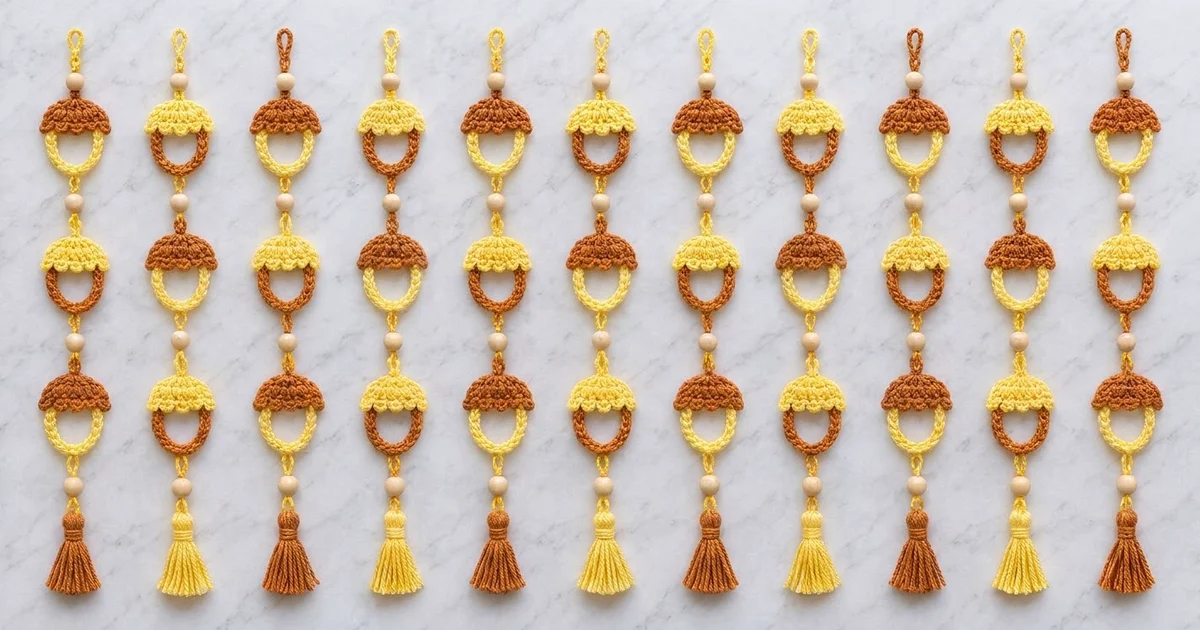
This window curtain is made of nine hanging strands. Each strand has five crocheted acorns, wooden beads and a soft tassel. Every acorn has a domed, textured cap with a little scalloped edge. The cap sits over an open oval ring that lets light through.
The curtain uses two colors, caramel brown and butter yellow. Brown-cap acorns on yellow rings alternate with yellow-cap acorns on brown rings, which gives the curtain a cheerful checkerboard pattern. Natural wooden beads tie the colors together. It’s an autumn design, but it works all year.
This pattern uses US crochet terms. Each acorn measures 2.75″ wide x 3″ tall (7.0 x 7.6 cm). Each strand is 33.5″ (85.1 cm) long from the top of the rod loop to the tip of the tassel. Hung 3.5″ (8.9 cm) apart, the nine strands cover about 30.75″ (78.1 cm) of rod.
Construction is modular. You crochet the rings and caps separately and sew each cap over its ring. Then you link the acorns into strands with short beaded chain connectors, add rod loops and tassels, block the pieces and hang the curtain.
Finished Size and Construction
- Acorn size: 2.75″ x 3″ (7.0 x 7.6 cm)
- Strand length: 33.5″ (85.1 cm), including the rod loop and tassel
- Curtain width as hung: about 30.75″ (78.1 cm) at 3.5″ (8.9 cm) spacing
- Skill level: Easy / advanced beginner
- Terminology: US
- Yarn weight: DK (#3) cotton
- Hook: 3.5 mm (E-4)
- Number of pieces: 45 rings, 45 caps, 9 tassels
- Layout: 9 strands x 5 acorns
- Piece size: ring 1.75″ x 2″ (4.4 x 5.1 cm); cap 2.75″ x 1.75″ (7.0 x 4.4 cm)
- Strand length before tassel: 30.5″ (77.5 cm)
- Edge finish depth: the rod loops hang 2″ (5.1 cm) and the tassels add 3″ (7.6 cm)
Materials
Use a smooth DK cotton. Cotton holds the ring shape, keeps the cap stitches crisp and stretches very little under the weight of the beads. Very soft acrylics make the strands get longer over time.
- Color A – Caramel Brown: 150 g (330 m / 360 yd)
- Color B – Butter Yellow: 150 g (330 m / 360 yd)
These quantities include a margin for a test acorn, tassel trimming and long weaving tails.
Tools and notions:
- 3.5 mm (E-4) crochet hook
- 60 natural wooden beads, 12 mm, with holes at least 3 mm wide (54 needed)
- Tapestry needle thin enough to pass through the beads
- Stitch markers
- Stiff card, 3″ (7.6 cm) wide, for the tassels
- Rustproof pins and a blocking mat
- Spray bottle, scissors and a measuring tape
- Curtain rod up to 1″ (2.5 cm) in diameter
Abbreviations (US Terms)
- ch: chain
- sl st: slip stitch
- sc: single crochet
- hdc: half double crochet
- dc: double crochet
- sc2tog: single crochet 2 together
- dc2tog: double crochet 2 together
- st(s): stitch(es)
- RS: right side
Special stitches:
- dc2tog: [Yarn over, insert the hook in the next st, pull up a loop, yarn over, pull through 2 loops] twice, then yarn over and pull through all 3 loops.
- Scallop: (hdc, dc, hdc) all in the same st.
- Bead lock: Slide one pre-strung bead up against the hook, then ch 1 snugly beyond it so the bead is trapped in the chain.
Gauge and Checkpoints
Gauge: 5 sc = 1″ (2.5 cm), 1 dc row = 0.4″ (1.0 cm) and 5 ch = 1″ (2.5 cm).
Make one complete test acorn first and check these measurements:
- Cap Row 1: 13 sc = 2.6″ (6.6 cm) wide.
- Cap after Row 5: 1.5″ (3.8 cm) tall.
- Cap with scallops: 2.75″ x 1.75″ (7.0 x 4.4 cm).
- Shaped ring: 1.75″ x 2″ (4.4 x 5.1 cm) outside.
- Assembled acorn: 2.75″ x 3″ (7.0 x 7.6 cm), with the cap overlapping the ring by 0.75″ (1.9 cm).
If the cap is too wide, go down to a 3.25 mm hook. If it’s too narrow, go up to 3.75 mm. Use the same hook for rings and caps so they stay in proportion. Also check your chain gauge: ch 20 should measure 4″ (10.2 cm) unstretched.

Ring (Nut)
Make 45 rings: 23 in Color B (for Colorway A) and 22 in Color A (for Colorway B).
Foundation: Ch 20. Sl st to the first ch to form a ring without twisting the chain.
Rnd 1: Ch 1 (does not count as a st). Work 32 sc into the center of the ring, over the chain rather than into the chain stitches. Sl st to the first sc. (32 sc)
Push the stitches together as you work so they cover the chain completely. Because they’re packed tightly, the stitch tops lean and twist slightly, which gives the ring its braided, rope-like texture.
Mark sc 1 as the top center. Sc 17 is the bottom center, directly opposite. Fasten off and weave in the ends. Gently ease the ring into a 1.75″ x 2″ (4.4 x 5.1 cm) oval with sc 1 at the top.
Cap
Make 45 caps: 23 in Color A (Colorway A) and 22 in Color B (Colorway B).
The cap is worked flat from the bottom edge up. The scallops are added afterward along the foundation chain.
Foundation: Ch 14.
Row 1 (RS): Sc in the 2nd ch from the hook and in each ch across. Turn. (13 sc)
Row 2: Ch 3 (counts as dc). Dc in each st across. Turn. (13 dc)
Row 3: Ch 3 (counts as dc). [Dc2tog] 6 times. Turn. (7 sts) This row uses 1 + 12 = 13 sts.
Row 4: Ch 2 (does not count). Dc2tog, dc in the next 3 sts, dc2tog. Turn. (5 sts)
Row 5: Ch 1 (does not count). Sc2tog, sc in the next st, sc2tog. (3 sc)
The cap now measures 1.5″ (3.8 cm) tall. Don’t fasten off. Ch 1 and sc evenly down the side edge to the foundation corner, working 2 sc per dc row and 1 sc per sc row.
Scallop Row: Work along the underside of the 13 foundation chain loops. Sc in the first loop, scallop in the next loop, sc in the next loop. Repeat from * 5 more times. (6 scallops + 7 sc) This row uses 1 + 12 = 13 loops.
Sl st up the second side edge to the top. Fasten off, leaving a 12″ (30.5 cm) tail for sewing.
The decreases pull the top inward, so the cap domes naturally. The scallops flare slightly and hang over the ring like a real acorn cap.
Assemble Each Acorn
- Lay the ring flat with sc 1 at the top.
- Center the cap over sc 1 with the RS facing you. The cap’s lower edge should cross ring stitches 28 through 6, which is 11 sts (5 + 1 + 5).
- Using the cap tail, backstitch along the top of cap Row 1, just above the scallops, through the ring stitches behind it.
- Tack the center of cap Row 3 to sc 1 with two small stitches.
- Leave the scallops free and weave in the tail.
The acorn should measure 2.75″ x 3″ (7.0 x 7.6 cm).
Make All Pieces
- Colorway A (brown cap, yellow ring): 23 acorns
- Colorway B (yellow cap, brown ring): 22 acorns
Odd-numbered strands start with A and even-numbered strands start with B. Then the colorways alternate down each strand.
Strand:   1  2  3  4  5  6  7  8  9
Acorn 1:  A  B  A  B  A  B  A  B  A
Acorn 2:  B  A  B  A  B  A  B  A  B
Acorn 3:  A  B  A  B  A  B  A  B  A
Acorn 4:  B  A  B  A  B  A  B  A  B
Acorn 5:  A  B  A  B  A  B  A  B  A
- Odd strands (5): 3 A + 2 B each, which makes 15 A and 10 B.
- Even strands (4): 2 A + 3 B each, which makes 8 A and 12 B.
- Totals: 23 A and 22 B.
The cords and tassels match each strand’s top cap: Color A for odd strands and Color B for even strands.
Joining: Beaded Strands
Each strand uses 6 beads: 1 in the top segment, 1 in each of the 4 connectors and 1 in the bottom segment. That’s 9 x 6 = 54 beads in total.
Top segment: Thread 1 bead onto the cord yarn. Leave a 6″ (15.2 cm) tail and ch 20. Sl st to the first ch to form the rod loop. Ch 4, bead lock, ch 4 (9 ch in total). Working from the front, sl st through the center st of Row 5 on the Acorn 1 cap. Fasten off.
Connector (4 per strand): Thread 1 bead. Join with a sl st in sc 17 of the ring above. Ch 4, bead lock, ch 4. Sl st through the Row 5 center st of the next cap. Fasten off.
Bottom segment: Thread 1 bead. Join with a sl st in sc 17 of Acorn 5. Ch 4, bead lock, ch 4. Fasten off, leaving an 8″ (20.3 cm) tail.
Stitch logic: Every connection is one sl st into one defined stitch: the Row 5 center st at the top of a cap or sc 17 at the bottom of a ring. That keeps each acorn hanging straight and centered.
Tension: Chain at your normal gauge, but pull the bead-lock ch snugly. Each segment of 9 ch measures 1.8″ (4.6 cm). With the 12 mm bead, the segment comes to 2.25″ (5.7 cm).
Size checkpoint: Each strand should measure 30.5″ (77.5 cm) without the tassel. Here’s how that adds up:
- 2″ rod loop
- 2.25″ top segment
- 5 acorns x 3″ = 15″
- 4 connectors x 2.25″ = 9″
- 2.25″ bottom segment
2 + 2.25 + 15 + 9 + 2.25 = 30.5″ (77.5 cm).
Border: Top Loops and Tassel Edge
This curtain has no stitched border. The edge finish is the row of rod loops along the top and the row of tassels along the bottom.
Edge gauge: 5 ch = 1″ (2.5 cm).
Top edge: 9 loops x ch 20 = 180 ch. Each loop is 4″ (10.2 cm) around and hangs 2″ (5.1 cm) deep over the rod.
Bottom edge: 9 tassels. Make each one this way:
- Wrap yarn 20 times around the 3″ (7.6 cm) card.
- Slide a 10″ (25.4 cm) tie under the wraps at the top and knot it tightly.
- Cut the wraps at the bottom. You’ll have 40 strands, each 6″ (15.2 cm) long, folded to 3″ (7.6 cm).
- Wrap a 12″ (30.5 cm) length 6 times around the tassel, 0.5″ (1.3 cm) below the top. Knot it and bury the ends inside the tassel.
- Sew the tassel to the end of the chain with the bottom-segment tail, then trim it to an even 3″ (7.6 cm).
Why the math works:
- A 1″ (2.5 cm) rod is 3.14″ (8.0 cm) around, so a 4″ loop slides freely with 0.86″ (2.2 cm) of ease.
- Nine strands at 3.5″ (8.9 cm) centers span 8 x 3.5″ + 2.75″ = 30.75″ (78.1 cm).
- That spacing leaves a 0.75″ (1.9 cm) gap between neighboring acorns, so the strands don’t tangle.
- A 30.5″ strand plus a 3″ tassel gives exactly 33.5″ (85.1 cm).
Final Blocking
- Mist each acorn lightly until it’s damp, not soaked.
- Pin each ring into a 1.75″ x 2″ (4.4 x 5.1 cm) oval.
- Shape each cap into a dome with your fingertips and pin all 6 scallops open evenly.
- Let everything dry completely.
- Hang each strand and mist the chains. Clip a clothespin to each tassel overnight so the strand hangs straight.
- Steam the tassels lightly, comb them out and trim them even.
Final Quality-Control Checklist
- 45 acorns: 23 Colorway A and 22 Colorway B
- Every ring has 32 sc, and the chain is fully covered
- Every cap has 6 scallops and is centered on sc 1
- All 54 beads are locked tightly, 6 per strand
- All strands measure 33.5″ (85.1 cm), within 0.25″ (0.6 cm) of each other
- The colors match the grid
- All ends are woven in
Troubleshooting
- Ring ruffles: Work 30 sc instead of 32 and reshape.
- Chain shows between the sc: Pack the stitches tighter or add 1–2 sc.
- Cap is flat: Go down one hook size for Rows 3–5.
- Scallops curl under: Pin each scallop flat while blocking.
- Bead slides: Tighten the bead-lock ch.
- Strands are uneven: Recount the segments. Each one is ch 4, bead lock, ch 4.
- Acorns twist: Check that each join is in sc 17 and in the Row 5 center st.
Care
Shake the curtain out gently to dust it. If you need to wash it, hand wash in cool water and dry the strands flat. Don’t tumble dry, because the wooden beads can crack.

Final Notes
The measurement chain is short:
- 13 sc make a 2.6″ (6.6 cm) cap base, and the scallops widen the cap to 2.75″ (7.0 cm).
- That cap over a 2″ (5.1 cm) ring makes a 3″ (7.6 cm) acorn.
- Five acorns plus the beaded segments make a 30.5″ (77.5 cm) strand, and the tassel brings it to 33.5″ (85.1 cm).
- Nine strands at 3.5″ (8.9 cm) spacing fill 30.75″ (78.1 cm) of rod.
Check your test acorn first, and every other measurement will follow.
Happy crocheting!