

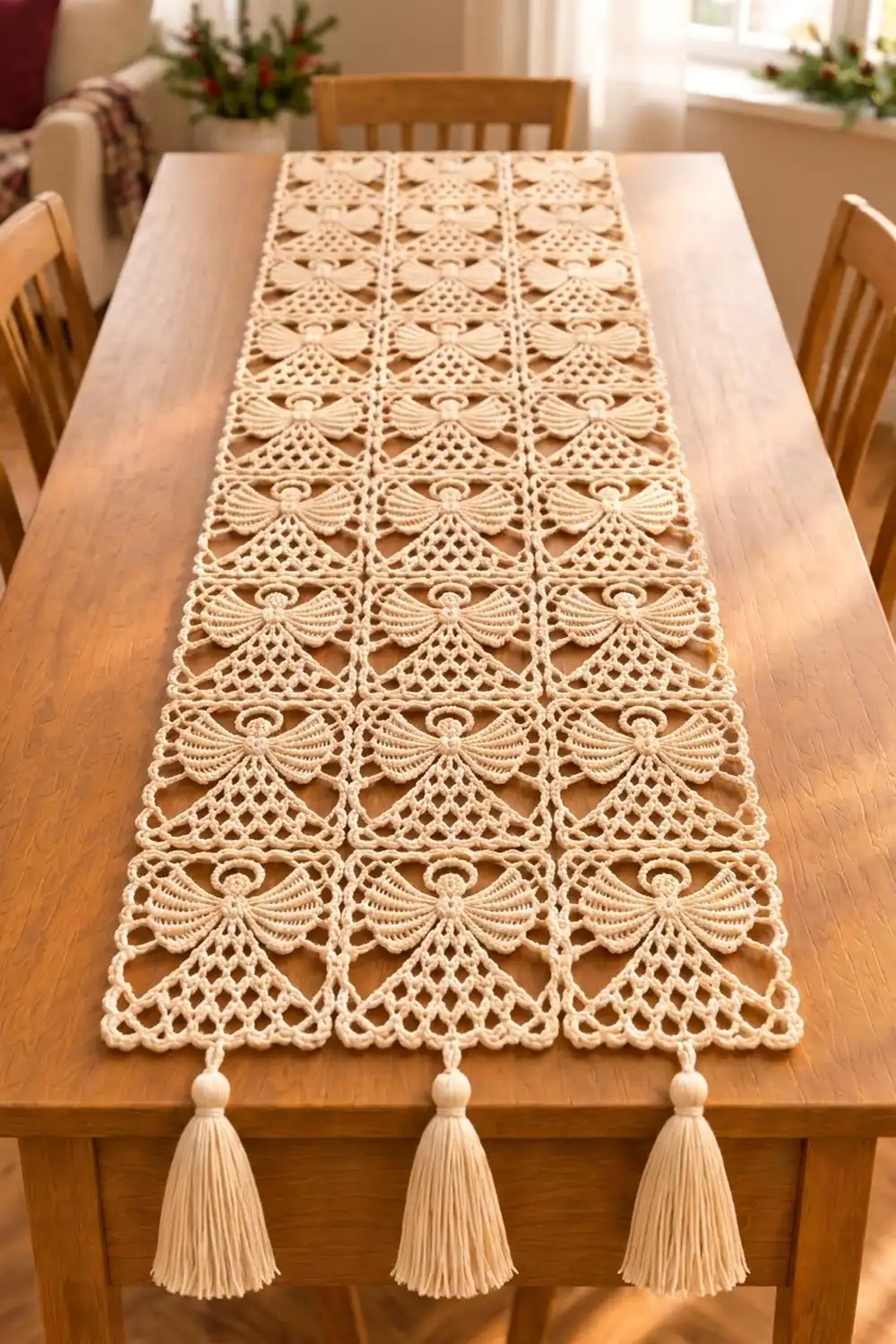
This table runner is made from soft cream lace squares, each holding one angel. Every angel has a round head, an arched halo, two fan-shaped wings with ribbed feathers and scalloped edges, and a skirt of open chain-loop mesh that widens into a triangle. A lacy chain-loop frame around each angel turns it into a neat square.
The runner is 3 squares wide and 8 squares long, 24 squares in all, worked in one color: warm ivory cream. A slim firming round goes around the whole edge, and three rounded-top tassels hang from each short end. It looks gentle and heirloom-like, and it suits a Christmas table or a winter mantel.
The pattern uses US crochet terms. The finished runner measures 21.5 in x 56.5 in (54.6 cm x 143.5 cm), not counting the tassels.
Each square is made in stages: head, halo, wings, skirt, then three frame rounds. The squares are joined as you go on the last frame round. A one-round border and the tassels finish the runner.
Finished Size and Construction
- Finished size: 21.5 in x 56.5 in (54.6 cm x 143.5 cm), without tassels
- Skill level: Intermediate
- Terminology: US crochet terms
- Yarn weight: Worsted (#4) cotton
- Hook: 4.5 mm (US 7)
- Number of pieces: 24 identical squares
- Layout: 3 squares wide x 8 squares long
- Square size: 7 in x 7 in (17.8 cm x 17.8 cm), blocked
- Size before border: 21 in x 56 in (53.3 cm x 142.2 cm)
- Border depth: 0.25 in (0.6 cm) per edge
- Tassels: 6, each 5 in (12.7 cm) long
Materials
Use a smooth, mercerized or combed worsted-weight cotton in a cream or ivory shade. Cotton shows the wing ribs and the mesh clearly, and it blocks crisply. Avoid fuzzy or very stretchy yarns, because the lace will lose its shape. Buy all the yarn from one dye lot, since a single-color runner shows even small shade changes.
- Cream (single color): 550 g, about 935 m (1,023 yd), based on 85 m per 50 g ball
- Squares: about 18 g each, 432 g total
- Border: about 10 g
- Tassels: about 7 g each, 42 g total
These quantities include a margin of about 13% for swatching, gauge changes, and tassel trimming.
Tools:
– 4.5 mm (US 7) crochet hook
– Tapestry needle
– 4 locking stitch markers
– Scissors
– 5 in (12.7 cm) piece of stiff cardboard for tassels
– Blocking mats, rustproof pins, and a spray bottle
Abbreviations (US Terms)
- ch – chain
- sl st – slip stitch
- sc – single crochet
- dc – double crochet
- sk – skip
- sp – space
- st(s) – stitch(es)
- RS – right side
Special stitches:
– Shell: 5 dc in the same stitch.
– Corner ring: ch 4, sl st in the 4th ch from the hook. This makes a small ring that marks a corner of the frame.
Gauge and Checkpoints
Make one complete square, block it, and measure it before you start the others. The whole runner depends on this square.
- Gauge: 27 sc along one side of Frame Rnd 2 = 6.5 in (16.5 cm).
- Head (after Rnd 2): 1.25 in (3.2 cm) across.
- Wings (after both wings): 6 in (15.2 cm) from wing tip to wing tip.
- Skirt (after Row 7): 3.5 in (8.9 cm) from head to hem.
- Frame Rnd 2: 6.5 in (16.5 cm) per side.
- Frame Rnd 3: 7 in (17.8 cm) per side, blocked.
If your square is too big, go down to a 4 mm hook. If it is too small, go up to a 5 mm hook. Change the hook, not the stitch counts, because the joining and border math depend on exact counts. Measure the test square again after blocking, since cotton often relaxes a little.
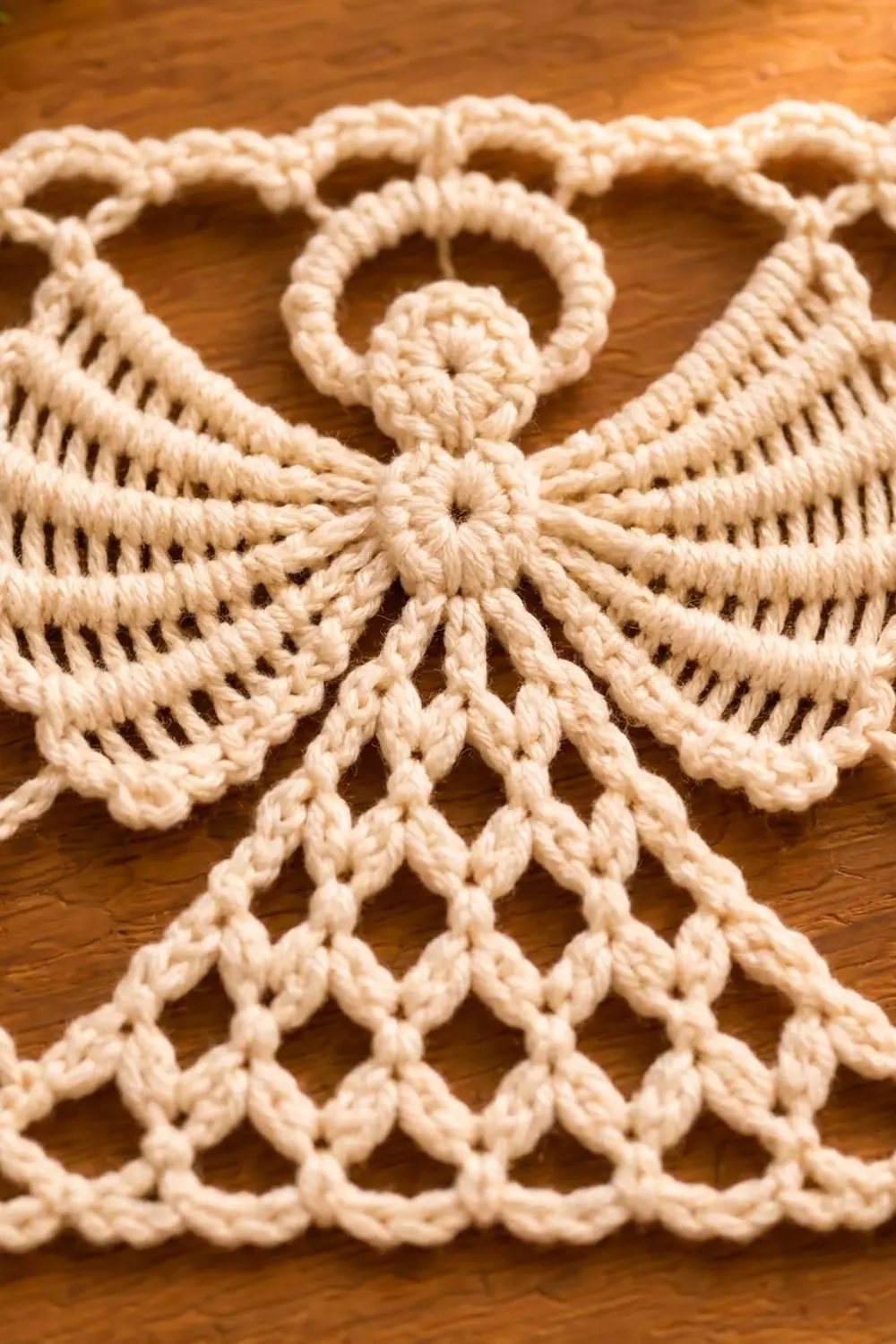
Square (Make 24)
Head
Rnd 1: Make a magic ring, ch 3 (counts as dc), 13 dc in the ring, sl st in the top of ch-3. Pull the ring closed. (14 dc)
Rnd 2: Ch 1, sc in each dc around, sl st in the first sc. (14 sc)
Number these sc from 1 to 14, going clockwise. Sc 1 is at the bottom center (6 o’clock), sc 4 is at 9 o’clock, sc 8 is at the top, and sc 12 is at 3 o’clock. Fasten off.
Halo
Row H1: Join yarn with sl st in sc 5, ch 14, sl st in sc 11. This makes an arch over the top of the head.
Row H2: Ch 1, turn, work 20 sc over the ch-14 arch, sl st in sc 5. (20 sc) Fasten off.
The halo stands as a separate ring above the head, with a small open gap underneath it.
Wings (Make 2)
Work the left wing from sc 4 and the right wing from sc 12. Both wings are worked the same way.
Row 1 (RS): Join yarn in the stated sc, ch 4 (counts as dc and ch 1), (dc, ch 1) 4 times in the same st, dc in the same st. (6 dc, 5 ch-1 sps)
Row 2: Ch 3 (counts as dc), turn, dc in the same st, (ch 2, 2 dc in next dc) 5 times. (12 dc, 5 ch-2 sps)
Row 3: Ch 3, turn, dc in next dc, (ch 3, dc in each of next 2 dc) 5 times. (12 dc, 5 ch-3 sps)
The paired dc make the ribbed feather lines, which fan out from the head.
Row 4: Ch 1, turn, sc in each of the first 2 dc, (5 sc in next ch-3 sp, sc in each of next 2 dc) 5 times. (37 sc)
Row 5: Ch 1, turn, sc in the first sc, (sk 1, shell in next sc, sk 1, sc in next sc) 9 times. (9 shells, 10 sc) Fasten off.
The 5th shell is the outermost tip of the wing. Mark its center (3rd) dc.
Skirt
Row 1: With RS facing, join yarn with sc in sc 1 of the head, ch 5, sc in the same st. (1 ch-5 loop)
Rows 2–7: Ch 5, turn, sc in the first loop, (ch 5, sc in next loop) across, ch 5, sc again in the same last loop. Each row adds one loop.
Loop counts: Row 2 has 2 loops, Row 3 has 3, Row 4 has 4, Row 5 has 5, Row 6 has 6, and Row 7 has 7. Do not fasten off.
The 7 loops of Row 7 are the hem loops.
Frame
Rnd 1 (anchor round): Ch 1, sc in the last loop of Row 7 (the right end of the hem). Then work around the square:
- Bottom: (ch 3, sc in next hem loop) 6 times, ch 4, corner ring.
- Left side: ch 11, sc in the marked dc of the left wing, ch 11, corner ring.
- Top: ch 11, sc in the 10th sc of the halo, ch 11, corner ring.
- Right side: ch 11, sc in the marked dc of the right wing, ch 11, corner ring.
- Finish: ch 4, sl st in the first sc.
Rnd 2: Work around, putting:
– 1 sc in each anchor sc
– 2 sc in each ch-3 sp
– 3 sc in each ch-4 sp
– 12 sc in each ch-11 sp
– (sc, ch 2, sc) in each corner ring
Sl st in the first sc.
Count per side between corners: bottom = 7 + 12 + 6 = 25; each other side = 12 + 1 + 12 = 25. Adding the 2 corner sc, each side has 27 sc. (108 sc and 4 ch-2 corner sps in total) Fasten off.
Rnd 3 (lace edge): Join yarn in the first corner sc of any side. *Sc in this corner sc, (ch 3, sk 1 sc, sc in next sc) 13 times, ending in the far corner sc, ch 3 for the corner loop (skip the ch-2 sp); repeat from * 3 more times, sl st in the first sc.
Each side has 14 sc and 13 ch-3 loops, plus 4 corner loops in total. (56 sc, 56 loops) Make Rnd 3 in full only on the first square. Fasten off.
Make All Pieces
Make 24 squares in cream, working the head through Frame Rnd 2 on each. Work Rnd 3 as you join the squares (see Joining).
Layout (3 wide x 8 long; each X = 1 square):
X X X
X X X
X X X
X X X
X X X
X X X
X X X
X X X
Joining
Method: Join as you go on Frame Rnd 3.
When you reach a side that touches a square that is already finished, replace each “ch 3” with: ch 1, sl st in the matching ch-3 loop of the finished square, ch 1. Join all 13 side loops and both corner loops on that side.
Stitch-to-stitch logic: Both squares have exactly 13 side loops per side, so the loops meet one to one. Join loop 1 to loop 1, loop 2 to loop 2, and so on.
Four-square corners: Where four squares meet, sl st into the same joining point that the earlier corners used. This keeps all 4 corners stacked in one spot.
Tension: Keep the ch-1 stitches on either side of the sl st the same size as the chains in an unjoined loop. If they are too tight, the seams will pucker. If they are too loose, gaps will open between squares.
Size checkpoint: Two joined squares should measure 14 in (35.6 cm). One finished row of 3 squares should measure 21 in (53.3 cm) across.
Border
Border gauge: 26 sc per square side = 7 in (17.8 cm).
Rnd 1: Join yarn in any outer corner loop of the runner. Work:
– (sc, ch 2, sc) in each of the 4 outer corner loops
– 2 sc in each of the 13 side loops of every square along the edge
– nothing in the joined corner loops at the seams
Sl st in the first sc. Fasten off.
Counts per side:
– Short sides: 3 squares x 26 sc = 78 sc between corners, or 80 sc counting both corner sc.
– Long sides: 8 squares x 26 sc = 208 sc between corners, or 210 sc counting both corner sc.
– Total: 78 + 78 + 208 + 208 + 8 corner sc = 580 sc, plus 4 ch-2 corner sps.
Why the math works: Each ch-3 loop spans 2 stitches of Rnd 2. Putting 2 sc in each loop puts back about the same stitch density as Rnd 2, so the edge lies flat. You skip the joined seam loops, so no extra stitches are added at the seams. The border adds 0.25 in (0.6 cm) on each edge, which brings the runner from 21 in x 56 in (53.3 cm x 142.2 cm) to 21.5 in x 56.5 in (54.6 cm x 143.5 cm).
Tassels (Make 6)
- Wrap yarn 40 times around the 5 in (12.7 cm) card.
- Tie the top of the bundle with a 12 in (30.5 cm) strand, then cut the loops at the bottom.
- Make a small ball of yarn and place it inside the top of the tassel to give it a rounded head about 0.75 in (1.9 cm) wide.
- Wrap yarn tightly under the head 8 times and secure it.
- Trim the strands evenly to 5 in (12.7 cm).
Use the tie strand to attach one tassel at the center of each square’s edge on both short ends, between the 13th and 14th border sc. That gives 3 tassels on each end.
Final Blocking
- Weave in all ends along the sc rounds, not through the open lace.
- Wet the runner in cool water, then gently squeeze out the water. Do not wring it.
- Lay it flat on blocking mats.
- Pin the 4 outer corners first, to 21.5 in x 56.5 in (54.6 cm x 143.5 cm).
- Pin the seam lines straight, checking that each square measures 7 in (17.8 cm).
- Open each wing’s scallops and pull the skirt mesh into a clean triangle.
- Shape each halo into a smooth arch.
- Let it dry completely. Steam the tassels separately and comb them straight.
Final Quality-Control Checklist
- All 24 squares measure 7 in (17.8 cm) per side.
- Every square has 27 sc per side on Rnd 2 and 13 loops per side on Rnd 3.
- Every halo has 20 sc, and every wing ends with 9 shells.
- Every skirt hem has 7 loops.
- All seams are flat, with the corners stacked.
- The border has 80 sc per short side and 210 sc per long side, counting corners.
- There are 3 tassels on each short end, evenly spaced.
Troubleshooting
- Wings curl: Your Row 4 sc are too tight. Work them more loosely, or block the wings harder.
- Skirt is lopsided: Check that each row ends with a second sc in the last loop.
- Frame ripples: Count the ch-11 sps; extra chains cause waves.
- Square is too small: Go up one hook size and check that Rnd 2 has 12 sc in each ch-11 sp.
- Seams gap open: Your ch-1 stitches around the joining sl st are too loose. Work them a little tighter on the next seam.
- Border flares: You probably worked into the seam loops. Remove those stitches.
- Halo is flat: Pin it into an arch while the runner is damp.
Care
Hand wash in cool water with a mild detergent and dry flat, reshaping while damp. Do not tumble dry, and only steam the lace lightly.
Final Notes
The measurement chain is simple. Each square has 27 sc per side and measures 6.5 in (16.5 cm) at Rnd 2 and 7 in (17.8 cm) after the lace edge. Joined 3 x 8, the squares measure 21 in x 56 in (53.3 cm x 142.2 cm). The 26-sc-per-square border brings the runner to 21.5 in x 56.5 in (54.6 cm x 143.5 cm). Check each stage before moving on, and your angels will line up perfectly.
Happy crocheting!