

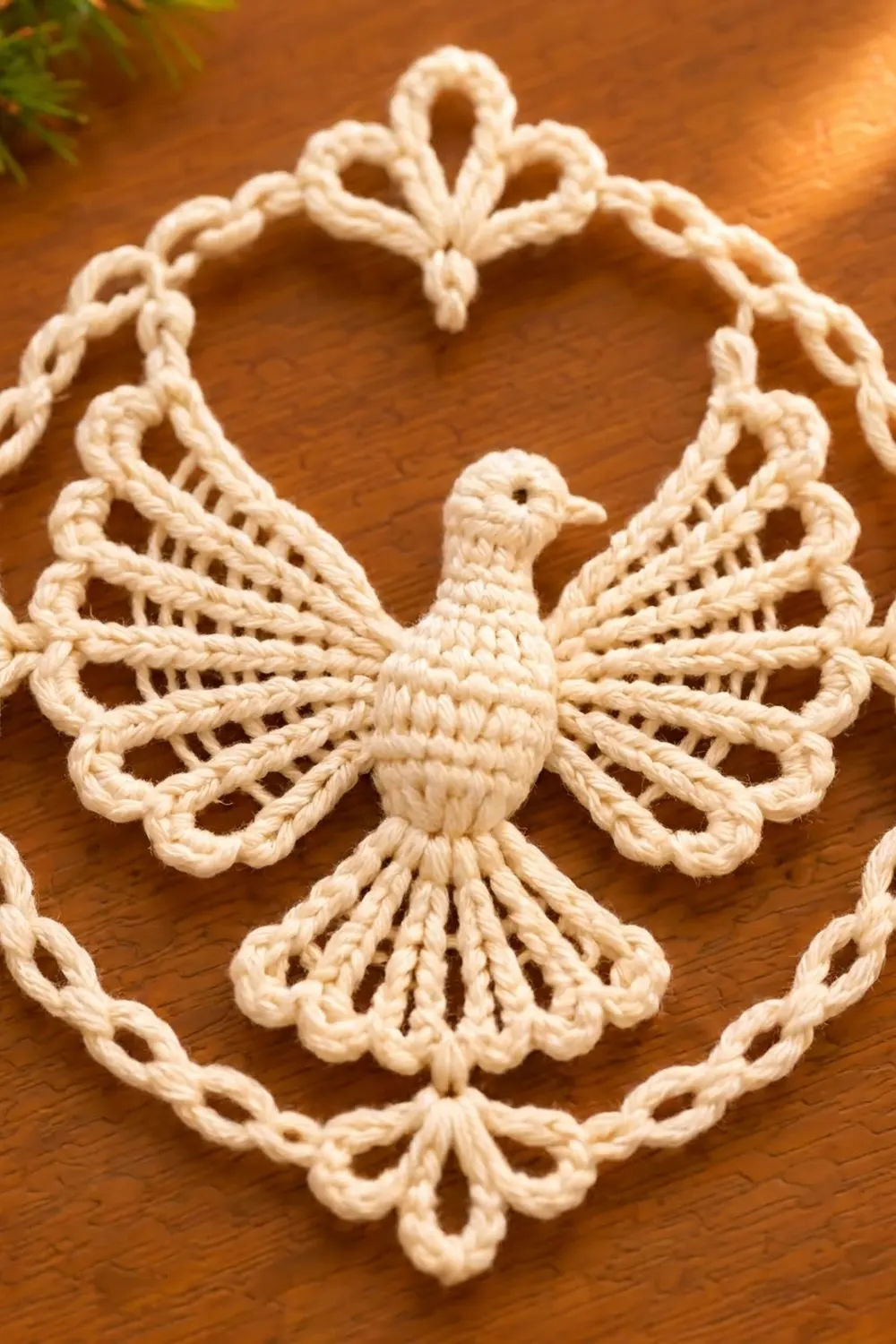
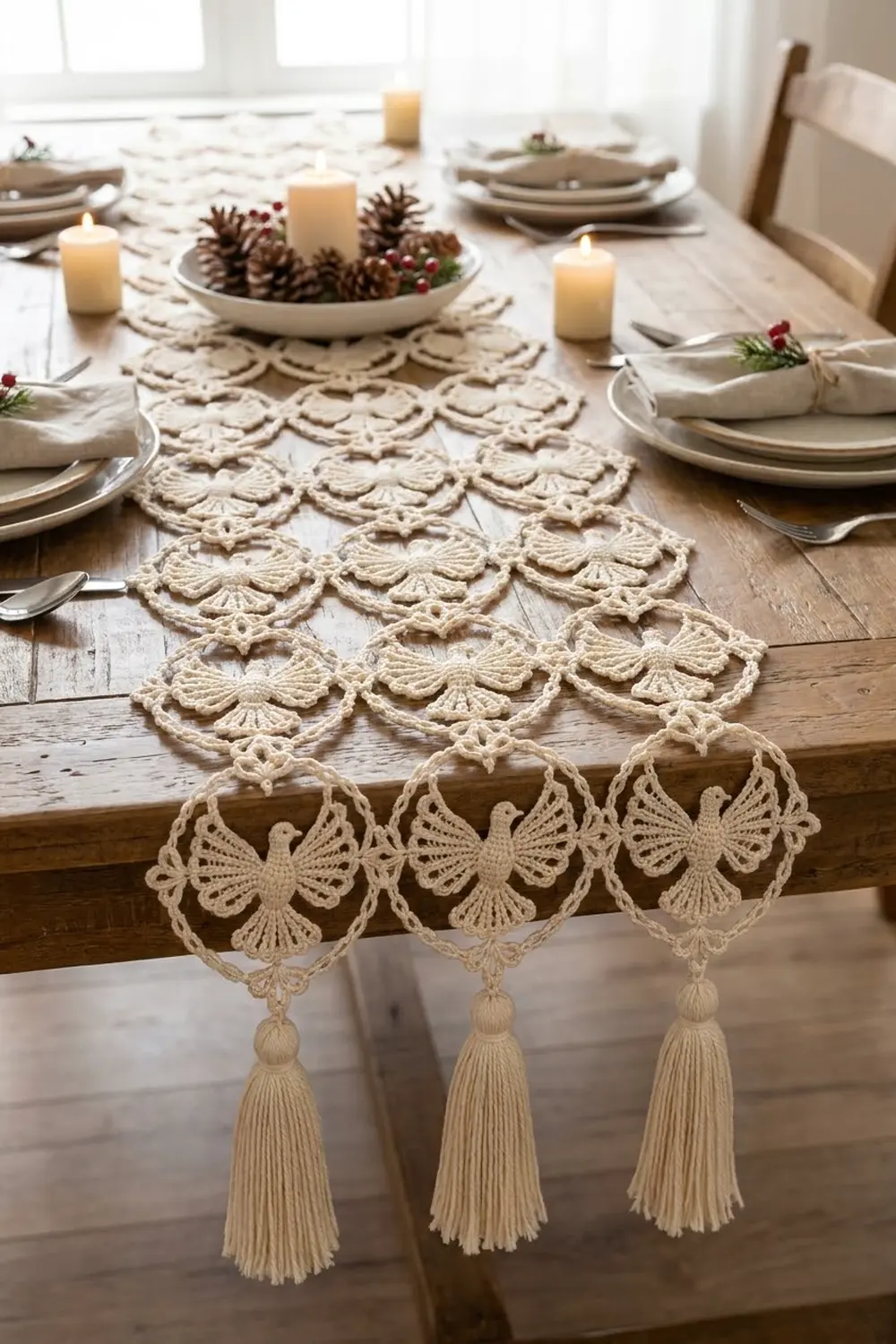
The Peace Dove Lace Table Runner is a long, airy runner made from 27 identical motifs. Each motif is a textured dove with fanned, feathered wings and a scalloped tail. The dove sits inside a chain-link ring that has a petal trefoil at the top, bottom, left and right.
The whole runner is worked in one cream cotton, so the texture does all the work. The body is ridged, the feathers end in tiny picots, and the table shows through the open spaces between motifs. It suits a holiday table, but a soft neutral like this works all year.
This pattern uses US crochet terms. Without tassels, the finished runner measures 19.5 in (49.5 cm) wide by 58.5 in (148.6 cm) long. With a 5 in (12.7 cm) tassel at each point of both ends, it is 68.5 in (174.0 cm) long.
For each motif you crochet one dove and one ring, then sew the dove inside the ring. You then sew the motifs together point to point, three across and nine long. There is no stitched border. The trefoil points form the outer edge, and six tassels finish the ends.
Finished Size and Construction
- Finished size: 19.5 x 58.5 in (49.5 x 148.6 cm); 68.5 in (174.0 cm) long with tassels
- Skill level: Intermediate
- Terminology: US
- Yarn weight: #3 light / DK cotton
- Hook: 3.5 mm (E-4)
- Number of pieces: 27 motifs (27 doves + 27 rings), plus 6 tassels
- Layout: 3 motifs wide x 9 motifs long
- Piece size: 6.5 in (16.5 cm) point to point
- Size before border: 19.5 x 58.5 in (49.5 x 148.6 cm)
- Border depth: 0 in (0 cm). The trefoil points are the finished edge.
Materials
Choose a smooth, tightly plied cotton in the #3 weight range, mercerized or matte, at about 100 m per 50 g. Cotton keeps the feather texture crisp and blocks flat. Avoid fuzzy or loosely plied yarns because they blur the picots and the ridged body. Buy all your yarn from one dye lot, since a large field of a single cream shows even small shade shifts.
- Cream: 350 g / 700 m (seven 50 g balls). This covers 27 motifs at about 10 g / 22 m each and 6 tassels at about 5 g / 12 m each.
- 3.5 mm (E-4) crochet hook
- Tapestry needle
- Stitch markers
- Sturdy card, 5 in (12.7 cm) tall, for the tassels
- Six 0.75 in (1.9 cm) wooden beads (optional, for tassel heads)
- Rustproof pins, blocking mats and a spray bottle
All quantities include a margin of about 15 percent for swatching and tension differences.
Abbreviations (US Terms)
- ch: chain
- sl st: slip stitch
- sc: single crochet
- hdc: half double crochet
- dc: double crochet
- tr: treble crochet
- BLO: back loop only
- sc2tog: single crochet 2 together
- sk: skip
- st(s): stitch(es)
Picot: Ch 3, sl st in 3rd ch from hook.
Trefoil (TF):
1. Ch 6, sl st in 5th ch from hook. This makes the first loop, with a 1-ch stem.
2. Ch 6, sl st in the same base sl st to make the second loop.
3. Ch 5, sl st in the same base sl st to make the third loop.
4. Fill the loops: (sc, hdc, 3 dc, hdc, sc) in the third loop, (sc, hdc, 5 dc, hdc, sc) in the second loop, and (sc, hdc, 3 dc, hdc, sc) in the first loop.
5. Sl st in the stem ch.
Each trefoil has 23 sts across 3 petals, and the larger center petal points outward.
Gauge and Checkpoints
Gauge: 18 sc = 4 in (10.2 cm) worked firmly in the round.
Make one complete motif before you start the others, and check it at every stage:
- Dove body after Rnd 3: 1.75 in (4.4 cm) long x 1 in (2.5 cm) wide
- Finished dove: 4.5 in (11.4 cm) wingtip to wingtip, 4 in (10.2 cm) head to tail tip
- Ring after Rnd 1: 4.5 in (11.4 cm) in diameter
- Ring after Rnd 3, excluding trefoils: 5.5 in (14.0 cm) in diameter
- Blocked motif: 6.5 in (16.5 cm) point to point, both ways
If the motif is too big, go down to a 3.25 mm hook. If it’s too small, go up to a 3.75 mm hook. Then check that the dove still fits inside the ring without buckling. If it doesn’t, change the hook size for the dove only. A difference of 0.25 in (0.6 cm) per motif adds up to 2.25 in (5.7 cm) over the length, so take the time to get this right.
Dove
Body
Ch 7.
Rnd 1: Sc in 2nd ch from hook and in the next 4 ch. Work 3 sc in the last ch. Then work along the opposite side of the chain: sc in the next 4 ch, and 2 sc in the first ch (the same ch as the first sc). Join with a sl st to the first sc. (14 sc: two 4-st sides and two 3-st ends)
Rnd 2: Ch 1. Work 2 sc in each of the next 3 sts, sc in the next 4 sts, 2 sc in each of the next 3 sts, and sc in the next 4 sts. Join. (20 sc: two 6-st ends and two 4-st sides)
Rnd 3: Ch 1, sc BLO in each st around. Join. (20 sc)
The front loops left unworked create the ridged texture on the body. Place markers as follows:
– Head: the center 4 sts of one end
– Tail: the center 4 sts of the other end
– Wings: all 4 sts of each side
Fasten off.
Head
Row 1: Join with a sl st in the first marked head st. Ch 1, sc in the same st and in the next 3 sts. (4 sc)
Row 2: Ch 1, turn. Work 2 sc in the first st, sc in the next 2 sts, and 2 sc in the last st. (6 sc)
Row 3: Ch 1, turn. Sc2tog, sc in the next 2 sts, sc2tog. (4 sc)
Row 4: Ch 1, turn. Sc2tog twice. (2 sc)
Beak: Ch 3, sl st in 2nd ch from hook, sl st in the next ch, and sl st in the last sc. Fasten off. Use the tail end to shape the head into a rounded dome, with the beak turned to one side.
Wings (make 2)
Row 1: Join with a sl st in the first wing st. Ch 4 (counts as tr), tr in the same st, 2 tr in the next st, 3 tr in the next st, and 2 tr in the last st. (9 tr)
Row 2: Ch 1, turn. Sc in the first tr, then ch 5, sc in the next tr 8 times. (9 sc, 8 ch-5 loops)
Row 3: Work (sc, hdc, 2 dc, picot, 2 dc, hdc, sc) in each ch-5 loop. Fasten off. (8 feathers)
Repeat on the other side so each wing fans into 8 long feathers with picot tips.
Tail
Row 1: Join with a sl st in the first tail st. Ch 3 (counts as dc), dc in the same st, then 2 dc in each of the next 3 sts. (8 dc)
Row 2: Ch 1, turn. Sc in the first dc, then ch 4, sc in the next dc 7 times. (7 ch-4 loops)
Row 3: Work (sc, hdc, 3 dc, hdc, sc) in each ch-4 loop. Fasten off. (7 feathers, 49 sts)
Chain-Link Ring
Ch 64 and join with a sl st to form a ring, taking care not to twist the chain.
Rnd 1: Ch 1, sc in each ch around. Join. (64 sc)
Rnd 2: Ch 1, sc in the first st. Work ch 3, sk 1, sc in the next st 31 times, then ch 3, sk 1, and join to the first sc. (32 sc, 32 ch-3 loops)
Rnd 3: Sl st into the first ch-3 loop and ch 1. Then work this sequence 4 times: sc in the current loop, TF, ch 3, then (sc in the next loop, ch 3) 7 times. Join to the first sc and fasten off. (32 sc, 32 ch-3 spaces, 4 TF)
Each repeat uses 8 loops (1 + 7), so the four repeats use all 32. Because the ch-3 loops in Rnd 3 sit offset from those in Rnd 2, the ring gets its chain-link look. The 4 trefoils sit exactly a quarter of the way apart, at the top, right, bottom and left.
Assemble Each Motif
- Lay the ring flat with one trefoil at the top. Place the dove inside with its head pointing toward that trefoil.
- Angle the wings upward. Sew the tips of the 2 outermost feathers of each wing to the inner edge of Rnd 1, just above the side trefoils.
- Sew the tips of the 3 center tail feathers to the inner edge of Rnd 1, just above the bottom trefoil.
- Leave the head free. It should sit about 0.75 in (1.9 cm) below the top of the ring.
- Weave in all ends on the back, then steam the motif to 6.5 in (16.5 cm) point to point.
Make All Pieces
Make 27 complete motifs, all in cream: 27 doves and 27 rings, using about 270 g / 594 m in total. Steam each motif to size as you finish it so the whole set matches.
In the layout grid below, D is one motif, and the dashes and bars are trefoil joins:
D - D - D
|   |   |
D - D - D
|   |   |
 ... 9 rows total ...
|   |   |
D - D - D
Joining
Motifs are joined only at their trefoil points, which leaves diamond-shaped openings between them.
Method: Lay 2 motifs right side up with the matching trefoils side by side. Using a tapestry needle and cream yarn, whipstitch the center 3 dc of the 5-dc center petal on one motif to the center 3 dc of the facing petal: stitch 1 to stitch 1, 2 to 2 and 3 to 3. Then work back through the same sts to lock the join.
Order:
1. Make 9 strips of 3 motifs by joining the right trefoil of one motif to the left trefoil of the next. That’s 2 joins per strip, 18 in total.
2. Join the strips together by sewing the bottom trefoil of each motif to the top trefoil of the motif below. That’s 3 joins per seam across 8 seams, 24 in total.
Each join uses the same 3 dc on both sides, so no stitches are added or lost at a seam and the motifs line up exactly.
Tension: Each join should pull the petals snugly together with no gap, but not so tight that they pucker or curl. Lay the work flat after every strip to check.
Size checkpoint: 3 motifs x 6.5 in = 19.5 in (49.5 cm) wide, and 9 motifs x 6.5 in = 58.5 in (148.6 cm) long.
Border
This runner has no continuous stitched border. A chain or sc border would fill in the scallops and hide the trefoil outline, which defines the design.
Border gauge: Not applicable. The motifs themselves set the edge stitch count.
- Each long side: 9 side trefoils x 23 sts = 207 edge sts
- Each short end: 3 bottom (or top) trefoils x 23 sts = 69 edge sts
None of these outer trefoils is joined to another motif, so every one keeps its full 23 sts. The math works because each edge motif adds exactly 1 trefoil to each outer side it touches.
Tassels (make 6)
- Wrap yarn 40 times around the 5 in (12.7 cm) card. Tie the top with a 10 in (25.4 cm) strand, then cut the loops at the bottom.
- If you’re using a bead, tuck it under the strands at the top. Wrap tightly 1 in (2.5 cm) below the top to form a round head, and secure the wrap.
- Tie a tassel to the center petal of each end trefoil, 3 per short end.
- Trim all tassels evenly to 5 in (12.7 cm).
Final Blocking
- Weave in any remaining ends along the backs of the stitches.
- Soak the runner in cool water for 15 minutes. Press out the water in a towel without wringing.
- Lay the runner on blocking mats and pin it to 19.5 x 58.5 in (49.5 x 148.6 cm).
- Pin each trefoil petal open and pin the wing feathers into a fan.
- Shape the dove bodies and heads with your fingers.
- Let it dry completely, for at least 24 hours, before you unpin it.
- Comb and trim the tassels once the runner is dry.
Final Quality-Control Checklist
- [ ] Every ring has 32 ch-3 spaces and 4 evenly spaced trefoils
- [ ] Every dove has 8 feathers per wing and 7 tail feathers
- [ ] Every dove’s head points toward its motif’s top trefoil
- [ ] Every motif measures 6.5 in (16.5 cm) point to point
- [ ] All 42 joins (18 + 24) are secure and lie flat
- [ ] The runner measures 19.5 x 58.5 in (49.5 x 148.6 cm)
- [ ] All 6 tassels hang evenly at 5 in (12.7 cm)
- [ ] No ends show on the right side
Troubleshooting
- Ring ruffles: The chains in Rnd 2 or Rnd 3 are too loose. Keep the ch-3s firm, or swap them for ch-2s.
- Ring cups: Rnd 1 is too tight. Go up a hook size for the foundation chain only.
- Dove is too large for the ring: Make the dove with a 3.25 mm hook.
- Feathers twist: Pin them flat when blocking. Also check that each feather is worked into the loop, not into a stitch.
- Trefoil is lopsided: Recount the loop chains (6, 6, 5) and make sure the 5-dc petal is in the center loop.
- Runner slants: A motif may have been joined rotated. Check that every top trefoil points the same way.
Care
Hand wash in cool water with mild soap and dry flat, reshaping the trefoils while the runner is damp. Do not tumble dry. Steam lightly to refresh it between uses.
Final Notes
The measurements build on each other. A gauge of 18 sc = 4 in (10.2 cm) gives a 4.5 in (11.4 cm) ring, which grows to a 6.5 in (16.5 cm) motif. Three motifs across make 19.5 in (49.5 cm), and nine motifs long make 58.5 in (148.6 cm). Adding 5 in (12.7 cm) tassels at both ends brings the total length to 68.5 in (174.0 cm). Get the first motif right and the rest of the runner will follow.
Happy crocheting!