
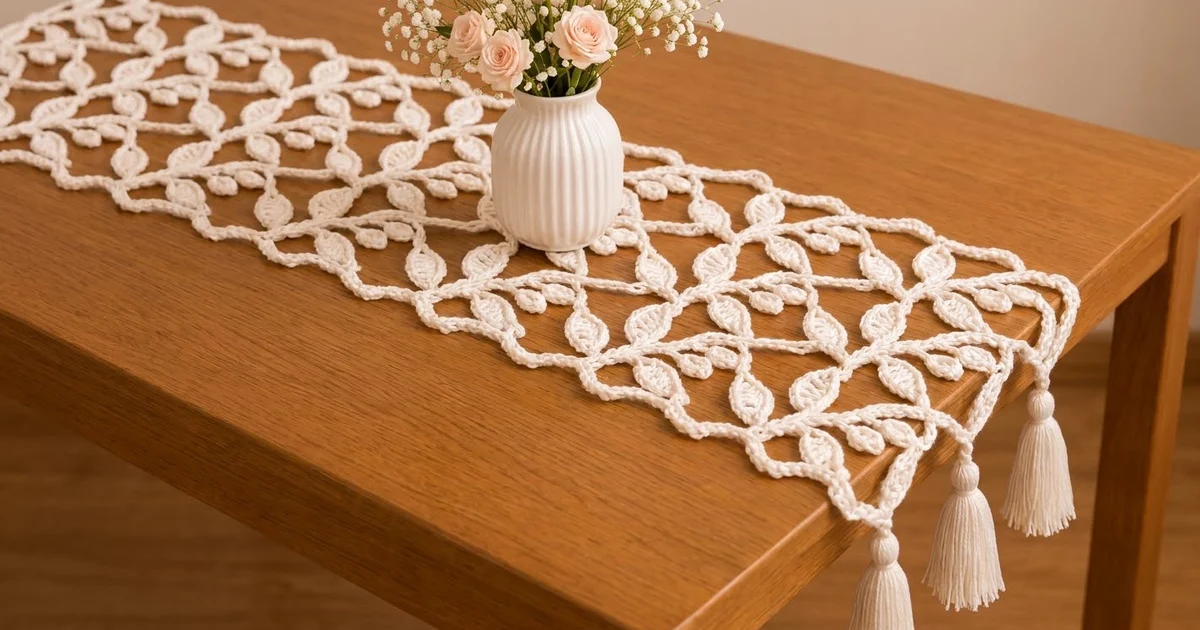
This runner is a cross between a vine and a lace net. Fifteen slim olive-branch strips are joined with crossing diagonal stems, so almond-shaped leaves and small round berries sit inside open diamonds. Each short end has three neat points, and each point carries a plump tassel.
The whole runner is one color: a soft ivory white. It looks calm and a little vintage on warm wood, and it suits a simple spring or wedding table. You could also use it all year on a sideboard.
The pattern uses US crochet terms. The finished runner measures 12.5 × 47 in (31.8 × 119.4 cm) from point to point. With the 4 in (10.2 cm) tassels at both ends, it is 55 in (139.7 cm) long overall.
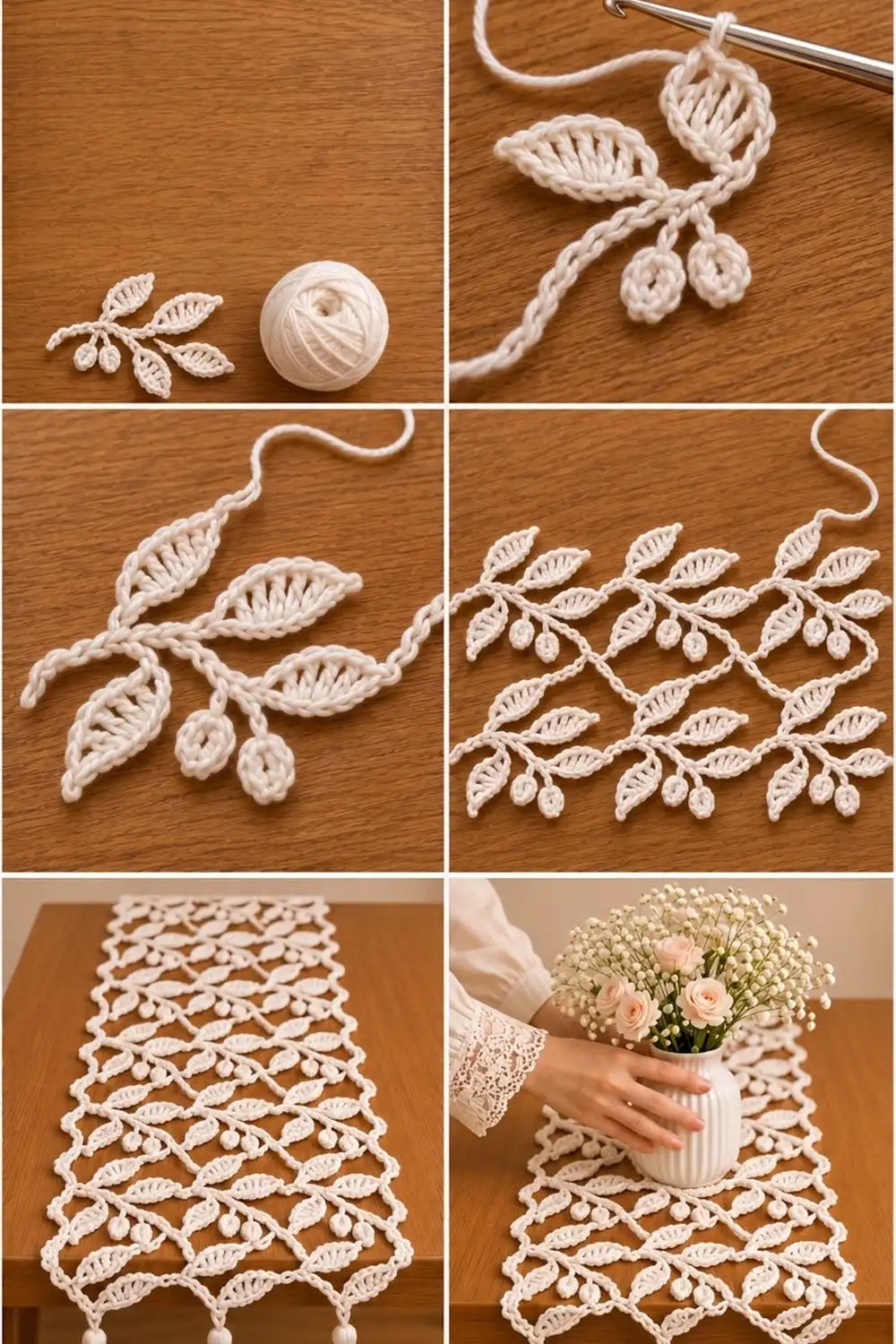
Construction is simple to follow. You make 15 identical vine strips. Each strip starts as a chain stem with leaves and berries built off it, then gets a single crochet pass back along the stem. Next you join the strips with two crossing chain zigzags per gap. Last, you add a border that straightens the long sides and shapes the pointed ends, then tie on six tassels.
Finished Size and Construction
- Finished size: 12.5 × 47 in (31.8 × 119.4 cm) point to point; 55 in (139.7 cm) including tassels
- Skill level: Intermediate
- Terminology: US
- Yarn weight: DK (#3) cotton
- Hook: 3.5 mm (E-4)
- Number of pieces: 15 identical vine strips
- Layout: 1 column of 15 strips, each running across the width, joined with a crossing-chain lattice
- Piece size: stem 12 in (30.5 cm) long; about 4.5 in (11.4 cm) tall with leaves and berries hanging free
- Size before border: 12 × 42 in (30.5 × 106.7 cm), measured stem to stem
- Border depth: about 0.25 in (0.6 cm) on the long sides; 2.5 in (6.4 cm) points on each short end
Materials
Yarn: Choose a smooth mercerized or combed DK cotton. Cotton holds the leaf shapes after blocking and keeps the lattice crisp. Avoid fuzzy or very stretchy yarns, because the chain stems will droop.
- Ivory white: 150 g, about 340 m
You will use about 265 m in total. That is roughly 135 m for the strips, 40 m for the lattice, 35 m for the border and 52 m for the tassels. The quantity above includes a margin of about 25% for swatching and dye-lot safety, so buy all of it at once.
Tools:
- 3.5 mm (E-4) crochet hook
- Tapestry needle
- Scissors
- Stiff card, 4 in (10.2 cm) tall, for tassels
- Rust-proof pins and a blocking surface at least 14 × 50 in (35.6 × 127.0 cm)
- Tape measure
- Spray bottle
Abbreviations (US Terms)
- ch – chain
- sl st – slip stitch
- sc – single crochet
- hdc – half double crochet
- dc – double crochet
- st(s) – stitch(es)
- sk – skip
- back bump – the horizontal bar on the back of a chain
Special stitches
Leaf: Ch 10. Sc in 2nd ch from hook, hdc in next ch, dc in next 5 ch, hdc in next ch, sc in last ch (9 sts; you are now at the base). Ch 1. Working along the opposite side of the foundation: sc in first ch, hdc in next ch, dc in next 5 ch, hdc in next ch, sc in next ch (9 sts; you are now at the tip). Ch 3, sl st in 3rd ch from hook (picot tip). Sl st in the skipped tip ch, then sl st in each of the 9 sts of the first side back to the base. Sl st in the stem ch at the base. The sl st return makes the corded outline, and the long dc center gives the ribbed look.
Berry Pair: *Ch 7, sl st in 4th ch from hook to form a ring, work 10 sc in the ring, sl st in first sc, sl st in each of the 3 stalk ch back to the stem; rep from * once more. Sl st in the stem ch at the base. Each berry is a small ring about 0.6 in (1.5 cm) across.
Gauge and Checkpoints
Gauge: 20 stem sc = 4 in (10.2 cm). One Leaf is 2 in (5.1 cm) long including the picot and about 0.9 in (2.3 cm) wide.
Test one full strip first. It is your swatch, and it will go into the runner.
Checkpoints:
- One strip: the stem measures 12 in (30.5 cm) lying flat.
- Three strips joined: stem 1 to stem 3 measures 6 in (15.2 cm).
- All strips joined: stem 1 to stem 15 measures 42 in (106.7 cm).
- After border: 12.5 in (31.8 cm) wide and 47 in (119.4 cm) point to point.
If your strip is too long, go down to a 3.25 mm hook. If it is too short, go up to a 3.75 mm hook. Change the hook, not the stitch count, so every number below still works.
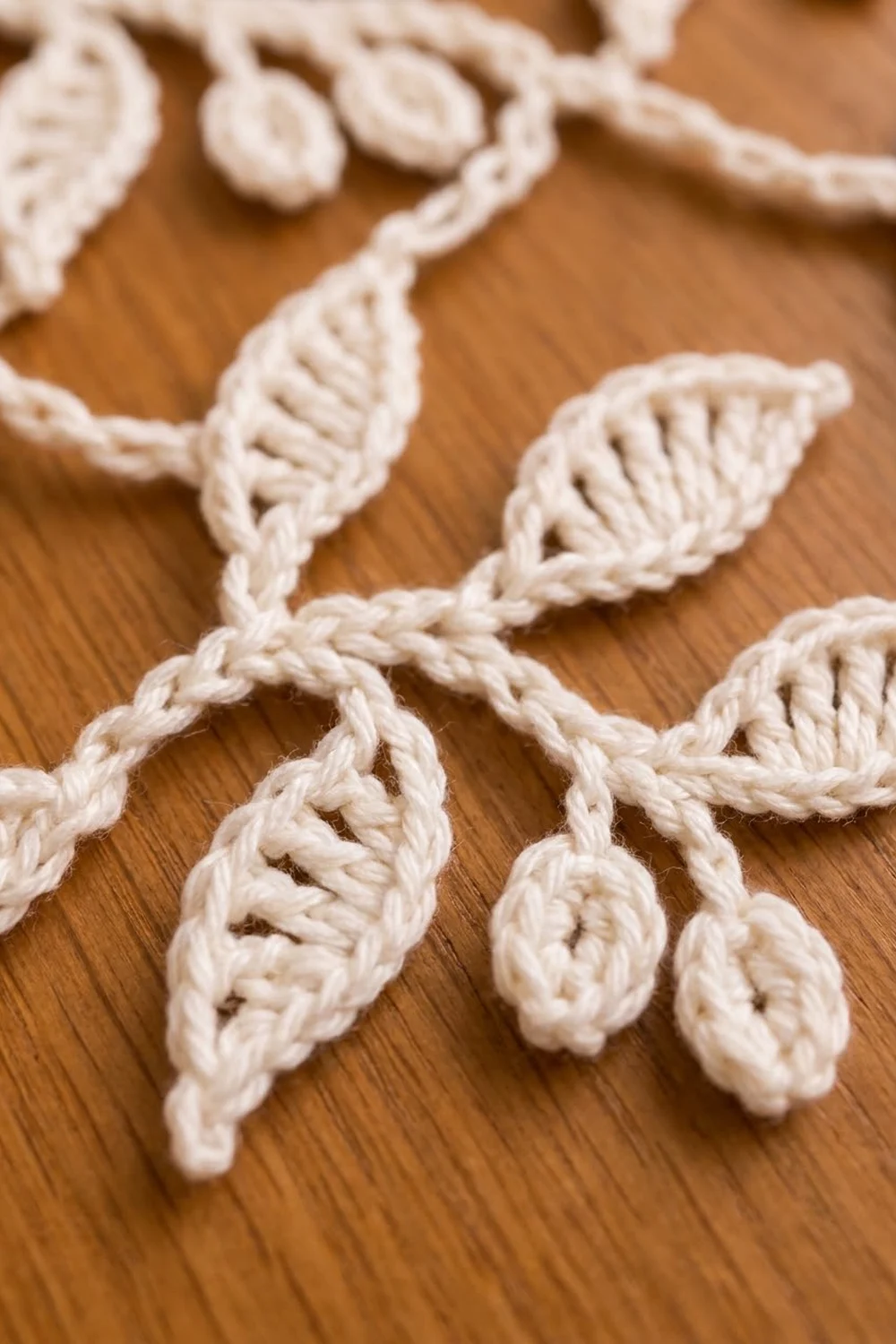
Vine Strip (make 15)
Each strip has 60 stem stitches, 4 leaves and 2 berry pairs. Features are spaced 10 stem chains apart, and each one is worked off the last stem chain you made.
Pass 1 (stem chain and features):
- Ch 5 (stem ch 1–5). Leaf at stem ch 5.
- Ch 10 (stem ch 6–15). Berry Pair at stem ch 15.
- Ch 10 (stem ch 16–25). Leaf at stem ch 25.
- Ch 10 (stem ch 26–35). Leaf at stem ch 35.
- Ch 10 (stem ch 36–45). Berry Pair at stem ch 45.
- Ch 10 (stem ch 46–55). Leaf at stem ch 55.
- Ch 5 (stem ch 56–60), then ch 1 for turning.
Count: 60 stem ch + 1 turning ch, 4 Leaves, 2 Berry Pairs. Leaf and berry chains are not stem chains, so they never change the stem count.
Pass 2 (corded stem): Sc in the back bump of the 2nd ch from hook and in the back bump of each stem ch across, stepping past each feature without working into it. (60 sc)
Fasten off and weave in the ends.
Counting from the first sc of Pass 2, the features now sit at sc 6 (Leaf), sc 16 (Berries), sc 26 (Leaf), sc 36 (Leaf), sc 46 (Berries) and sc 56 (Leaf). The layout is symmetrical, so both ends of the strip look the same.
Strip check: stem 12 in (30.5 cm); leaves 2 in (5.1 cm). Correct any difference now.
Make All Pieces
Make 15 strips in ivory white, about 9 m each. That gives 60 Leaves and 30 Berry Pairs (60 berries) in total.
Lay the strips in one column, all right side up, with sc 1 at the left. Space the stems 3 in (7.6 cm) apart:
END A   (3 points + 3 tassels)
Strip 1   ~~~~~~~~~~~~
          XXXXXXXXXXXX   gap 1
Strip 2   ~~~~~~~~~~~~
          XXXXXXXXXXXX   gap 2
Strip 3   ~~~~~~~~~~~~
   ...    (same pattern)
Strip 14  ~~~~~~~~~~~~
          XXXXXXXXXXXX   gap 14
Strip 15  ~~~~~~~~~~~~
END B   (3 points + 3 tassels)
Each ~ row is a 60-st strip, and each X row is a lattice gap. There are 14 gaps.
Joining
Each gap gets two crossing chain zigzags, which form the X-shaped stems and the diamond openings. Work with the right side up and keep the lattice chains behind the leaves.
The attachment points are sc 1, 10, 20, 30, 40, 50 and 60 of each stem, so every feature sits centered between two attachment points.
Lattice A: Join yarn with a sl st in sc 1 of the lower strip. Ch 16, sl st in sc 10 of the upper strip. Ch 16, sl st in sc 20 of the lower strip. Continue the same way: ch 16, upper sc 30; ch 16, lower sc 40; ch 16, upper sc 50; ch 16, lower sc 60. Fasten off. (6 segments, 96 ch)
Lattice B: Join yarn with a sl st in sc 1 of the upper strip. Ch 8, sl st around the middle of the Lattice A segment you are crossing, ch 8, sl st in the next attachment st on the opposite strip; rep from * 5 more times. The segments land on lower sc 10, upper sc 20, lower sc 30, upper sc 40, lower sc 50 and upper sc 60. Fasten off. (6 segments of 16 ch, 96 ch, 6 locking sl sts)*
Each gap uses 192 ch. Join strip 1 to strip 2, then join strip 3 to strip 2, and continue down the column.
Stitch-to-stitch logic: Each segment spans 9 or 10 stem sts across and about 2.7 in (6.9 cm) down. A 16-ch segment is 3.2 in (8.1 cm) long, which covers that diagonal with a little ease, so the stems stay straight.
Tension: Chain at the same tension as your stems. Tight chains pull the stems toward each other, and loose chains let the lattice sag. If your gap comes out short, add 1 ch to every segment in both lattices.
Size checkpoint: After 3 strips, stem 1 to stem 3 = 6 in (15.2 cm). After all 15, stem 1 to stem 15 = 42 in (106.7 cm).
Border
Border gauge: 5 sc = 1 in (2.5 cm). One strip-end st plus a 14-ch bridge = 15 sts = 3 in (7.6 cm), which matches the stem spacing.
Round 1 (frame): Join yarn in sc 1 of strip 1.
- Short end A: sc in each of the 60 stem sts of strip 1. (60 sc; the corners are sts 1 and 60)
- Long side 1: ch 14, sc in sc 60 of next strip; rep from * 13 more times, ending in sc 60 of strip 15, which is the first corner of end B. (14 bridges + 13 strip-end sc between the 2 corners)*
- Short end B: sc in each of the 60 stem sts of strip 15, working from sc 60 to sc 1. (60 sc)
- Long side 2: work as for long side 1, using sc 1 of strips 14 to 2, then ch 14 and sl st in the first sc of the round.
Round 1 total: 146 sc (120 on the ends + 26 on the sides) and 28 bridges of 14 ch.
Row 2 (long sides only): Join yarn in the corner st of long side 1. Sc in each sc and each ch to the opposite corner. (211 sc = 2 corners + 13 strip-end sc + 14 × 14 ch) Fasten off. Repeat on long side 2. (211 sc)
Row 3 (points, short ends only): Join yarn in st 1 of short end A. Ch 17, sl st in 3rd ch from hook (tip ring), ch 14, sk 18 sts, sl st in next st; sl st in next st; rep from * twice more, leaving out the final sl st. The points land on sts 1–20, 21–40 and 41–60. (3 points, each with two 14-ch sides and a 3-ch tip ring)* Fasten off. Repeat on short end B.
Round 4 (edging): Join yarn at st 1 of short end A.
- Each point: 14 sc along the first chain side, (2 sc, ch 3, 2 sc) in the tip ring, 14 sc along the second side, then sl st in each of the 2 notch sl sts (skip this after the third point). (32 sc + 1 ch-3 tip per point; 96 sc per end)
- Each long side: sl st in each sc. (211 sl sts)
Work end A, long side 1, end B and long side 2, then join with a sl st. Fasten off.
Tassels (make 6): Wrap yarn 40 times around the 4 in (10.2 cm) card. Thread a 10 in (25.4 cm) strand under the top loops, pass it through a ch-3 tip and tie it tightly. Cut the bottom loops. Wrap an 18 in (45.7 cm) strand around the neck 0.5 in (1.3 cm) below the top, tie it off and hide the ends inside. Trim the tassel to 4 in (10.2 cm).
Why the math works: The long sides follow the stem spacing exactly: 14 pitches × 15 sts + 1 = 211 sts. At 5 sts per inch, 211 sts = 42.2 in (107.2 cm), which is the 42 in (106.7 cm) body plus one stitch. The short ends split 60 sts into 3 × 20, so each point is centered on one-third of the width. Each point skips 18 sts and spans 3.8 in (9.7 cm). Its 14-ch sides are 2.8 in (7.1 cm) long and rise about 2 in (5.1 cm); the tip ring and edging bring the point to 2.5 in (6.4 cm). Row 2 and Round 4 add 0.25 in (0.6 cm) to each long side, so the 12 in (30.5 cm) width becomes 12.5 in (31.8 cm). The length is 42 + 2.5 + 2.5 = 47 in (119.4 cm).
Final Blocking
- Soak the runner in cool water for 10 minutes, then press the water out in a towel. Do not wring it.
- Lay it right side up on the blocking surface.
- Pin the long sides straight, 12.5 in (31.8 cm) apart.
- Pin each stem straight across, 3 in (7.6 cm) apart.
- Pin each lattice X so the diamonds open evenly.
- Arrange the leaves. On every strip, the leaves at sc 6 and 36 point up and the leaves at sc 26 and 56 point down. The berries hang down.
- Pin each point to a sharp tip 2.5 in (6.4 cm) beyond the end stem, for 47 in (119.4 cm) overall.
- Mist the tassels, smooth them straight and leave everything to dry completely.
Final Quality-Control Checklist
- 15 strips, each with 60 stem sc, 4 leaves and 2 berry pairs
- 14 gaps, each with two crossing lattices locked at every X
- Stems straight and 3 in (7.6 cm) apart
- Long sides: 211 sc and 211 sl sts each
- Each end: 3 points, 96 edging sc and 3 ch-3 tips
- 6 tassels, all 4 in (10.2 cm) long and tied firmly
- Width 12.5 in (31.8 cm); length 47 in (119.4 cm) point to point
- All ends woven in on the wrong side
Troubleshooting
Stems curve or ripple: Pass 2 was too tight or too loose. Rework it with a hook 0.25 mm larger or smaller.
Leaves curl: This is normal before blocking. Pin each leaf flat and let it dry fully.
Lattice sags: Your chains are loose. Remake the segments with 15 ch, or block firmly.
Strips pull together: Your chains are tight. Use 17 ch per segment.
Long side waves: The bridges are too long. Check for 14 ch per bridge and 211 sc per side.
Points look blunt: Pin the tip ring firmly during blocking, and check that each point skips exactly 18 sts.
Tassels splay: Wrap the neck tighter, then mist and smooth the tassels while they dry.
Care
Hand wash in cool water with mild soap, and dry flat, re-pinning the points and leaves if needed. Do not hang the runner to dry, because the lattice will stretch.
Final Notes
The whole runner rests on a short chain of measurements. Twenty stem sc measure 4 in (10.2 cm), so every strip is 12 in (30.5 cm). The stems sit 3 in (7.6 cm) apart, so 14 gaps make 42 in (106.7 cm). The border adds 0.25 in (0.6 cm) to each long side and a 2.5 in (6.4 cm) point at each end. That gives 12.5 × 47 in (31.8 × 119.4 cm), plus 4 in (10.2 cm) tassels. Check each measurement as you go, and the finished runner will lie flat and square.
Happy crocheting!