

The Ivory Lantern Lattice runner is an open, airy table runner made of lemon-shaped diamond frames, linked by tiny five-petal flowers. Each frame has a rope-textured inner ring and a band of fanned tall stitches that swells at the middle of each side. When the frames are joined they form a lattice of lanterns with star-shaped openings between them.
The runner uses one color: a soft ivory cotton. Because it’s all one color, the texture does the work. The stitch-height changes shape the frames, and the flowers add small round accents at every junction. Three tassels at each end finish the look.
This pattern uses US crochet terms. The finished runner measures 19 x 49 in (48.3 x 124.5 cm) from flower tip to flower tip. With tassels it measures 59 in (149.9 cm) long.
Construction is simple and modular. You make 24 diamond frames first. Then you make 59 small flowers and join them to the frame points as you go. The edge flowers form the scalloped border, so no border rounds are added. Six tassels finish the ends.
Finished Size and Construction
- Finished size: 19 x 49 in (48.3 x 124.5 cm); 59 in (149.9 cm) long including tassels
- Skill level: Intermediate (simple stitches; most of the work is careful joining)
- Terminology: US crochet terms
- Yarn weight: Worsted (#4) cotton or cotton blend
- Hook: 4.0 mm (G-6)
- Number of pieces: 24 diamond frames + 59 joining flowers + 6 tassels
- Layout: 3 frames across x 8 frames long
- Frame size: 5 in (12.7 cm) from point to point, measured both ways
- Flower size: 1.25 in (3.2 cm) across
- Frame-to-frame gap across one flower: 1 in (2.5 cm)
- Size before border: 19 x 49 in (48.3 x 124.5 cm); the edge flowers are the border
- Border depth: 1 in (2.5 cm) of flower beyond each outer frame point; no extra rounds
Materials
Yarn: Choose a smooth, matte worsted-weight cotton or cotton blend at about 190 m per 100 g. Cotton keeps its points crisp after blocking and holds the tall-stitch band upright. Avoid fuzzy or very stretchy yarn, because the open lattice can sag.
- Ivory / cream: 260 g (490 m)
Approximate yarn use:
– Each frame: about 11 m (24 frames = 264 m)
– Each flower: about 1.6 m (59 flowers = about 95 m)
– Each tassel: about 9.5 m (6 tassels = 57 m)
These amounts add up to about 416 m. The stated quantity includes a margin of about 15–20% for gauge differences and swatching.
Tools:
– 4.0 mm (G-6) crochet hook
– Tapestry needle
– Scissors
– Rustproof pins and a blocking mat at least 20 x 50 in (50.8 x 127.0 cm), or several interlocking mats
– Spray bottle
– Stiff card 5.5 in (14.0 cm) tall, for tassels
– Stitch markers (optional)
Abbreviations (US Terms)
- ch – chain
- sl st – slip stitch
- sc – single crochet
- hdc – half double crochet
- dc – double crochet
- tr – treble crochet (yarn over twice)
- sp – space
- st(s) – stitch(es)
- rep – repeat
Special stitches
- Petal: (hdc, dc, ch 1, dc, hdc) all in the same stitch. The ch-1 is the petal tip.
- Join-petal: (hdc, dc, sl st into the frame’s ch-3 point loop, dc, hdc) all in the same stitch. This replaces the ch-1 tip.
- Join-valley: sl st in the next sc, ch 1, sl st into the frame’s ch-3 point loop, ch 1, sl st in the same sc.
Gauge and Checkpoints
Base gauge: 18 sc = 4 in (10.2 cm) worked in rows with a 4.0 mm hook.
Make one complete frame and one flower before starting the rest. Check them at each stage:
- After Round 1: Pinch the four corners into a diamond. The inner opening should measure about 3 in (7.6 cm) from point to point.
- After Round 2: The frame should measure about 4.5 in (11.4 cm) from point to point, not counting the ch-4 loops.
- After Round 3: The frame should measure 5 in (12.7 cm) from point to point, not counting the ch-3 loops.
- Flower: 1.25 in (3.2 cm) across, from petal tip to the opposite valley.
If your frame is too big, go down to a 3.75 mm (F-5) hook. If it’s too small, go up to a 4.5 mm (7) hook. Being off by 0.25 in (0.6 cm) per frame changes the runner length by 2 in (5.1 cm), so it’s worth getting this right.
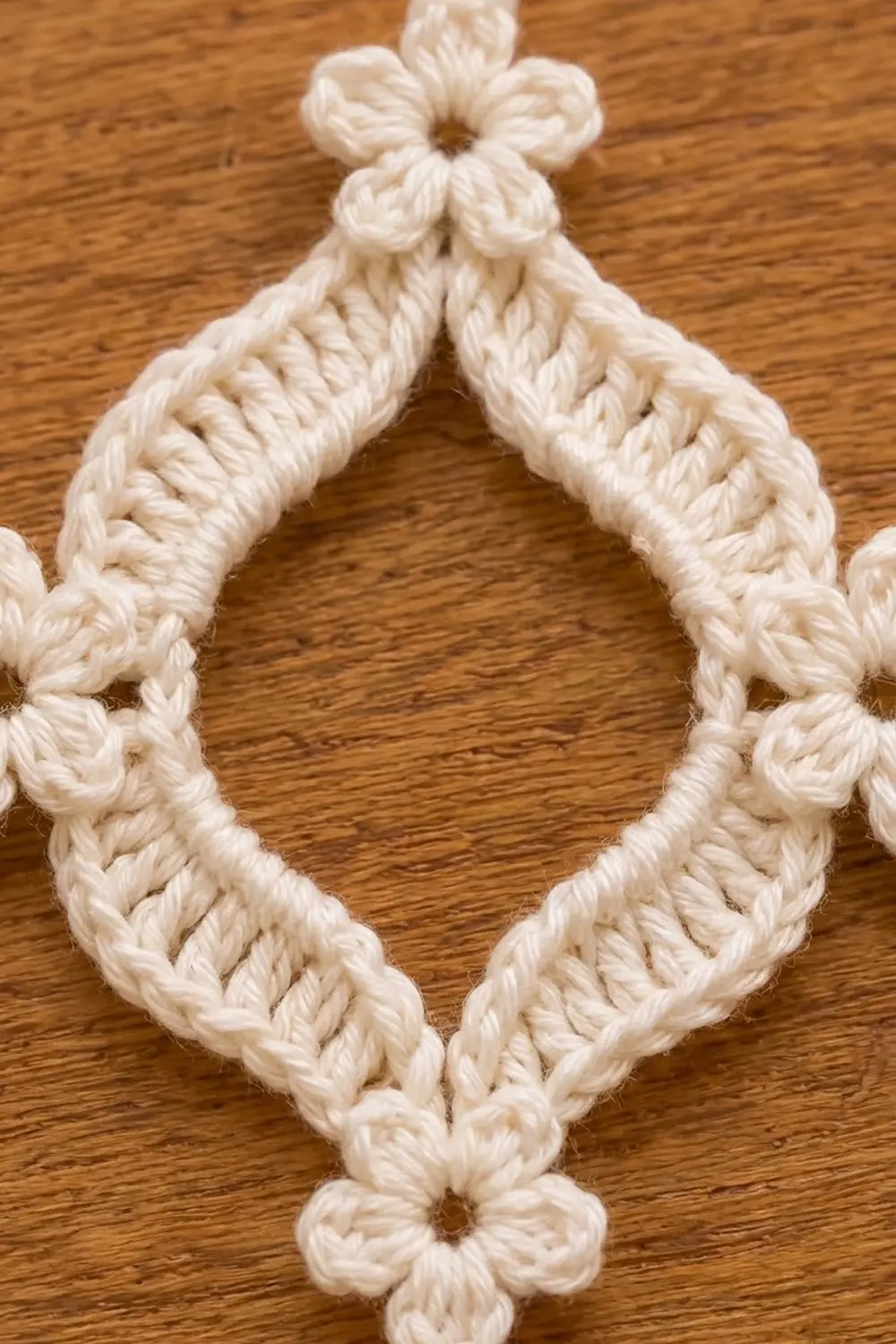
Diamond Frame (Make 24)
Ch 48 and sl st in the first ch to form a ring, taking care not to twist it.
Round 1 (inner ring): Ch 1 (does not count as a stitch). Work (sc, ch 2, sc) in the same ch as the join. Sc in each of the next 11 ch, then (sc, ch 2, sc) in the next ch. Rep from * 2 more times. Sc in each of the last 11 ch. Join with a sl st to the first sc.
Count: 52 sc + 4 ch-2 corner sps. There are 13 sc between each pair of corners: 1 corner sc + 11 sc + 1 corner sc.
This tight round of sc over the chain makes the rope-like inner edge.
Round 2 (fanned band): Sl st into the first ch-2 sp. Ch 1, then work (sc, ch 4, sc) in the same sp.
Side sequence: sc in the next sc, hdc in the next sc, dc in each of the next 2 sc, tr in each of the next 5 sc, dc in each of the next 2 sc, hdc in the next sc, sc in the next sc. That’s 13 sts.
(Sc, ch 4, sc) in the next ch-2 sp, then work the side sequence. Rep from * 2 more times. Join to the first sc.
Count: 60 sts + 4 ch-4 point loops. Each side has 13 band sts + 2 corner sc.
The stitches rise from sc to tr and back down. That makes the band narrow at the points and widest at the middle of each side, so the sides bow outward into the lantern shape.
Round 3 (outer edge, trim round): Sl st into the first ch-4 loop. Ch 1, then work (2 sc, ch 3, 2 sc) in the same loop. Sc in each of the next 15 sts, then (2 sc, ch 3, 2 sc) in the next ch-4 loop. Rep from * 2 more times. Sc in each of the last 15 sts. Join and fasten off.
Count: 60 sc (1 in each existing stitch) + 16 sc (4 added in each loop) = 76 sc + 4 ch-3 point loops. Each side between loops has 2 + 15 + 2 = 19 sc.
Weave in the ends along the outer sc edge so they don’t show in the open center. Check the 5 in (12.7 cm) measurement.
Joining Flower (Make 59, joined as you go)
Ch 4 and sl st in the first ch to form a ring.
Round 1: Ch 1, work 10 sc in the ring, and join to the first sc. (10 sc)
Round 2 (free flower): Sl st in the first sc, then work a petal in the next sc. Sl st in the next sc, petal in the next sc. Rep from * 3 more times. Join to the first sl st and fasten off.
Count: 5 petals (20 sts + 5 ch-1 tips) + 5 sl st valleys.
The open ring in the middle gives the flower its visible hole. Every flower in the runner is joined, so in practice you always work Round 2 with one or two joins.
Make All Pieces
All pieces use the same ivory yarn.
- Frames: 24 (about 264 m)
- Flowers: 59 (about 95 m). Of these, 37 are interior flowers that join two frames, and 22 are edge flowers that join one frame.
- Tassels: 6 (about 57 m)
Edge flowers: 3 at each short end and 8 on each long side = 6 + 16 = 22.
Check: 24 frames x 4 points = 96 points. The flowers make 37 x 2 + 22 x 1 = 96 joins. Every point is used exactly once.
Layout grid (M = frame, F = flower; the pattern repeats for 8 rows):
    F       F       F        <- end flowers + tassels
F   M   F   M   F   M   F    <- row 1
    F       F       F
F   M   F   M   F   M   F    <- row 2
    F       F       F
   ... repeat to row 8 ...
F   M   F   M   F   M   F    <- row 8
    F       F       F        <- end flowers + tassels
There are 9 rows of point flowers (3 each, 27 total) and 8 rows of side flowers (4 each, 32 total). That gives 27 + 32 = 59 flowers.
Joining
Method: Lay all 24 frames out face up in the 3 x 8 grid. Each frame sits on point, so its points face up, down, left, and right. Every point is a ch-3 loop.
Interior flowers (37): Work Rounds 1 and 2 of the flower with two joins:
– Work petal 1 as a join-petal into the point loop of the first frame.
– Work petals 2 and 3 as normal petals.
– Work the fourth valley as a join-valley into the point loop of the second frame.
– Finish petals 4 and 5 as normal petals.
Petal 1 and the fourth valley sit exactly opposite each other (180° apart), so the two frames line up in a straight line through the flower.
- Vertical junctions connect the bottom point of the upper frame to the top point of the lower frame.
- Side junctions connect the right point of the left frame to the left point of the right frame.
Edge flowers (22): Work petal 1 as a join-petal into the outer point loop and leave the other petals free. Turn the flower so its fourth valley points straight out. That’s where the tassels attach on the end flowers.
Stitch-to-stitch logic: Each join uses only the ch-3 point loop. No stitches are added to the frames, so each frame keeps its count of 76 sc + 4 loops.
Tension: Keep the join sl sts snug but not tight. A tight join puckers the point, and a loose one lets the lattice droop. Make sure the ch-3 loop isn’t twisted before you slip stitch into it.
Joining order: Work row by row. Start with the 3 top end flowers. Then do the side flowers of row 1 from left to right, then the vertical flowers between rows 1 and 2, and so on.
Size checkpoint: After rows 1–2 are joined, the piece should measure 19 in (48.3 cm) wide and 12 in (30.5 cm) from the top flower tips to the middle of the second row of point flowers. Each frame-plus-flower repeat is 6 in (15.2 cm).
Border (Edge Finish)
This design has no added border rounds. The 22 edge flowers form the scalloped border, matching the finished runner.
Border gauge: One edge flower every 6 in (15.2 cm), each sticking out 1 in (2.5 cm) beyond its frame point.
Counts per side:
– Each short end: 3 frames x 1 point flower per frame = 3 flowers
– Each long side: 8 frames x 1 side flower per frame = 8 flowers
Why the math works:
– Width: 3 frames x 5 in + 2 interior gaps x 1 in + 2 edge flowers x 1 in = 19 in (48.3 cm). This equals 3 repeats of 6 in plus 1 in.
– Length: 8 frames x 5 in + 7 interior gaps x 1 in + 2 end flowers x 1 in = 49 in (124.5 cm). This equals 8 repeats of 6 in plus 1 in.
The edge doesn’t add any stitches, so nothing ruffles or cups.
Tassels (Make 6)
- Wrap yarn 30 times around the 5.5 in (14.0 cm) card.
- Slide a 12 in (30.5 cm) strand under the top and tie it tightly. Leave the tails long for attaching.
- Cut the bottom loops.
- Wrap another strand 6 times around the bundle, 0.5 in (1.3 cm) below the top, to form the neck. Tie it off and bury the ends inside the tassel.
- Trim the tassel evenly to 5 in (12.7 cm).
- Use the top ties to attach one tassel to the outward-facing fourth valley of each end flower, 3 per end. Knot securely and hide the tails inside the tassel head.
Final Blocking
- Weave in all remaining ends before you block.
- Soak the runner in cool water for 10 minutes. Press out the water; don’t wring it.
- Roll it in a towel to remove excess moisture.
- Lay it flat on the mats and pin the outer edge to 19 x 49 in (48.3 x 124.5 cm).
- Pin every flower center so the grid stays square. Each frame should measure 5 in (12.7 cm) from point to point, and each flower gap should be 1 in (2.5 cm).
- Gently shape the bowed sides of each frame with your fingers so the tr band stands evenly.
- Let it dry completely, which takes 24 hours. Leave the tassels unpinned and comb them straight while they’re damp.
Final Quality-Control Checklist
- 24 frames, each 5 in (12.7 cm) from point to point, each with 76 sc + 4 ch-3 loops
- 59 flowers, each 1.25 in (3.2 cm) across
- 96 point loops, each joined exactly once
- Runner 19 x 49 in (48.3 x 124.5 cm), with straight long edges
- 6 tassels, each 5 in (12.7 cm) long, 3 at each end
- No twisted loops, loose ends, or puckered joins
Troubleshooting
- Frames are wavy: Your Round 2 tension is too loose. Go down a hook size, or tighten the tr stitches.
- Sides don’t bow out: Check that you worked 5 tr at the middle of each side, not dc.
- The lattice leans diagonally: One flower was joined at the wrong petal. The two joins must be at petal 1 and the fourth valley.
- The runner is too long: Your flowers are oversized. Remake them with a smaller hook.
- Tassels look skimpy: Increase to 35 wraps. Allow about 1.5 m more yarn for each tassel.
Care
Hand wash cool, roll in a towel, and dry flat, pinning back to 19 x 49 in (48.3 x 124.5 cm) if needed. Comb the tassels while damp.
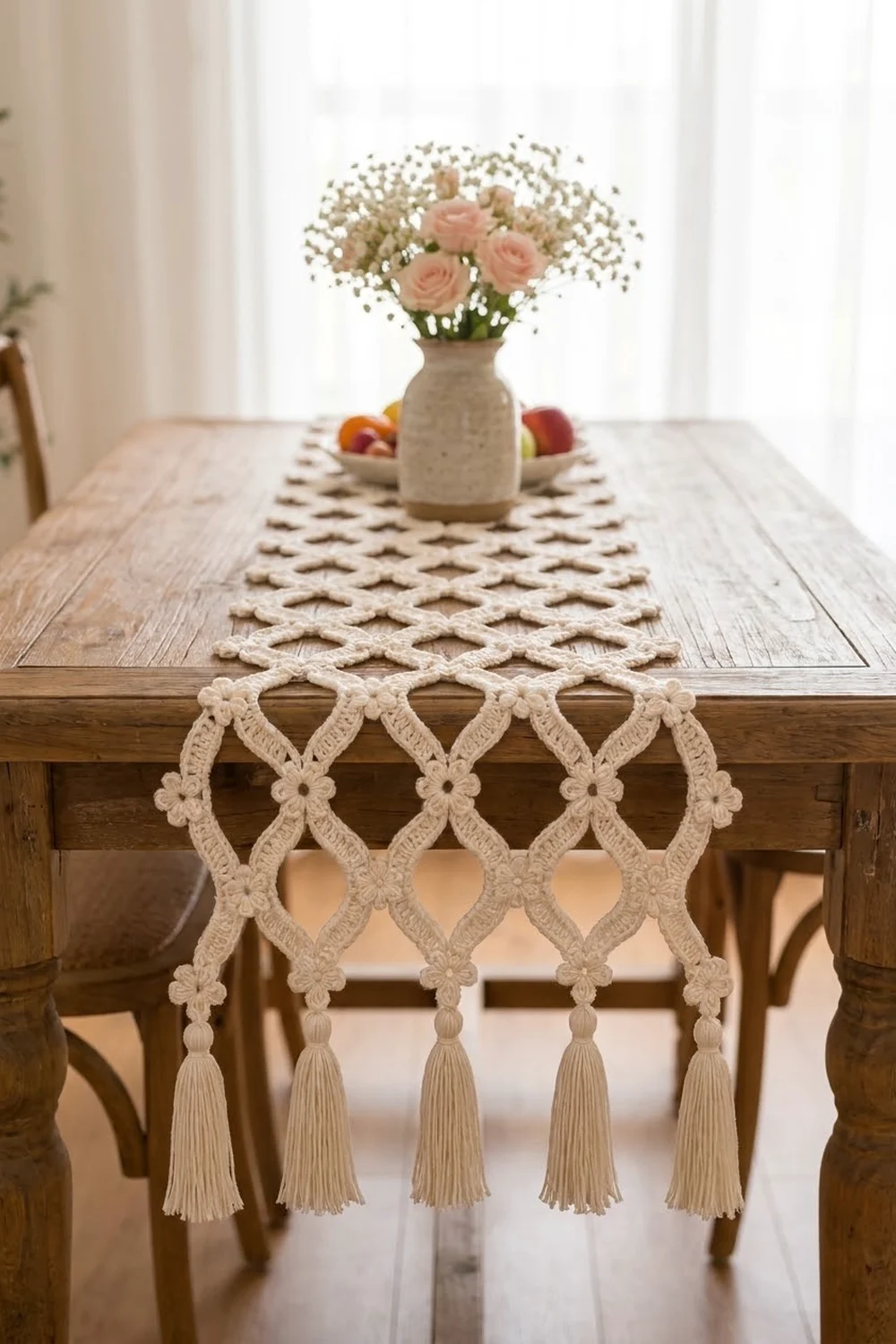
Final Notes
The measurement chain is simple:
1. Frame gauge gives a 5 in (12.7 cm) frame.
2. One flower adds 1 in (2.5 cm), giving a 6 in (15.2 cm) repeat.
3. 3 x 8 repeats plus 1 in on each dimension gives a 19 x 49 in (48.3 x 124.5 cm) runner.
4. Six 5 in (12.7 cm) tassels bring the total length to 59 in (149.9 cm).
Check the first frame carefully, and the rest of the runner falls into place.
Happy crocheting!