
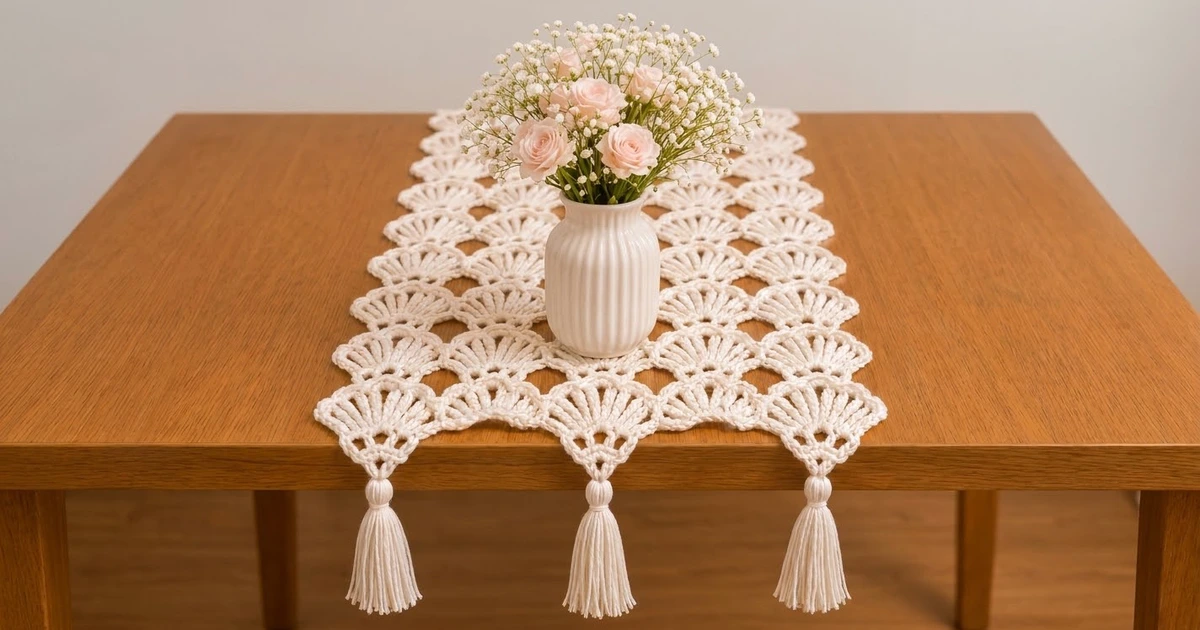
The Seashell Lace Fan Table Runner is made from small open fan motifs, each shaped like a scallop shell. Seven tall ribs spread out from a tiny base with slim gaps between them, and a soft scalloped edge runs across the top. Three small arches at the base and a chain loop on each side give the motif its lacy look.
The runner uses one color, a warm ivory cotton. It looks clean and a little vintage and works well on a wooden table, a sideboard, or under a spring centerpiece. A thick tassel hangs from each end column, three tassels per end.
This pattern uses US crochet terms. The finished runner measures 13.5 in (34.3 cm) wide and 42 in (106.7 cm) long. Tassels of about 5 in (12.7 cm) hang from each end.
Construction is simple. Make one test motif first. Then work the rest with a join-as-you-go method in the final round. The runner is 3 motifs wide and 12 motifs long, for 36 motifs in total. There is no added border because the motif scallops are the finished edge. Tassels finish both ends.
Finished Size and Construction
- Finished size: 13.5 in x 42 in (34.3 cm x 106.7 cm), not counting tassels
- Skill level: Intermediate (join-as-you-go)
- Terminology: US
- Yarn weight: DK / light (#3) cotton
- Hook: 4.0 mm (G-6)
- Number of pieces: 36 fan motifs, joined as you go
- Layout: 3 motifs across x 12 motifs long
- Motif size: 4.5 in wide x 3.5 in tall (11.4 cm x 8.9 cm)
- Size before border: 13.5 in x 42 in (34.3 cm x 106.7 cm)
- Border depth: 0 in (0 cm), because the motif edges are the border
- Tassels: 6, each about 5 in (12.7 cm) long
Materials
Choose a smooth mercerized cotton or cotton blend in DK weight. Mercerized cotton shows the ribs and scallops clearly and blocks crisply. Avoid fuzzy or very stretchy yarn, which blurs the openwork and makes the runner sag over time.
- Ivory (only color): 250 g, about 525 m (574 yd), based on 50 g balls of about 105 m (115 yd)
- Motifs: about 10 m (11 yd) each, 360 m (394 yd) total
- Tassels: about 8 m (9 yd) each, 48 m (52 yd) total
Tools:
- 4.0 mm (G-6) crochet hook
- Tapestry needle
- Scissors
- Stitch markers
- Stiff card 5 in (12.7 cm) tall, for the tassels
- Blocking mats, rust-proof pins, and a spray bottle
- Measuring tape
The quantities include a margin of about 25%. This covers gauge differences, the test motif, and weaving in ends. Buy all the balls from one dye lot so the ivory matches across the runner.
Abbreviations (US Terms)
- ch: chain
- sl st: slip stitch
- sc: single crochet
- dc: double crochet
- tr: treble crochet
- sp: space
- st(s): stitch(es)
- RS / WS: right side / wrong side
- rep: repeat
Special stitch, Loop Join: In place of a ch-4 loop, ch 2, sl st around the matching ch-4 loop of the finished neighbor motif, then ch 2. The joined loop still counts as a ch-4 loop.
Special stitch, Point Join: After the stated sc, insert the hook from front to back through the stated sc of the finished motif below. Yarn over and pull through that stitch and the loop on your hook.
Gauge and Checkpoints
Make one complete motif before you start joining. Block it lightly and measure it. Every runner measurement depends on this one piece.
Checkpoints for one motif:
- After Row 1: 1.75 in (4.4 cm) wide x 1 in (2.5 cm) tall
- After Row 2: 4 in (10.2 cm) wide x 3 in (7.6 cm) tall
- After Rnd 3: 4.5 in (11.4 cm) wide x 3.5 in (8.9 cm) tall
Measure the width across the widest point of the top scallops. Measure the height from the bottom-center sc to the center of the top edge.
If your motif is too big: switch to a 3.75 mm (F-5) hook, or check that you are not pulling your tr stitches extra tall.
If your motif is too small: switch to a 4.5 mm (7) hook. Make sure the ch-2 spaces in Row 2 are not tight, because they control how far the fan spreads.
A difference of 0.25 in (0.6 cm) per motif adds up to 0.75 in (1.9 cm) across the width and 3 in (7.6 cm) along the length, so it is worth matching closely.
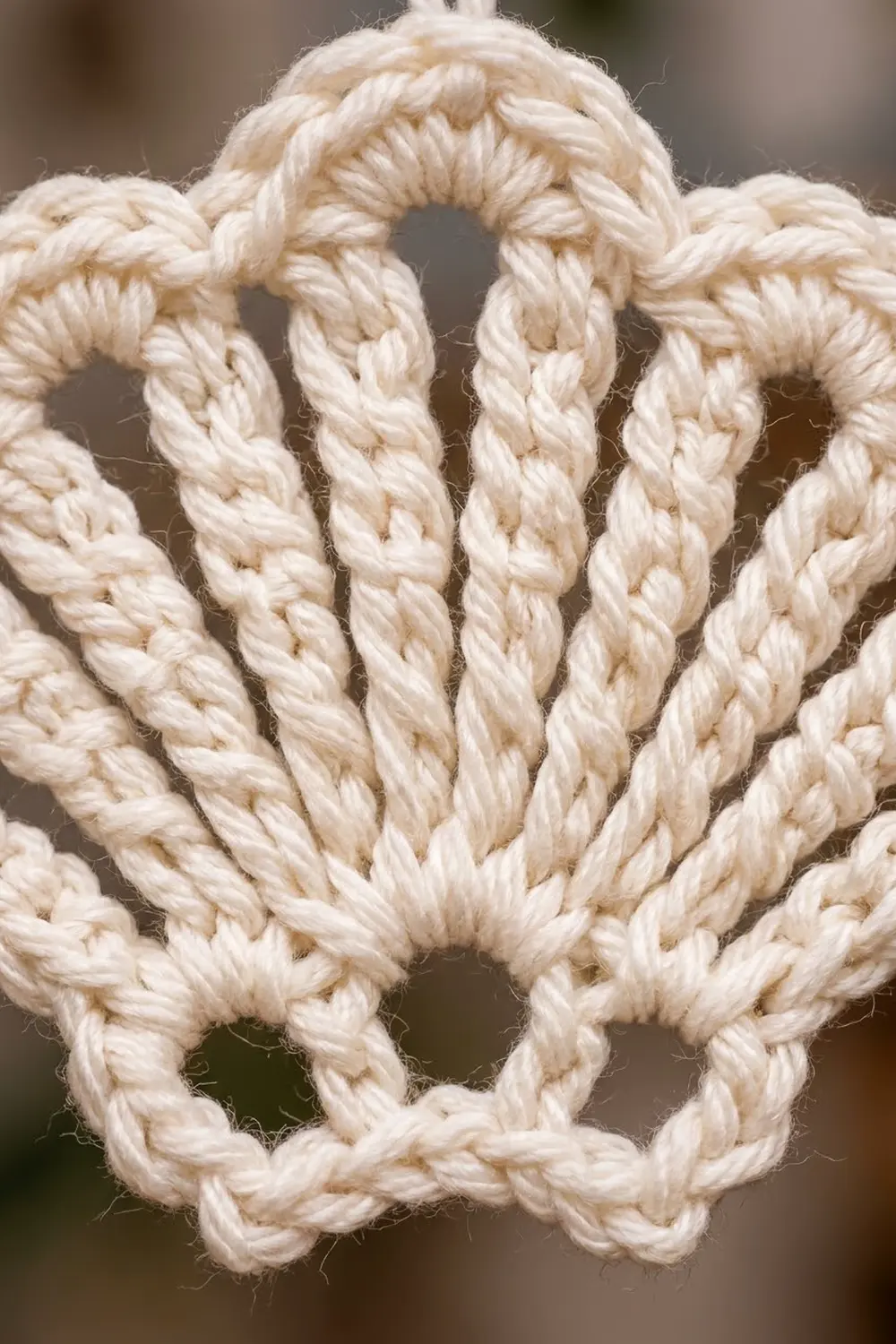
Fan Motif
You work the motif in two short rows from a ring, then finish it with one outline round that goes all the way around.
Ring: Ch 5, sl st in the first ch to form a ring.
Row 1 (RS): Ch 3 (counts as dc), [ch 2, dc in ring] 3 times. Turn.
Count: 4 dc and 3 ch-2 spaces. These 3 spaces become the small arches at the base. Keep the dc on the upper half of the ring so they form a half circle. The lower half of the ring stays free.
Row 2 (WS): Ch 4 (counts as tr), ch 2, tr in next ch-2 sp, ch 2, tr in next dc, ch 2, tr in next ch-2 sp, ch 2, tr in next dc, ch 2, tr in next ch-2 sp, ch 2, tr in top of beginning ch-3. Turn.
Count: 7 tr and 6 ch-2 spaces. These are the seven ribs of the fan: one in each stitch and one in each space of Row 1.
Rnd 3 (RS, outline): This round works across the top, then down the sides and around the base, and closes into a ring.
- Top edge: Ch 1, sc in first tr, [3 sc in next ch-2 sp, sc in next tr] 6 times. Work the last sc in the top of the beginning ch-4.
Top count: 7 sc on the ribs + 18 sc in the spaces = 25 sc. Place a marker in the 13th sc. This is the top-center point. - First side loop: Ch 4, sc around the post of the Row 1 stitch at this end of the base.
- Base loops: Ch 4, sc in the free lower half of the ring at center bottom. Ch 4, sc around the post of the Row 1 stitch at the opposite end.
- Second side loop: Ch 4, sl st in the first sc of the round.
Rnd 3 count: 28 sc (25 top + 3 base) and 4 ch-4 loops. The 2 side loops form the open “wings” at the lower corners. The 2 base loops frame the three small base arches from below.
Fasten off the test motif. Block it to 4.5 in x 3.5 in (11.4 cm x 8.9 cm) before you continue.
Make All Pieces
You need 36 ivory motifs. Motif 1 is your test motif. Work Motifs 2 to 36 through Row 2 as written, then work Rnd 3 with the joins described below.
Work the runner one row at a time, left to right, starting at the tassel end. All motifs point the same way, with the base toward the starting end and the scallops toward the far end.
Row 12:  M34  M35  M36   (far end, scallops)
Row 11:  M31  M32  M33
Row 10:  M28  M29  M30
Row 9:   M25  M26  M27
Row 8:   M22  M23  M24
Row 7:   M19  M20  M21
Row 6:   M16  M17  M18
Row 5:   M13  M14  M15
Row 4:   M10  M11  M12
Row 3:   M7   M8   M9
Row 2:   M4   M5   M6
Row 1:   M1   M2   M3    (start end, bases + tassels)
Joining
All joining happens in Rnd 3, using the two special joins.
Side joins (Loop Join): Motifs side by side in the same row meet at their side loops. When a side loop faces a finished motif, work a Loop Join in place of that ch-4. Each motif in columns 2 and 3 joins to the motif on its left with one Loop Join. That is 2 side joins per row, 24 in total.
Rnd 3 always travels in one direction, so the side loop that faces your left neighbor may be the first or the second one. Hold the new motif RS up with the base toward you, and join whichever side loop touches the neighbor.
Base joins (Point Join): From Row 2 of the runner onward, each motif’s base sits on the top-center point of the motif below it. When you work the sc in the ring at center bottom, follow it with a Point Join into the marked 13th sc of the motif directly below. That is 3 base joins per row for Rows 2 to 12, 33 in total.
Stitch logic: Each join either replaces chains or follows an existing sc, so the joins add no stitches to the motif counts. Every motif still has 28 sc and 4 loops, and every loop still works as a ch-4.
Tension: Keep the ch-2 halves of each Loop Join at the same tension as your normal chains. Tight joins pucker the runner and pull the motifs closer than 4.5 in (11.4 cm) apart. Loose joins make the oval gaps sag.
Size checkpoint: After Row 2 of the runner (6 motifs), the piece should measure 13.5 in (34.3 cm) wide x 7 in (17.8 cm) long. After Row 4, it should measure 14 in (35.6 cm) long. If it doesn’t, check your joins before going further.
Border (Edge Finish) and Tassels
This runner has no stitched border round. The scalloped top edges, side loops, and base arches already make a finished lace edge, and a border would hide the shell shape.
Border gauge: 0 rounds, 0 in (0 cm) deep.
Why the math works: The width is 3 motifs x 4.5 in = 13.5 in (34.3 cm). The length is 12 motifs x 3.5 in = 42 in (106.7 cm). With no border, the size before the border is the final size.
Tassels (make 6):
- Wrap yarn 30 times around the 5 in (12.7 cm) card.
- Slide a 12 in (30.5 cm) tie strand under the wraps at the top and knot it tightly.
- Cut through the wraps at the bottom edge of the card.
- Wrap a 20 in (50.8 cm) strand 8 times around the tassel, 0.75 in (1.9 cm) below the top. Knot it and bury the ends inside the tassel.
- Trim the strands evenly to 5 in (12.7 cm).
Attaching: At the start end, tie one tassel to the bottom-center sc of each of Motifs 1, 2, and 3. At the far end, tie one tassel to the marked 13th sc of each of Motifs 34, 35, and 36. Pass the tie strands through the stitch, knot twice on the WS, and bury the tails inside the tassel head.
Final Blocking
- Weave in all ends before blocking. The tassel ties are already secured.
- Mark a 13.5 in x 42 in (34.3 cm x 106.7 cm) rectangle on your blocking mats.
- Lay the runner RS up inside the rectangle.
- Pin each side join and each base join first, keeping the motifs on a grid of 4.5 in (11.4 cm) by 3.5 in (8.9 cm).
- Pin each top scallop point and each side loop so the ribs fan out evenly.
- Mist the runner until it is damp but not soaked. Pat the ribs straight with your fingers.
- Let the tassels hang off the mat. Leave everything to dry fully, then unpin.
- Comb the tassels with your fingers and trim any long strands.
Final Quality-Control Checklist
- 36 motifs in a 3 x 12 layout, all facing the same direction
- Every motif has 7 tr ribs and 6 ch-2 spaces
- Every motif has 25 sc across the top and 3 sc at the base
- 24 side joins and 33 base joins, with none skipped
- Width is 13.5 in (34.3 cm) at every row
- Length is 42 in (106.7 cm) along each long edge
- 6 tassels, each about 5 in (12.7 cm) long
- All ends woven in on the WS
Troubleshooting
The fan cups instead of lying flat. Either the ch-2 spaces in Row 2 are too tight or Rnd 3 is missing sc. Check that every space has 3 sc.
The fan ruffles. You may have worked 4 sc in some spaces. Recount the top edge; it should have 25 sc.
Motifs overlap at the sides. Your Loop Joins are too tight. Keep each ch-2 relaxed.
The runner curves to one side. One column is a different height from the others. Check that every base join goes into the 13th sc, not the 12th or 14th.
The base arches close up. The dc in Row 1 crept around the whole ring. Keep them on the upper half.
The tassels look thin. Use 35 wraps instead of 30, and allow about 1 m (1.1 yd) more yarn per tassel.
Care
Hand wash in cool water with mild soap, roll the runner in a towel to remove water, and dry it flat. If the scallops lose their shape, pin it again to the blocking measurements.
Final Notes
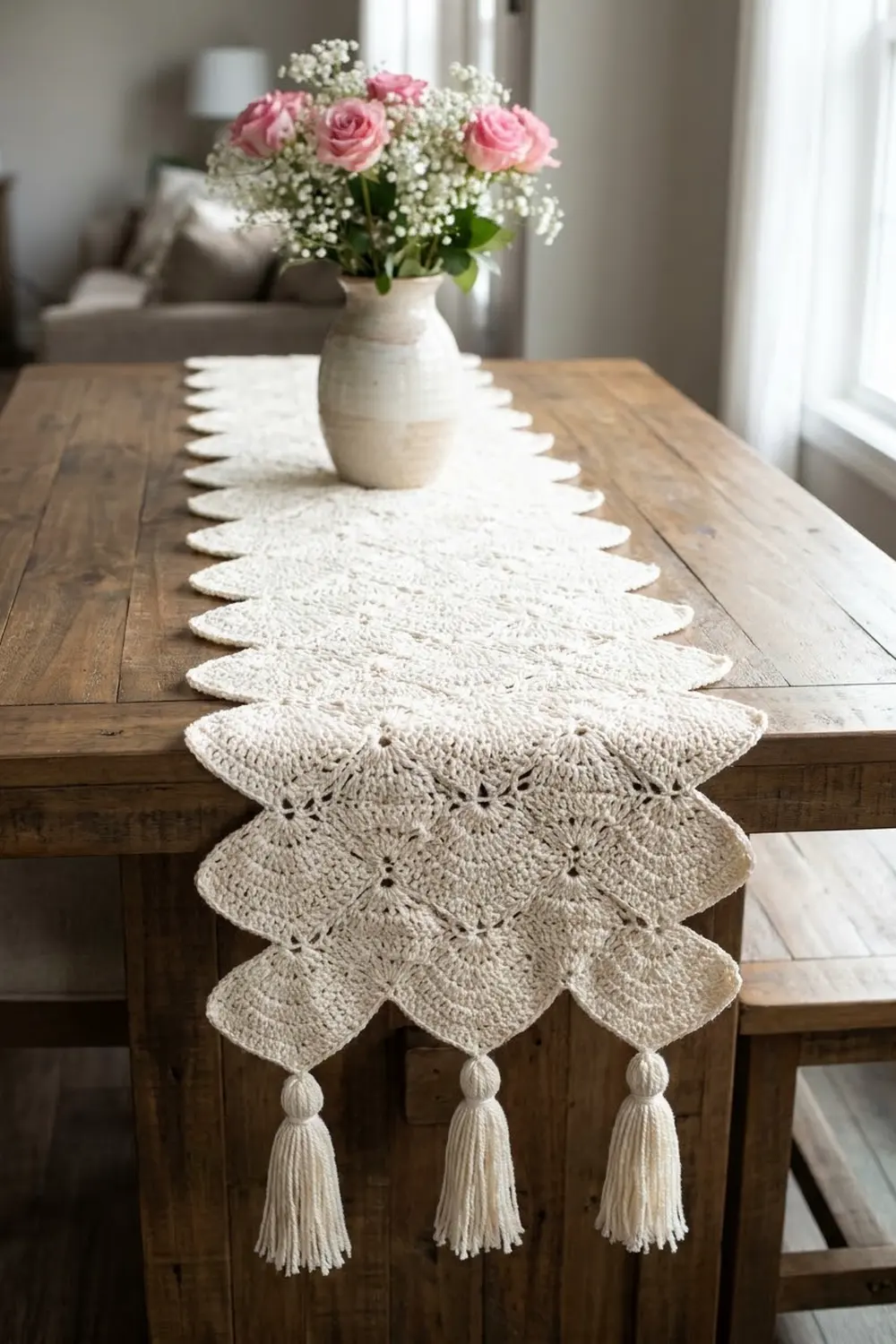
The whole runner depends on one chain of measurements. Row 1 sets a base 1.75 in (4.4 cm) wide. Row 2 spreads the fan to 4 in x 3 in (10.2 cm x 7.6 cm). Rnd 3 finishes each motif at 4.5 in x 3.5 in (11.4 cm x 8.9 cm). Three motifs across give 13.5 in (34.3 cm), and twelve rows give 42 in (106.7 cm). There is no border to add, so that is the final size, finished with six 5 in (12.7 cm) tassels.
Match your test motif closely and keep the joins relaxed, and the rest of the runner will follow.
Happy crocheting!