
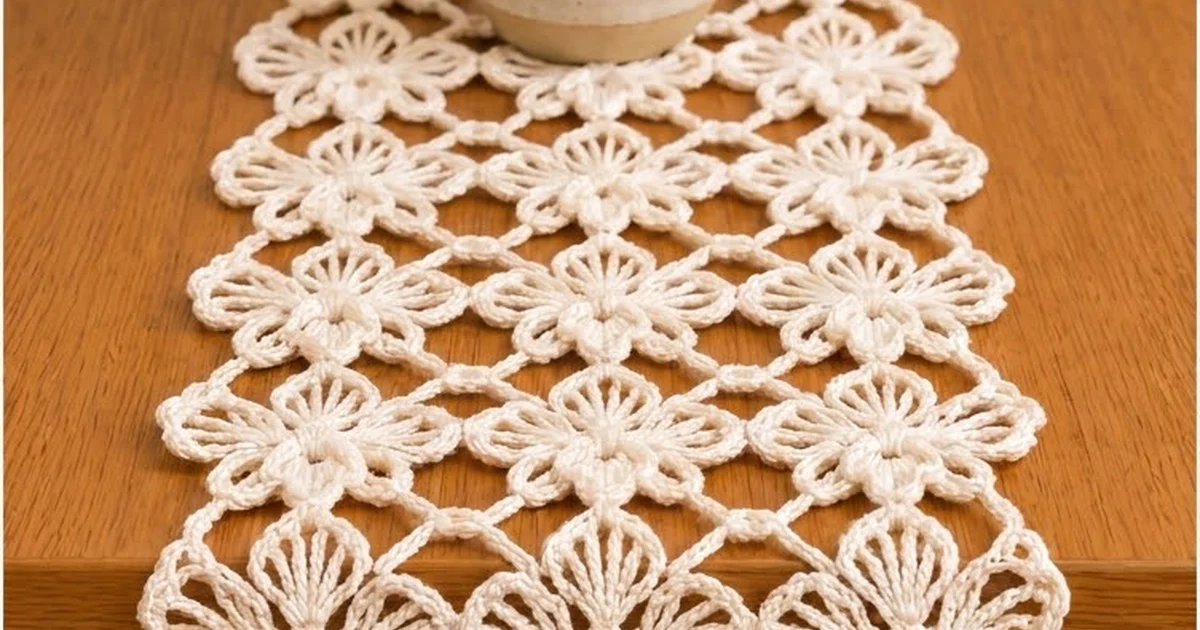
This table runner is made from soft cream flower motifs set three across. Each flower has three large fan petals with open spokes, two smaller lower petals, and a raised, scalloped lip that curls forward over a small open center. Diagonal chain bars meet in small rings between the flowers, so the runner looks light and airy on a wood table.
The whole runner uses one color, a warm ivory cotton. It looks vintage and romantic, and it is simple enough for a modern dining table, sideboard, or entry console. Tassels hang from each end flower and add a little weight to the ends.
The pattern uses US crochet terms. The finished runner measures 12 in (30.5 cm) wide and 49 in (124.5 cm) long without tassels, or 55 in (139.7 cm) including the 3 in (7.6 cm) tassels at both ends.
Construction is simple and repeats. You crochet 30 flower motifs in the round and join them side to side with join-as-you-go on the last petal round. Then you add 18 small lattice fillers in the spaces where four flowers meet. There is no solid border. The edge is made by the flowers’ own outlined petals, and tassels finish the short ends.
Finished Size and Construction
- Finished size: 12 in x 49 in (30.5 cm x 124.5 cm), plus 3 in (7.6 cm) tassels at each end
- Skill level: Intermediate
- Terminology: US crochet terms
- Yarn weight: DK / light worsted (#3) cotton
- Hook: 3.5 mm (E-4)
- Number of pieces: 30 flower motifs + 18 lattice fillers + 6 tassels
- Layout: 3 motifs wide x 10 motifs long
- Piece size: 4 in (10.2 cm) across from side petal tip to side petal tip, and 4 in (10.2 cm) tall from top petal tip to lip, after blocking
- Size before border: 12 in x 49 in (30.5 cm x 124.5 cm)
- Border depth: 0 in (0 cm). The petal outline round is the finished edge, with no extra border rounds
Materials
Pick a smooth, mercerized or combed cotton in DK weight. Cotton holds the open petal spokes crisply after blocking and handles washing well. Avoid fuzzy or very splitty yarns, since the lattice bars and spokes need clean stitch definition.
- Ivory / cream: 150 g, about 360 m (394 yd), for example three 50 g balls of about 120 m (131 yd) each
Approximate use: about 7 m (7.7 yd) per motif (210 m total), about 1.2 m (1.3 yd) per filler (22 m total), and about 4 m (4.4 yd) per tassel (24 m total). That is roughly 256 m. The quantity listed includes a comfortable margin for gauge differences and test swatches.
Tools:
- 3.5 mm (E-4) crochet hook
- Tapestry needle
- Stitch markers (at least 2)
- Scissors
- Stiff card 5 in (12.7 cm) tall for the tassels
- Blocking mats, rust-proof pins, and a spray bottle
- Tape measure
Abbreviations (US Terms)
- ch – chain
- sl st – slip stitch
- sc – single crochet
- dc – double crochet
- tr – treble crochet
- sp(s) – space(s)
- st(s) – stitch(es)
- BLO / FLO – back loop only / front loop only
- RS – right side
Special technique – Join-as-you-go tip (JAYG tip): When you reach the tip sc of a petal that should join a neighbor, insert the hook from front to back into the matching tip sc of the finished neighbor and sl st. Then work the tip sc of the current motif as usual. The sl st is not counted, so the petal’s sc count does not change.
Gauge and Checkpoints
Gauge isn’t critical for fit, but it controls the final length and how much yarn you use. Crochet one full motif first, including the lip, and block it before you start the rest.
Checkpoints for one motif (lightly stretched flat):
- After Round 1: center ring about 0.75 in (1.9 cm) across
- After Round 2: about 2 in (5.1 cm) across the chain loops
- After Round 3: about 3.5 in (8.9 cm) from side petal tip to side petal tip
- After Round 4 and blocking: 4 in (10.2 cm) wide and 4 in (10.2 cm) tall
If your motif is too big, go down to a 3.25 mm (D-3) hook. Also check that your treble crochets aren’t pulled extra tall.
If your motif is too small, go up to a 3.75 mm (F-5) hook, or loosen the ch-2 spaces between spokes.
Each 0.25 in (0.6 cm) of difference per motif changes the runner by 0.75 in (1.9 cm) in width and 2.5 in (6.4 cm) in length, so it’s worth matching.
Flower Motif (make 30)
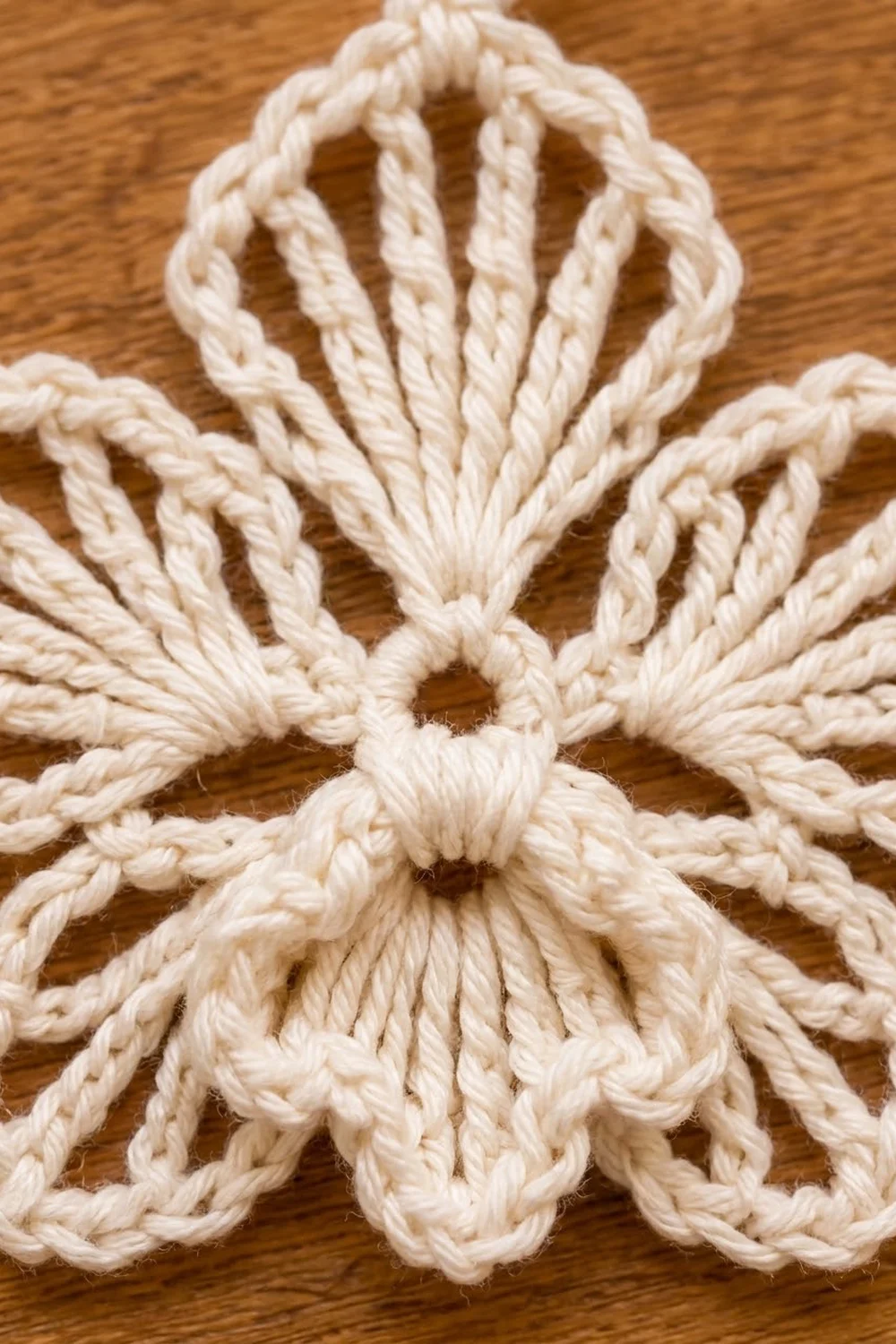
Hold the motif with the RS facing you throughout. In Round 2 you make 5 loops. Loops 1, 2 and 3 become the large fan petals: loop 1 is one side petal, loop 2 is the top petal, and loop 3 is the other side petal. Loops 4 and 5 become the two smaller lower petals. The lip sits between loops 4 and 5.
Round 1: Ch 6, sl st in first ch to form a ring. Ch 1, 15 sc in ring, sl st in first sc to join. (15 sc)
Number the sts 1 to 15 in your head, with st 1 as the first sc. Place a marker in st 13. This is the center bottom.
Round 2 (BLO): Ch 1. Working in BLO only, sc in st 1, [ch 7, skip 2 sts, sc in next st] 3 times (sc in sts 4, 7, 10), ch 5, skip 2 sts, sc in st 13, ch 5, skip last 2 sts, sl st in first sc to join. (5 sc, 3 ch-7 loops, 2 ch-5 loops)
The front loops of Round 1 stay free. You’ll use 5 of them for the lip later.
Round 3 (petal spokes): Sl st into first ch-7 loop. Ch 4 (counts as tr), [ch 2, tr] 6 times in same loop. This makes the first large petal: 7 tr and 6 ch-2 sps.
Sc in next sc.
In next ch-7 loop: tr, [ch 2, tr] 6 times. Sc in next sc. Repeat in the third ch-7 loop, then sc in next sc.
In next ch-5 loop: dc, [ch 2, dc] 4 times. Sc in next sc. Repeat in the last ch-5 loop. Sc in the first sc of Round 2 and sl st in top of beginning ch-4 to join.
(3 large petals of 7 tr and 6 ch-2 sps each; 2 small petals of 5 dc and 4 ch-2 sps each; 5 sc between petals)
Round 4 (petal outline): Ch 1.
Large petal: sc in first tr, [3 sc in ch-2 sp, sc in next tr] 6 times. (25 sc. The tip is sc 13, worked in the center tr.)
Sl st in next sc between petals.
Repeat for the other two large petals.
Small petal: sc in first dc, [2 sc in ch-2 sp, sc in next dc] 4 times. (13 sc. The tip is sc 7, worked in the center dc.)
Sl st in next sc between petals. Repeat for the second small petal. Sl st in first sc to join.
(101 sc: 3 x 25 + 2 x 13, plus 5 sl sts. Sl sts are not counted.)
Check: 25 = 7 sc into spokes + 6 x 3 sc into spaces. 13 = 5 sc into spokes + 4 x 2 sc into spaces.
Fasten off on the first motif. On later motifs, use JAYG tips in Round 4 as described in Joining.
Lip, Row 1 (FLO): Turn the motif so the marked st 13 is at the bottom. Join yarn in the free front loop of st 11. Ch 3 (counts as dc), dc in same loop, 2 dc in FLO of sts 12, 13 and 14, dc in FLO of st 15. (9 dc)
Lip, Row 2 (scallops): Ch 1, turn. Sc in first dc, skip 1, 5 dc in next, skip 1, sc in next (the center st), skip 1, 5 dc in next, skip 1, sc in top of turning ch. (13 sts: 3 sc + 10 dc, 2 scallops)
Fasten off and weave in all ends. The lip stands forward over the center ring and frames the open hole.
Make All Pieces
All pieces use the single ivory color.
- Flower motifs: 30 (about 210 m)
- Lattice fillers: 18 (about 22 m), worked between rows during assembly
- Tassels: 6 (about 24 m)
Layout grid (M = motif, F = filler; every motif’s top petal points toward Row 1):
Row 1:   M - M - M
           F   F
Row 2:   M - M - M
           F   F
Row 3:   M - M - M
  ...   (repeat)
Row 9:   M - M - M
           F   F
Row 10:  M - M - M
“-” marks a JAYG side-petal tip join. There are 2 joins per row x 10 rows = 20 joins, and 2 fillers per gap x 9 gaps = 18 fillers.
Joining
Side-to-side (within a row): Make the first motif of a row completely. For the second motif, work Round 4 as normal until you reach the tip sc of the side petal facing the first motif. Work a JAYG tip into the first motif’s matching side-petal tip (sc 13), then finish Round 4. Join the third motif to the second in the same way. Only one stitch connects each pair, so the petals lie tip to tip with no overlap.
Lattice fillers (between rows): Finish two full rows. Each place where four motifs meet gets one filler.
Ch 4, sl st in first ch to form a ring. Then make 4 arms, one at a time:
[Ch 7, sl st in the attachment point, sl st in each of the 7 ch back toward the ring, sl st in ring] 4 times. Fasten off.
The attachment points, going around the ring:
- Upper-left motif: tip sc 7 of the small lower petal nearest the gap
- Upper-right motif: tip sc 7 of the small lower petal nearest the gap
- Lower-right motif: on the side petal facing the gap, the 6th sc from the joined tip, counted toward the top petal
- Lower-left motif: same position on its side petal facing the gap
The arms make the diagonal X between the flowers, with the small ring in the middle.
Tension: Keep all the 7-ch arms the same length. If the arms are tight, the rows bunch together. If they are loose, the lattice sags. Lay the work flat after every filler and check that it doesn’t cup.
Size checkpoint: Two joined rows plus their fillers should measure 12 in (30.5 cm) wide and about 9 in (22.9 cm) long (4 + 1 + 4 in, or 10.2 + 2.5 + 10.2 cm). The gap between rows settles at 1 in (2.5 cm) after blocking.
Border (Edge Finish and Tassels)
This runner has no crocheted border round. Round 4 of each motif already outlines every petal with sc, so the edge is finished and scalloped as worked. Adding rounds would hide the flower shape.
Edge gauge: The outline round works out to about 6 sc per inch (2.4 sc per cm) along the petal curves. At that density, each outer petal edge is already stable.
Counts per side:
- Long sides: 10 motifs each. Every outer side petal (25 sc) is left free, so 10 free petals per long side
- Short ends: 3 motifs each, with 1 tassel per motif, so 3 tassels per end and 6 total
Tassels (make 6): Wrap yarn 30 times around the 5 in (12.7 cm) card. Slide a 6 in (15.2 cm) strand under the wraps at the top and tie tightly. Cut the loops at the bottom. Wrap another strand 5 times around the bundle 0.5 in (1.3 cm) below the top tie, knot it, and hide the tails inside. Trim to 3 in (7.6 cm) below the neck.
Placement: At the Row 10 end, tie each tassel to the center sc of its motif’s lip (Row 2, the sc between the scallops). At the Row 1 end, tie each tassel to the top petal’s tip sc 13.
Why the math works: Each motif is 4 in (10.2 cm) wide and joined tip to tip, so 3 x 4 in = 12 in (30.5 cm). In length, 10 motifs x 4 in = 40 in plus 9 gaps x 1 in = 9 in gives 49 in (124.5 cm). The border adds 0 in, so the size before border and the finished size are the same.
Final Blocking
- Weave in all remaining ends along the sc outlines.
- Lay the runner face up on blocking mats.
- Pin the long edges straight to 12 in (30.5 cm). Put one pin at each outer side petal tip.
- Pin the length to 49 in (124.5 cm), checking that each row gap is 1 in (2.5 cm).
- Pin each top petal tip, and open each fan so the spokes spread evenly.
- Shape each lip so it curls gently forward. Don’t flatten it.
- Spray until damp but not soaked, and let it dry fully before unpinning.
- Comb the tassels straight and trim the ends evenly.
Final Quality-Control Checklist
- 30 motifs, each with 101 outline sc and a 13-st scalloped lip
- Large petals have 25 sc each and small petals have 13 sc each
- 20 side joins, with each one a single sl st at the petal tips
- 18 fillers, each with 4 arms of 7 ch
- All top petals point toward the same end
- Width is 12 in (30.5 cm) and length is 49 in (124.5 cm)
- 6 tassels, each 3 in (7.6 cm), centered on the end motifs
- No loose ends show on the RS
Troubleshooting
Petals ruffle: The spokes are too tall or the ch-2 spaces are too long. Work the tr tighter, or use 2 sc in each large-petal space instead of 3 and recheck the shape.
Petals cup inward: The outline is too tight. Go up a hook size for Round 4 only.
Lip lies flat or won’t sit forward: Make sure Round 2 was worked in BLO so the front loops are left free.
Runner pulls narrower in the middle: The filler arms are tight. Remake them with looser chains.
Rows drift out of line: Check each motif’s orientation before you join it, with the top petal toward Row 1.
Tassels twist: Steam them lightly and hang the runner to dry.
Care
Hand wash in cool water with mild soap, press out the water in a towel, and dry flat, pinning to shape if needed. Avoid tumble drying, which can stretch the lattice bars.

Final Notes
The measurement chain is straightforward. A 15-sc ring grows into a 4 in (10.2 cm) motif with 101 outline sc. Three motifs joined tip to tip give 12 in (30.5 cm) of width. Ten rows with 1 in (2.5 cm) lattice gaps give 49 in (124.5 cm) of length, and the 3 in (7.6 cm) tassels bring the full length to 55 in (139.7 cm). If your first blocked motif comes out at 4 in (10.2 cm), all the other measurements will follow.
Happy crocheting!