

This table runner is made of twenty-one openwork maple leaves joined into a light, lacy strip. Each leaf has a chain-and-slip-stitch center vein with short side twigs, a rope-like single crochet outline, five pointed lobes, and a short stem that ends in a small loop. Three soft tassels hang from each short end.
The whole runner is worked in one shade, a warm ivory cotton. Because it uses a single color, the texture does all the work: veins, open spaces, and crisp leaf points show clearly against a wood table, and the piece suits autumn tables as easily as a neutral everyday setting.
This pattern uses US crochet terms. The finished runner measures 15 in (38.1 cm) wide by 38.5 in (97.8 cm) long across the leaves. With tassels it is 46.5 in (118.1 cm) long.
Construction is simple to follow. You crochet each leaf in five rounds from a small center ring, and from the second leaf onward you join it to its neighbors as you go in the last round. The leaves sit three across and seven down, with every stem loop linked to the top point of the leaf below. Tassels are added last.
Finished Size and Construction
- Finished size: 15 in (38.1 cm) wide x 38.5 in (97.8 cm) long; 46.5 in (118.1 cm) long including tassels
- Skill level: Intermediate
- Terminology: US crochet terms
- Yarn weight: DK / light worsted (weight 3) cotton
- Hook: 3.5 mm (E-4)
- Number of pieces: 21 identical maple leaf motifs plus 6 tassels
- Layout: 3 leaves across x 7 leaves down
- Piece size: 5 in (12.7 cm) wide x 5.5 in (14.0 cm) tall, top point to stem loop
- Size before border: 15 in (38.1 cm) x 38.5 in (97.8 cm)
- Border depth: 0 in (0 cm); there is no stitched border, and the edge is formed by the leaf points. Tassels add 4 in (10.2 cm) at each end.
Materials
Choose a smooth, mercerized or combed cotton in DK weight. Cotton gives the leaves crisp points and well-defined veins, and it blocks flat. Steer clear of fuzzy or very stretchy yarns, which blur the openwork.
- Ivory / cream: 150 g, about 345 m (three 50 g balls of about 115 m each)
Each leaf uses about 10 m of yarn, so the 21 leaves need about 210 m. Each tassel uses about 7.5 m, so six tassels need about 45 m. That comes to roughly 255 m in total. The quantity above includes a margin of about 35% to cover gauge differences and your test leaf.
Tools:
- 3.5 mm (E-4) crochet hook
- Tapestry needle
- Scissors
- Stitch marker
- Stiff card, 4.5 in (11.4 cm) tall, for tassels
- Blocking mat, rust-proof pins, and a spray bottle
- Tape measure
Abbreviations (US Terms)
- ch – chain
- sl st – slip stitch
- sc – single crochet
- sp – space
- st(s) – stitch(es)
- sk – skip
- rnd – round
Special stitches:
- Twig: Ch 4, sl st in 2nd ch from hook and in next 2 ch. The skipped ch at the end is the twig tip.
- Twig pair: Work 2 twigs into the same spine st, then nudge one to each side of the vein.
- Picot tip: (2 sc, ch 3, 2 sc) in the same sp.
- Joining picot: (2 sc, ch 1, sl st in the matching ch-3 picot of the finished leaf, ch 1, 2 sc) in the same sp.
Gauge and Checkpoints
Gauge is measured on the motif itself. Before you start the runner, make one complete test leaf and block it.
- After Rnd 1: ring is 0.75 in (1.9 cm) across
- After Rnd 2: 1.5 in (3.8 cm) across
- After Rnd 3: top vein tip to stem loop is 5 in (12.7 cm)
- After Rnd 5, blocked: 5 in (12.7 cm) wide and 5.5 in (14.0 cm) tall
A tolerance of 0.25 in (0.6 cm) either way is fine. If the leaf is bigger than that, go down to a 3.25 mm hook. If it is smaller, go up to a 3.75 mm hook. Most of a leaf’s size comes from the vein chains, so keep them even and not too tight. A tight vein chain makes the leaf pucker once the outline goes around it.
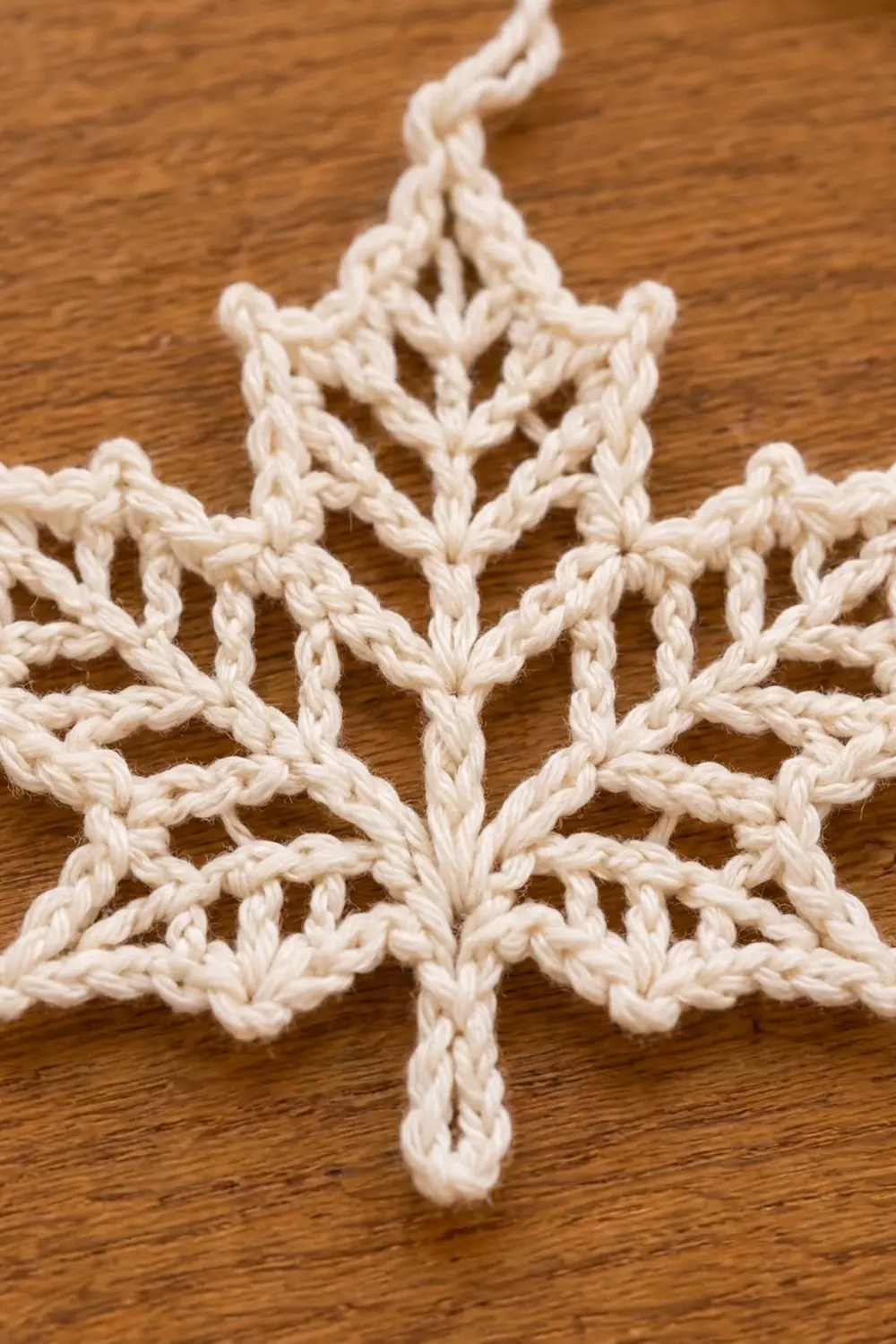
Maple Leaf Motif (Make 21)
The leaf has six directions, evenly spaced around the center: the stem (bottom), the lower-right lobe, the upper-right lobe, the top lobe, the upper-left lobe, and the lower-left lobe. Work counterclockwise with the right side facing you.
Rnd 1: Make a magic ring. Ch 1, 12 sc in the ring, then join with a sl st to the first sc. Pull the ring closed. (12 sc)
Rnd 2: Ch 1, sc in the same st, ch 3, sk 1 st, sc in next st, ch 3, sk 1 st; rep from * 4 more times. Join with a sl st to the first sc. (6 sc, 6 ch-3 sps)
The first ch-3 sp is the stem sp. Going counterclockwise, the next five sps are lower-right, upper-right, top, upper-left, and lower-left.
Rnd 3 (veins and stem): Sl st in the stem sp.
- Stem: Ch 10, sl st in the 4th ch from hook (this forms the stem loop), sl st in next 6 ch, then sl st in the stem sp. (7 sl st along the stem)
- Sl st in next sc, sl st in next ch-3 sp. Then work the vein for that sp:
- Lower-right vein: Ch 8, sl st in 2nd ch from hook and next 2 ch, twig pair, sl st in next 4 ch, sl st in same sp. (7 spine sl st, 1 twig pair)
- Upper-right vein: Ch 12, sl st in 2nd ch from hook and next 2 ch, twig pair, sl st in next 3 ch, twig pair, sl st in next 5 ch, sl st in same sp. (11 spine sl st, 2 twig pairs)
- Top vein: Ch 14, sl st in 2nd ch from hook and next 2 ch, twig pair, sl st in next 3 ch, twig pair, sl st in next 3 ch, twig pair, sl st in next 4 ch, sl st in same sp. (13 spine sl st, 3 twig pairs)
- Upper-left vein: Work as the upper-right vein.
- Lower-left vein: Work as the lower-right vein.
Work the bracketed move (sl st in next sc, sl st in next sp) before each of the five lobe veins. After the lower-left vein, sl st in the last sc and in the stem sp.
Count check: 5 vein tips, 18 twigs (2 + 4 + 6 + 4 + 2), and 1 stem loop. Each spine uses every ch except the skipped tip ch: 8 − 1 = 7, 12 − 1 = 11, and 14 − 1 = 13.
Rnd 4 (outline chains): This round links all the tips in order around the leaf. Going counterclockwise, each lobe has its twigs on the side nearer the stem, then its vein tip, then its twigs on the far side.
Sl st at the stem base. Ch 4, sc in the first twig tip of the lower-right lobe, ch 4, (sc, ch 3, sc) in the vein tip, ch 4, sc in the next twig tip. Ch 3 (valley), sc in the first twig tip of the next lobe, then [ch 4, sc in next twig tip] to the vein tip, ch 4, (sc, ch 3, sc) in the vein tip, then [ch 4, sc in next twig tip] to the last twig of that lobe. Repeat from * for the upper-right, top, upper-left, and lower-left lobes. Ch 4 and join with a sl st at the stem base.
Count check: 20 ch-4 arcs (2 + 4 + 6 + 4 + 2 inside the lobes, plus 2 at the stem), 4 ch-3 valleys, and 5 ch-3 tip sps.
Rnd 5 (rope outline): Sl st into the first ch-4 arc. Ch 1, then work 5 sc in each ch-4 arc, 3 sc in each ch-3 valley, and a picot tip in each ch-3 tip sp. Do not work into the sc of Rnd 4. Join with a sl st to the first sc and fasten off, leaving a 6 in (15.2 cm) tail to weave in.
Count check: (20 arcs x 5 sc) + (4 valleys x 3 sc) + (5 tips x 4 sc) = 100 + 12 + 20 = 132 sc, plus 5 ch-3 picots.
Because the 3-sc valleys are tighter than the 5-sc arcs, the outline dips between the lobes. That dip, together with the picot tips, gives the leaf its maple shape.
Make All Pieces
Make 21 leaves in ivory. Leaf 1 is made in full. Every leaf after that is joined as you go in Rnd 5. Work the leaves in reading order, starting at the far end of the runner.
        Col A   Col B   Col C
Row 1:   L1  -   L2  -   L3      (tassels on top tips)
          |       |       |
Row 2:   L4  -   L5  -   L6
          |       |       |
Row 3:   L7  -   L8  -   L9
          |       |       |
Row 4:   L10 -   L11 -   L12
          |       |       |
Row 5:   L13 -   L14 -   L15
          |       |       |
Row 6:   L16 -   L17 -   L18
          |       |       |
Row 7:   L19 -   L20 -   L21     (tassels on stem loops)
In the grid, “-” is a two-point side join and “|” is a stem-loop-to-top-tip join.
Joining
All joins are made in Rnd 5 using joining picots in place of picot tips. You never sew between leaves.
Side joins (two points per seam): When the new leaf sits to the right of a finished leaf, work its upper-left tip as a joining picot into the finished leaf’s upper-right picot. Then work its lower-left tip as a joining picot into the finished leaf’s lower-right picot.
Vertical join (one point per seam): When the new leaf sits below a finished leaf, work its top tip as a joining picot. Instead of a picot, make the sl st through the stem loop of the leaf above.
Stitch logic: A joining picot is ch 1, sl st, ch 1, which has the same length as the ch 3 it replaces. Each leaf keeps exactly 132 sc. No stitches are added at any seam, so the spacing stays at 5 in (12.7 cm) across and 5.5 in (14.0 cm) down.
Tension: Keep the joining sl st snug but not tight. If it is too tight, the points pull together and the seam puckers. If it is too loose, the leaves drift apart.
Size checkpoint: After Row 1, the strip should measure 15 in (38.1 cm) across. After Row 2, the piece should be 11 in (27.9 cm) long. After Row 3, it should be 16.5 in (41.9 cm) long.
Border
This runner has no stitched border. The lace edge is the leaf outline itself: the side lobe points down the long edges, plus the top tips and stem loops at the ends. For that reason the border gauge is the motif gauge, and the border depth is 0 in (0 cm).
Long sides: 7 leaves per side, each showing 2 free points (upper and lower side lobes), for 14 points per side. No stitches are added.
Short ends: 3 attachment points per end, which equals 3 columns x 1 point per leaf. At the far end these are the 3 top-tip picots of Row 1. At the near end they are the 3 stem loops of Row 7.
Tassels (make 6): Wrap yarn 30 times around the 4.5 in (11.4 cm) card. Slide a 10 in (25.4 cm) strand under the wraps at the top and tie it tightly. Cut the bottom loops. Wrap a second strand 6 times around the bundle, 0.5 in (1.3 cm) below the top, and knot it. Trim the tassel to 4 in (10.2 cm). Use the top tie ends to knot each tassel through its picot or stem loop.
Why the math works: No stitches are added along any edge, so the width stays at 3 x 5 in = 15 in (38.1 cm) and the length at 7 x 5.5 in = 38.5 in (97.8 cm). The tassels hang beyond the ends: 38.5 + 4 + 4 = 46.5 in (118.1 cm).
Final Blocking
- Weave in all ends along the outline sc, never across open spaces.
- Soak the runner in cool water for 10 minutes, then press out the water in a towel. Do not wring it.
- Lay it right side up on the blocking mats.
- Pin the 5 points of every leaf first, working from the center of the runner outward.
- Check that the width is 15 in (38.1 cm) at every row and the length is 38.5 in (97.8 cm).
- Straighten each vein and twig so it runs from the center toward its point.
- Spritz lightly and let it dry completely before unpinning.
- Comb out the tassels and retrim them evenly to 4 in (10.2 cm).
Final Quality-Control Checklist
- 21 leaves, each with 132 sc and 5 points
- 18 twigs per leaf, with none missing or doubled
- All side seams joined at 2 points, and every vertical seam joined at the stem loop
- Width of 15 in (38.1 cm) and length of 38.5 in (97.8 cm) after blocking
- 6 tassels, all 4 in (10.2 cm) long and firmly knotted
- No visible tails or knots
Troubleshooting
- Leaf cups or ruffles: The vein chains are tight compared with the outline. Work Rnd 3 chains looser, or go up a hook size for Rnd 3 only.
- Points look blunt: Make sure you work 2 sc on each side of the ch-3 picot, not 3, and pin the points sharply when blocking.
- Twigs flop to one side: Nudge one twig of each pair to each side before you work Rnd 4.
- Runner is narrower than 15 in (38.1 cm): The joining sl sts are pulling. Rework them looser, or block the piece wider.
- Rows slant: Check that each side seam uses the matching upper and lower points, not a top tip.
Care
Hand wash in cool water with a mild detergent, then reshape and dry flat. Re-pin the points if they soften over time.

Final Notes
The measurement chain runs like this: a 0.75 in (1.9 cm) ring grows to a 1.5 in (3.8 cm) center. The veins reach 5 in (12.7 cm), and the outline finishes the leaf at 5 in (12.7 cm) x 5.5 in (14.0 cm). Three leaves across make 15 in (38.1 cm), seven leaves down make 38.5 in (97.8 cm), and the tassels bring the total length to 46.5 in (118.1 cm). If you check each stage, the finished runner will come out to size.
Happy crocheting!