
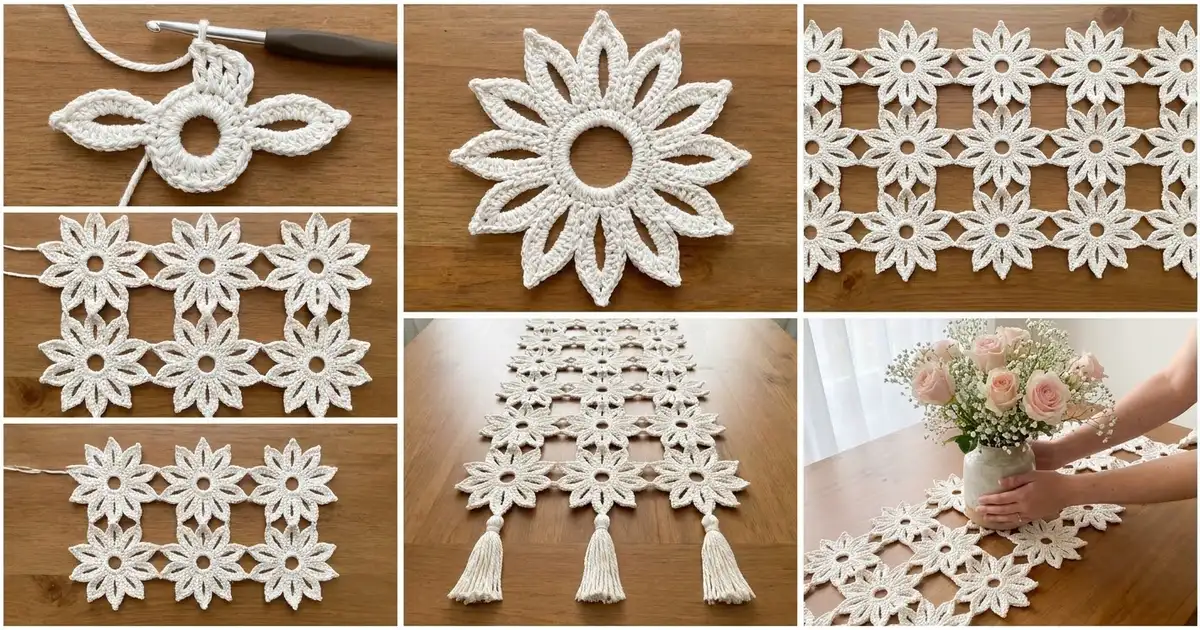
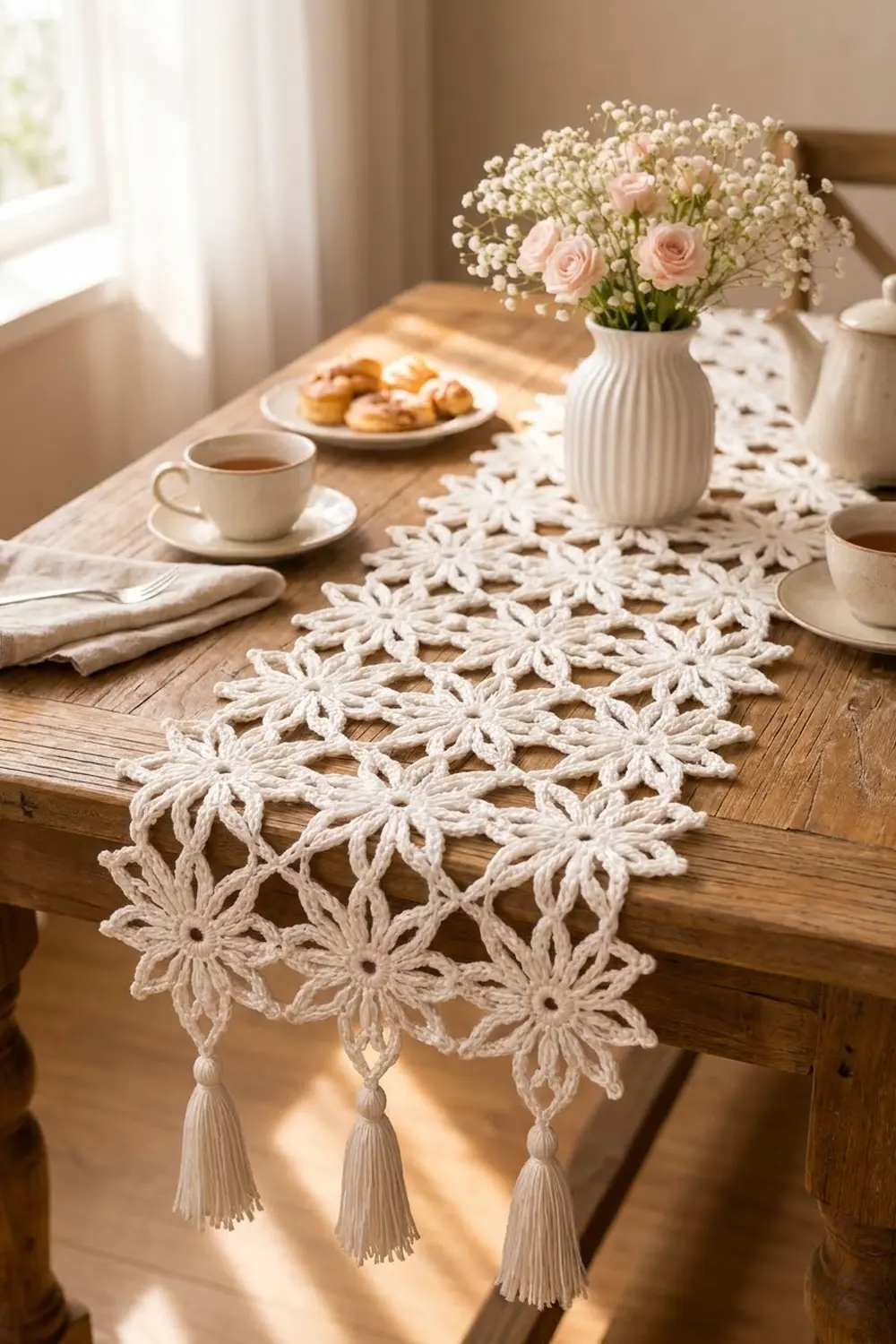
This airy table runner is made from twenty-four 12-petal starflower motifs joined tip to tip. Each motif has a small open center. Each petal has a pointed lace outline with a solid spine inside, which gives the runner a light, snowflake-like look. Three tassels finish each end.
The runner shown uses a single shade of soft white cotton, so the texture is what stands out. Ivory, natural, or pale linen shades suit the same vintage style. A strong, smooth cotton gives the petals clear outlines and keeps the points sharp after blocking.
This pattern uses US crochet terms. The finished runner measures 15 in x 40 in (38.1 cm x 101.6 cm) without the tassels. With 4 in (10.2 cm) tassels at each end, the overall length is 48 in (121.9 cm).
You make one motif in four rounds: a ring of single crochet, then twelve solid spines, then a chain outline around each spine, then a single crochet covering over the outline. From the second motif onward, you join each motif to its neighbors during the last round (join-as-you-go). There is no crocheted border. The free petal tips form the edge, and tassels finish the short ends.
Finished Size and Construction
- Finished size: 15 in x 40 in (38.1 cm x 101.6 cm), plus 4 in (10.2 cm) tassels at each end
- Skill level: Intermediate
- Terminology: US crochet terms
- Yarn weight: DK (weight 3) cotton
- Hook: 3.5 mm (E-4)
- Number of pieces: 24 motifs
- Layout: 3 motifs wide x 8 motifs long
- Piece size: 5 in (12.7 cm) across, measured tip to opposite tip
- Size before border: 15 in x 40 in (38.1 cm x 101.6 cm)
- Border depth: 0 in (0 cm). There is no crocheted border; the edge is the free petal tips.
Materials
Yarn: Use a mercerized or combed DK cotton, about 110 m (120 yd) per 50 g ball. Avoid fuzzy or very soft cottons, because the petal outlines need crisp stitches.
- White/ivory: 200 g, about 440 m (481 yd), which is 4 balls
One motif uses about 5 g (11 m / 12 yd). All 24 motifs use about 120 g. The six tassels use about 20 g together. These quantities include a margin for your test motif and the tassels.
Tools:
– 3.5 mm (E-4) crochet hook
– Tapestry needle
– Scissors
– Stiff card 4.5 in (11.4 cm) tall, for the tassels
– Blocking mats and rustproof pins
– Spray bottle
– Measuring tape
Abbreviations (US Terms)
- ch – chain
- sl st – slip stitch
- sc – single crochet
- hdc – half double crochet
- dc – double crochet
- sk – skip
- sp – space
- st(s) – stitch(es)
- rep – repeat
Special stitch: spine. Ch 9. Starting in the 2nd ch from the hook, work sc, hdc, dc in each of the next 4 ch, hdc, sc. That is 8 sts back along the chain. The skipped first ch stays at the top as the tip ch.
Special stitch: joining tip. Work this in Round 4 in place of a plain tip: (sc, ch 1, sl st in the ch-3 tip sp of the neighboring motif, ch 1, sc).
Gauge and Checkpoints
Make one full motif before starting the runner, then block it lightly and measure it. Each round has a target size:
- After Round 1: the ring measures 1.25 in (3.2 cm) across.
- After Round 2: the spines measure 4.25 in (10.8 cm) from tip to opposite tip.
- After Round 3: the outline loops measure 4.75 in (12.1 cm) from tip to opposite tip.
- After Round 4: the motif measures 5 in (12.7 cm) from tip to opposite tip.
A difference of up to 0.25 in (0.6 cm) is fine. Remember that each 0.25 in (0.6 cm) of motif difference changes the runner width by 0.75 in (1.9 cm) and the length by 2 in (5.1 cm).
If your motif is too big: go down to a 3.25 mm hook, or tighten your chains. Loose chains in Rounds 2 and 3 are the most common cause.
If your motif is too small: go up to a 3.75 mm hook. If the petals curl, the outline chains are too tight, so loosen them before changing the hook.

Motif Pattern
Round 1 – Center Ring
Ch 6, then sl st in the first ch to form a ring.
Ch 1, work 24 sc in the ring, and sl st in the first sc to join. (24 sc)
This makes the firm band of single crochet around the open center.
Round 2 – Spines
Each repeat works into 2 sts: a spacer sc first, then a base sc that holds the spine.
Ch 1. Sc in the next sc (spacer). Sc in the next sc (base). Work 1 spine. Sl st in the same base sc. Rep from * to * 11 more times.
Sl st in the first sc to join. You are now sitting in the first spacer sc.
Round 2 count: 24 sc around the ring (12 spacers + 12 bases), plus 12 spines of 8 sts each (96 spine sts). There are 12 free tip ch, one at the top of each spine.
The spines should stand straight out like wheel spokes. If they bend, you probably worked into the wrong side of the chain. Work into the back bump.
Round 3 – Petal Outlines
Ch 1, sc in the same spacer sc.
Ch 8. Work (sc, ch 3, sc) in the tip ch of the next spine. Ch 8. Sc in the next spacer sc. Rep from * to * 11 more times. On the last rep, skip the final sc and instead sl st in the first sc to join.
Round 3 count: 12 spacer sc, 24 sc at the tips (2 per petal), 12 ch-3 tip sps, and 24 ch-8 sps.
Each ch-8 runs from a spacer up to a tip, so two ch-8s frame each spine in a pointed loop. You should see an open gap between the spine and its outline. The outline chains are slightly longer than the spine, and that extra length is what makes the lancet shape.
Round 4 – Outline Cover
This round covers the outline chains with single crochet and sharpens each point.
Ch 1, then work the next instruction into the same spacer st only for the first petal: sk the spacer sc.
Work 10 sc in the next ch-8 sp. Sc in the next sc. Work (sc, ch 3, sc) in the ch-3 tip sp. Sc in the next sc. Work 10 sc in the next ch-8 sp. Sk the spacer sc. Rep from * to * 11 more times.
Sl st in the first sc to join. Fasten off and weave in the ends.
Round 4 count: 24 sc per petal (10 + 1 + 2 + 1 + 10), which is 288 sc in total, plus 12 ch-3 tips.
Number the petals 1 to 12 in the order you worked them. Petals 1, 4, 7, and 10 are the four cardinal tips, each 3 petals apart. Opposite tips are 6 petals apart: petal 1 is opposite petal 7, and petal 4 is opposite petal 10. Only cardinal tips are used for joining.
Make All Pieces
Make 24 motifs in white/ivory:
- Motif 1: work all four rounds as written.
- Motifs 2 to 24: work Rounds 1 to 3 as written, then join to the earlier motifs during Round 4.
Layout grid (3 columns x 8 rows):
        Col A  Col B  Col C
Row 1:   [1]    [2]    [3]    <- tassel end
Row 2:   [4]    [5]    [6]
Row 3:   [7]    [8]    [9]
Row 4:  [10]   [11]   [12]
Row 5:  [13]   [14]   [15]
Row 6:  [16]   [17]   [18]
Row 7:  [19]   [20]   [21]
Row 8:  [22]   [23]   [24]   <- tassel end
Joining
Method: Join as you go. Use the joining tip in Round 4 whenever a cardinal tip faces a finished motif.
Stitch-to-stitch logic: Each shared side has exactly one join, from one cardinal tip to the facing cardinal tip. A joining tip has the same number of sc as a plain tip, and its ch 1 + sl st + ch 1 takes the place of the ch-3. Because of this, the stitch count stays at 288 sc per motif. Neighboring centers end up 5 in (12.7 cm) apart, which is one full motif diameter. The four petals around each join form the diamond-shaped openings.
Order of work:
– Motifs 2 and 3: join petal 4 to the left neighbor’s petal 10.
– First motif of each new row: join petal 1 to the above motif’s petal 7.
– All other motifs: join petal 1 to the motif above, then petal 4 to the motif on the left.
Rotate each new motif before starting Round 4 so that petal 1 faces up and petal 4 faces left. Before you start, make sure the joins will land on the cardinal tips.
Joins in total: 2 per row x 8 rows = 16 side-to-side joins, plus 3 per row gap x 7 gaps = 21 top-to-bottom joins. That makes 37 joins.
Tension advice: Keep the ch 1 on each side of the join the same size as your normal chains. A tight join pulls the two tips into a pucker, and a loose one leaves a floppy gap.
Size checkpoint: After Row 2 (6 motifs), lay the piece flat. It should measure 15 in (38.1 cm) wide and 10 in (25.4 cm) long. Fix any problem now, before you join more rows.
Border (Edge Finish) and Tassels
Border gauge: Not applicable. This design has no crocheted border, and the border depth is 0 in (0 cm), to match the open star-point edge.
Why the math works without a border: Every motif is a fixed 5 in (12.7 cm) from tip to tip, and every join holds its neighbors exactly one diameter apart. That makes each long side 8 x 5 in = 40 in (101.6 cm) and each short end 3 x 5 in = 15 in (38.1 cm). No stitches are added along the edges, so the edges cannot ruffle or draw in.
Free tips per side:
– Each long side: 8 free outer cardinal tips, one per motif.
– Each short end: 3 free cardinal tips (petal 7 in Row 1, petal 1 in Row 8). These hold the tassels.
Tassels (make 6):
1. Wrap yarn 30 times around the 4.5 in (11.4 cm) card.
2. Slide a 12 in (30.5 cm) tie strand under the loops at the top and knot it tightly.
3. Cut the loops at the bottom edge.
4. Wrap a second strand tightly around the bundle 0.5 in (1.3 cm) below the top to form the head. Knot it and hide the ends inside the tassel.
5. Trim the tassel to 4 in (10.2 cm).
6. Use the tie strand to attach the tassel to the ch-3 tip of a free short-end cardinal tip.
Attach 3 tassels at each end, one per end motif.
Final Blocking
- Weave in all remaining ends along the sc of the outlines, never across the open spaces.
- Soak the runner in cool water for 10 minutes, then gently press out the water. Do not wring it.
- Roll it in a towel to remove the extra moisture.
- Lay it on the blocking mats and pin it to 15 in x 40 in (38.1 cm x 101.6 cm).
- Pin every free petal tip into a sharp point. Pin each center ring round.
- Press each spine straight with your fingers. The gaps between the spines and outlines should stay open.
- Leave it to dry completely, which takes about 24 hours.
- Unpin the runner, then comb and re-trim the tassels to 4 in (10.2 cm).
Final Quality-Control Checklist
- 24 motifs, each 5 in (12.7 cm) across
- Every motif has 12 petals with 288 sc in Round 4
- Every spine has 8 sts and sits centered in its outline
- 37 joins in total, each at a cardinal tip
- Runner measures 15 in x 40 in (38.1 cm x 101.6 cm)
- 6 tassels, each 4 in (10.2 cm), 3 at each end
- All ends woven in securely, with none showing in the open spaces
Troubleshooting
- Petals cup or curl: The Round 3 chains are too tight. Rework them more loosely, or use 11 sc per ch-8 sp in Round 4.
- Outline ripples: Round 4 is overfilled. Use no more than 10 sc per sp.
- Spine leans sideways: It was worked into the front loop of the chain. Use the back bump.
- Join puckers: The ch 1 is too tight on either side of the sl st.
- Runner too long or too short: Check the size of one motif. Every 0.25 in (0.6 cm) per motif changes the length by 2 in (5.1 cm).
- Tips joined in the wrong place: Count petals from petal 1. Joins must be on petals 1, 4, 7, or 10.
Care
Hand wash in cool water with a mild detergent and dry flat, reshaping the tips. Rinse out spills quickly so cotton stays bright.
Final Notes
The measurements build on each other. A ring of 1.25 in (3.2 cm) leads to spines of 4.25 in (10.8 cm), outlines of 4.75 in (12.1 cm), and a finished motif of 5 in (12.7 cm). Three motifs across give 15 in (38.1 cm), and eight down give 40 in (101.6 cm). The tassels then add 4 in (10.2 cm) at each end. If your first motif is right, the runner will come out right.
Happy crocheting!