
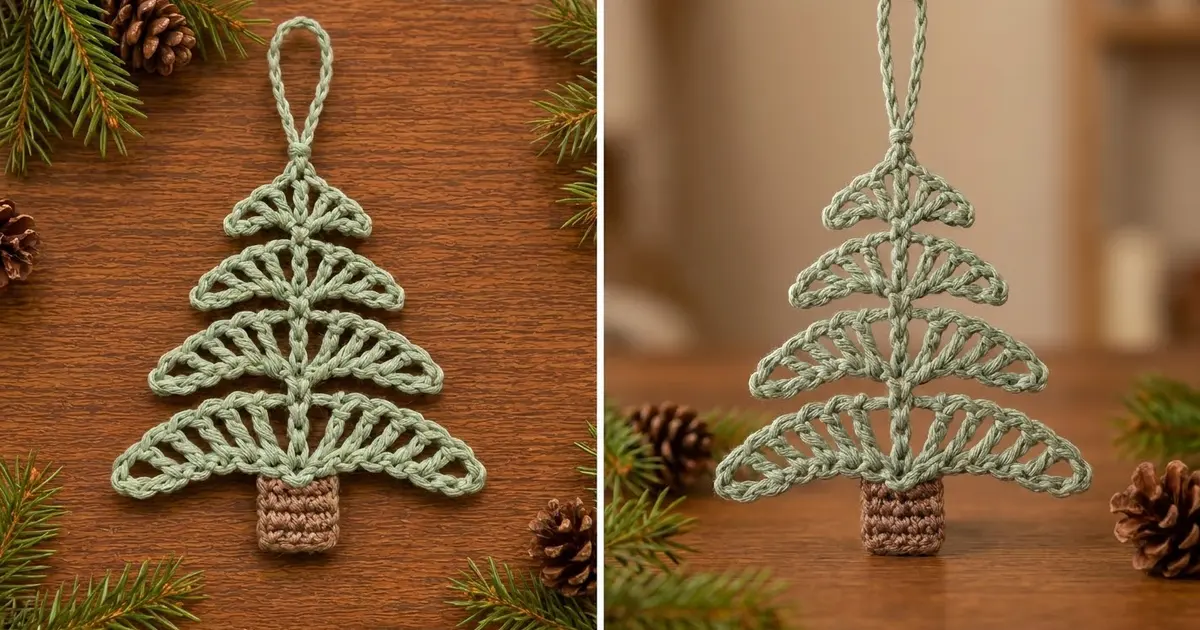
This little tree ornament is made from four airy fan-shaped tiers stacked down a raised center spine. It has a chain hanging loop at the top and a small brown trunk at the base. Each tier is a half-circle of tall spokes with a rope-like chain edge, and the tips curl down slightly, like a snowy pine branch.
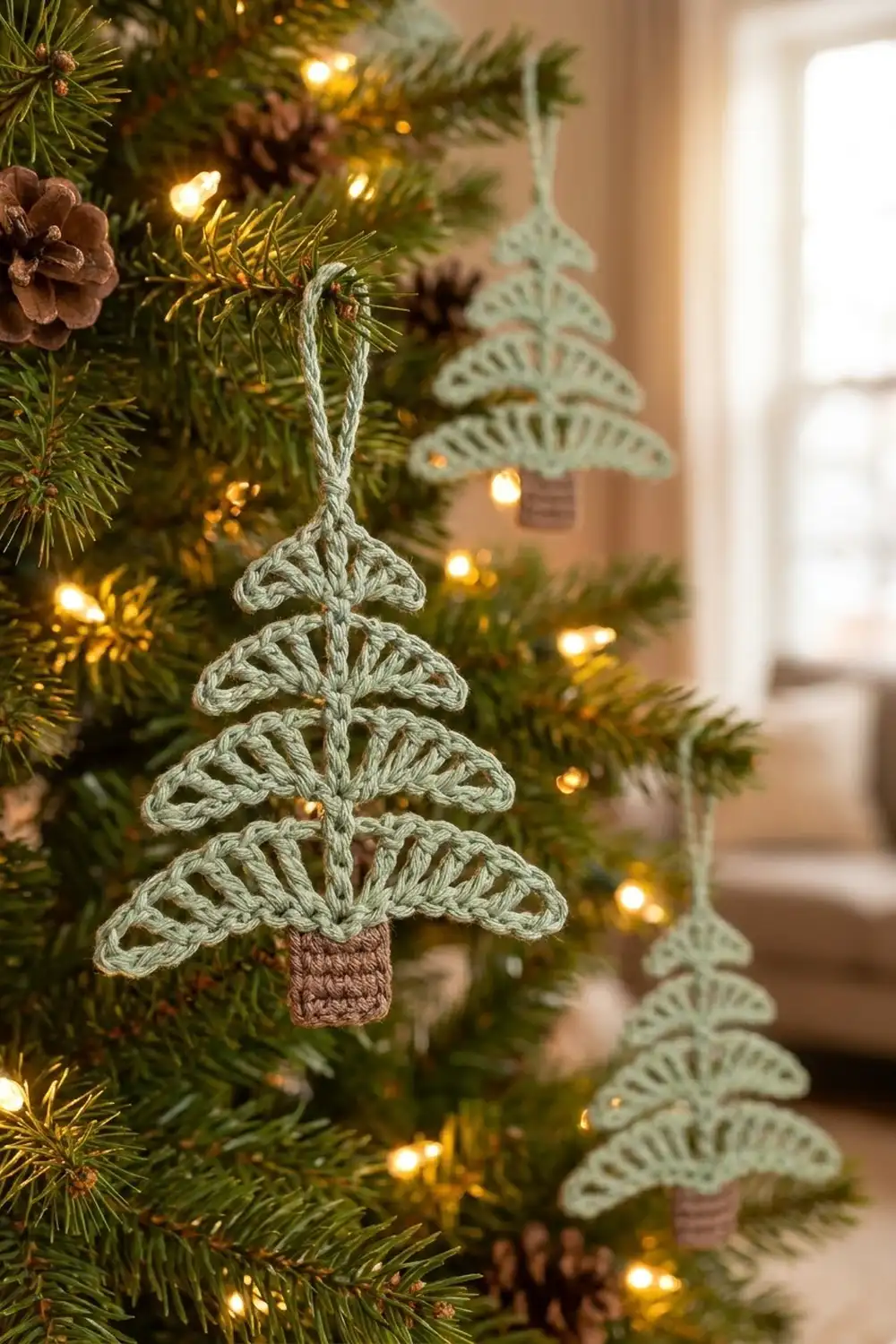
The sample uses soft sage green for the tree and warm cocoa brown for the trunk. The look is simple and Scandinavian. It suits a natural-themed tree, a gift topper, or a window hook. Make one, or make a dozen in the same color for a calm, matching tree.
This pattern uses US crochet terms. The finished ornament measures 3.5 in (8.9 cm) wide at the bottom tier and about 5 in (12.7 cm) tall from treetop to trunk. With the hanging loop it is about 7 in (17.8 cm) tall overall.
Construction is simple. You chain the hanging loop and spine in one strand. Then you work each tier as a two-row fan into a marked spine chain: Row 1 makes the spokes, and Row 2 is the curled edge. A surface slip stitch line covers the spine, and a small sc patch is sewn on as the trunk.
Finished Size and Construction
- Finished size: 3.5 in (8.9 cm) wide × about 5 in (12.7 cm) tall, plus a 2 in (5.1 cm) loop
- Skill level: Easy–Intermediate (tall stitches into one chain)
- Terminology: US
- Yarn weight: Worsted (#4), cotton or cotton blend
- Hook: 4.0 mm (US G-6)
- Number of pieces: 1 ornament (spine with 4 tiers worked onto it, plus a small trunk patch sewn on)
- Layout: 4 tiers stacked vertically, each wider than the one above
- Piece size: bottom tier 3.5 in (8.9 cm) wide; trunk 0.75 in (1.9 cm) wide × 0.8 in (2.0 cm) tall
- Size before border: bottom tier spokes span 2.75 in (7.0 cm)
- Border depth: 0.25 in (0.6 cm) chain edge plus a 0.125 in (0.3 cm) picot tip at each end
Materials
Use a smooth, firmly plied worsted cotton. Cotton holds the fan shape after blocking and shows the stitches clearly. Avoid fuzzy or very splitty yarn, because the spokes are worked into a single chain and you need to see where your hook goes.
- Sage green (tree, spine, loop): 10 g, about 20 m
- Cocoa brown (trunk): 2 g, about 4 m
Both quantities include a margin for a gauge swatch and tails. One ornament actually uses about 7 g of green and 1 g of brown.
Tools:
- 4.0 mm (US G-6) crochet hook
- 4 locking stitch markers
- Tapestry needle
- Scissors
- Rust-proof pins and a foam blocking mat
- Spray bottle
- Optional: fabric stiffener or diluted white glue for a firmer ornament
Abbreviations (US Terms)
- ch – chain
- sl st – slip stitch
- sc – single crochet
- dc – double crochet
- tr – treble crochet (yarn over twice)
- dtr – double treble crochet (yarn over 3 times)
- trtr – triple treble crochet (yarn over 4 times; draw up a loop, then [yarn over, pull through 2 loops] 5 times)
- sp – space
- st(s) – stitch(es)
- RS – right side
Special stitches:
- Picot: ch 3, sl st in 3rd ch from hook.
- Surface sl st: with the yarn held behind the work, insert the hook from front to back through the piece, pull up a loop, and draw it through the loop on the hook.
Gauge and Checkpoints
Gauge matters more for the spokes than for the stitch count. Test one tier before you commit.
- Chain gauge: 4 ch = 1 in (2.5 cm), worked loosely
- Sc gauge: 4 sc and 5 rows = 1 in (2.5 cm)
- Stitch heights: dc 0.6 in (1.5 cm), tr 0.8 in (2.0 cm), dtr 1 in (2.5 cm), trtr 1.25 in (3.2 cm)
Test first: chain 10 and work Tier 4 (below) into the 4th ch from the hook. The spokes should span 2.75 in (7.0 cm). After the edge row, the tier should measure 3.5 in (8.9 cm) from tip to tip.
Checkpoints:
- Spine chain of 17 = 4.25 in (10.8 cm).
- Tier widths after Row 1: 1.25 in (3.2 cm), 1.75 in (4.4 cm), 2.25 in (5.7 cm), 2.75 in (7.0 cm).
- Tier widths after Row 2: 2 in (5.1 cm), 2.5 in (6.4 cm), 3 in (7.6 cm), 3.5 in (8.9 cm).
- Trunk: 0.75 in (1.9 cm) × 0.8 in (2.0 cm).
Too big? Go down to a 3.75 mm (US F-5) hook, or pull each yarn over snug before you draw through.
Too small? Go up to a 4.5 mm (US 7) hook. Tall stitches worked tightly will make the tiers cup instead of lying flat.
Pattern
Part 1: Hanging Loop and Spine
With sage green, ch 16, sl st in 1st ch to form a ring. This is the hanging loop, about 2 in (5.1 cm) long when it hangs flat.
Spine: ch 17. Do not turn. Fasten off with a 6 in (15.2 cm) tail.
Count the spine chains starting from the one right next to the loop (ch 1) and moving down to the last one (ch 17). Place markers as follows:
- Ch 1: Tier 1 apex
- Ch 4: Tier 2 apex
- Ch 8: Tier 3 apex
- Ch 12: Tier 4 apex
Lay the spine flat and vertical with the loop at the top and the RS (smooth V side) facing you. Make sure the chain is not twisted.
Each tier’s center spoke will also be tacked to one spine chain:
- Tier 1: ch 3
- Tier 2: ch 7
- Tier 3: ch 11
- Tier 4: ch 17
Part 2: Tiers
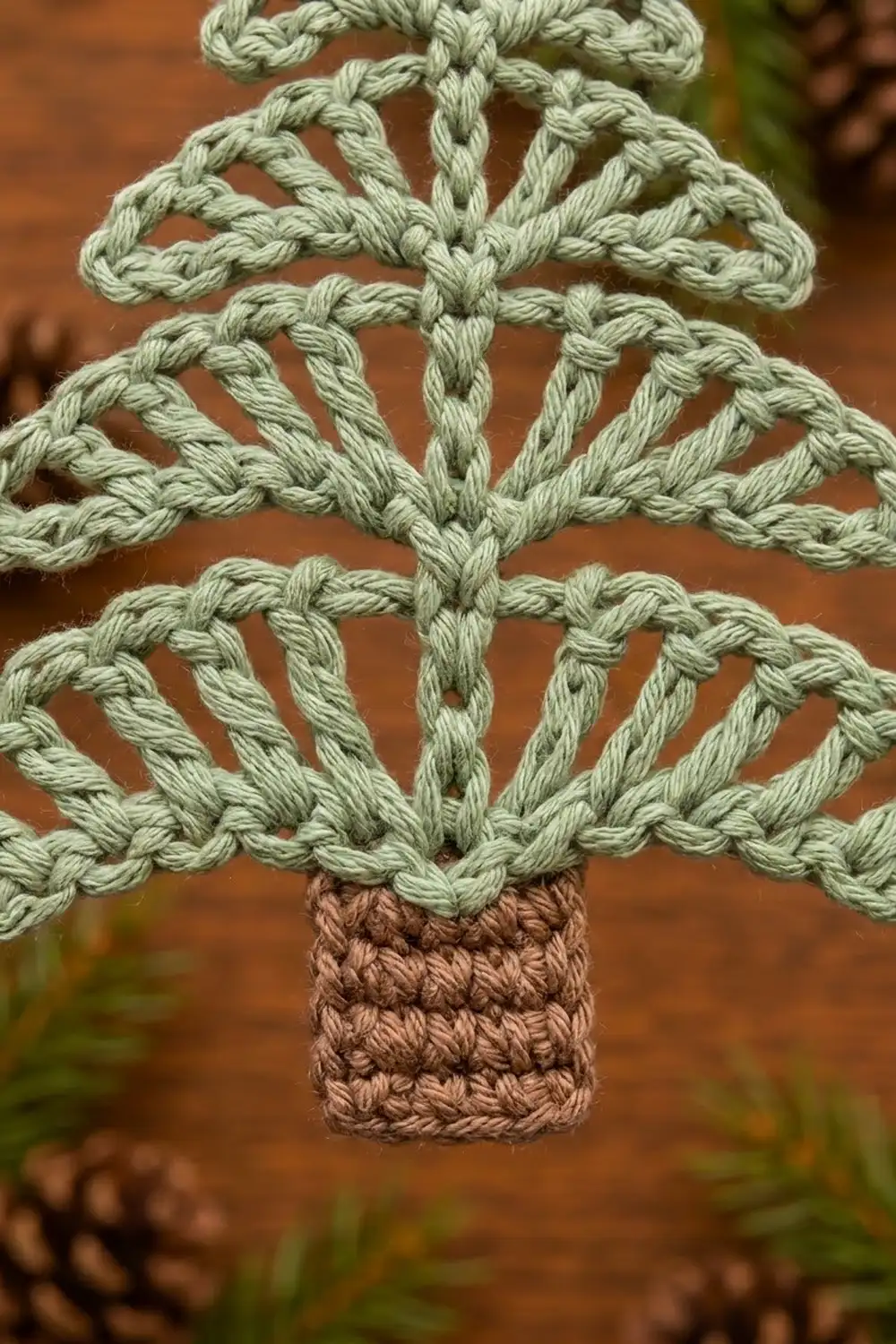
Each tier is worked into the back bump of its marked apex chain, so the front V of the spine stays clean. Hold the work so the spokes fan downward in a half-circle, from one side of the spine, down over the spine, and up to the other side. The spine chain below the apex lies behind the center spoke.
Tier 1 (top, dc spokes)
Row 1: Join green with a sl st in the Tier 1 apex. Ch 3 (counts as dc). [Ch 1, dc] 4 times in the same apex ch.
Count: 5 dc spokes and 4 ch-1 sps.
Arrange the spokes in a half-circle. The 3rd dc is the center spoke and lies over the spine.
Row 2 (edge): Ch 1, turn. Sc in the top of the first spoke, picot. Ch 1, sc in the top of the next spoke. Repeat from * across. For the center (3rd) spoke, work the sc through the spoke top and the ch 3 spine chain together. Picot, sl st in the top of the same last spoke. Fasten off.
Count: 5 sc, 4 ch-1 sps, 2 picots.
Checkpoint: 2 in (5.1 cm) from tip to tip.
Tier 2 (tr spokes)
Row 1: Join green with a sl st in the Tier 2 apex. Ch 4 (counts as tr). [Ch 1, tr] 6 times in the same apex ch.
Count: 7 tr spokes and 6 ch-1 sps. The 4th tr is the center spoke.
Row 2: Work as for Tier 1 Row 2. Tack the center (4th) spoke to spine ch 7.
Count: 7 sc, 6 ch-1 sps, 2 picots.
Checkpoint: 2.5 in (6.4 cm) from tip to tip.
Tier 3 (dtr spokes)
Row 1: Join green with a sl st in the Tier 3 apex. Ch 5 (counts as dtr). [Ch 1, dtr] 8 times in the same apex ch.
Count: 9 dtr spokes and 8 ch-1 sps. The 5th dtr is the center spoke.
Row 2: Work as for Tier 1 Row 2. Tack the center (5th) spoke to spine ch 11.
Count: 9 sc, 8 ch-1 sps, 2 picots.
Checkpoint: 3 in (7.6 cm) from tip to tip. The edge of this tier overlaps the Tier 4 apex slightly, just as each tier overlaps the one below.
Tier 4 (bottom, trtr spokes)
Row 1: Join green with a sl st in the Tier 4 apex. Ch 6 (counts as trtr). [Ch 1, trtr] 10 times in the same apex ch.
Count: 11 trtr spokes and 10 ch-1 sps. The 6th trtr is the center spoke.
Row 2: Work as for Tier 1 Row 2. Tack the center (6th) spoke to spine ch 17, the last chain.
Count: 11 sc, 10 ch-1 sps, 2 picots.
Checkpoint: 3.5 in (8.9 cm) from tip to tip.
Part 3: Raised Spine
With the RS facing, join green at the base of the hanging loop. Surface sl st down the center of the spine, working once into each spine chain from ch 1 to ch 17. That is 17 surface sl sts. Work through every center spoke and tacking sc along the way. Fasten off and pull the tail to the back.
This gives the thick, braided center line and locks each center spoke in place.
Part 4: Trunk
With cocoa brown, ch 4.
Row 1: Sc in the 2nd ch from the hook and in each ch across. (3 sc)
Rows 2–4: Ch 1, turn, sc in each st across. (3 sc)
Fasten off with a 10 in (25.4 cm) tail.
The trunk is 0.75 in (1.9 cm) wide × 0.8 in (2.0 cm) tall. Center its top edge on the spine end, tucked just behind the Tier 4 edge, and whipstitch it in place from the back.
Border (Tier Edging)
On this ornament, Row 2 of each tier is the border. It is a rope-like sc-and-chain edge with a picot at each end that curls down.
Border gauge: each sc and each ch-1 sp covers about 0.25 in (0.6 cm) along the curve.
| Tier | Spokes (Row 1) | Sc | Ch-1 sps | Picots | Edge length |
|---|---|---|---|---|---|
| 1 | 5 | 5 | 4 | 2 | 2.25 in (5.7 cm) |
| 2 | 7 | 7 | 6 | 2 | 3.25 in (8.3 cm) |
| 3 | 9 | 9 | 8 | 2 | 4.25 in (10.8 cm) |
| 4 | 11 | 11 | 10 | 2 | 5.25 in (13.3 cm) |
Why the math works: each tier has an odd number of spokes, so there is always exactly one center spoke to tack to the spine, with the same number of spokes on each side. The edge has one sc per spoke and one ch-1 per gap between spokes. So the number of sc equals the number of spokes, and the number of ch-1 sps is one less.
The edge length roughly matches the outer curve of each half-circle. Tier 1 has a radius of about 0.75 in (1.9 cm), so its half-circle is about 2.36 in (6.0 cm) around, and its 2.25 in (5.7 cm) edge sits flat. The lower tiers run slightly longer than their curves. That small extra length makes the gentle scallop and lets the tips droop like a branch.
The border adds 0.25 in (0.6 cm) of edge plus a 0.125 in (0.3 cm) picot on each side. That is 0.375 in (1.0 cm) per side, or 0.75 in (1.9 cm) per tier. This is why Tier 4 grows from 2.75 in (7.0 cm) to 3.5 in (8.9 cm).
Final Blocking
- Weave in all ends along the spine or inside the trunk, but don’t trim them yet.
- Spray the ornament until it is damp, not soaked.
- Pin the spine straight on the mat, with the loop at the top.
- Pin each tier into a smooth half-circle. Put one pin at each spoke top, and make sure the center spoke lines up with the spine.
- Check the widths: 2 in (5.1 cm), 2.5 in (6.4 cm), 3 in (7.6 cm), 3.5 in (8.9 cm).
- Pin each picot so it points slightly down and out.
- Pin the trunk square and centered.
- Optional: brush on a thin coat of fabric stiffener.
- Let it dry completely, ideally overnight. Then unpin and trim the tails.
Final Quality-Control Checklist
- The loop is 2 in (5.1 cm) long and not twisted.
- There are 4 tiers with 5, 7, 9, and 11 spokes.
- Each center spoke sits exactly on the spine.
- Each edge has 2 picots, both curling down.
- The raised spine runs straight from the loop to the trunk.
- The trunk is centered and measures 0.75 in (1.9 cm) wide.
- The overall size is 3.5 in (8.9 cm) × about 5 in (12.7 cm), plus the loop.
- No ends show from the front.
Troubleshooting
Tier cups or curls up: the edge is too tight. Rework Row 2 more loosely, or go up a hook size for the edge only.
Edge ruffles heavily: the chains are too loose. Make the ch-1 sps snug, or use a 3.75 mm (US F-5) hook for Row 2.
Center spoke drifts off the spine: you tacked into the wrong spine chain. Count again from the loop, rework the center sc, and then add the surface sl st line.
Base of the fan is bulky: work into the back bump only, and keep the first loop of each tall stitch short.
Tiers crowd each other: check that the spine is 4.25 in (10.8 cm) long. Chains worked too tightly make the tiers bunch up.
Trunk is lopsided: count 3 sc in every row, and make sure the turning ch-1 does not count as a stitch.
Care
Hand wash in cool water, press out the water in a towel, and reshape. Then dry the ornament flat. Store it flat in tissue so the tiers keep their shape.
Final Notes
The measurements build on each other:
- 4 ch = 1 in (2.5 cm) gives a 4.25 in (10.8 cm) spine.
- Spoke heights from 0.6 in (1.5 cm) to 1.25 in (3.2 cm) give fans 1.25 in (3.2 cm) to 2.75 in (7.0 cm) wide.
- A 0.375 in (1.0 cm) edge on each side brings them to 2 in (5.1 cm) through 3.5 in (8.9 cm).
- A 0.8 in (2.0 cm) trunk finishes the tree at about 5 in (12.7 cm) tall, plus a 2 in (5.1 cm) loop.
Check gauge on one tier, follow the counts, and the rest falls into place.
Happy crocheting!