

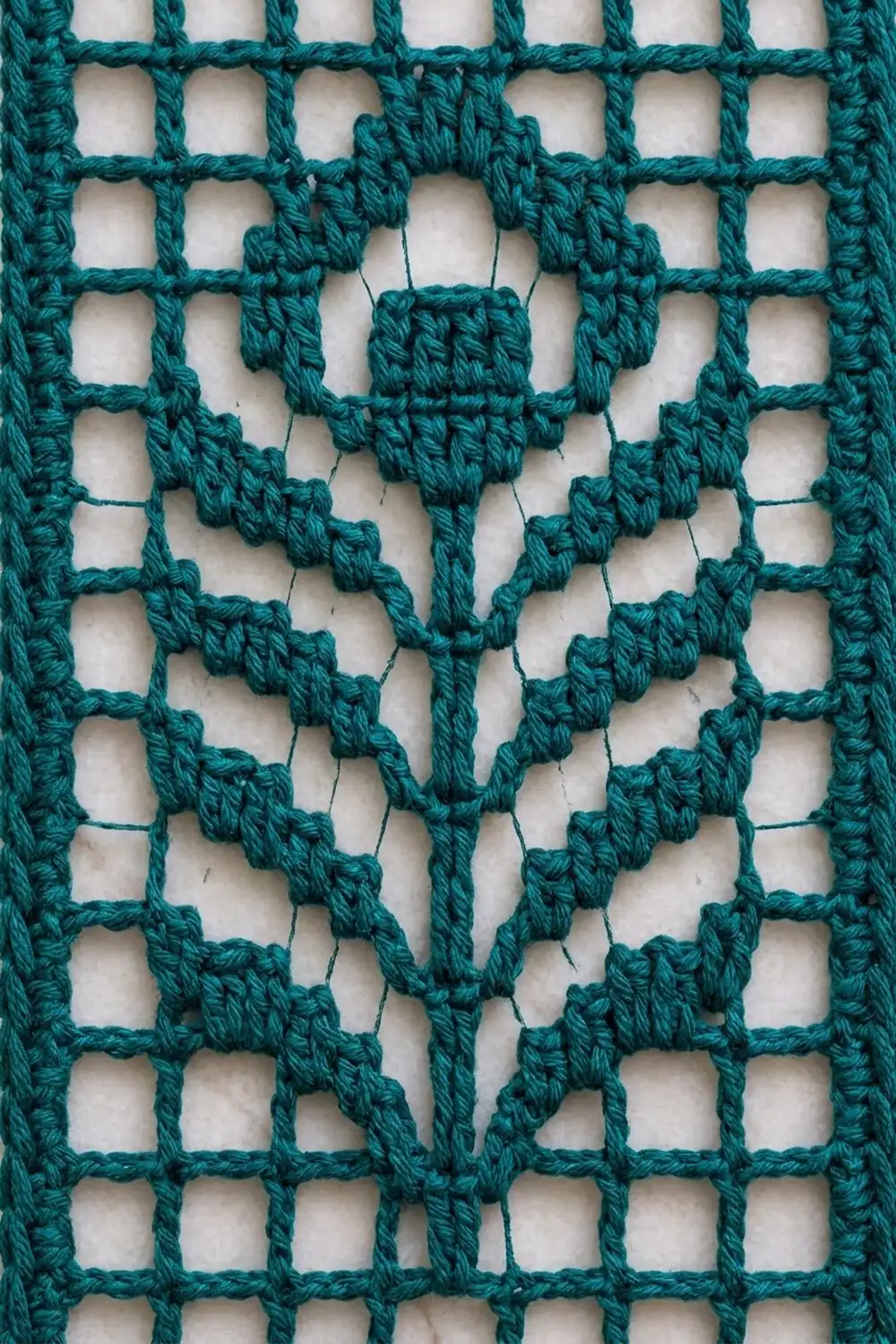
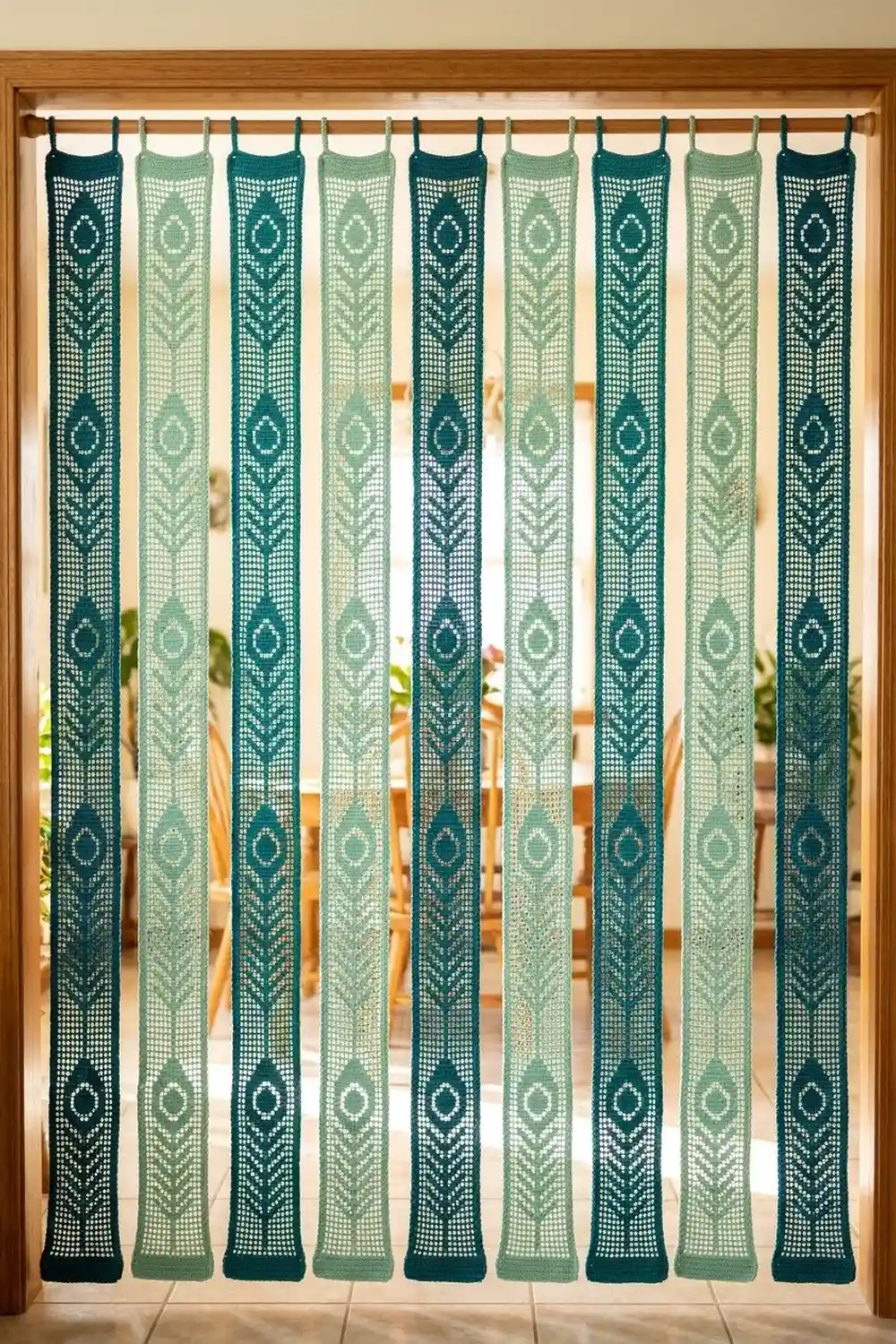
This curtain is made from nine long, separate filet crochet strips that hang side by side from a rod. Each strip has a stack of nine peacock feathers. Every feather has a diamond “eye” with a solid center, sitting on a straight stem with V-shaped barbs that get shorter toward the top. Light shows through the open mesh, so the feathers are easy to see from both sides of a doorway.
The colors alternate deep teal and soft mint, with five teal strips and four mint strips. Each strip is one solid color. The style is calm and graphic, a little Art Deco and a little boho. It suits a doorway, a closet opening, or a sunny window.
All instructions use US crochet terms. Each finished strip measures 6 in (15.2 cm) wide by 75 in (190.5 cm) long, plus two hanging tabs. The full curtain spans about 58 in (147.3 cm) on the rod.
Each strip is worked flat in rows of filet mesh, with a solid bar at the bottom and top. Next comes a two-round border with a corded crab-stitch edge, and then two folded tabs are sewn to the top. The strips are never joined to each other. They hang separately and move freely when you walk through.
Finished Size and Construction
- Finished strip size: 6 in x 75 in (15.2 cm x 190.5 cm)
- Skill level: Intermediate (basic filet, long repetitive rows)
- Terminology: US
- Yarn weight: Fingering (super fine, #1) mercerized cotton
- Hook: 3.0 mm (US C/2 or D/3)
- Number of pieces: 9 strips (5 teal, 4 mint) plus 18 tabs
- Layout: 9 strips in one row, alternating colors, hung with 0.5 in (1.3 cm) gaps
- Strip size before border: 11 squares x 149 rows = 5.5 in x 74.5 in (14.0 cm x 189.2 cm)
- Border depth: 0.25 in (0.6 cm) per side, 2 rounds
- Size after border: 6 in x 75 in (15.2 cm x 190.5 cm)
- Feather motif: 9 squares x 13 rows = 4.5 in x 6.5 in (11.4 cm x 16.5 cm)
Materials
Choose a smooth, mercerized cotton. It gives crisp squares, holds its shape after blocking, and stretches very little as the strips hang. Avoid fuzzy or very stretchy yarns. They blur the feather outline and get longer over time.
- Teal: 250 g / 850 m (5 strips and 10 tabs)
- Mint: 200 g / 680 m (4 strips and 8 tabs)
Each strip with its tabs uses about 146 m (about 43 g). These amounts include a margin of about 15% for testing gauge and for small differences in tension.
Tools:
– 3.0 mm crochet hook
– Tapestry needle
– Rust-proof pins and a large blocking surface (foam mats, or a clean carpet covered with a towel)
– Spray bottle
– Measuring tape
– Stitch markers
– A curtain rod up to 1.25 in (3.2 cm) in diameter and at least 60 in (152.4 cm) long
Abbreviations (US Terms)
- ch – chain
- sc – single crochet
- dc – double crochet
- st(s) – stitch(es)
- sp – space
- rev sc – reverse single crochet (crab stitch)
- O – open square (mesh)
- B – block (filled square)
Reverse single crochet (rev sc): Work from left to right (if you’re right-handed). Insert the hook in the next stitch to the right, yarn over, and pull up a loop. Yarn over and pull through both loops. This makes the twisted, corded edge.
Working the squares: Every row has 34 sts: 1 starting post plus 11 squares of 3 sts each.
- O over O: ch 2, dc in next dc.
- O over B: ch 2, skip 2 dc, dc in next dc.
- B over O: 2 dc in ch-2 sp, dc in next dc.
- B over B: dc in next 3 dc.
- Starting a row with an O: ch 5 (counts as dc and ch 2), then finish the first square as above.
- Last dc of a row: work it into the 3rd ch of the turning ch-5, or into the top of the ch-3 on the row after Row 1.
Every feather row starts and ends with an open square, so Rows 2-148 all start with ch 5.
Gauge and Checkpoints
Gauge: 10 squares and 10 rows = 5 in (12.7 cm) square in filet mesh. One square is 0.5 in (1.3 cm) wide and tall. In sc, 6 sc = 1 in (2.5 cm).
Use the start of your first strip as the test piece. Work Rows 1-20: the bottom bar, three open rows, one full feather, and three more open rows. Pin it lightly and measure.
- After Row 20: 5.5 in (14.0 cm) wide x 10 in (25.4 cm) tall
- After Row 84: 42 in (106.7 cm) tall
- After Row 149: 74.5 in (189.2 cm) tall
- After border: 6 in x 75 in (15.2 cm x 190.5 cm)
If your piece is too big, go down a hook size. If it’s too small, go up a hook size. If the width is right but the rows are too tall, wrap the yarn a little more snugly on each dc. The squares should look square. Filet strips stretch a little as they hang, so a gauge that’s slightly short is better than one that’s slightly long.
Strip Pattern
Work each strip in one color. Here’s how the rows are arranged:
- Row 1: solid bottom bar
- Rows 2-4: open rows
- Rows 5-148: 9 repeats of [13 feather rows (M1-M13) + 3 open rows]
- Row 149: solid top bar
For repeat k (k = 0 to 8), the feather rows are Rows 5+16k to 17+16k, and the open rows after them are Rows 18+16k to 20+16k. The last feather ends on Row 145, and Rows 146-148 are open.
Foundation: Ch 36.
Row 1 (solid bar): Dc in 4th ch from hook and in each ch across. Turn. (33 dc + beginning ch-3 = 34 sts; 11 B)
Rows 2-4 (open): Ch 5, skip 2 sts, dc in next st. Ch 2, skip the next 2 sts (or the ch-2 sp), dc in next dc. Repeat from * across. Turn. (12 dc + 11 ch-2 sps = 34 sts; 11 O)
Feather Rows
Each row has 11 squares and 34 sts. The feather is symmetrical, so each row reads the same in either direction.
- M1: 5 O, 1 B, 5 O (stem tip; 1 block)
- M2: 4 O, 3 B, 4 O (first barbs start; 3 blocks)
- M3: 3 O, B, O, B, O, B, 3 O (3 blocks)
- M4: 2 O, B, 2 O, B, 2 O, B, 2 O (3 blocks)
- M5: O, B, 2 O, 3 B, 2 O, B, O (first barbs end, second barbs start; 5 blocks)
- M6: 3 O, B, O, B, O, B, 3 O (3 blocks)
- M7: 2 O, B, 2 O, B, 2 O, B, 2 O (3 blocks)
- M8: 5 O, 1 B, 5 O (stem only; 1 block)
- M9: 4 O, 3 B, 4 O (bottom of eye ring; 3 blocks)
- M10: 3 O, B, O, B, O, B, 3 O (sides of ring and eye center; 3 blocks)
- M11: 2 O, B, O, 3 B, O, B, 2 O (widest part of ring and solid center; 5 blocks)
- M12: 3 O, B, O, B, O, B, 3 O (3 blocks)
- M13: 4 O, 3 B, 4 O (top of eye ring; 3 blocks)
Square 6, the center square, is a block on every feather row, so it forms the stem. The barbs move one square outward on each row, which makes the V shapes. The first pair of barbs is 4 squares long and the second pair is 3, so the feather narrows toward the top. In M9-M13, the outer blocks form a diamond ring around open squares. The center blocks in square 6, plus the 3-block bar in M11, form the solid diamond center.
Open rows after each feather: Work 3 rows of 11 O, the same as Rows 2-4.
Checkpoint: Each 16-row repeat measures 8 in (20.3 cm). Put a marker at the end of each repeat so you can count feathers quickly.
Row 149 (solid top bar): Ch 3 (counts as dc). 2 dc in ch-2 sp, dc in next dc. Repeat from * across. Work the last group into the turning ch-5 sp and its 3rd ch. (34 sts; 11 B)
Don’t fasten off. Go straight on to the border.
Make All Pieces
- Teal: 5 strips, 10 tabs
- Mint: 4 strips, 8 tabs
Layout grid (left to right, seen from inside the room):
T  M  T  M  T  M  T  M  T
1  2  3  4  5  6  7  8  9
T = teal, M = mint. Both outer strips are teal.
Tabs (make 2 per strip, in the strip’s color)
Ch 7.
Row 1: Sc in 2nd ch from hook and in each ch across. Turn. (6 sc)
Rows 2-30: Ch 1, sc in each sc across. Turn. (6 sc)
Fasten off, leaving a 12 in (30.5 cm) tail. Each tab measures 1 in x 6 in (2.5 cm x 15.2 cm).
Joining: Attaching Tabs and Hanging
The strips are not joined to each other. The only joining in this project is sewing the tabs to each strip after the border and blocking are done.
Placement: The top edge has 34 sc from the border. Counting from the right corner: 3 sc, tab (6 sc), 16 sc, tab (6 sc), 3 sc. That adds up to 3 + 6 + 16 + 6 + 3 = 34.
Stitch-to-stitch logic: Lay one end of a tab on the front of the strip so its 6 sc line up with 6 sc on the top edge. Whipstitch each tab stitch to the matching border stitch, one to one. Fold the tab over to the back and line up its other end with Row 148 on the wrong side. Whipstitch it down across the same 6 columns. This makes a loop that fits a rod up to 1.25 in (3.2 cm) across.
Tension: Sew firmly, but don’t pull the yarn tight. The top bar should stay flat, with no puckers. Weave the tails into the tab itself rather than into the mesh, so they stay hidden.
Size checkpoint: Slide the strips onto the rod in grid order, with 0.5 in (1.3 cm) gaps between them. Nine strips at 6 in (15.2 cm) plus eight gaps at 0.5 in (1.3 cm) = 58 in (147.3 cm).
Border
Border gauge: 6 sc = 1 in (2.5 cm). Each row is 0.5 in (1.3 cm) tall, so 3 sc per row end along the sides also works out to 6 sc per inch.
Rnd 1 (sc): Ch 1 and turn. Along the top, sc in each of the 34 sts of Row 149. Ch 2 for the corner. Down the side, work 3 sc around the post at each row end, from Row 149 to Row 1 (149 row ends). Ch 2. Along the bottom, sc in the free loop of each of the 34 foundation chains. Ch 2. Up the second side, work 3 sc in each row end (149 row ends). Ch 2, then sl st to the first sc to join.
- Top: 34 sc
- Each side: 149 x 3 = 447 sc
- Bottom: 34 sc
- Corners: 4 ch-2 sps (no sc at the corners)
- Total: 962 sc + 4 ch-2 sps
Rnd 2 (crab stitch): Ch 1. Work 1 rev sc in each sc and 2 rev sc in each corner ch-2 sp. Join and fasten off.
- Top and bottom: 34 rev sc each
- Each side: 447 rev sc
- Corners: 2 rev sc each (8 total)
- Total: 962 + 8 = 970 rev sc
Why the math works: Across the top, 34 sc cover 5.5 in (14.0 cm), which is 6.2 sc per inch. Down the sides, 447 sc cover 74.5 in (189.2 cm), which is 6.0 sc per inch. The two rates are within 3% of each other, so the edge won’t ruffle or pull in. The ch-2 corners let the crab stitch turn neatly without adding any sc to the side counts. The two rounds add 0.25 in (0.6 cm) on every side, which brings the strip to 6 in x 75 in (15.2 cm x 190.5 cm).
Final Blocking
- Weave in all ends along solid columns or inside the border, never across open squares.
- Soak each strip in cool water for 10 minutes. Press the water out gently; don’t wring it.
- Roll the strip in a towel to remove extra water.
- Lay the strip flat and pin the four corners to 6 in x 75 in (15.2 cm x 190.5 cm).
- Pin along both long edges every 4 in (10.2 cm), checking that the width stays at 6 in (15.2 cm).
- Square up the mesh. Use your fingers to straighten each column of dc so the stems run straight up and down.
- If you’re short on space, block in 3 sections of 25 in (63.5 cm), and let each section dry before moving on.
- Let the strip dry completely, then sew on the tabs.
Final Quality-Control Checklist
- Every row has 34 sts (11 squares)
- Each strip has 149 rows and 9 feathers
- The stem is in square 6 on every feather row
- Every eye ring is closed and has a solid center
- Border counts are 34 / 447 / 34 / 447 sc, plus 4 corners
- Each strip measures 6 in x 75 in (15.2 cm x 190.5 cm)
- Tabs are sewn 3 sc in from each corner
- Colors alternate T-M-T-M-T-M-T-M-T
Troubleshooting
- Squares lean or slant: When you work O over B, make sure you skip exactly 2 sts. Check that the last dc of each row goes into the 3rd ch of the turning chain.
- Feather is off-center: Count the squares in M1. The block must be square 6 of 11.
- Strip is wider at the bottom: The foundation chain was too tight. Redo it with a hook one size larger.
- Side border ruffles: Alternate 3 sc and 2 sc in the row ends, then recount the side stitches.
- Strips stretch after hanging: Re-block them, then let them hang for a day before you check the final length.
- Mint strips are shorter than teal: Different dye lots and colors can change your tension. Block both colors to the same 75 in (190.5 cm).
Care
Hand wash in cool water with mild soap, then lay flat to dry and pin back to size. Don’t tumble dry, because it stretches the long strips.
Final Notes
The size of this curtain builds up in simple steps. One square is 0.5 in (1.3 cm). Eleven squares make 5.5 in (14.0 cm), and 149 rows make 74.5 in (189.2 cm). The two-round border adds 0.25 in (0.6 cm) on each side, for a strip that’s 6 in x 75 in (15.2 cm x 190.5 cm). Nine strips with 0.5 in (1.3 cm) gaps span 58 in (147.3 cm). Check your gauge on the first 20 rows and keep every row at 34 sts, and the feathers will line up from top to bottom.
Happy crocheting!