
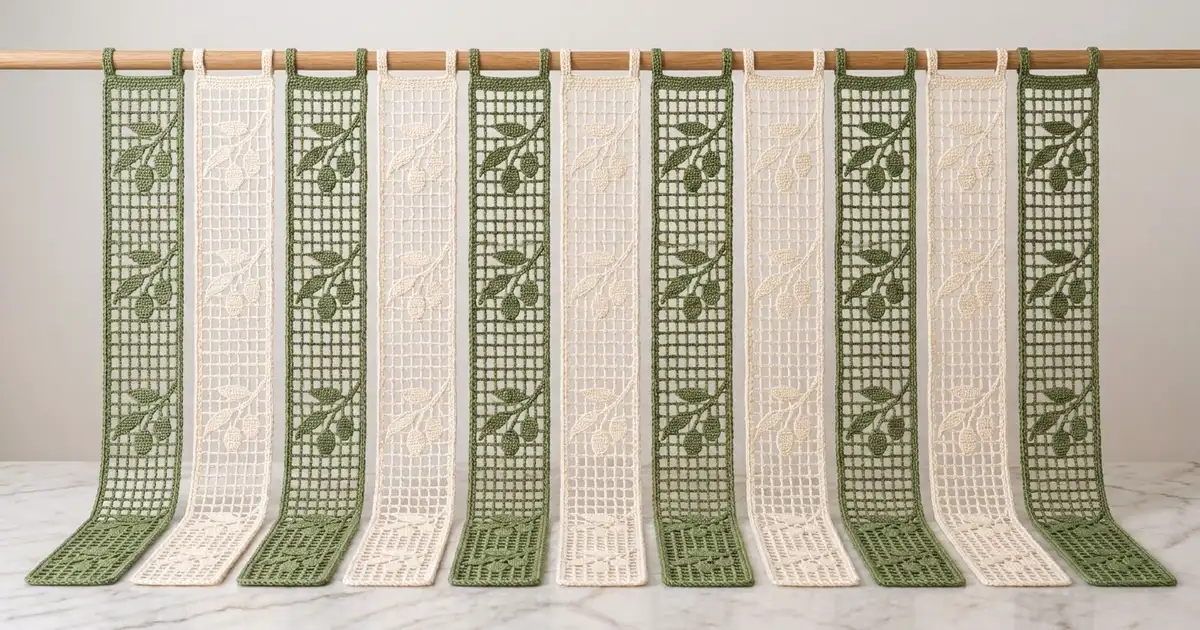
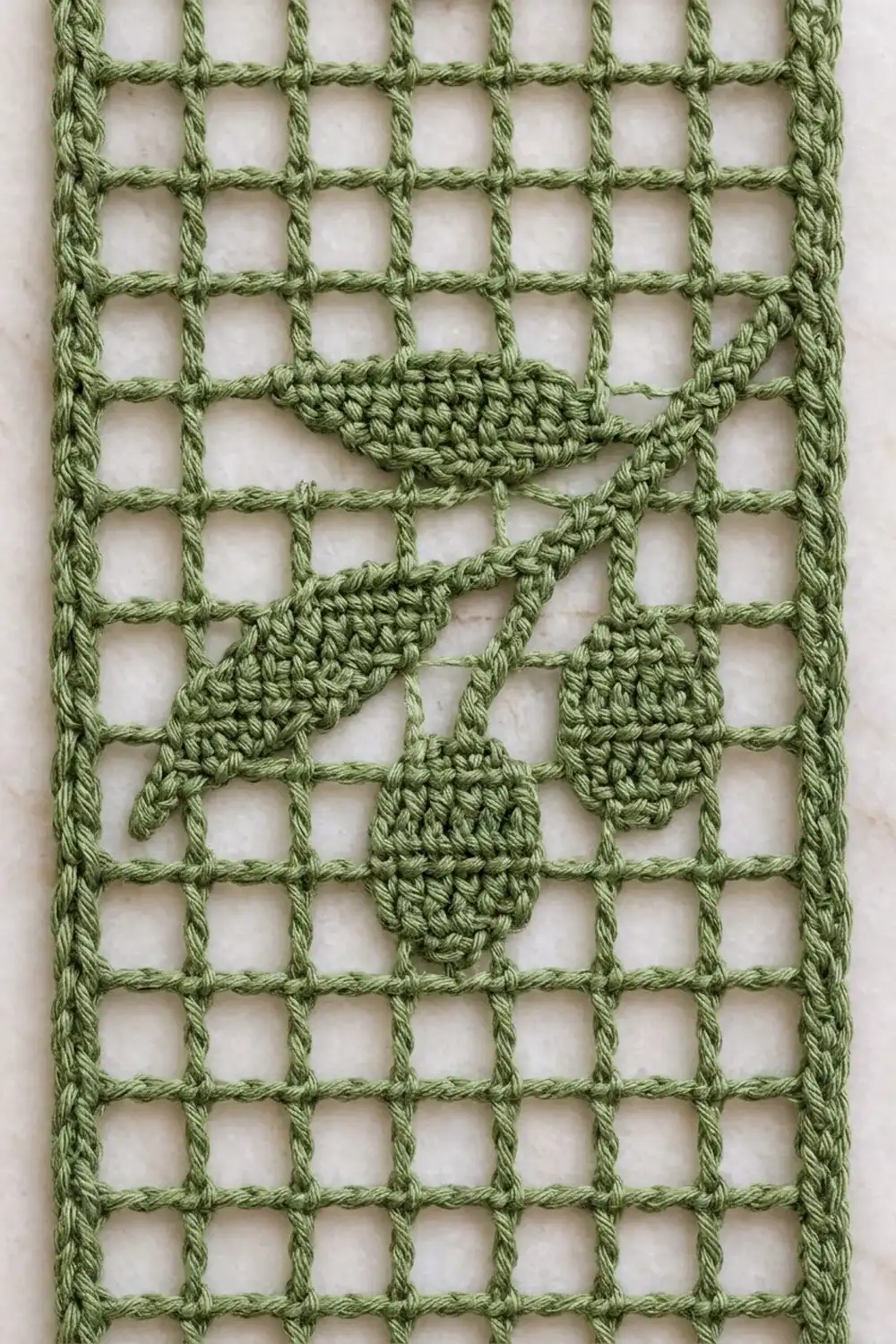
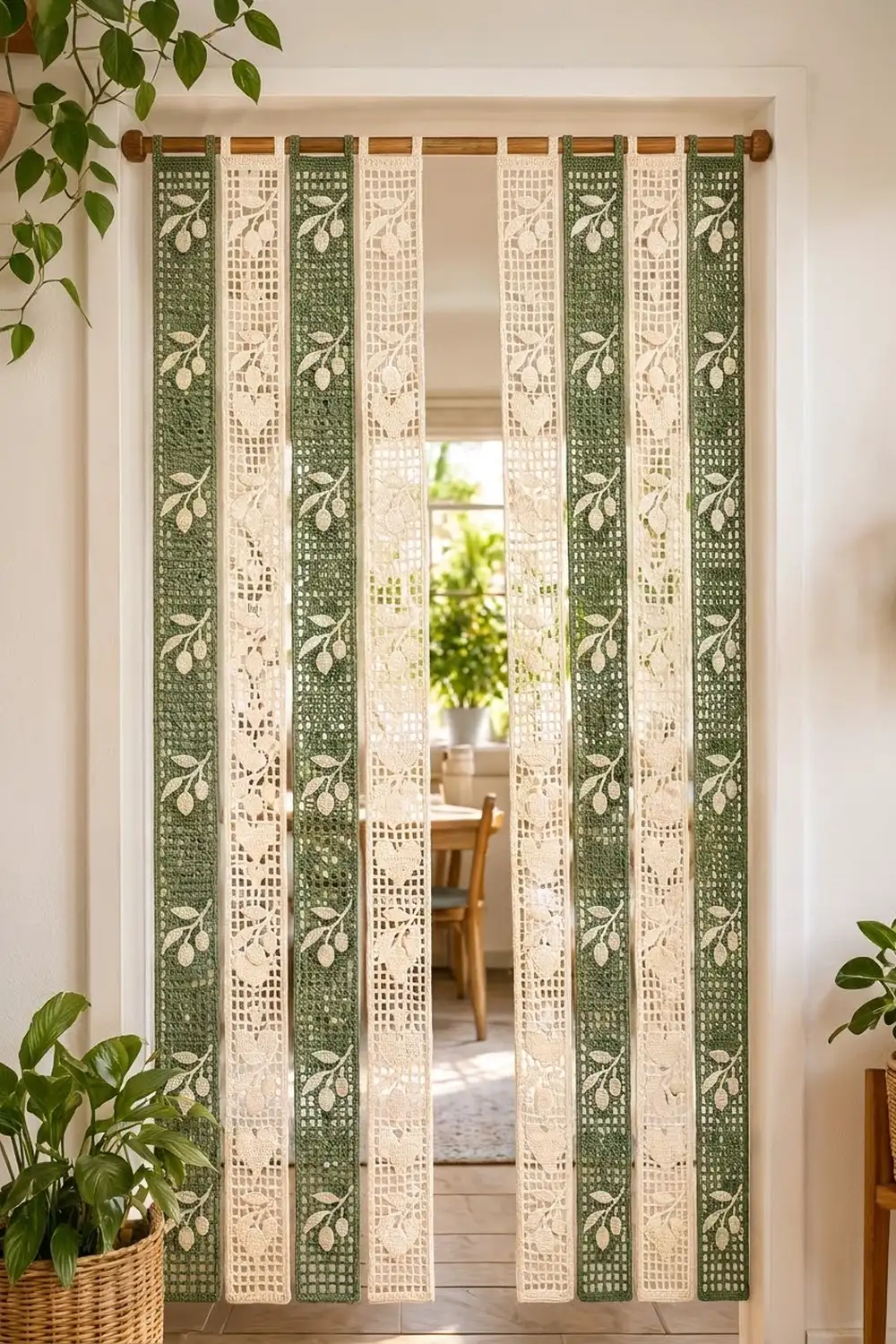
This curtain is made of nine narrow filet crochet strips that hang side by side from a rod. Each strip has an open square mesh with olive branches worked in solid blocks: a diagonal stem, two pointed leaves, and three hanging olives. The motif repeats eight times down each strip.
The strips alternate sage green and cream, five green and four cream, with green on both outer edges. When the light comes through, the open mesh glows and the solid olive shapes stand out.
All instructions use US crochet terms. Each finished strip measures 4.0 in (10.2 cm) wide and hangs 77.8 in (197.6 cm) long. With 0.5 in (1.3 cm) gaps, the nine strips span 40.0 in (101.6 cm) of rod.
Each strip is worked flat in rows of filet mesh. Next comes a two-round single-crochet border, and then the top is folded over to form a rod pocket. The strips are never sewn to each other, so each one hangs and moves on its own.
Finished Size and Construction
- Finished strip size: 4.0 in × 79.6 in (10.2 cm × 202.2 cm) before folding; hangs 77.8 in (197.6 cm) long
- Skill level: Intermediate
- Terminology: US
- Yarn weight: Sport (#2) mercerized cotton
- Hook: 3.0 mm
- Number of pieces: 9 separate strips (5 green, 4 cream)
- Layout: 9 strips in a single row on the rod, unjoined
- Strip body before border: 9 meshes × 198 rows = 3.6 in × 79.2 in (9.1 cm × 201.2 cm)
- Border depth: 0.2 in (0.5 cm) per side
Materials
Choose a smooth, mercerized cotton. It gives crisp mesh, clear block edges, and very little stretch when the strip hangs. Avoid fuzzy or very stretchy fibers, because they blur the motif and the strip will grow in length.
- Sage green: 7 balls of 50 g / 155 m (170 yd), total 350 g / 1085 m
- Cream: 6 balls of 50 g / 155 m (170 yd), total 300 g / 930 m
Each strip uses about 55 g / 170 m. These quantities include a generous margin for your gauge swatch and for differences in tension.
Tools:
– 3.0 mm crochet hook
– Tapestry needle
– Stitch markers
– Measuring tape
– Rustproof pins and a long blocking surface
– Spray bottle
– Curtain rod up to 1 in (2.5 cm) in diameter
Abbreviations (US Terms)
- ch – chain
- dc – double crochet
- sc – single crochet
- sk – skip
- sp – space
- st(s) – stitch(es)
- RS / WS – right side / wrong side
Special stitches:
– O (open mesh): ch 2, sk 2 sts (or the ch-2 sp), dc in next dc.
– B (block): 2 dc in the ch-2 sp below (or 1 dc in each of the next 2 dc), then dc in next dc.
– Starting O: ch 5 (counts as dc + ch 2), sk the ch-2 sp or 2 sts, dc in next dc.
– Starting B: ch 3 (counts as dc), dc in each of next 2 sts, dc in next dc.
Every row has 28 sts: 10 “post” dc plus 2 sts (ch or dc) in each of the 9 meshes.
Gauge and Checkpoints
Gauge: 10 meshes × 10 rows = 4.0 in × 4.0 in (10.2 cm × 10.2 cm). One mesh is 0.4 in (1.0 cm) square.
Before you commit to nine strips, make a test strip. Work Rows 1–24 (one full motif) and check:
- After Row 1: 3.6 in (9.1 cm) wide
- After Row 7: 2.8 in (7.1 cm) tall
- After Row 24: 9.6 in (24.4 cm) tall
If the swatch is too big, go down 0.25 mm in hook size. If it is too small, go up 0.25 mm. If only the height is off, adjust how tall you pull up your dc loops rather than changing the hook. Filet squares that come out taller than they are wide will stretch the olives into long ovals.
Strip Pattern
Work the strip flat in rows.
Reading the rows: odd rows are RS rows and are worked right to left. Even rows are WS rows. Each row is written in working order, so simply work the meshes in the order listed.
Foundation: ch 32.
Row 1 (RS): dc in 8th ch from hook. ch 2, sk 2 ch, dc in next ch 8 times. Turn. (9 meshes; 10 dc, 28 sts)
From here on, begin each row with a Starting O or Starting B as listed. End each row by working the last dc into the 3rd ch of the turning ch-5, or into the top of the turning ch-3.
Olive Motif Repeat (24 rows)
- Row 1 (RS): O9. (The first time through, this is the foundation row above.)
- Rows 2–7: O9 in each row.
- Row 8 (WS): O1, B2, O1, B2, O3.
- Row 9 (RS): O3, B2, O1, B2, O1.
- Row 10: O1, B2, O1, B2, O3.
- Row 11: O4, B1, O1, B1, O2.
- Row 12: O3, B1, O5.
- Row 13: O4, B1, O1, B2, O1.
- Row 14: B5, O1, B2, O1.
- Row 15: O1, B2, O1, B3, O2.
- Row 16: O4, B1, O1, B2, O1.
- Row 17: O2, B1, O1, B1, O4.
- Row 18: O5, B1, O3.
- Row 19: O3, B1, O1, B2, O2.
- Row 20: O1, B6, O2.
- Row 21: O2, B1, O1, B2, O3.
- Row 22: O7, B1, O1.
- Row 23: B1, O8.
- Row 24: O9.
Every row totals 9 meshes and 28 sts.
What the shapes are:
– Rows 8–10: two side-by-side olives, each 2 blocks wide and 3 rows tall.
– Rows 11–13: the twigs that join the olives to the stem.
– Rows 13–15: the lower leaf, 5 blocks at its widest.
– Rows 14–16: the higher right-hand olive.
– Rows 19–21: the upper leaf, 6 blocks wide including the stem.
– Rows 22–23: the stem rising to the upper right edge.
Full Strip
- Rows 1–192: Work the 24-row repeat 8 times.
- Rows 193–198: O9 in each row. These open rows become the rod pocket.
Fasten off.
Checkpoint: 9 meshes × 198 rows, measuring 3.6 in × 79.2 in (9.1 cm × 201.2 cm). There are 7 open rows below the first motif and 7 above the last one, so the strip looks balanced.
Make All Pieces
- Sage green: 5 strips
- Cream: 4 strips
Layout (left to right on the rod):
| G | C | G | C | G | C | G | C | G |
G = green, C = cream. Each strip is 4.0 in (10.2 cm) wide, and the gaps are 0.5 in (1.3 cm).
Finish and border all nine strips before blocking, so they all get the same treatment.
Joining (Hanging Without Seams)
The strips are not joined to each other. Instead, each strip is finished with its own rod pocket, so the curtain can part easily as you walk through it.
Method:
1. After the border is done, fold the top 1.8 in (4.6 cm) to the WS. This is the border plus Rows 195–198, and the fold line runs along the top of Row 194.
2. Stitch-to-stitch logic: on each long edge, the folded part covers about 14 border sc. Whipstitch those 14 sc to the 14 sc directly behind them, one to one, so the pocket sides close neatly.
3. Across the width, tack the folded top border to each of the 10 dc posts of the mesh row it lies on.
4. Keep the tension relaxed. If you pull tightly, the pocket will pucker and the strip will hang crooked.
Checkpoint: the pocket is about 3.6 in (9.1 cm) around inside. Each strip now hangs 77.8 in (197.6 cm) long and 4.0 in (10.2 cm) wide.
Border
Border gauge: about 7.5–8 sc per inch (3 sc per 1.0 cm).
Work the border with the RS facing, starting at the top right corner.
Round 1:
1. Join yarn and ch 1.
2. Short edge: sc in each of the 28 sts across.
3. Corner: ch 1.
4. Long edge: 3 sc in each row-end, 198 × 3 = 594 sc.
5. Corner: ch 1.
6. Bottom edge: 28 sc along the foundation (work each sc into the base of a stitch).
7. Corner: ch 1.
8. Long edge: 594 sc.
9. Corner: ch 1.
10. Join with a sl st to the first sc.
Round 1 counts: 28 + 594 + 28 + 594 = 1244 sc, plus 4 ch-1 corner spaces. The corner spaces are not counted in the side totals.
Round 2: ch 1. Sc in each sc, and work (sc, ch 1, sc) in each corner space. Join.
Round 2 counts:
– Short sides: 28 + 2 = 30 sc each
– Long sides: 594 + 2 = 596 sc each
– Total: 30 + 596 + 30 + 596 = 1252 sc, plus 4 ch-1 corner spaces
Fasten off and weave in the ends.
Why the math works: along the short edge, 28 sc span 3.6 in, which is about 7.8 sc per inch. On the long edges, each row is 0.4 in tall, so 3 sc per row-end gives 7.5 sc per inch. Both edges are close to the same density, so the border lies flat without rippling or pulling in.
Final Blocking
- Soak each strip in cool water for 10 minutes, then press out the water in a towel. Don’t wring it.
- Lay the strip flat on the blocking surface with the RS up.
- Pin both long edges straight to 4.0 in (10.2 cm) wide, placing pins every 4 in (10.2 cm).
- Gently ease the length to 79.6 in (202.2 cm). Don’t stretch it further, or the strip will shrink back unevenly.
- Square up the mesh by running a finger down each column of dc posts.
- Leave it until completely dry, then sew the rod pocket.
Final Quality-Control Checklist
- [ ] Each strip is 9 meshes wide and 198 rows long
- [ ] Every row has 28 sts
- [ ] There are 8 olive motifs per strip, all facing the same way
- [ ] Border Round 2 has 30 / 596 / 30 / 596 sc
- [ ] Width is 4.0 in (10.2 cm) all along the strip
- [ ] Hanging length is 77.8 in (197.6 cm), and all nine strips match within 0.5 in (1.3 cm)
- [ ] The pocket is tacked at all 10 dc posts
- [ ] The strips alternate green and cream, with green at both ends
Troubleshooting
- The strip slants: you are probably working the last dc into the wrong turning chain. Always finish in the 3rd ch of the ch-5, or in the top of the ch-3.
- The olives look stretched: your dc are too tall. Shorten your loops, or try a smaller hook just for the blocks.
- The border ruffles: use 2 sc in every third row-end, and work Round 2 more firmly.
- The border pulls in: loosen up, or go up 0.25 mm in hook size for the border only.
- The strips are different lengths: block them all together and pin them to the same 79.6 in (202.2 cm) mark.
- A motif is mirrored: check that odd rows are RS rows and are read in working order.
Care
Hand wash in cool water with mild detergent, then lay flat to dry. Reshape gently while damp before hanging the strips back up.
Final Notes
Here is the measurement chain from start to finish:
– Mesh: 0.4 in (1.0 cm)
– Strip body: 9 meshes × 198 rows = 3.6 in × 79.2 in (9.1 cm × 201.2 cm)
– After border: 2 rounds add 0.2 in (0.5 cm) per side, for 4.0 in × 79.6 in (10.2 cm × 202.2 cm)
– After the fold: the 1.8 in (4.6 cm) pocket leaves a hanging length of 77.8 in (197.6 cm)
– Full curtain: nine strips with 0.5 in (1.3 cm) gaps span 40.0 in (101.6 cm)
If your test motif matches the gauge, every number after it will fall into place.
Happy crocheting!