
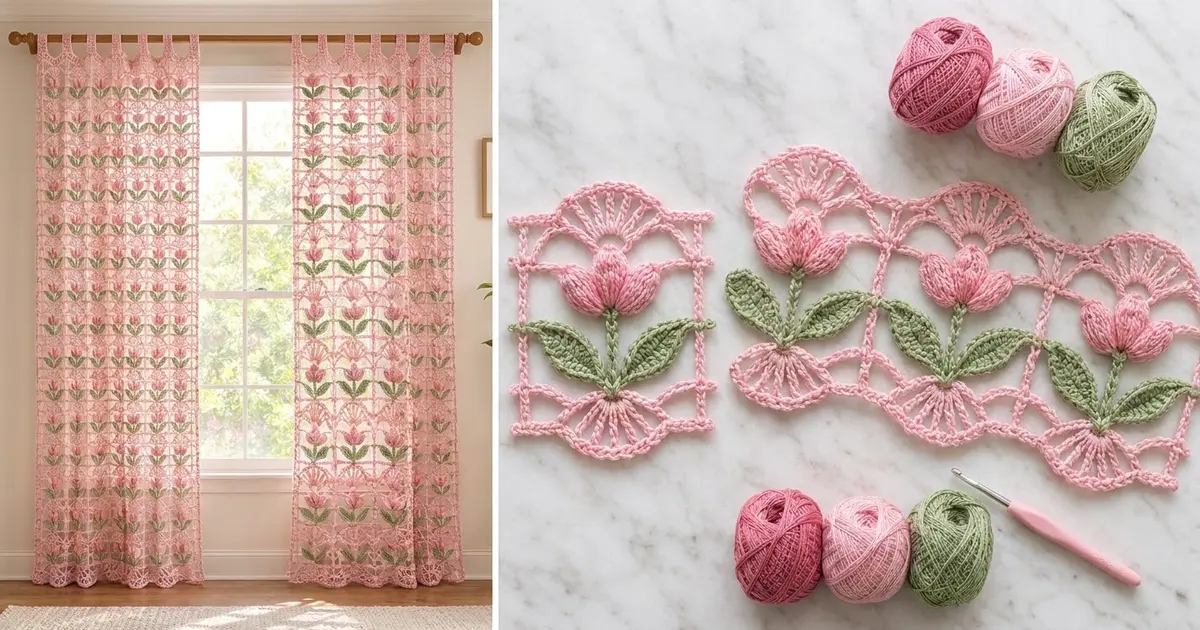
The Tulip Lattice Curtain is a light, airy tab-top panel built from rectangular lace motifs. Each motif has an open light pink frame with fans at the top and bottom, plus a raised rose-pink tulip with sage-green leaves sewn onto the center.
The colors are soft and romantic: a light pink lattice, rose pink tulips, and sage green stems and leaves. At a window, light comes through the open mesh, and the tulips line up in neat columns.
This pattern uses US crochet terms. One finished panel measures 26.5 x 74.25 in (67.3 x 188.6 cm) without tabs. With the tabs looped over the rod, it hangs about 78.25 in (198.8 cm) long. The photo shows a pair, so make two panels.
Construction overview: crochet 36 background motifs in rows and sew a tulip, a stem, and two leaves onto each one. Join the motifs in a 4 x 9 grid, work a three-round border with a scalloped edge, and add seven tabs across the top.
Finished Size and Construction
- Finished panel size: 26.5 x 74.25 in (67.3 x 188.6 cm), plus tabs
- Skill level: Intermediate
- Terminology: US
- Yarn weight: DK (#3) cotton or cotton blend
- Hook: 4 mm (US G-6)
- Number of pieces per panel: 36 motifs (make two panels for a pair)
- Layout: 4 motifs wide x 9 motifs tall
- Single motif size: 6 x 8 in (15.2 x 20.3 cm)
- Size before border: 24 x 72 in (61.0 x 182.9 cm)
- Border depth: 1.25 in (3.2 cm) on the sides and bottom, 1 in (2.5 cm) on top
Materials
Choose a smooth DK cotton. Cotton holds the lattice shape, drapes well, and survives washing. Avoid fuzzy yarns, which blur the open frame. The quantities below assume about 2.3 m per gram (roughly 115 m per 50 g).
| Color | Use | Per panel | Pair of panels |
|---|---|---|---|
| Light pink | Motifs, joining, border, tabs | 450 g / 1,035 m | 900 g / 2,070 m |
| Rose pink | Tulip petals | 90 g / 207 m | 180 g / 414 m |
| Sage green | Stems and leaves | 110 g / 253 m | 220 g / 506 m |
All quantities include a margin of about 10% for swatching and differences in tension.
Tools: 4 mm (US G-6) hook, tapestry needle, locking stitch markers, rust-proof pins, blocking mats, spray bottle, measuring tape, scissors.
Abbreviations (US Terms)
- ch – chain
- sl st – slip stitch
- sc – single crochet
- hdc – half double crochet
- dc – double crochet
- tr – treble crochet
- sk – skip
- st(s) – stitch(es)
- sp – space
- RS / WS – right side / wrong side
Special stitch – tr11tog (11-leg treble cluster): *Yarn over twice, insert hook in next st, yarn over and pull up a loop, (yarn over, pull through 2 loops) twice; repeat from * 10 more times (12 loops on hook), yarn over and pull through all 12 loops. This counts as 1 st. Its 11 legs form the spokes of the bottom fan.
Counting rule: In the background motif, every dc and every chain counts as 1 st. “Work into every st” means into the chains as well as the dc. A beginning ch-3 counts as 1 dc. A beginning ch-4 counts as 1 dc plus 1 ch.
Gauge and Checkpoints
Gauge: 18 sts and 9 dc rows = 4 in (10.2 cm). Each dc row is about 0.44 in (1.1 cm) tall.
Make one complete background motif first and use it as your swatch. Lightly block it, then check:
- After Row 1: width is 6 in (15.2 cm).
- After Row 4: height is about 1.75 in (4.4 cm).
- After Row 10: height is just under 4.5 in (11.4 cm).
- After Row 18: motif is 6 x 8 in (15.2 x 20.3 cm).
If your motif is too big, go down a hook size. If it is too small, go up a size. An error of only 0.25 in (0.6 cm) per motif adds up to 1 in (2.5 cm) across the panel and 2.25 in (5.7 cm) down its length.
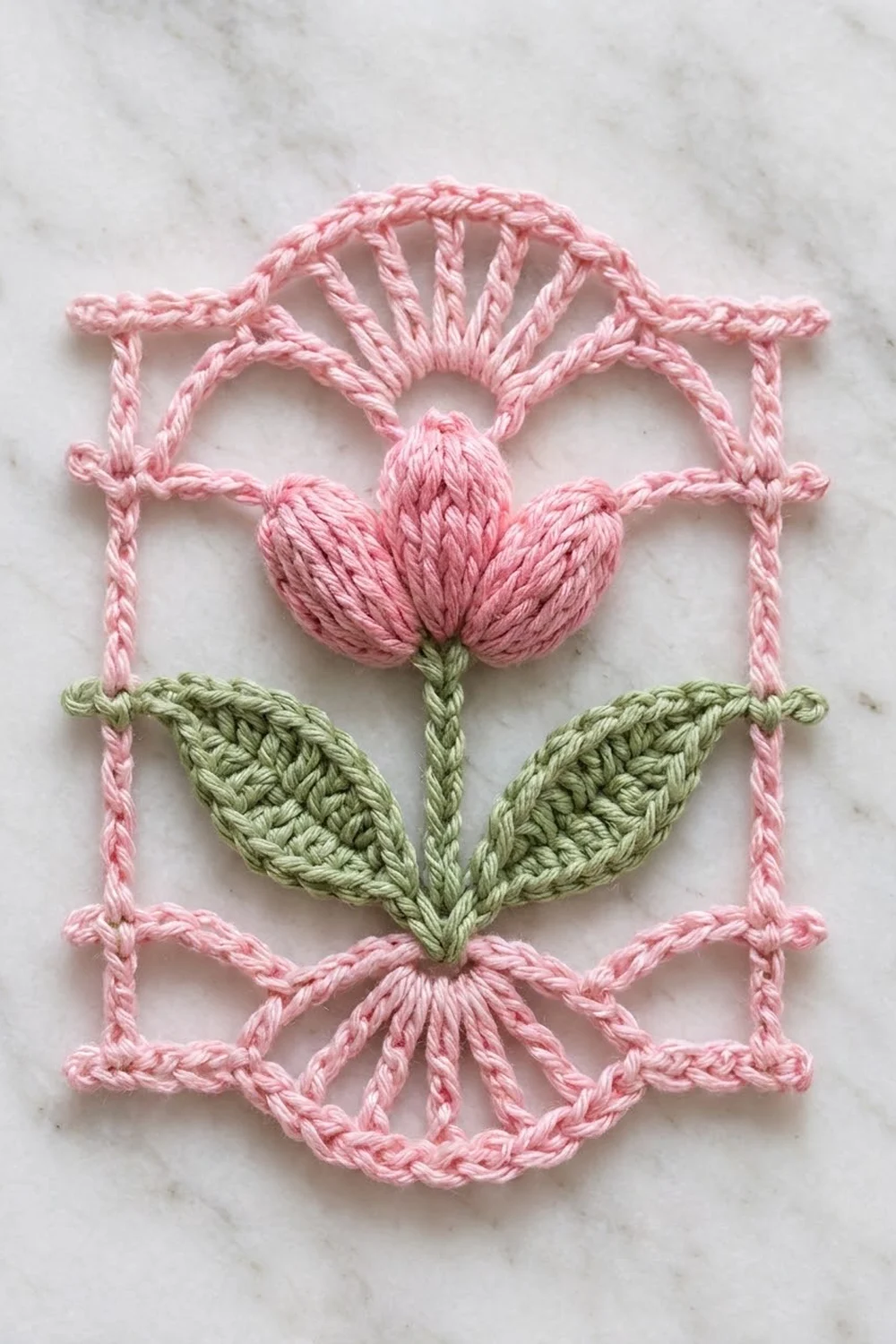
Background Motif (make 36 per panel)
With light pink, ch 29.
Row 1 (RS, bottom bar): Dc in 4th ch from hook (the skipped 3 ch count as 1 dc), dc in each remaining ch across, turn. (27 sts)
Row 2 (mesh): Ch 4 (counts as dc + ch 1), sk next st, dc in next st, *ch 1, sk next st, dc in next st; repeat from * across, turn. (14 dc + 13 ch = 27 sts)
Row 3 (bottom fan): Ch 4 (counts as dc + ch 1), sk next st, dc in st 3. Dc in st 4, ch 4, sk sts 5–8, tr11tog over sts 9–19, ch 4, sk sts 20–23, dc in st 24. Dc in st 25, ch 1, sk st 26, dc in st 27, turn. (3 frame sts + 11 center sts + 3 frame sts = 17 sts)
The 11 cluster legs fan downward from one top point. The stem will start at this point.
Row 4 (bar): Ch 3 (counts as dc), dc in ch-1, dc in next dc. Dc in next dc, 9 dc in ch-4 sp, dc in top of cluster, 9 dc in next ch-4 sp, dc in next dc. Dc in next dc, dc in ch-1, dc in last st, turn. (3 + 21 + 3 = 27 sts)
Rows 5–9: Repeat Row 2. (27 sts each row)
Row 10 (leaf bar): Ch 3, dc in every st across, turn. (27 sts)
Rows 11–14: Repeat Row 2. (27 sts each row)
Row 15 (top fan): Ch 4 (counts as dc + ch 1), sk next st, dc in st 3. Dc in st 4, ch 4, sk sts 5–13, 11 dc in st 14 (the center st), ch 4, sk sts 15–23, dc in st 24. Dc in st 25, ch 1, sk st 26, dc in st 27, turn. (3 + [1 + 4 + 11 + 4 + 1 = 21] + 3 = 27 sts)
The 11 dc open upward like a sunburst.
Row 16 (fan tops): Ch 4, sk next st, dc in st 3. Dc in next dc, ch 4, sk 4 ch, dc in each of next 11 dc, ch 4, sk 4 ch, dc in next dc. Dc in next dc, ch 1, sk ch, dc in last st, turn. (3 + 21 + 3 = 27 sts)
Row 17: Repeat Row 2. (27 sts)
Row 18 (top bar): Ch 3, dc in every st across. (27 sts) Fasten off, leaving a 6 in (15.2 cm) tail.
Stitches 1–3 and 25–27 form the vertical ladder posts on each side. Rows 1, 4, 10, and 18 form the solid horizontal bars.
Tulip Petals (make 3 per motif)
With rose pink, ch 8.
Rnd 1: Sc in 2nd ch from hook, hdc in next ch, dc in next 3 ch, hdc in next ch, 5 sc in last ch (rounded tip). Working along the other side of the chain: hdc in next ch, dc in next 3 ch, hdc in next ch, sc in last ch, sl st to first sc. (17 sts)
Fasten off, leaving a 10 in (25.4 cm) tail for sewing. Each petal is a puffy oval about 1.6 in (4.1 cm) long.
Stem (make 1 per motif)
With sage green, ch 19. Sl st in back bump of 2nd ch from hook and in each ch across. (18 sl sts)
Fasten off with a long tail. The stem is about 4 in (10.2 cm) long. That matches the distance from the cluster point at the top of Row 3 to the top of Row 12.
Leaves (make 2 per motif)
With sage green, ch 12.
Rnd 1: Sc in 2nd ch from hook, hdc in next ch, dc in next 2 ch, tr in next 3 ch, dc in next 2 ch, hdc in next ch, (sc, ch 2, sc) in last ch for the pointed tip. Working along the other side: hdc in next ch, dc in next 2 ch, tr in next 3 ch, dc in next 2 ch, hdc in next ch, sc in last ch, sl st to first sc. (22 sts + 1 ch-2 tip)
Fasten off with a long tail. The starting chain shows down the middle as a leaf spine. Each leaf is about 2.5 in (6.4 cm) long.
Assemble Each Tulip Motif
- Lay the background motif RS up with Row 1 at the bottom.
- Pin the stem straight up the center, from the cluster point to the top of Row 12. Whipstitch it down along its length.
- Place the two side petals with their bases touching the top of the stem and their tips angled out and up.
- Lay the center petal on top so it overlaps both side petals by about 0.5 in (1.3 cm), with its tip pointing straight up.
- Sew around the outer edges, leaving the tips slightly free so they stand up.
- Sew a leaf on each side of the stem. Each leaf’s base sits on the Row 10 bar and its tip angles up and out.
- Weave in all ends on the WS.
Make All Pieces
Per panel: 36 light pink background motifs, 108 rose pink petals, 36 green stems, and 72 green leaves. For a pair, double everything.
Layout grid (4 wide x 9 tall). Each T is 1 assembled tulip motif, placed with Row 1 at the bottom:
T T T T
T T T T
T T T T
T T T T
T T T T
T T T T
T T T T
T T T T
T T T T
Joining
Join with light pink, using a slip-stitch seam on the WS. Hold two motifs RS together and work through both layers.
Vertical seams (side to side): Each side edge has 18 dc row ends. Work 2 sl sts into each row end, for 36 sl sts per seam. First join the four motifs of each row into horizontal strips.
Horizontal seams (strip to strip): Match the Row 18 top of one strip to the foundation-chain bottom of the strip above. Work 1 sl st through each pair of matching sts, for 27 sl sts per motif and 108 per seam.
Keep the seams as loose as the fabric. Tight seams pull the lattice into waves. If that happens, go up one hook size for joining only.
Checkpoint: The joined panel measures 24 x 72 in (61.0 x 182.9 cm): 4 motifs x 6 in across and 9 motifs x 8 in down.
Border
Border gauge: work 2 sc per dc row end along the sides and 1 sc per st along the top and bottom. Each sc is about 0.22 in (0.6 cm) wide, the same as one stitch at 18 sts per 4 in, so the edge lies flat.
Rnd 1: With RS facing, join light pink in the first st of the top edge at the right corner. Work 1 sc in each st across the top (4 x 27 = 108 sc), then ch 2 for the corner. Down the long side, work 2 sc in each row end (9 x 36 = 324 sc), then ch 2. Work 1 sc in each foundation ch across the bottom (108 sc), then ch 2. Work 324 sc up the other side, ch 2, and sl st to first sc.
Do not add any stitches at the seams. Work only into the motifs’ own sts and row ends. (108 + 324 + 108 + 324 = 864 sc + 4 corner ch-2 sps)
Rnd 2: Ch 3 (counts as dc) in the same st, then dc in each sc around, working (2 dc, ch 2, 2 dc) in each corner ch-2 sp. Sl st to top of ch-3. Each short side has 108 + 2 + 2 = 112 dc, and each long side has 324 + 2 + 2 = 328 dc. (880 dc + 4 corner ch-2 sps)
Rnd 3 (scallops): Ch 1, then sc in each of the 112 dc across the top. In the corner sp, work (sc, ch 3, sc). Down the long side, *sc in next dc, sk 1, 5 dc in next dc, sk 1; repeat from * 82 times. In the corner sp, work (sc, ch 3, sc). Across the bottom, repeat from * 28 times. In the corner sp, work (sc, ch 3, sc). Up the last side, repeat from * 82 times. In the final corner sp, work (sc, ch 3, sc), then sl st to first sc. Fasten off.
Why the math works: Each scallop uses exactly 4 sts. The bottom edge has 112 sts (112 ÷ 4 = 28 scallops), and each long side has 328 sts (328 ÷ 4 = 82 scallops). Nothing is left over, so every corner turns cleanly.
Rnds 1–2 add 0.75 in (1.9 cm) and the scallops add 0.5 in (1.3 cm), for 1.25 in (3.2 cm) per side. The flat sc top adds 1 in (2.5 cm). Width: 24 + 1.25 + 1.25 = 26.5 in (67.3 cm). Length: 72 + 1.25 + 1 = 74.25 in (188.6 cm).
Tabs
Divide the 112 top sts into 7 tabs of 10 sts with 6 gaps of 7 sts (70 + 42 = 112). Start the first tab at st 1, skip 7 sts after each tab, and end the last tab at st 112.
Each tab: Join light pink in the first st of the tab, ch 1, sc in the same st and in the next 9 sts, turn. (10 sc) Work 35 more rows of 10 sc, or until the tab measures 8 in (20.3 cm). Fasten off with a long tail. Fold the tab to the WS and sew its end to the base of the border, making a loop that hangs about 4 in (10.2 cm). Each tab is about 2.2 in (5.6 cm) wide.
Final Blocking
- Weave in all remaining tails along a seam.
- Lay the panel flat on blocking mats, WS up.
- Pin the corners to 26.5 x 74.25 in (67.3 x 188.6 cm).
- Pin the long sides every 3–4 in (7.6–10.2 cm), keeping the seams straight.
- Pin out each scallop point along the bottom.
- Mist with water until damp, not soaked.
- Let it dry completely, then unpin. Turn it RS up and shape the petals with your fingers.
Final Quality-Control Checklist
- Every motif is 6 x 8 in (15.2 x 20.3 cm), with 27 sts in each solid bar.
- All tulips point toward the top of the curtain.
- Every stem starts at the bottom fan’s cluster point.
- Both leaves sit on the Row 10 bar.
- Vertical seams have 36 sl sts. Horizontal seams have 27 sl sts per motif.
- Border Rnd 2 has 112 sts per short side and 328 per long side.
- The 7 tabs are evenly spaced and the same length.
Troubleshooting
Bottom fan puckers: The cluster legs are too tight. Keep each yarn over loose.
Row 4 bar ripples: Work the 9 dc into each ch-4 space, not into the individual chains.
Petals curl: Steam lightly and pin them flat to dry before sewing.
Later motifs come out smaller: Your tension has tightened. Compare each motif to the first, and remake any that are more than 0.25 in (0.6 cm) small.
Border flares: Go down a hook size for Rnds 1–2.
Care
Hand wash, or machine wash on a gentle cycle in cool water inside a mesh laundry bag. Lay flat to dry, and re-pin to the blocked measurements if needed.
Final Notes
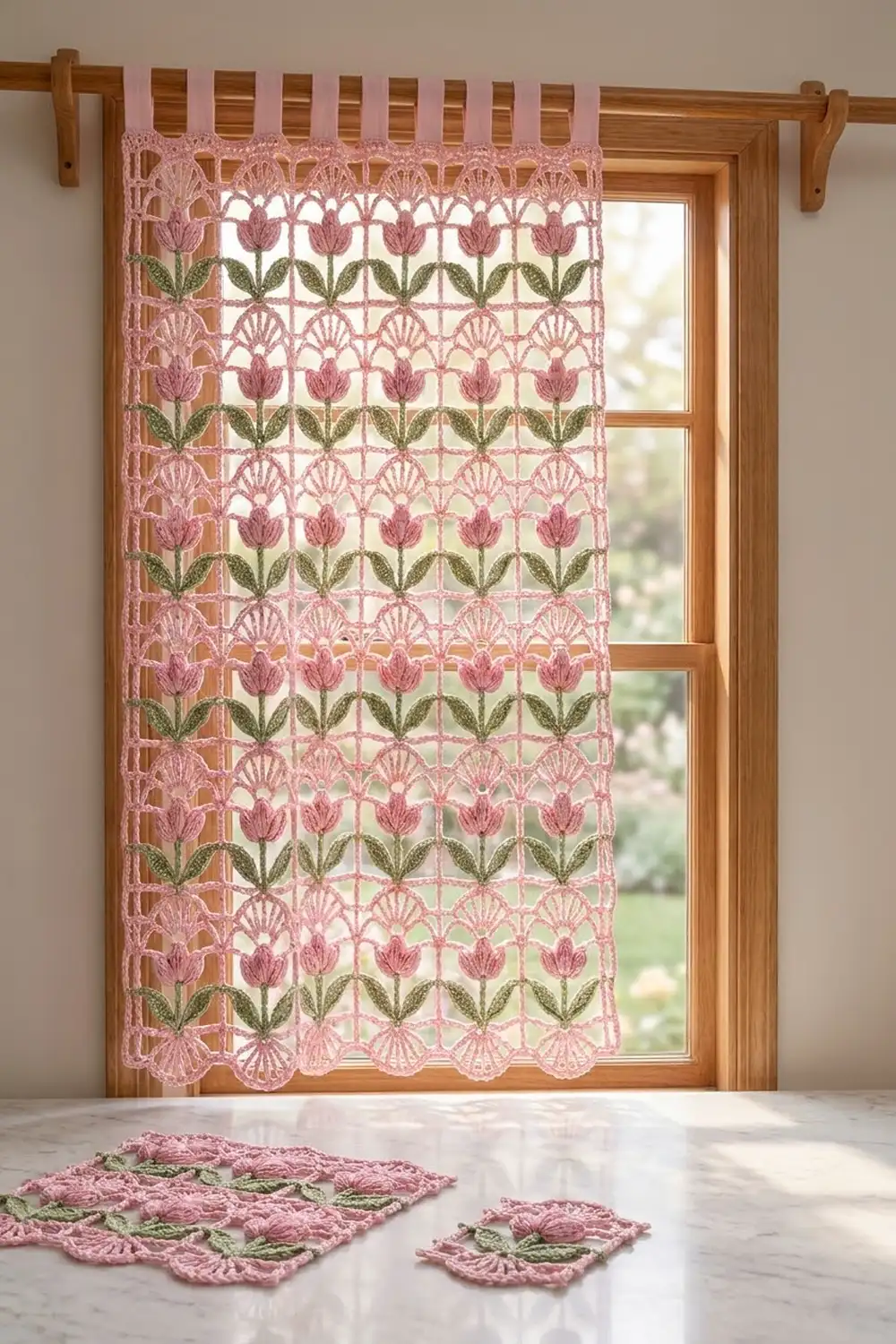
The whole curtain grows from one measurement chain. Twenty-seven sts make 6 in (15.2 cm), and 18 rows make 8 in (20.3 cm). Four motifs across give 24 in (61.0 cm), and nine motifs down give 72 in (182.9 cm). The border brings the panel to 26.5 x 74.25 in (67.3 x 188.6 cm), and the tabs add about 4 in (10.2 cm) of hanging loop. Get your first motif right, and every later step will fit.
Happy crocheting!