
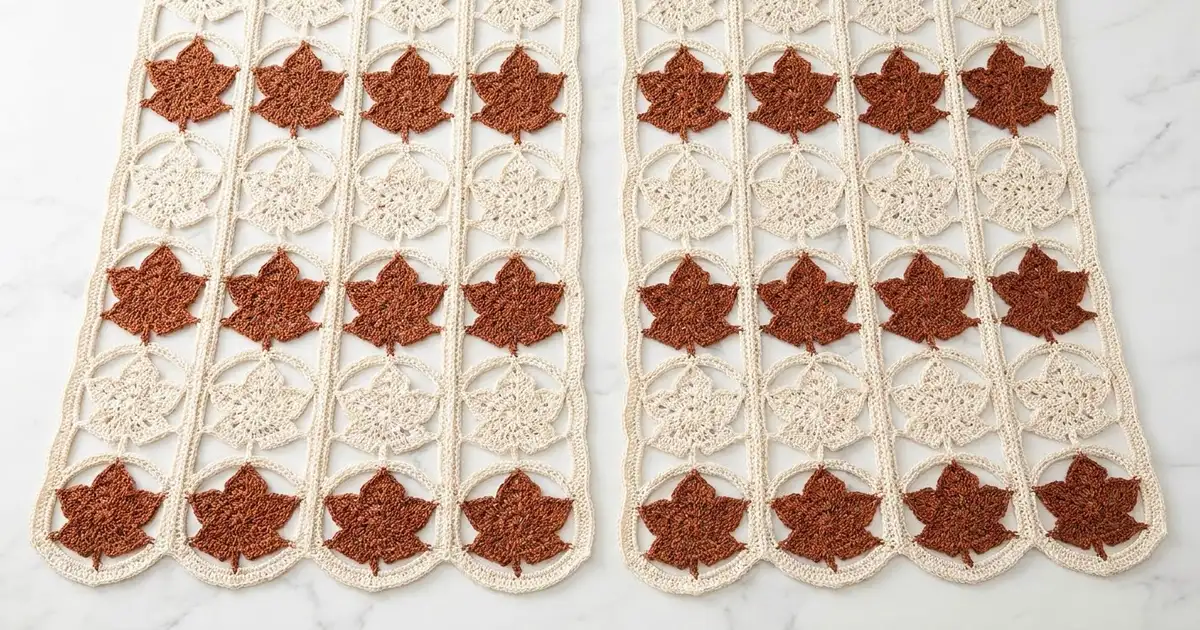
This lace curtain panel is a grid of small maple leaves. Each leaf sits inside its own cream chain frame, and the frames meet in narrow columns of open chain links. Rows of rust leaves alternate with rows of cream leaves, so the panel reads as soft horizontal bands of autumn color when light comes through it.
The palette is just two colors: warm rust (Color A) and natural cream (Color B). Smooth DK cotton keeps every lobe point and chain arch crisp. It also holds up to daylight and washing better than acrylic.
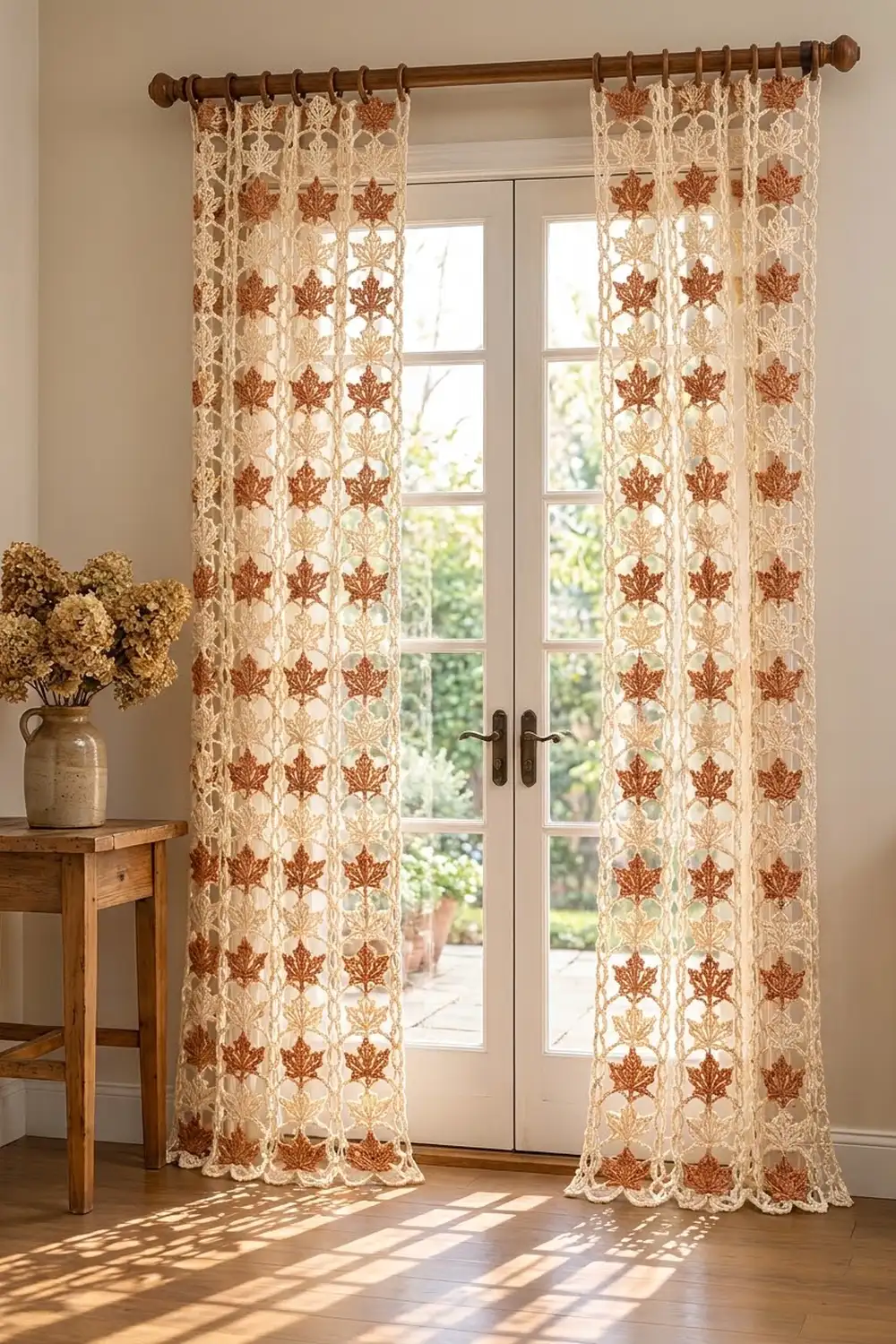
All terms are US crochet terms. One finished panel measures 19.75 in wide x 70.75 in long (50.2 cm x 179.7 cm). The photo shows a pair hanging side by side, so make two panels for the same look.
You’ll work 60 motifs per panel. Each one is a five-lobed leaf with a two-round cream frame. Then you join them in a 5 x 12 grid with a slip-stitch link join and add a sc border with a scalloped bottom edge.
Finished Size and Construction
- Finished panel size: 19.75 in x 70.75 in (50.2 cm x 179.7 cm)
- Skill level: Intermediate
- Terminology: US crochet terms
- Yarn weight: DK (3), cotton
- Hook: 4.0 mm (US G-6)
- Number of pieces: 60 motifs per panel (30 with Color A leaves, 30 with Color B leaves), 120 for a pair
- Layout: 5 motifs across x 12 motifs down
- Motif size: 3.75 in wide x 5.75 in tall (9.5 cm x 14.6 cm)
- Size before border: 18.75 in x 69 in (47.6 cm x 175.3 cm)
- Border depth: 0.5 in (1.3 cm) on the sides and top, 1.25 in (3.2 cm) at the scalloped bottom
Materials
Use a smooth mercerized or combed DK cotton, about 115 m per 50 g ball. Matte cotton works too, but the leaf points won’t look as sharp. Buy each color from a single dye lot, because a long curtain shows color shifts clearly in sunlight.
Per panel:
– Color A (rust): 100 g / 230 m
– Color B (cream): 400 g / 920 m
For a pair: Color A 200 g / 460 m, Color B 800 g / 1,840 m.
These quantities include a margin of roughly 15% for gauge differences and tails.
Tools:
– 4.0 mm (US G-6) hook
– Tapestry needle
– Stitch markers
– Rustproof pins and a large blocking surface
– Spray bottle
– 7 curtain clip rings per panel
Abbreviations (US Terms)
- ch – chain
- sl st – slip stitch
- sc – single crochet
- hdc – half double crochet
- dc – double crochet
- tr – treble crochet
- sk – skip
- st(s) – stitch(es)
- sp – space
- RS – right side
Special stitch – Link join: Line up 2 edges with RS up. Ch 1, sk 1 st on the first motif, sl st in the next st; ch 1, sk 1 st on the second motif, sl st in the next st. The ch-1 bars zigzag between the two cream frames and open small chain links down the seam.
Gauge and Checkpoints
Gauge: 16 sc x 16 rows = 4 in (10.2 cm) with a 4.0 mm hook. That’s 4 sc per inch.
Make one complete motif before you commit to all 60, then check these sizes:
- Leaf after Row 2: about 3 in (7.6 cm) wide across the side lobes and 3 in (7.6 cm) from ring to top point
- Leaf with stem: about 4 in (10.2 cm) tall
- Motif after Frame Rnd 2, pinned square: 3.75 in x 5.75 in (9.5 cm x 14.6 cm)
If your motif is too big, go down 0.5 mm. If it’s too small, go up 0.5 mm. If only the frame is off, change hooks for the frame rounds and keep the leaf as it is. Re-check the size after every hook change, because a small error per motif adds up over 12 rows.
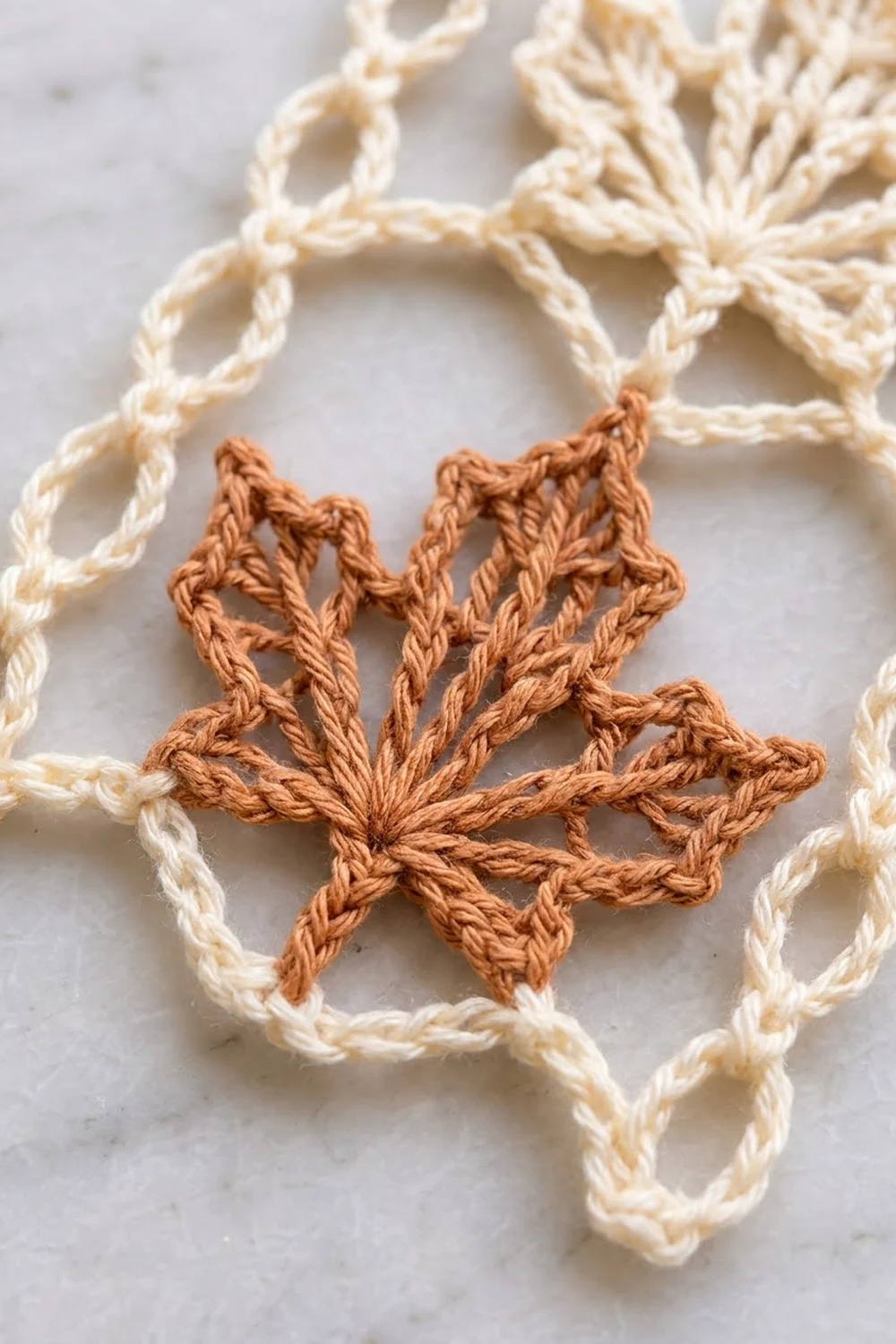
Leaf (make 30 in Color A and 30 in Color B)
Rnd 1 (veins): Make a magic ring. Ch 1, sc in ring, ch 7, sc in ring, ch 9, sc in ring, ch 11, sc in ring, ch 9, sc in ring, ch 7, sc in ring. Pull the ring tight and don’t join.
Count: 6 sc and 5 ch-loops (7, 9, 11, 9, 7).
The loops fan upward into a half circle. The ch-11 loop is the center top lobe.
Row 2 (lobes): Work back across the loops, working into each loop in order and sl st in each sc between the lobes.
- First ch-7 loop: (sc, hdc, 2 dc, ch 3, 2 dc, hdc, sc). Sl st in next sc.
- Ch-9 loop: (sc, hdc, 2 dc, tr, ch 3, tr, 2 dc, hdc, sc). Sl st in next sc.
- Ch-11 loop: (sc, hdc, 2 dc, 2 tr, ch 3, 2 tr, 2 dc, hdc, sc). Sl st in next sc.
- Next ch-9 loop: same as the first ch-9 loop. Sl st in next sc.
- Last ch-7 loop: same as the first ch-7 loop. Sl st in last sc.
Count: 8 + 10 + 12 + 10 + 8 = 48 sts, plus 5 ch-3 lobe points.
Each lobe outlines its own chain loop, so every lobe has an open lacy center and a sharp ch-3 tip.
Stem: Ch 7. Sl st in 2nd ch from hook and in each of the next 5 ch (6 sl sts). Fasten off and weave in the ends.
The stem tip is the turning point at the far end of the stem.
Frame (Color B, all 60 motifs)
Number the lobe points from left to right: Lobe 1 (lower left) through Lobe 5 (lower right). Lobe 3 is the top point.
Frame Rnd 1: With RS facing, join B in the ch-3 sp of Lobe 3. Ch 1, sc in same sp. Ch 11 (top right corner loop), sc in Lobe 4 point. Ch 7, sc in Lobe 5 point. Ch 11 (bottom right corner loop), sc in stem tip. Ch 11 (bottom left corner loop), sc in Lobe 1 point. Ch 7, sc in Lobe 2 point. Ch 11 (top left corner loop). Sl st in first sc.
Count: 6 sc + (4 x 11 ch) + (2 x 7 ch) = 64 sts.
These chains make the cream arches that hold the leaf in its window.
Frame Rnd 2: Ch 1. Sc in each sc and in each ch around, but work 3 sc in the 6th (center) ch of each ch-11 corner loop. Sl st in first sc and fasten off.
Count: 64 sts worked one per stitch + 8 extra corner sts = 72 sc.
Each ch-11 loop becomes 13 sc: 5 before the corner, 3 in the corner ch, and 5 after it.
Per side, including both corner center sts:
– Top: 1 + 6 + 1 (Lobe 3 sc) + 6 + 1 = 15 sts
– Bottom: 15 sts, centered on the stem sc
– Each long side: 1 + 6 + 1 + 7 + 1 + 6 + 1 = 23 sts
Check: 15 + 15 + 23 + 23 = 76. Subtract the 4 corner sts counted twice and you get 72.
Pin the motif to 3.75 in x 5.75 in (9.5 cm x 14.6 cm). Since 15 sts ÷ 4 = 3.75 in and 23 sts ÷ 4 = 5.75 in, the frame lands exactly on gauge.
Make All Pieces
Per panel: 30 motifs with Color A leaves and 30 motifs with Color B leaves. Every frame is Color B. For the pair, make 60 of each.
Layout (5 across x 12 down, top row first):
Row 1:  A A A A A
Row 2:  B B B B B
Row 3:  A A A A A
Row 4:  B B B B B
Row 5:  A A A A A
Row 6:  B B B B B
Row 7:  A A A A A
Row 8:  B B B B B
Row 9:  A A A A A
Row 10: B B B B B
Row 11: A A A A A
Row 12: B B B B B
Point every leaf upward, with the stem at the bottom of its frame.
Joining
Method: Use the link join with Color B. Join each horizontal row of 5 motifs first, then join the rows to each other.
Stitch-to-stitch logic: Each long side has 23 sts. Sl st in the corner st of both motifs, then repeat the link join 11 times. That covers 1 + (2 x 11) = 23 sts on each motif and ends on the opposite corners.
To join two rows, work across the full 75-st edge: 5 motifs x 15 sts. Sl st in both end corners, then repeat the link join 37 times, since 1 + (2 x 37) = 75. Within each motif that’s 1 + (2 x 7) = 15 sts, so the links line up the same way on every motif.
The skipped sts stay visible as the cream cords on either side of the chain links.
Tension: Keep the ch-1 bars relaxed but not loopy. The two frames should sit edge to edge with no gap and no pull. Where 4 corners meet, sl st through all corner sts so the intersection doesn’t open up.
Size checkpoint: Lay the joined panel flat. It should measure 18.75 in x 69 in (47.6 cm x 175.3 cm): 5 x 3.75 in across and 12 x 5.75 in down. The link join takes up no extra width because the motifs sit edge to edge.
Border
Border gauge: 4 sc and 4 rnds = 1 in (2.5 cm).
Starting counts:
– Top and bottom: 5 motifs x 15 sts = 75 sts per edge
– Long sides: 12 motifs x 23 sts = 276 sts per edge
Each motif’s own corner sts are already in these numbers. At the seams, the two corner sts that sit next to each other each get 1 sc, and nothing is added for the seam itself.
Rnd 1: With RS facing, join B in the top right corner st. Ch 1, 3 sc in the corner st. Sc in each st along every edge, with 3 sc in each of the other 3 panel corners. Sl st in first sc.
Count: (2 x 75 + 2 x 276 − 4 shared corners) = 698 sts worked one per stitch + 8 extra = 706 sc.
Per side, corner centers included: top and bottom 77 sts, long sides 278 sts.
Rnd 2: Ch 1. Sc in each st with 3 sc in each corner center st. Sl st in first sc.
Count: 706 + 8 = 714 sc.
Per side: top and bottom 79 sts, long sides 280 sts.
Row 3 (bottom scallops only): With RS facing, join B in the bottom left corner center st. Sc in that st. Sk 2 sts, 5 dc in next st, sk 2 sts, sc in next st. Repeat from * across. Fasten off.
Count: 13 scallops, ending with a sc in the bottom right corner center st.
Why the math works: Each scallop uses 6 sts, and the bottom edge has 79 sts. Since 79 = (6 x 13) + 1, there are exactly 13 scallops with a sc at each corner.
The 2 sc rounds add 0.5 in (1.3 cm) per side. The scallops add another 0.75 in (1.9 cm) at the bottom. That makes the finished panel 18.75 + 1 = 19.75 in wide and 69 + 0.5 + 0.5 + 0.75 = 70.75 in long.
Hanging: Clip a ring onto top st 1 and then every 13th st (sts 1, 14, 27, 40, 53, 66, 79). Since 6 x 13 = 78, you get 7 rings about 3.25 in (8.3 cm) apart.
Final Blocking
- Weave in all the remaining ends along the frame cords, never through the leaf centers.
- Soak the panel in cool water for 15 minutes, then press the water out in a towel. Don’t wring it.
- Lay the panel flat on a sheet over a clean floor or a bed.
- Pin the 4 corners to 19.75 in x 70.75 in (50.2 cm x 179.7 cm).
- Pin along every seam line so the columns run straight.
- Pin out each lobe tip and each scallop.
- Let it dry completely before you unpin, usually 24 to 48 hours.
Final Quality-Control Checklist
- Every motif has 72 frame sts: 15 on the top and bottom, 23 on each long side.
- All leaves point up and the row colors alternate A, B, A, B.
- Every seam uses 11 links on the long sides and 37 links across each 75-st row edge.
- Border Rnd 2 has 79 sts on the top and bottom and 280 on each long side.
- There are 13 even scallops along the bottom.
- The panel blocks to 19.75 in x 70.75 in (50.2 cm x 179.7 cm).
Troubleshooting
- Leaf cups or ruffles: Your Rnd 1 loops are too short or too tight. Chain loosely, or use a 4.5 mm hook just for the loops.
- Frame pulls the leaf out of shape: Your corner loops are too short. Recount the 11 ch, and keep the chain tension even.
- Seams pucker: Your link join is too tight. Loosen the ch-1 bars, or make them ch 2 and still skip 1 st.
- Panel leans to one side: You’ve worked a motif upside down. Check that every stem points down.
- Scallop count is off: Recount Rnd 2. The bottom edge needs exactly 79 sts.
Care
Hand wash cool or machine wash on a gentle cycle in a mesh bag. Reshape and dry flat, and hang it again only once it’s fully dry.
Final Notes
The measurement chain runs like this: 4 sc per inch gives a 15 x 23 st frame. That makes each motif 3.75 in x 5.75 in (9.5 cm x 14.6 cm). Five across and 12 down gives 18.75 in x 69 in (47.6 cm x 175.3 cm). Two sc rounds and a scalloped bottom then bring the panel to 19.75 in x 70.75 in (50.2 cm x 179.7 cm).
Check your first motif carefully, since every other number depends on it. For a longer curtain, add rows in pairs so the colors keep alternating. Each extra row adds 5.75 in (14.6 cm) and 23 sts to each long side, and the 79-st scalloped bottom stays the same.
Happy crocheting!