
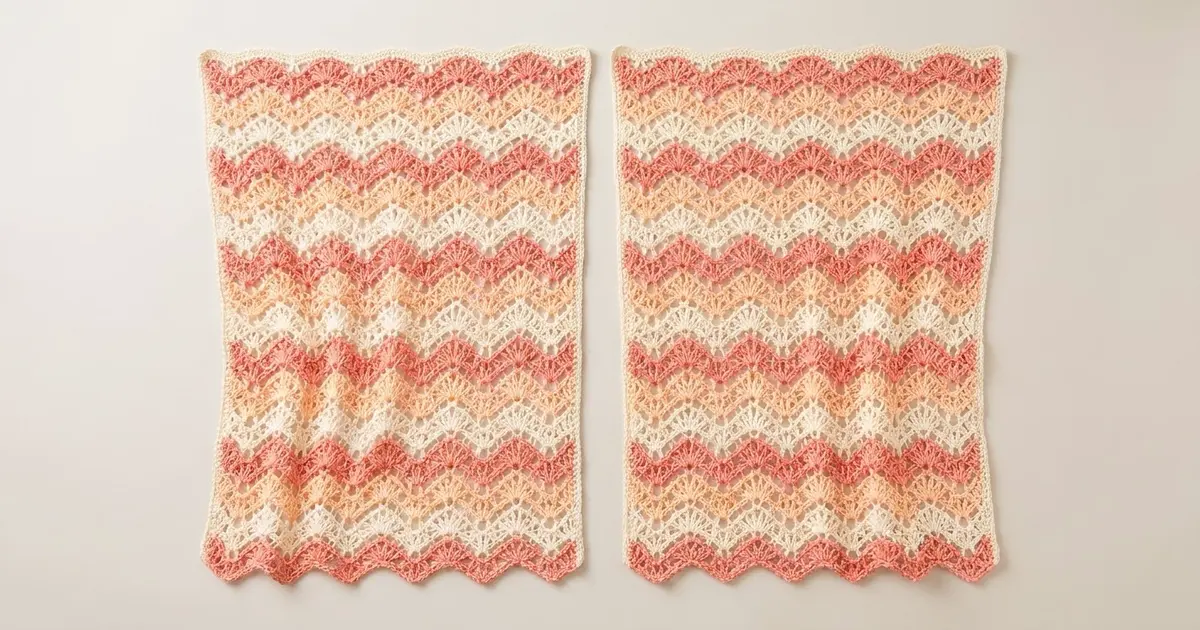
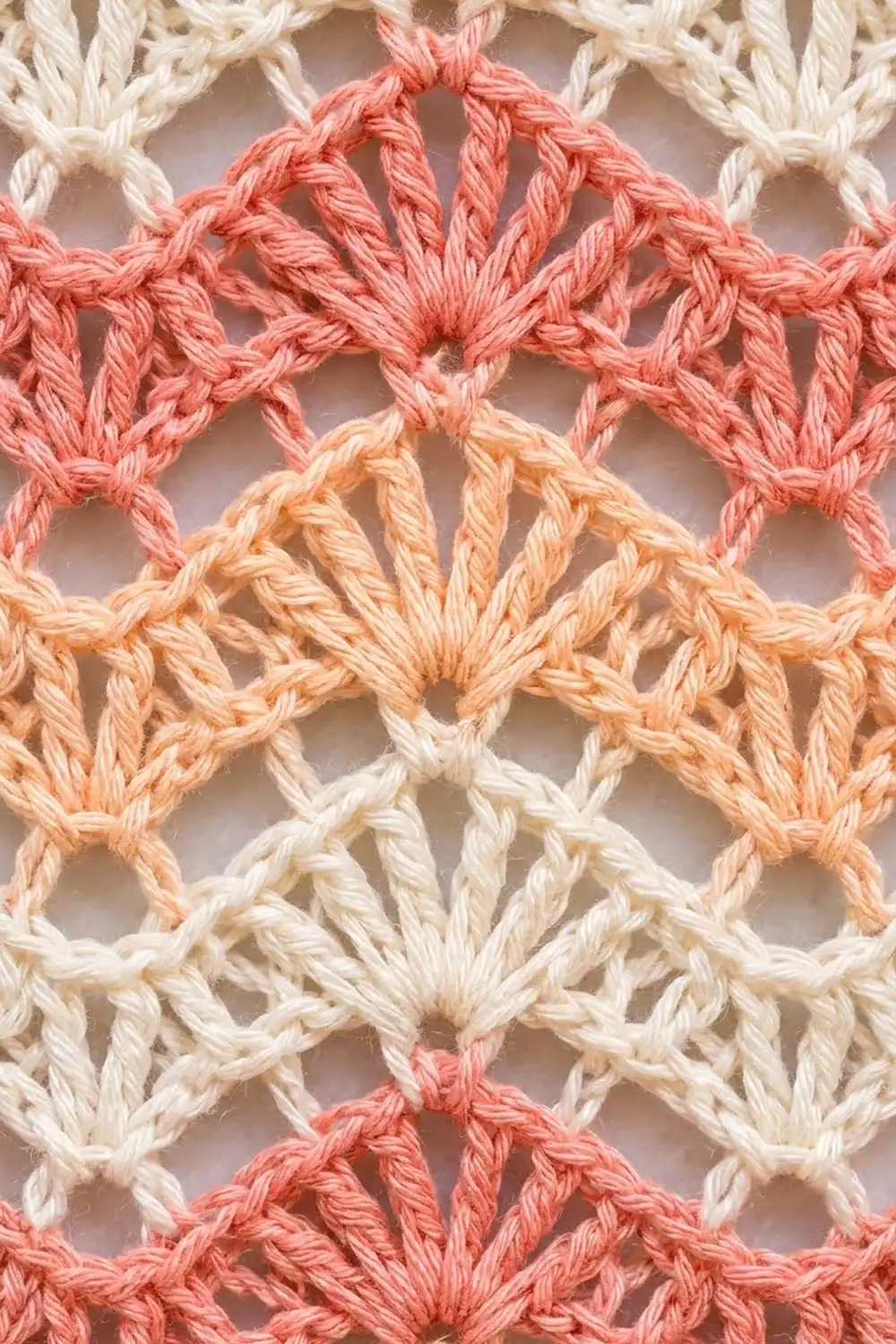
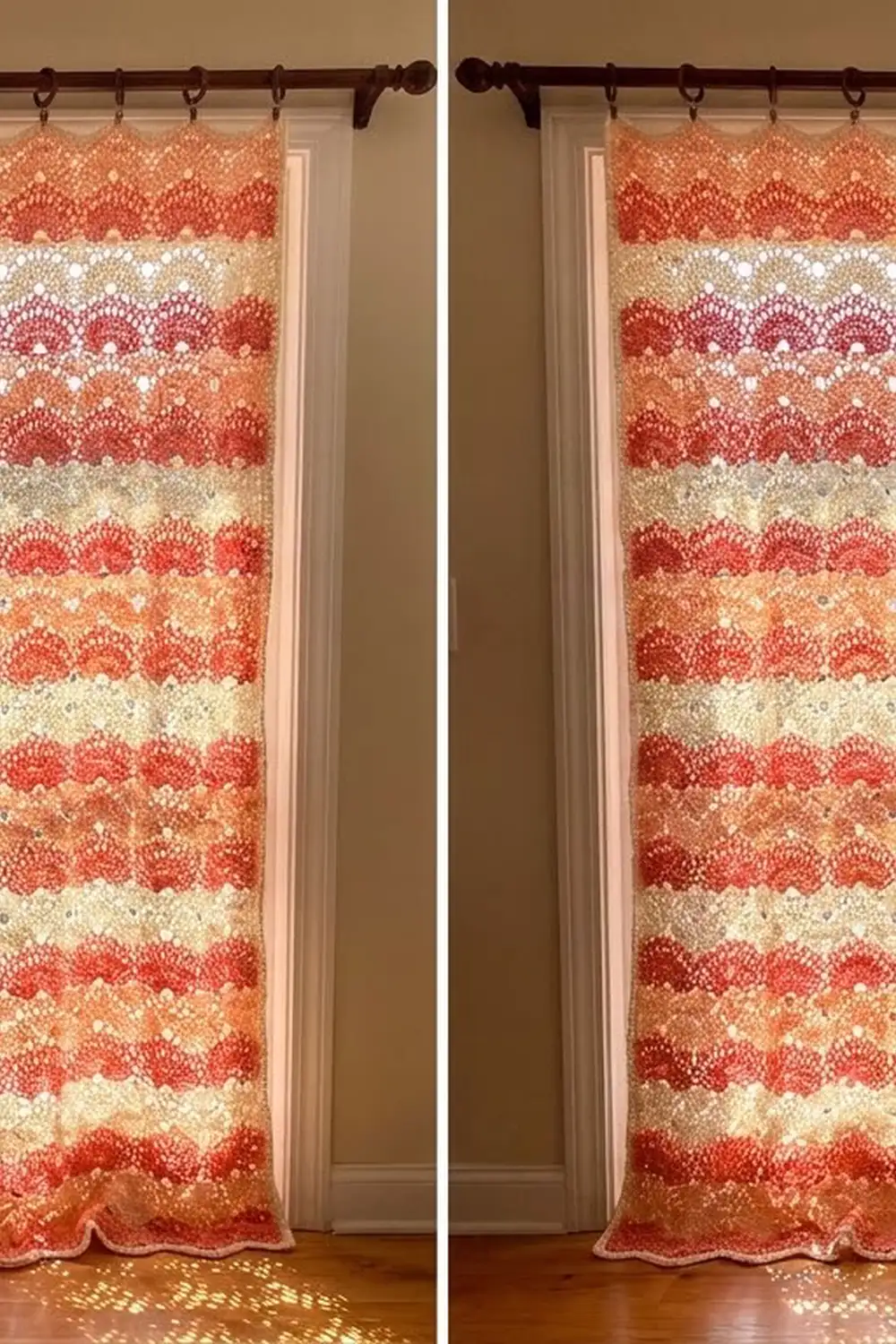
This curtain panel pairs the easy movement of a classic ripple with an airy lace texture. Each wave has a seven-stitch fan sitting in its valley, an open V-stitch at each crest, and chain spaces along the slopes that let light through. Hung in a sunny window, the stripes look soft and summery.
The palette is coral, peach and cream, worked in two-row stripes that repeat from bottom to top. The bottom edge is left as a natural zigzag of points. The top is straightened with two short rows so it hangs neatly from clip rings, and a narrow single crochet border firms up the side edges. All instructions use US crochet terms.
One finished panel measures 41 in wide by 83.5 in long (104.1 cm by 212.1 cm), measured along the side edges. The bottom points hang about 1 in (2.5 cm) lower. The photographed set is two identical panels hung side by side. They are not joined, so you simply make the panel twice.
Construction is straightforward. You crochet one flat piece in rows from the bottom edge up, alternating a ripple mesh row with a fan row. You then work two straightening rows across the top and finish with a two-row border along the sides and top.
Finished Size and Construction
- Finished size: 41 in x 83.5 in (104.1 cm x 212.1 cm) per panel, measured at the side edges
- Skill level: Intermediate
- Terminology: US crochet terms
- Yarn weight: DK (3), cotton or cotton blend
- Hook: 5 mm (US H-8)
- Number of pieces: 1 per panel; the photographed pair is 2 identical, unjoined panels
- Layout: worked flat in rows, 10 wave repeats wide and 66 stripes tall
- Piece size before border: 40 in x 83 in (101.6 cm x 210.8 cm)
- Border depth: 0.5 in (1.3 cm) on the sides and top; the bottom has no border
Materials
Use a smooth, mercerized or soft-spun DK cotton. Cotton holds the fan shapes crisply, hangs straight, and stands up to washing and sunlight better than most acrylics. Use the same brand and weight for all three colors so the stripes stay even.
Per panel:
- Coral: 200 g / 480 m
- Peach: 200 g / 480 m
- Cream: 250 g / 600 m (includes the top rows and border)
For the pair (2 panels):
- Coral: 400 g / 960 m
- Peach: 400 g / 960 m
- Cream: 500 g / 1,200 m
These amounts include a margin of about 10–15 percent for your gauge swatch and small differences in tension.
Tools:
- 5 mm (US H-8) crochet hook
- Tapestry needle
- Locking stitch markers
- Measuring tape
- Rust-proof pins and a large blocking surface (or a clean floor covered with towels)
- 11 curtain clip rings per panel (22 for the pair) and a curtain rod
Abbreviations (US Terms)
- ch: chain
- sc: single crochet
- hdc: half double crochet
- dc: double crochet
- tr: treble crochet
- dtr: double treble crochet
- sk: skip
- sp: space
- st(s): stitch(es)
- rep: repeat
- RS / WS: right side / wrong side
Special stitches:
- V-st: (dc, ch 3, dc) in the same st or sp.
- Fan: 7 dc in the same st.
- dc3tog (double crochet 3 together): [yarn over, insert hook in next st, pull up a loop, yarn over, pull through 2 loops] 3 times, yarn over, pull through all 4 loops on hook.
Counting note: every chain counts as one stitch, so a V-st counts as 5 sts and a ch-2 counts as 2 sts. A beginning ch-3 counts as 1 dc.
Gauge and Checkpoints
Pattern gauge: 1 wave repeat (16 sts) = 4 in (10.2 cm) wide, and 2 rows (one stripe) = 1.25 in (3.2 cm) tall, measured along the side edge after blocking.
Border gauge: 4 sc and 4 rows = 1 in (2.5 cm).
Make a test swatch first. Ch 45. Work Row 1 below, but work the starred repeat only 2 times in total. You will have 45 sts (3 repeats). Then work Rows 2–8 and block the swatch.
- Swatch width: 12 in (30.5 cm)
- Swatch height at the side edge: 5 in (12.7 cm)
If your swatch is too big, go down 0.5 mm in hook size. If it is too small, go up 0.5 mm. Width matters most: an error of only 0.25 in (0.6 cm) per repeat changes the panel width by 2.5 in (6.4 cm).
Checkpoints on the panel:
- After Row 2: 40 in (101.6 cm) wide, 1.25 in (3.2 cm) tall
- After Row 24: 15 in (38.1 cm) tall
- After Row 66: 41.25 in (104.8 cm) tall
- After Row 132: 82.5 in (209.6 cm) tall
- After Row 134: 83 in (210.8 cm) tall
- After the border: 41 in x 83.5 in (104.1 cm x 212.1 cm)
Measure the lace lying flat and unstretched. Never measure it while it hangs from your hook or lap.
The Panel
Stripe sequence: change color every 2 rows in this order: coral, peach, cream. Rows 1–2 are coral, Rows 3–4 peach, Rows 5–6 cream, and then the sequence repeats. Change color on the last yarn over of the final st of a row. Carry the unused colors loosely up the side edge; the border will cover them.
Foundation
With coral, ch 143.
Row 1 (RS, Ripple Mesh Row)
Dc in 5th ch from hook (skipped 4 ch count as dc and ch-1 sp), ch 1, sk next ch, dc in next 2 ch, dc3tog over next 3 ch, dc in next 2 ch, ch 1, sk next ch, dc in next ch, ch 1, sk next ch.
*V-st in next ch, ch 1, sk next ch, dc in next ch, ch 1, sk next ch, dc in next 2 ch, dc3tog over next 3 ch, dc in next 2 ch, ch 1, sk next ch, dc in next ch, ch 1, sk next ch; rep from * 8 more times, dc in last ch. Turn.
Count: 157 sts (10 dc3tog valleys and 9 V-st peaks). Each slope holds 5 sts (ch 1, dc, ch 1, dc, dc). The V-sts push the crests up and the dc3tog clusters pull the valleys down, so the foundation edge forms a downward point under each valley.
Row 2 (WS, Fan Row)
Ch 3 (counts as dc), ch 2, sk next 5 sts, Fan in dc3tog, ch 2, sk next 5 sts.
*V-st in ch-3 sp of next V-st, ch 2, sk next 5 sts, Fan in next dc3tog, ch 2, sk next 5 sts; rep from * 8 more times, dc in top of turning ch. Turn.
Count: 157 sts (10 Fans and 9 V-sts). Each ch-2 skips over a 5-st slope, which makes the open diamond eyelets between the fans and crests.
Row 3 (Ripple Mesh Row)
Change to peach at the end of Row 2.
Ch 3 (counts as dc), ch 1, dc in next ch-2 sp, ch 1, dc in first 2 dc of Fan, dc3tog over next 3 dc of Fan, dc in last 2 dc of Fan, ch 1, dc in next ch-2 sp, ch 1.
*V-st in ch-3 sp of next V-st, ch 1, dc in next ch-2 sp, ch 1, dc in first 2 dc of next Fan, dc3tog over next 3 dc, dc in last 2 dc of Fan, ch 1, dc in next ch-2 sp, ch 1; rep from * 8 more times, dc in top of turning ch. Turn.
Count: 157 sts. The dc3tog always closes over the center 3 dc of a Fan, so each valley stays directly above the one below.
Row 4 (Fan Row)
Work as Row 2. Count: 157 sts.
Rows 5–132
Keep alternating: odd rows repeat Row 3 and even rows repeat Row 2. Keep the stripe sequence. Every row has 157 sts.
When you finish you will have 132 rows, or 66 stripes: 22 coral, 22 peach and 22 cream. Row 132 is a cream Fan Row. Do not fasten off.
Row 133 (Top Straightening Row, cream)
This conversion row fills the low spots above each Fan with taller stitches and keeps the crests short.
Ch 1, sc in first dc, 2 hdc in next ch-2 sp, [dc in first dc of Fan, tr in next 5 dc, dc in last dc of Fan], 2 hdc in next ch-2 sp.
*Sc in next dc, 3 sc in ch-3 sp, sc in next dc, 2 hdc in next ch-2 sp, [dc in first dc of Fan, tr in next 5 dc, dc in last dc of Fan], 2 hdc in next ch-2 sp; rep from * 8 more times, sc in top of turning ch. Turn.
Count: 157 sts worked 1-per-existing-stitch + 0 extra = 157 sts. The top edge should now look nearly level.
Row 134 (cream)
Ch 1, sc in each st across. Turn. Count: 157 sc. Fasten off.
Border
The border runs up the right side, across the top and down the left side. The bottom points stay unbordered so the zigzag hangs freely.
Side edge logic: work 2 sc into each dc row end and 1 sc into each sc row end. That gives 132 x 2 = 264, plus 2 for Rows 133–134, for 266 sc per side.
Count convention: the side and top counts below do not include the 3-st corner groups. Those are listed separately.
Border Row 1 (RS, cream)
With RS facing, join cream at the bottom corner of the right side edge (base of Row 1). Ch 1. Work 266 sc evenly up the side. Work 3 sc in the first st of Row 134 (corner). Sc in the next 155 sts. Work 3 sc in the last st (corner). Work 266 sc evenly down the left side. Turn.
Count: side 266 + corner 3 + top 155 + corner 3 + side 266 = 693 sc.
Across the full top, the 155 middle sts are worked 1-per-stitch, and the 2 end sts become 3-sc corners. That gives 155 + 6 = 161 sc, which is the 157 sts of Row 134 plus 4 extra.
Border Row 2 (WS, cream)
Ch 1, sc in each sc, working 3 sc in the center sc of each corner group. Fasten off.
Count: side 267 + corner 3 + top 157 + corner 3 + side 267 = 697 sc (693 + 4).
Why the math works: each side gains 1 st and the top gains 2 because the first and last sc of each Row 1 corner group now belong to the straight edges. At 4 rows per inch, two border rows add 0.5 in (1.3 cm) to each side and to the top. The width becomes 40 + 0.5 + 0.5 = 41 in (104.1 cm), and the length becomes 83 + 0.5 = 83.5 in (212.1 cm).
The edge is meant to be a little tight: 2 sc per dc row end is fewer than a flat sc edge would normally need. A heavy cotton panel stretches as it hangs, and the firm edge keeps the sides from rippling.
Final Blocking
- Weave in all ends on the wrong side, following the stitch direction for at least 2 in (5.1 cm).
- Soak the panel in cool water with a little gentle wash for 15 minutes.
- Press out the water. Roll the panel in towels to remove more. Do not wring it.
- Lay it flat and shape it to 41 in x 83.5 in (104.1 cm x 212.1 cm).
- Pin the 10 bottom points so they are evenly spaced 4 in (10.2 cm) apart.
- Pin the side edges straight and the top edge level. Open each Fan and V-st with your fingers.
- Let the panel dry completely, then unpin it.
- Attach 11 clip rings along the top: one at each top corner and one above each of the 9 crests, about 4 in (10.2 cm) apart.
Final Quality-Control Checklist
- Every pattern row has 157 sts.
- Each dc3tog sits directly above the Fan below it, and each V-st sits above a V-st.
- The stripes go coral, peach, cream, with no color repeated twice in a row.
- There are 66 stripes in total.
- The top edge is level after Row 134.
- Each side has 266 border sc in Row 1 and 267 in Row 2.
- Carried yarns are hidden under the border and are not pulling.
- The panel measures 41 in x 83.5 in (104.1 cm x 212.1 cm).
- For a pair, the two panels are within 0.5 in (1.3 cm) of each other in length.
Troubleshooting
The waves drift sideways. A Fan went into the wrong st. Count the 5 sts on each slope and check that every Fan sits in a dc3tog.
The side edges pull in. Your turning ch-3 may be too tight. Loosen it, or try ch 2 plus a firm first dc.
The side edges wave. You worked too many border sc. Go back to exactly 2 sc per dc row end.
The top edge is still uneven. Your tr stitches may be short. Work them with a looser first loop, or use dtr over the center 3 dc of each Fan.
The panel grows longer as it hangs. This is normal for cotton. Hang it for 24 hours before you attach the rings, then measure again.
The two panels are different lengths. Compare the stripe counts first. If they match, re-block the longer panel with less vertical stretch.
Care
Machine wash cool on a gentle cycle inside a mesh laundry bag, or hand wash. Reshape and dry flat; don’t hang the panel while it is wet, because it will stretch.
Final Notes
Here is the full measurement chain. A 16-st repeat equals 4 in (10.2 cm), so 10 repeats give 40 in (101.6 cm). Each 2-row stripe equals 1.25 in (3.2 cm), so 66 stripes give 82.5 in (209.6 cm). The two top rows bring the panel to 83 in (210.8 cm), and the two-row border finishes it at 41 in x 83.5 in (104.1 cm x 212.1 cm). Check your swatch and count 157 sts on every row, and the waves will line up. Make a second panel the same way to complete the pair.
Happy crocheting!