

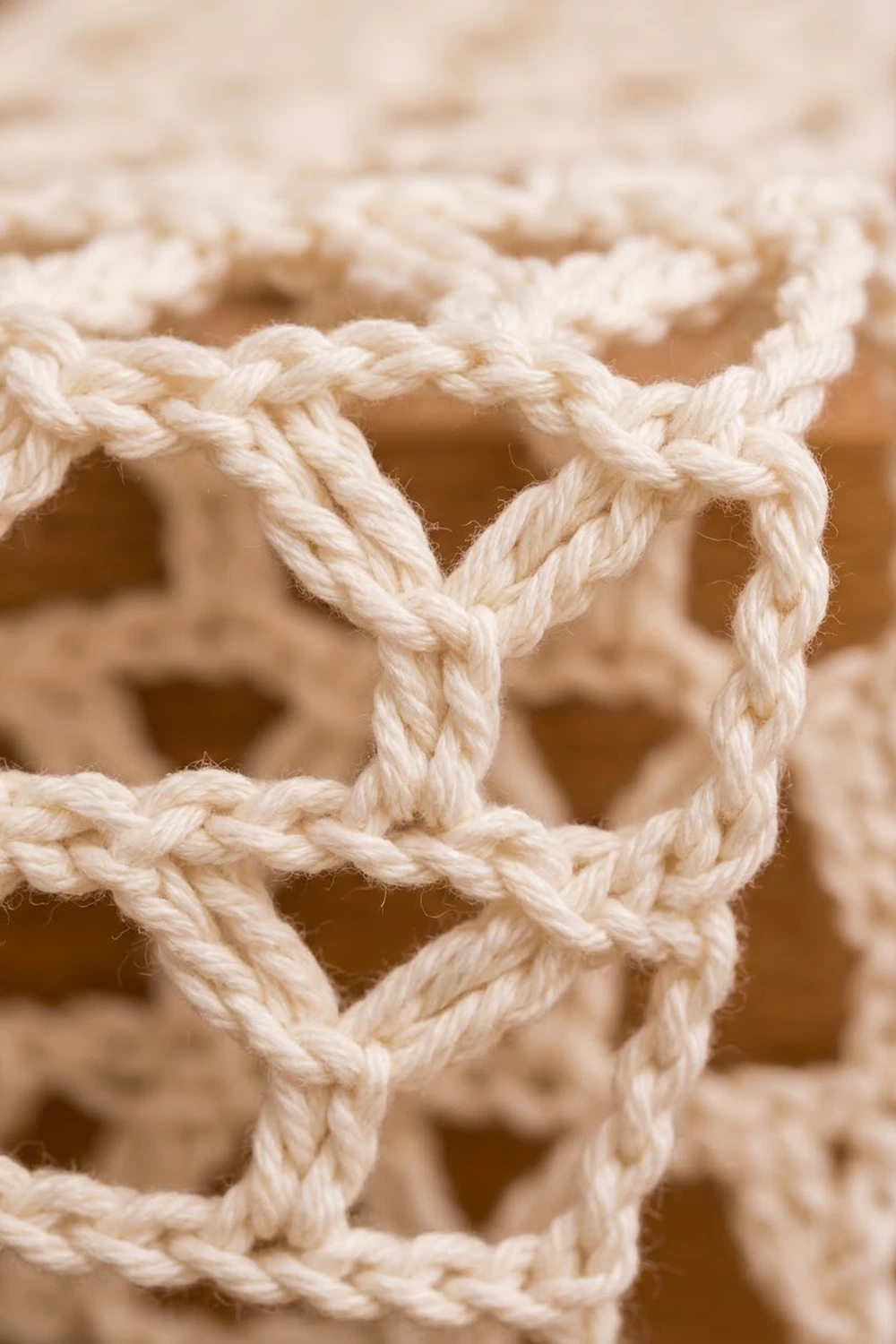
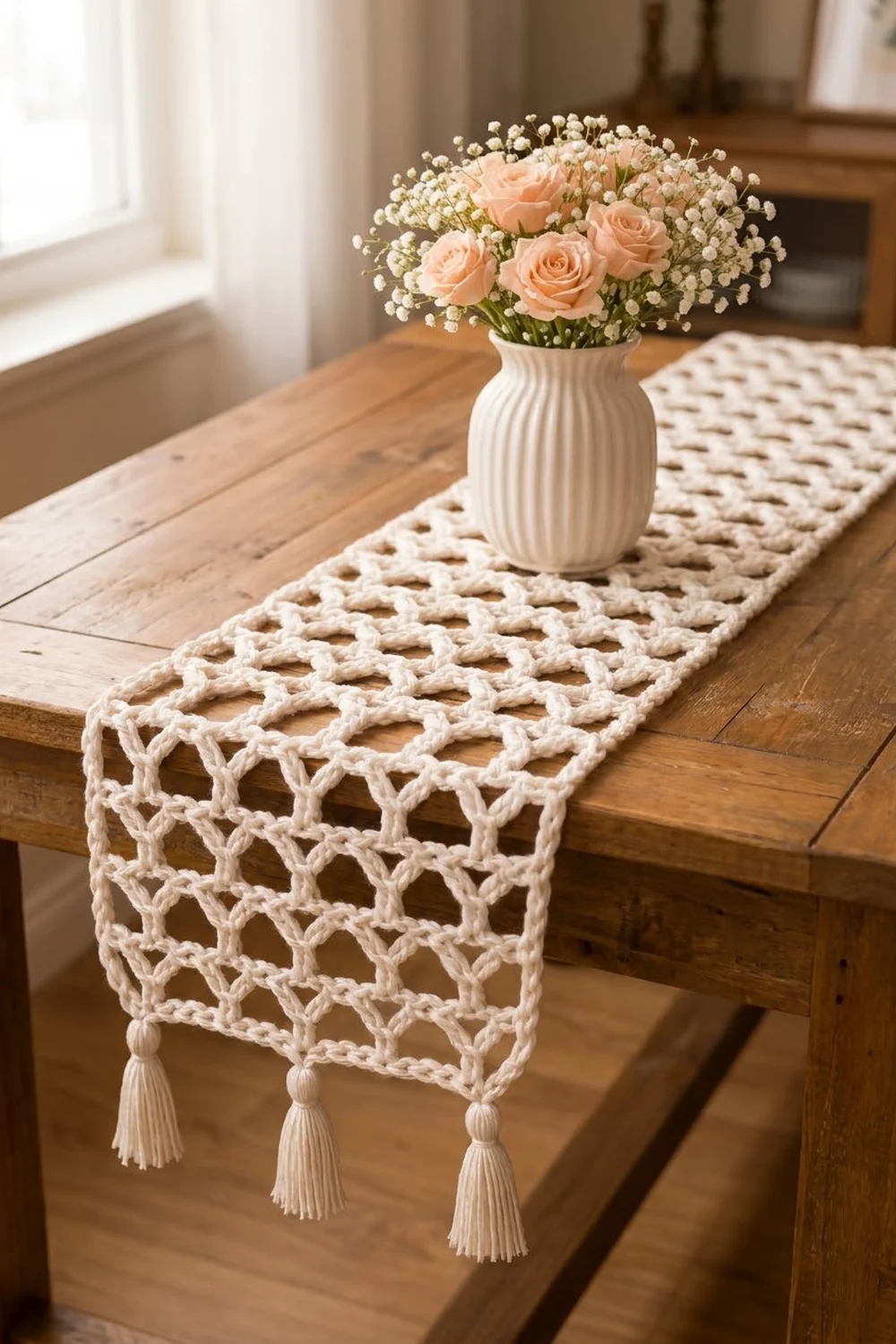
The Ivory Arches Table Runner is an airy, lace-like mesh made of tall Y-shaped stitches. Each Y grows from a corded bar, opens into two arms, and meets its neighbors under the next bar. Row after row, this builds a pattern of soft rounded arches that lets the wood of your table show through.
The runner is worked in one ivory or cream yarn. Because there is only one color, the texture does all the work: thick two-strand stems, crisp horizontal bars, a corded border, and three full tassels at each end. It suits farmhouse, cottage, and minimalist rooms, and it photographs beautifully under a vase of flowers.
This pattern uses US crochet terms. The finished runner measures 15 in (38.1 cm) wide by 49 in (124.5 cm) long before tassels. The tassels add 4 in (10.2 cm) at each end.
Construction is simple. You make one rectangular piece in rows, alternating a Y-stitch row with a single crochet bar row. Then you work two border rounds all the way around and add six tassels. There are no motifs to join.
Finished Size and Construction
- Finished size: 15 in × 49 in (38.1 cm × 124.5 cm), plus 4 in (10.2 cm) tassels at each end
- Skill level: Easy-intermediate
- Terminology: US crochet terms
- Yarn weight: Worsted (#4), cotton or cotton blend
- Hook: 5.0 mm (US H-8)
- Number of pieces: 1 (plus 6 tassels)
- Layout: Single rectangle worked in rows, 7 Ys across × 36 Y-rows long
- Piece size before border: 14⅓ in × 48⅓ in (36.4 cm × 122.8 cm)
- Border depth: ⅓ in (0.8 cm) on each side
Materials
Yarn: Use a smooth worsted-weight cotton or cotton blend with a good twist. Cotton gives the stems and bars their crisp, corded look and holds up well to washing. Avoid fuzzy acrylic, because it blurs the arches.
- Ivory / cream: about 450 g (about 765 m / 837 yd), including about 60 g for the six tassels
These quantities include a margin of about 15% for your swatch, tension differences, and fuller tassels. If you crochet loosely, buy one extra ball from the same dye lot.
Tools:
– 5.0 mm (US H-8) crochet hook
– Tapestry needle
– Scissors
– Stitch markers (4)
– A stiff card 4½ in (11.4 cm) tall, for winding tassels
– Measuring tape
– Blocking mats and rust-proof pins
– Spray bottle
Abbreviations (US Terms)
- ch – chain
- sc – single crochet
- tr – treble crochet (yarn over twice)
- sk – skip
- sp – space
- st(s) – stitch(es)
- rev sc – reverse single crochet (crab stitch): sc worked from left to right (right to left for left-handers)
- RS / WS – right side / wrong side
Special stitch – Y-stitch (Y-st): Work (tr, ch 3, tr) all in the same stitch. The two tr legs sit side by side at the base, which forms the thick two-strand stem. They spread apart at the top to form the arms, with the ch-3 between them. Each Y-st gives 5 working positions at the top: tr, 3 ch, tr.
Gauge and Checkpoints
Gauge: 12 sc = 4 in (10.2 cm). One sc row = ⅓ in (0.8 cm). One Y-row plus one sc bar row = 1⅓ in (3.4 cm). One 6-st repeat = 2 in (5.1 cm).
Test swatch: Make a small test piece before starting the runner.
- Ch 20.
- Row 1: Sc in 2nd ch from hook and in each ch across (19 sc).
- Work Rows 2–3 of the main pattern 3 times, using the swatch counts given in the pattern notes below.
The finished swatch has 7 rows and 3 Ys per Y-row. It should measure 6⅓ in (16.1 cm) wide by 4⅓ in (11.0 cm) tall. Block it lightly before measuring.
Checkpoints for the runner:
– After Row 1: 43 sc, 14⅓ in (36.4 cm) wide
– After Row 3: 1⅔ in (4.2 cm) tall
– After Row 25: 16⅓ in (41.5 cm) tall
– After Row 49: 32⅓ in (82.1 cm) tall
– After Row 73: 48⅓ in (122.8 cm) tall
If your swatch is too big, go down to a 4.5 mm hook. If it’s too small, go up to a 5.5 mm hook. If your width matches but the Y-rows are too tall, wrap the yarn a little more snugly on the tr yarn-overs rather than changing hooks. That keeps the arches in proportion.
Runner Body
Pattern notes:
– The stitch count must be a multiple of 6 plus 1. The runner uses 43 sts (7 repeats).
– The ch 4 at the start of a Y-row counts as 1 tr. The ch 1 at the start of an sc row does not count as a stitch.
– Every sc bar row has 43 sc. Every Y-row has 43 working positions across the top.
– Swatch version: Use 19 sts. Repeat the bracketed sections 2 times instead of 6, so each Y-row has 3 Ys.
Foundation: Ch 44.
Row 1 (RS): Sc in 2nd ch from hook and in each ch across. Turn. (43 sc)
This row forms the first corded bar.
Row 2 (Y-row):
1. Ch 4 (counts as tr) for the edge post.
2. Sk next 2 sc and work Y-st in next sc.
3. Ch 1, sk next 5 sc, Y-st in next sc. Repeat from * 5 more times.
4. Sk next 2 sc and tr in last sc. Turn.
Stitches used from the row below: 1 + 2 + 1 + (6 × 6) + 2 + 1 = 43.
Positions across the top: 1 tr + 5 (first Y) + 6 × (1 ch + 5 Y) + 1 tr = 43.
(7 Y-sts, 6 ch-1 sps, 2 edge tr)
The 5 skipped sc between stems open up as rounded arches. The ch 1 between Ys lets the arms of neighboring Ys meet at the top, just as in the photo. The outer arm of each end Y leans against the edge tr.
Row 3 (bar row):
1. Ch 1 and sc in first tr.
2. Sc in next tr, 3 sc in ch-3 sp, sc in next tr.
3. Sc in ch-1 sp, then sc in next tr, 3 sc in ch-3 sp, sc in next tr. Repeat from * 5 more times.
4. Sc in top of turning ch-4. Turn.
Count: 1 + 5 + (6 × 6) + 1 = 43 sc.
This bar closes the tops of the Ys and becomes the base for the next Y-row.
Rows 4–73: Repeat Rows 2–3 thirty-five more times. Row 73 is a bar row, so both ends of the runner finish on a corded bar. Do not fasten off.
That makes 73 rows in total:
– 37 sc bar rows (the odd rows)
– 36 Y-rows (the even rows)
– 7 × 36 = 252 Y-stitches
Because the Ys stack directly above each other, each stem lines up with the stem below it. This creates the tidy columns of arches seen along the runner.
Body check: The piece should measure 14⅓ in × 48⅓ in (36.4 cm × 122.8 cm). Lay it flat and measure before starting the border. Correct any size problem now, because the border will not fix it.
Border
The border makes the firm, corded frame around the edge. Each round adds ⅓ in (0.8 cm) to the depth when measured together, bringing the runner to 15 in × 49 in (38.1 cm × 124.5 cm).
Border gauge: Same as the body, 3 sc = 1 in (2.5 cm). Along the long sides, work 1 sc per sc row-end and 3 sc per Y-row end. A tr row is 1 in (2.5 cm) tall, which is exactly 3 sc wide, so the edge stays flat.
Round 1 (sc)
Do not turn. Ch 1 and work along the last row (Row 73) first.
Short side 1 (top of Row 73):
– 3 sc in first st (corner).
– Sc in next 41 sts.
– 3 sc in last st (corner).
Long side 1 (row-ends from Row 72 down to Row 2):
– Work 1 sc in each sc row-end. There are 35 of these (Rows 71 down to 3).
– Work 3 sc in each Y-row end. There are 36 of these.
– Total: 35 + 108 = 143 sc.
Short side 2 (other side of the foundation chain):
– 3 sc in first st (corner).
– Sc in next 41 sts.
– 3 sc in last st (corner).
Long side 2: Work 143 sc as on Long side 1.
Join with sl st to first sc.
Round 1 total: 4 corners × 3 + 2 × 41 + 2 × 143 = 12 + 82 + 286 = 380 sc
Place a marker in the center sc of each corner.
Per-side counts, including both corner center stitches:
– Short sides: 1 + 1 + 41 + 1 + 1 = 45 sts
– Long sides: 1 + 1 + 143 + 1 + 1 = 147 sts
Why the math works
The body is 43 sts wide. The corner centers add 1 st on each side, so 43 + 2 = 45 sts. At 3 sts per inch, 45 sts = 15 in (38.1 cm), which matches the finished width.
On the long sides, 143 sc covers Rows 2–72, which measure 47⅔ in (121.1 cm). The corner centers sit on Rows 1 and 73 and add ⅓ in (0.8 cm) each. With the border depth at both ends, the total length is 147 sts ÷ 3 = 49 in (124.5 cm). The stitch count and the measured length agree.
Round 2 (rev sc)
- Ch 1. Working in reverse direction, work rev sc in each sc around, including 1 rev sc in each corner center.
- Join with sl st to first st. (380 rev sc)
- Fasten off and weave in ends.
Keep the corner stitches slightly loose so the corners lie square. This round gives the twisted, rope-like frame you see in the photo.
Tassels (Make 6)
- Wind yarn 30 times around the 4½ in (11.4 cm) card.
- Slide a 10 in (25.4 cm) strand under the loops at the top and tie it tightly.
- Cut the loops at the bottom.
- Wrap a second strand 6 times around the tassel ¾ in (1.9 cm) below the top to form the head. Tie it and bury the ends inside the tassel.
- Trim the strands evenly to 4 in (10.2 cm).
Attaching: On each short end, tie one tassel to each marked corner center st. Tie the third tassel to the 23rd st of that side’s 45 sts, which is the exact center. This spacing matches the three evenly spaced tassels in the photo.
Final Blocking
- Wet the runner in cool water, then gently press out the water. Do not wring it.
- Roll it in a towel to remove extra moisture.
- Lay it flat on blocking mats and pin it to 15 in × 49 in (38.1 cm × 124.5 cm).
- Pin the four corners first, then the centers of each side, then fill in every 2 in (5.1 cm).
- Use your fingers to open each Y. Spread the arms evenly and round out the arches.
- Check that the stems sit in straight columns from end to end.
- Let it dry completely. Steam the tassels lightly and comb them straight.
Final Quality-Control Checklist
- [ ] Every bar row has 43 sc.
- [ ] Every Y-row has 7 Ys, with the outer arms touching the edge posts.
- [ ] The body has 73 rows, starting and ending with a bar row.
- [ ] Border Round 1 has 380 sc: 45 per short side and 147 per long side, including the corner centers.
- [ ] The corners are square and the edges lie flat without ruffling or cupping.
- [ ] The finished size is 15 in × 49 in (38.1 cm × 124.5 cm).
- [ ] There are 3 tassels per end, all trimmed to 4 in (10.2 cm).
- [ ] All ends are woven in securely.
Troubleshooting
Arches look squashed or the Ys lean. Check that you skip exactly 5 sc between Ys and 2 sc at each edge. Miscounts usually show up as one lopsided arch near the ends.
The runner gets narrower or wider. Recount the bar rows. Each ch-3 sp needs exactly 3 sc, and each ch-1 sp needs 1 sc. Remember the turning ch-4 needs its sc.
The long sides ruffle. You probably have too many sc per Y-row end. Use 3, not 4.
The long sides pull in. Your tr may be taller than 1 in (2.5 cm). Shorten your tr slightly, or work the border on a hook one size larger.
The crab stitch twists the corners. Loosen your tension on the corner center stitches and block the corners well.
The tassels look thin. Wind 35 times instead of 30. There is enough yarn margin for this.
Care
Hand wash or machine wash on gentle in cool water, then reshape and dry flat. Avoid hanging the runner to dry while it is wet, because the open mesh will stretch.
Final Notes
The measurement chain carries through the whole runner:
- 12 sc = 4 in (10.2 cm), so 43 body sts = 14⅓ in (36.4 cm).
- Row 1 plus 36 Y-row/bar-row pairs = 48⅓ in (122.8 cm).
- Border Round 1 has 45 sts per short side and 147 per long side, which gives a finished 15 in × 49 in (38.1 cm × 124.5 cm) runner.
Check your swatch, keep counting at the checkpoints, and the arches will line up perfectly from one end to the other.
Happy crocheting!