
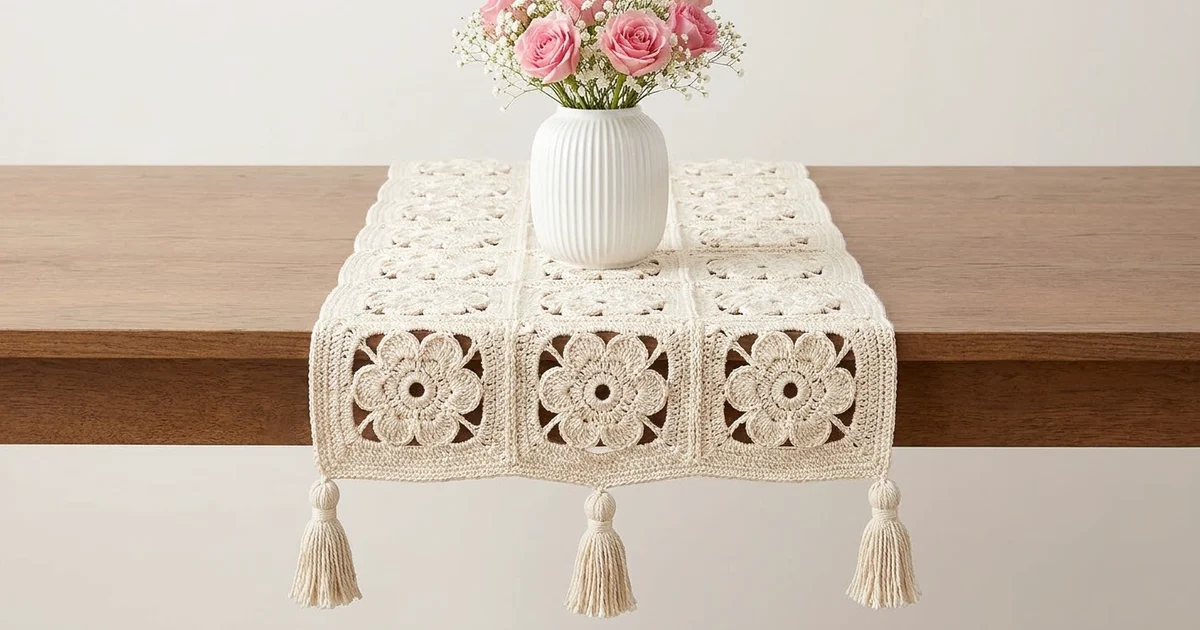
The Petal Lattice Table Runner is a light, lacy runner made from small framed flower squares. Each square holds a soft five-petal flower with an open center, held inside a thin square frame. The flower touches the frame only at its petal tips, so the table shows through all around it.
The runner uses one color, a warm cream or soft white cotton. You join 30 squares three across and ten long, then add a slim border. Three chunky tassels hang from each short end, one centered under each column. The style is romantic and a little vintage, and it works for a spring table or for everyday use.
This pattern uses US crochet terms. Before tassels, the finished runner measures 13.75 in x 43.5 in (34.9 cm x 110.5 cm). The tassels add 4 in (10.2 cm) at each end.
You make it in four steps. First crochet a ring, work five petals into it, and build a chain frame anchored at each petal tip. Square the frame off with a round of single crochet. Next, join the squares with slip stitches on the wrong side. Then work a two-round border around the whole runner and tie on the tassels.
Finished Size and Construction
- Finished size: 13.75 in x 43.5 in (34.9 cm x 110.5 cm), plus 4 in (10.2 cm) tassels at each end
- Skill level: Intermediate
- Terminology: US crochet terms
- Yarn weight: Worsted (#4) cotton
- Hook: 5.0 mm (US H-8)
- Number of pieces: 30 identical squares and 6 tassels
- Layout: 3 squares wide x 10 squares long
- Single square size: 4.25 in x 4.25 in (10.8 cm x 10.8 cm), 16 sc per side
- Size before border: 12.75 in x 42.5 in (32.4 cm x 108.0 cm)
- Border depth: 0.5 in (1.3 cm), 2 rounds of sc
Materials
Yarn: Choose a smooth, mercerized or combed 100% cotton in worsted weight. Cotton gives crisp petals, and the frames keep their shape after blocking. The sample yarn is 50 g = 78 m (85 yd) per ball.
- Cream (one color): 350 g, about 546 m (597 yd), which is 7 balls of the sample yarn
Here is roughly how the yarn is used: about 210 g for the 30 squares, 15 g for joining, 20 g for the border, and 50 g for the tassels. The 350 g total includes a margin of about 15% for your gauge swatch and for differences in tension.
Tools:
- 5.0 mm (US H-8) crochet hook
- Tapestry needle
- Sharp scissors
- Stitch markers (4 or more)
- A piece of stiff card 4 in (10.2 cm) tall, for the tassels
- Blocking mats, rust-proof pins, and a spray bottle
- Measuring tape
Abbreviations (US Terms)
- ch – chain
- sl st – slip stitch
- sc – single crochet
- tr – treble crochet (yarn over twice)
- dtr – double treble crochet (yarn over three times)
- st(s) – stitch(es)
- sp – space
- sk – skip
- RS / WS – right side / wrong side
Standing sc: With a slip knot on the hook, insert the hook into the stitch, yarn over, and pull up a loop. Yarn over again and pull through both loops. This starts a round without a joining slip stitch.
Petal: ch 4, (2 tr, 1 dtr, 2 tr) in the same st, ch 4.
Gauge and Checkpoints
Gauge: 16 sc = 4.25 in (10.8 cm), measured along one blocked side of Rnd 4.
Make one full square first. Wet it, pin it to 4.25 in (10.8 cm), and let it dry. This shows you how your yarn behaves before you make all 30.
Checkpoints for one square:
- After Rnd 1, the ring measures about 1.25 in (3.2 cm) across.
- After Rnd 2, the flower measures about 3.5 in (8.9 cm) from petal tip to petal tip.
- After Rnd 4, each blocked side measures 4.25 in (10.8 cm).
If your square is too big: Change to a 4.5 mm (US 7) hook.
If your square is too small: Change to a 5.5 mm (US I-9) hook.
Small errors add up quickly. If each square is off by only 0.25 in (0.6 cm), the runner’s length will be off by ten times that amount.
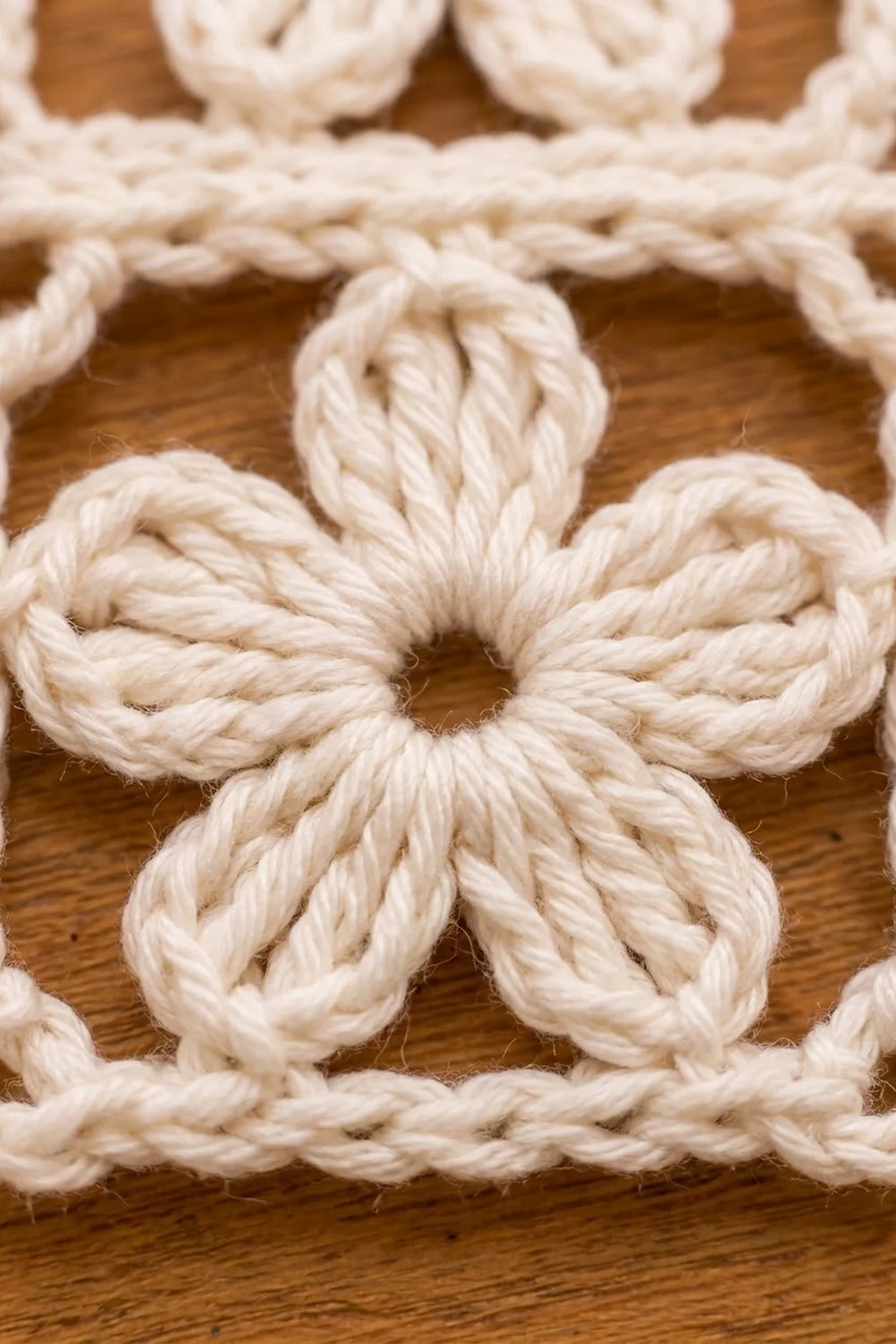
Flower Square (Make 30)
Rnd 1 – Ring
Ch 5 and sl st to the first ch to form a ring.
Ch 1 and work 15 sc into the ring. Sl st to the first sc to join. (15 sc)
The ring stays open, which gives the flower its visible center hole.
Rnd 2 – Petals
*Sl st in next sc, work a Petal in the next sc [ch 4, (2 tr, 1 dtr, 2 tr) in the same sc, ch 4], sl st in next sc; repeat from * 4 more times. Fasten off.
Each petal uses 3 sc from Rnd 1, so the 5 petals use all 15 sc.
Stitch count: 5 petals, each with 5 tall sts (4 tr and 1 dtr).
The dtr in the middle of each petal is the petal tip. Shape each petal with your fingers so the tips are round and the petals fan out evenly.
Rnd 3 – Frame Chain
With the RS facing you, join the yarn with a standing sc in the dtr at the tip of any petal. This becomes the top petal.
*Ch 11, sc in the dtr of the next petal; repeat from * 3 more times. Ch 11 and sl st to the first sc to join.
Stitch count: 5 sc + 55 ch = 60 sts.
Number the sts from 1 to 60, with the first sc as st 1. The sc at the petal tips are sts 1, 13, 25, 37, and 49.
Rnd 4 – Squaring Round
This round turns the five-point chain loop into a square. Work into each chain (under the top loop and the back bump), not around the chain loop, so every chain counts as one stitch.
Ch 1. Sc in the same st as the join and in the next 6 sts (7 sc). *Work (sc, ch 2, sc) in the next ch for a corner, then sc in the next 14 sts; repeat from * 2 more times. Work (sc, ch 2, sc) in the next ch, then sc in the last 7 sts. Sl st to the first sc. Fasten off and weave in the ends.
Stitch check: 7 + 1 + 14 + 1 + 14 + 1 + 14 + 1 + 7 = 60 sts, so you work every Rnd 3 st exactly once.
Stitch count: 60 sc (one in each existing st) + 4 extra corner sc = 64 sc and 4 ch-2 corner sps.
Per side: 16 sc between the corner sps. This number already includes the 2 corner sc on that side.
The top petal touches the middle of the top edge. Two petals touch the upper sides, and the other two touch the bottom edge near the lower corners. This is how five petals naturally sit inside a square, and it gives the frame its open, airy look.
Make All Pieces
Make 30 squares in cream. Pin each square to 4.25 in (10.8 cm) and block it before joining, either one at a time or a few at once. Blocked squares join much more evenly.
Layout grid (3 wide x 10 long, every top petal pointing toward Row 1):
Row 1:   [ ] [ ] [ ]   <- tassel end
Row 2:   [ ] [ ] [ ]
Row 3:   [ ] [ ] [ ]
Row 4:   [ ] [ ] [ ]
Row 5:   [ ] [ ] [ ]
Row 6:   [ ] [ ] [ ]
Row 7:   [ ] [ ] [ ]
Row 8:   [ ] [ ] [ ]
Row 9:   [ ] [ ] [ ]
Row 10:  [ ] [ ] [ ]   <- tassel end
Joining
Method: Slip stitch join on the WS, through both loops of both squares.
How the stitches match: Hold two squares with RS together. Sl st through both ch-2 corner sps, then through each of the 16 pairs of matching sc, then through the next pair of ch-2 corner sps. That makes 16 + 2 = 18 sl sts per square edge. Each sl st goes into a stitch that already exists, so the join adds no stitches to any edge.
Step 1 – Rows: Join the 3 squares in each row along their side edges, which takes 2 seams per row. You now have 10 strips of 3 squares each.
Step 2 – Long seams: Join the strips along their long edges, working across all 3 squares in one pass. Each long seam is 3 x 18 = 54 sl sts, and you need 9 long seams. Where four corners meet, the corner sps are already joined from Step 1. Sl st through them and keep going.
Tension: Keep each sl st about as loose as an sc. A tight join will pucker the frames and make the runner smaller. If the seam feels stiff, go up one hook size for joining only.
Size checkpoint: A joined row of 3 squares should measure 12.75 in (32.4 cm). The whole joined runner should measure 12.75 in x 42.5 in (32.4 cm x 108.0 cm).
Border
Border gauge: The border uses the same gauge as the squares, 16 sc = 4.25 in (10.8 cm). Each round adds about 0.25 in (0.6 cm) of depth on every side.
Border Rnd 1
With the RS facing you, join the yarn with a standing sc in any sc along an edge.
Sc in each sc around. In each of the 4 outer corner ch-2 sps of the runner, work (sc, ch 2, sc). At each seam, sk the joined ch-2 sps and go straight on to the first sc of the next square. Sl st to the first sc.
Count per side (between corner ch-2 sps):
- Short side: 3 squares x 16 sc = 48 sc, plus 1 corner sc at each end = 50 sc
- Long side: 10 squares x 16 sc = 160 sc, plus 1 corner sc at each end = 162 sc
Total: 50 + 162 + 50 + 162 = 424 sc and 4 ch-2 corner sps.
Border Rnd 2
Sl st into the nearest corner ch-2 sp and ch 1. *Work (sc, ch 2, sc) in the corner sp, then sc in each sc to the next corner; repeat from * around. Sl st to the first sc. Fasten off and weave in the ends.
Count per side (between corner ch-2 sps):
- Short side: 50 + 2 = 52 sc
- Long side: 162 + 2 = 164 sc
Total: 52 + 164 + 52 + 164 = 432 sc and 4 ch-2 corner sps.
Why the math works: Each square side has 16 sc, including its own corner sc. That means each side of the runner starts with exactly (number of squares x 16) sc. You skip the joined corner sps, so the seams add nothing. Only the 4 outer corners grow, adding 1 sc to each side per round.
At 16 sc per 4.25 in (10.8 cm), 52 sc measures about 13.75 in (34.9 cm) and 164 sc measures about 43.5 in (110.5 cm). That is the joined size plus 0.5 in (1.3 cm) of border on each edge.
Tassels (Make 6)
Wrap the yarn 30 times around the 4 in (10.2 cm) card. Slide a 10 in (25.4 cm) strand under the wraps at the top and knot it tightly. Cut through the wraps at the bottom.
To form the head, wrap a second strand about 8 times around the tassel, 0.75 in (1.9 cm) below the top. Knot it and hide the ends inside the tassel. Trim the bottom evenly to 4 in (10.2 cm).
Tie 3 tassels to each short end with the top strands, working through Border Rnd 2. Center each tassel under a column, between the 8th and 9th sc of that square’s edge. Knot them securely and bury the ends inside the tassel heads.
Final Blocking
- Soak the runner in cool water for 10 minutes.
- Gently press out the water, then roll the runner in a towel and press again. Do not wring it.
- Lay it flat on blocking mats with the RS up.
- Pin the four corners to 13.75 in x 43.5 in (34.9 cm x 110.5 cm).
- Pin along each long edge at every seam line, every 4.25 in (10.8 cm).
- Make sure every square is square and every frame line is straight. Nudge the petals so each tip touches the frame.
- Pin the short ends straight so the tassels hang evenly.
- Let the runner dry completely before you unpin it.
- Comb the tassels with your fingers and trim any long strands.
Final Quality-Control Checklist
- 30 squares, each 4.25 in (10.8 cm) per side with 16 sc per side
- Every flower has 5 petals and an open center
- Every top petal points toward the same end
- Seams lie flat and do not pucker where corners meet
- Border Rnd 2 has 52 sc on each short side and 164 sc on each long side
- The runner measures 13.75 in x 43.5 in (34.9 cm x 110.5 cm)
- Each end has 3 tassels, each 4 in (10.2 cm) long and centered under a column
- All ends are woven in securely
Troubleshooting
The frame ripples: The Rnd 3 chains are too long for your tension. Use ch 10 between petals, which gives 5 sc + 50 ch = 55 sts. Then work Rnd 4 as 6 sc, 3 x (corner, 13 sc), corner, 6 sc. That makes 15 sc per side, so work out the border counts as squares x 15.
The frame pulls the petals flat: The chains are too tight. Go up one hook size for Rnd 3 only.
The flower is lopsided: Check that each petal uses exactly 3 sc of Rnd 1.
The square comes out as a rectangle: A corner landed one stitch early or late. Count Rnd 4 against the plan of 7 + 14 + 14 + 14 + 7.
One end of the runner is wider than the other: Your gauge changed as you worked. Measure the squares as you go, and block them all to the same size before joining.
The seams pucker: Redo the seam with looser slip stitches or a larger hook.
Care
Hand wash in cool water with mild soap. Dry flat, reshaping while damp, and don’t wring it so the petals and tassels keep their shape.
Final Notes
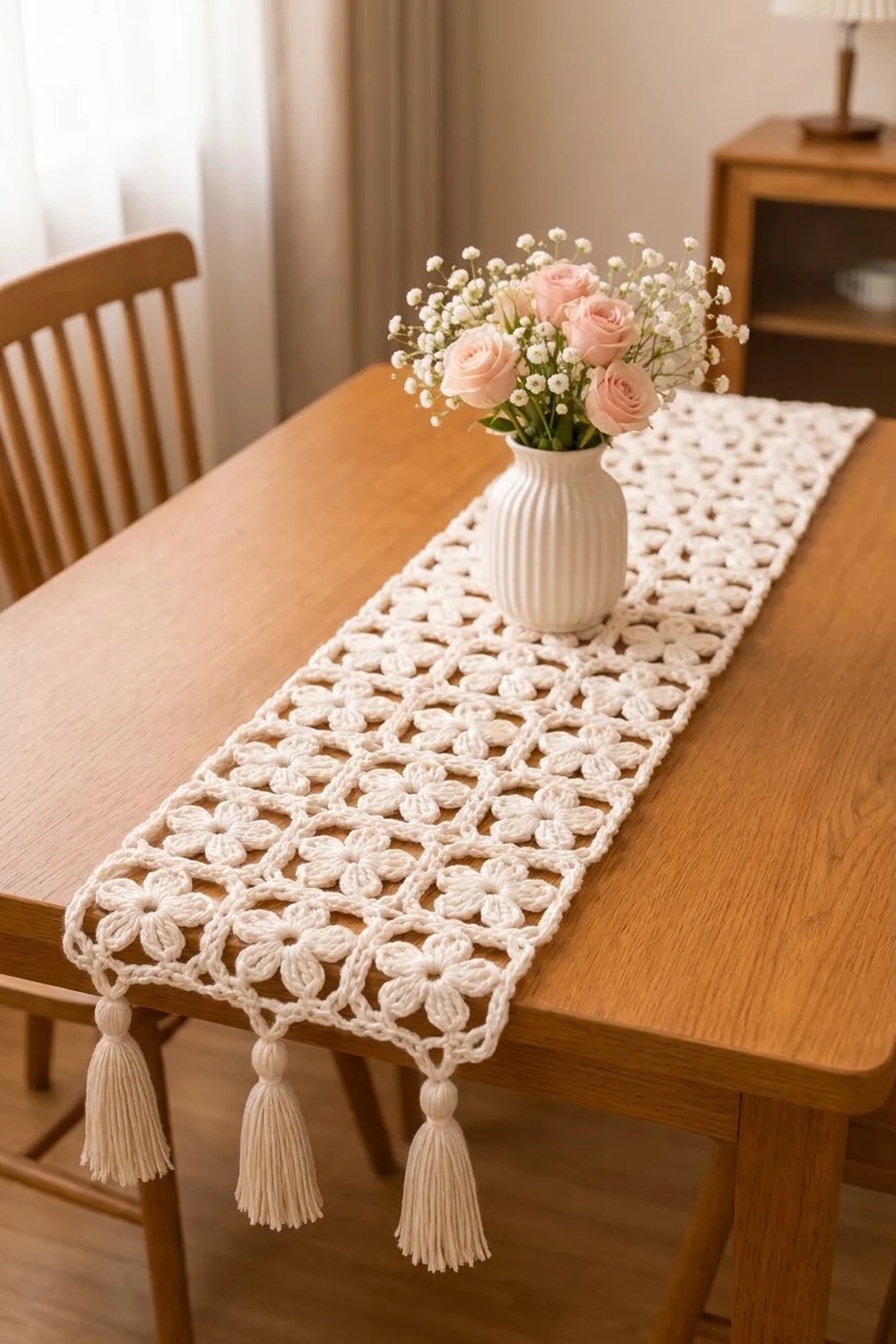
Each stage sets up the next measurement. The 15-sc ring grows into five petals. The 60-st frame chain becomes a 64-sc square with 16 sc per side, and each square blocks to 4.25 in (10.8 cm). Joined three across and ten long, the squares measure 12.75 in x 42.5 in (32.4 cm x 108.0 cm). Two border rounds bring the runner to 13.75 in x 43.5 in (34.9 cm x 110.5 cm). If you check each of these measurements as you go, the runner will come together cleanly.
Happy crocheting!