

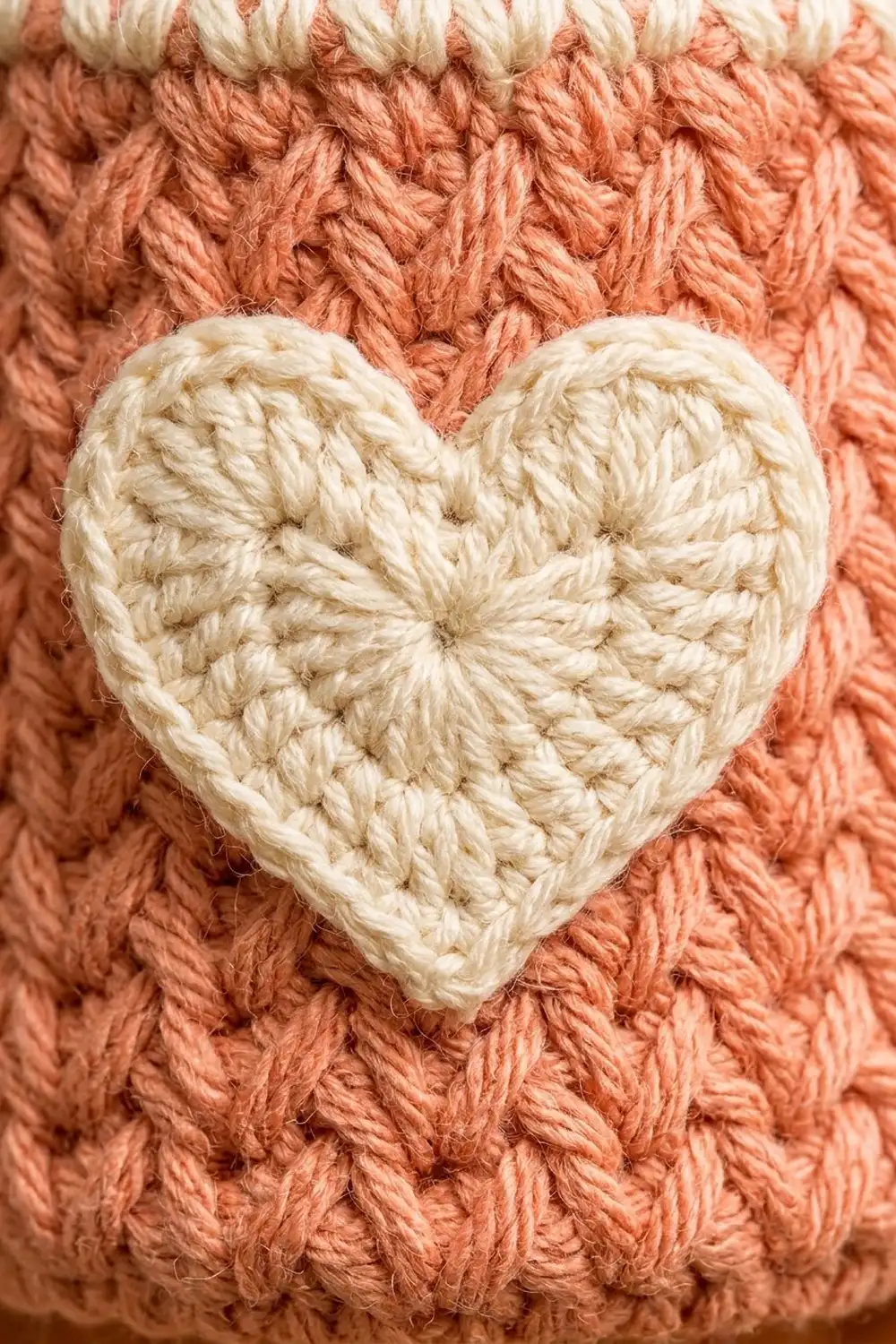
This hanging toilet paper holder has two coral cylindrical pockets stacked one above the other. Two ivory straps run up the sides and loop over a natural wooden dowel. Each pocket has a tidy ivory rim and an ivory heart appliqué centered on the front.
The pocket walls are worked in herringbone half double crochet. The stitch gives a dense, slanted, almost woven texture, so the walls hold their shape and you can’t see the rolls through them. The coral and ivory pairing feels warm and soft and suits a bathroom with natural wood and brass accents.
This pattern uses US crochet terms. Each pocket measures 5.25 in (13.3 cm) across and 4.5 in (11.4 cm) tall, which fits a standard roll. The full holder hangs 18 in (45.7 cm) from the top of the dowel to the bottom of the lower pocket.
Construction is simple. You crochet a solid single crochet base, work the walls upward in herringbone half double crochet, and finish with an ivory rim. Then you make two straps and two hearts, sew the pockets onto the straps one above the other, and fold the strap tops over the dowel.
Finished Size and Construction
- Finished size: 18 in (45.7 cm) hanging length; pockets 5.25 in (13.3 cm) diameter
- Skill level: Easy-intermediate
- Terminology: US crochet terms
- Yarn weight: Worsted (#4)
- Hook: 4.5 mm (US 7)
- Number of pieces: 6 crocheted pieces (2 pockets, 2 straps, 2 hearts) plus 1 dowel
- Layout: 2 pockets stacked vertically on 2 parallel straps, 1 in (2.5 cm) gap between pockets
- Piece size: each pocket 5.25 in (13.3 cm) diameter x 4.5 in (11.4 cm) tall
- Size before border (rim): pocket wall 4 in (10.2 cm) tall
- Border (rim) depth: 0.5 in (1.3 cm), 2 rounds of ivory single crochet
Materials
Choose a smooth worsted-weight cotton or cotton blend. Cotton keeps the walls firm and handles a humid bathroom well. Acrylic also works, but it makes a slightly softer pocket.
- Coral (main color): 110 g / 200 m
- Ivory (contrast color): 60 g / 110 m
Both quantities include a margin of about 15 percent for your gauge swatch and small differences in tension.
Tools:
- 4.5 mm (US 7) crochet hook
- Wooden dowel, 0.75 in (1.9 cm) diameter, 10 in (25.4 cm) long
- Tapestry needle
- 4 locking stitch markers
- Scissors
- Measuring tape
- Pins (optional, for positioning straps and hearts)
Abbreviations (US Terms)
- ch: chain
- sl st: slip stitch
- sc: single crochet
- dc: double crochet
- tr: treble crochet
- inc: 2 sc in the same stitch
- BLO: back loop only
- st(s): stitch(es)
- rnd(s): round(s)
Herringbone half double crochet (HBhdc): Yarn over and insert your hook into the stitch. Yarn over, pull up a loop, and pull it straight through the first loop on the hook as well (2 loops left on hook). Yarn over and pull through both loops. The stitch is shorter and denser than a regular hdc and makes the diagonal ridges you can see on the pocket walls.
Gauge and Checkpoints
Gauge:
- Single crochet: 16 sts x 18 rows = 4 in (10.2 cm)
- HBhdc in rounds: 16 sts x 12 rnds = 4 in (10.2 cm)
Make one complete pocket before you start the second. It works as your swatch and shows any problems early.
Checkpoints:
- After base Rnd 6 (36 sts): about 2.75 in (7.0 cm) across.
- After base Rnd 11 (66 sts): 5.25 in (13.3 cm) across, 16.5 in (41.9 cm) around.
- After wall Rnd 6: wall is 2 in (5.1 cm) tall.
- After wall Rnd 12: wall is 4 in (10.2 cm) tall.
- After rim: total height is 4.5 in (11.4 cm).
If your piece is too big: go down to a 4 mm (US G-6) hook. If it is too small: go up to a 5 mm (US H-8) hook. A pocket that comes out more than 0.25 in (0.6 cm) narrower than 5.25 in (13.3 cm) may squeeze the roll, so check the fit with a real roll now.
Pocket (Make 2)
Base
Use Coral. Do not join the base rounds; work them in a continuous spiral and move a marker up to the first st of each round.
Rnd 1: Make a magic ring and work 6 sc into it. Pull the ring closed. (6 sts)
Rnd 2: Inc in each st around. (12 sts)
Rnd 3: (Sc in next st, inc) 6 times. (18 sts)
Rnd 4: (Sc in next st, inc, sc in next st) 6 times. (24 sts)
Rnd 5: (Sc in next 3 sts, inc) 6 times. (30 sts)
Rnd 6: (Sc in next 2 sts, inc, sc in next 2 sts) 6 times. (36 sts)
Rnd 7: (Sc in next 5 sts, inc) 6 times. (42 sts)
Rnd 8: (Sc in next 3 sts, inc, sc in next 3 sts) 6 times. (48 sts)
Rnd 9: (Sc in next 7 sts, inc) 6 times. (54 sts)
Rnd 10: (Sc in next 4 sts, inc, sc in next 4 sts) 6 times. (60 sts)
Rnd 11: (Sc in next 9 sts, inc) 6 times. (66 sts)
Moving the increases on even rounds keeps the base round instead of hexagonal. Sl st into the next st to smooth the step at the end of the spiral. Lay the base flat and check that it measures 5.25 in (13.3 cm) across.
Walls
From here on, join each round. The ch 1 at the start of a round does not count as a stitch.
Rnd 1 (turning round): Ch 1, HBhdc in BLO of each st around. Join with a sl st to the first HBhdc. (66 sts)
Working through the back loops leaves a ridge of front loops around the base. This makes a crisp fold, so the walls stand straight up from a flat bottom.
Rnds 2–12: Ch 1, HBhdc in both loops of each st around. Join with a sl st to the first HBhdc. (66 sts in each round)
The stitch count stays at 66 sts every round, so the walls rise as a straight cylinder with no flare. Check the height: 2 in (5.1 cm) after Rnd 6 and 4 in (10.2 cm) after Rnd 12. Fasten off Coral and weave in the end on the inside.
The join seam may lean slightly to one side. This is normal for joined HBhdc. That part of the wall will end up behind a strap or at the back of the pocket.
Rim (Border)
Border gauge: 16 sc = 4 in (10.2 cm), the same as the wall gauge of 16 HBhdc = 4 in (10.2 cm). This is why the rim needs no extra stitches.
Join Ivory with a sl st in any st of wall Rnd 12.
Rim Rnd 1 (conversion round): Ch 1, sc in each st around. Join with a sl st to the first sc. (66 sc worked 1 per existing st + 0 added = 66 sts)
Rim Rnd 2: Ch 1, sc in each st around. Join with a sl st to the first sc. (66 sts)
Fasten off and weave in the end.
Per side: For placement, think of the pocket as two halves between the strap positions. The front half and back half each have 33 sts, and 33 + 33 = 66.
Why the math works: At this gauge, 66 sts make 16.5 in (41.9 cm) around, both in HBhdc and in sc. Because the gauges match, the rim lies flush on the wall and does not ruffle or pull in. The 2 sc rounds add 0.5 in (1.3 cm), so the pocket goes from 4 in (10.2 cm) to 4.5 in (11.4 cm) tall.
Strap (Make 2)
Use Ivory.
Foundation: Ch 6.
Row 1: Sc in the 2nd ch from the hook and in each ch across. Turn. (5 sts)
Rows 2–90: Ch 1, sc in each st across. Turn. (5 sts in each row)
The strap is 1.25 in (3.2 cm) wide and 20 in (50.8 cm) long, because 90 rows divided by 4.5 rows per inch is 20 in. Fasten off and leave a 12 in (30.5 cm) tail for sewing the dowel loop.
Strap zones (mark these with stitch markers):
- Rows 1–20: lower pocket, 4.5 in (11.4 cm)
- Rows 21–25: gap, about 1 in (2.5 cm)
- Rows 26–45: upper pocket, 4.5 in (11.4 cm)
- Rows 46–72: free hanging section, 6 in (15.2 cm)
- Rows 73–90: dowel loop, 4 in (10.2 cm), folded in half
Heart Appliqué (Make 2)
Use Ivory.
Rnd 1: Make a magic ring. Ch 3 (counts as tr), then work into the ring: 2 tr, 3 dc, ch 1, 1 tr (the point), ch 1, 3 dc, 3 tr, ch 3, sl st into the ring. Pull the ring tight. (13 sts and 2 ch-1 spaces)
Rnd 2: Ch 1. Working along the edge: 2 sc in each of the first 3 tr (6 sts), sc in each of the next 3 dc (3 sts), sc in the ch-1 sp, (sc, ch 2, sc) in the point tr, sc in the next ch-1 sp, sc in each of the next 3 dc (3 sts), 2 sc in each of the last 3 tr (6 sts). Sl st into the center dip at the top. (22 sc plus 1 ch-2 point)
The heart measures 2 in (5.1 cm) wide and 1.75 in (4.4 cm) tall. Fasten off and leave a 10 in (25.4 cm) tail for sewing.
Make All Pieces
- Coral: 2 pockets (base and walls)
- Ivory: 2 rims, 2 straps, 2 hearts
Layout (front view):
   ===========O===========   dowel
       |S|           |S|     strap loops (rows 73-90)
       |T|           |T|     free straps (rows 46-72)
       |R| [ POCKET ]|R|     upper pocket (rows 26-45)
       |A| [  <3    ]|A|
       |P|           |P|     gap (rows 21-25)
       | | [ POCKET ]| |     lower pocket (rows 1-20)
       | | [  <3    ]| |
Joining
Method: Whipstitch with Ivory, through both loops of the strap edge and into the pocket wall.
Placing the straps: Mark pocket st 1 and st 34 on rim Rnd 2. These sit directly opposite each other, 33 sts apart. Center one strap over sts 65, 66, 1, 2, and 3, and center the other over sts 32 through 36. The join seam sits under one strap.
Stitch-to-stitch logic: Line up strap Row 1 with the base fold of the lower pocket. Strap Rows 1–18 run along wall Rnds 1–12, which is 4 in (10.2 cm) on both. Sew 3 strap rows to every 2 HBhdc rounds. Strap Rows 19 and 20 line up with rim Rnds 1 and 2, one row per round. Sew down both long edges of each strap.
Attach the upper pocket the same way along strap Rows 26–45. Leave Rows 21–25 unsewn to make the gap.
Tension: Make your whipstitches snug but not tight. If they are too tight, the walls will pucker or the strap will shorten. Insert a roll while you sew so the cylinder keeps its full shape.
Hearts: Center each heart on the front half of its pocket over sts 17 and 18. Its center should be 2.25 in (5.7 cm) above the base fold. Whipstitch around the outside edge of the heart.
Dowel: Fold strap Rows 82–90 back over the dowel onto Rows 73–81 and whipstitch through both layers.
Size checkpoint: From the top of the dowel to the bottom of the lower pocket should measure 18 in (45.7 cm), which is 81 rows divided by 4.5 rows per inch.
Final Blocking
- Fill both pockets with toilet rolls or rolled towels.
- Mist the walls, rims, and straps lightly with water.
- Pat each heart flat with your fingers and smooth the point.
- Straighten the straps so they hang plumb and parallel.
- Hang the holder from the dowel and let it dry fully, for about 24 hours.
- Remove the filler and check all measurements again.
Final Quality-Control Checklist
- Each pocket is 5.25 in (13.3 cm) across and 4.5 in (11.4 cm) tall.
- Every wall and rim round has 66 sts.
- The straps are 1.25 in (3.2 cm) wide and sit directly opposite each other.
- The gap between the pockets is about 1 in (2.5 cm).
- The hearts are centered on the fronts and the points face down.
- The hanging length is 18 in (45.7 cm).
- The dowel loops are sewn through both layers.
- All ends are woven in on the inside.
Troubleshooting
- Base ruffles: Your increases are too frequent for your tension. Go down a hook size for the base only.
- Base cups upward: Go up a hook size for the base, or check that you have the right count for each round.
- Walls flare out: Count your stitches. You may have added a stitch at the joins.
- Roll fits too tightly: Add a 12th base round, (sc in next 10 sts, inc) 6 times, for 72 sts. Work all wall and rim rounds with 72 sts and place the straps 36 sts apart.
- Pocket sags: Your strap stitches are too loose. Add a second line of whipstitch along the edges.
- Heart curls: Steam it flat before sewing it on.
Care
Hand wash in cool water and lay flat to dry with a roll inside each pocket. Slide the dowel out before washing.

Final Notes
The measurement chain is:
- Base: 66 sts make 5.25 in (13.3 cm) across and 16.5 in (41.9 cm) around.
- Walls: 12 HBhdc rounds at 66 sts make 4 in (10.2 cm).
- Rim: 2 sc rounds at 66 sts add 0.5 in (1.3 cm), for a 4.5 in (11.4 cm) pocket.
- Straps: 90 rows make 20 in (50.8 cm). Folding over the dowel leaves 18 in (45.7 cm) of hanging length.
If your gauge matches at each checkpoint, the pockets, straps, and dowel will line up neatly.
Happy crocheting!