

The Rosewood Trellis is a three-tier hanging organizer for a bathroom, nursery or entryway wall. Three round baskets sit one above the other between two crocheted straps, and the whole tower hangs from a wooden dowel with a crocheted cord.
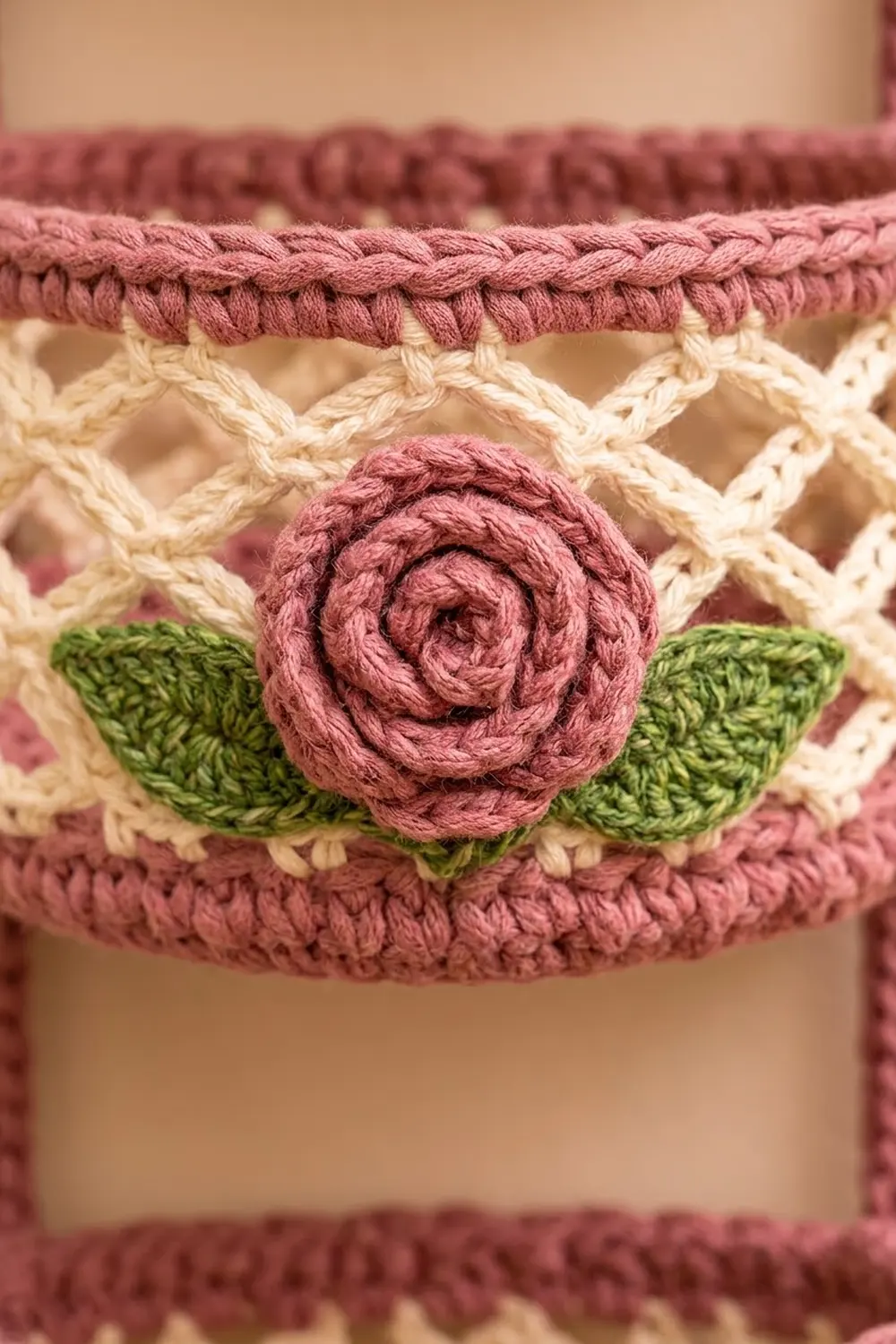
Each basket has a solid dusty rose base, an open ivory diamond mesh around the side, and a corded dusty rose rim. On the front of each basket is a rolled rose with two green leaves. The style is soft and vintage, but the baskets are sturdy enough to hold perfume bottles, brushes, jars and rolled washcloths.
This pattern uses US crochet terms. Each basket measures 6.5 in (16.5 cm) across and 4 in (10.2 cm) tall. The assembled tower is 10 in (25.4 cm) wide at the dowel and about 28 in (71.1 cm) tall from the cord peak to the bottom basket.
You crochet a flat circle for each base, then work the side upward in the round, change to ivory for the mesh, and finish with a dusty rose rim. Next you make two straps worked lengthwise, three roses and six leaves. Last, you sew the baskets to the straps, fold the straps over the dowel and add the cord.
Finished Size and Construction
- Finished size: 10 in (25.4 cm) wide x about 28 in (71.1 cm) tall, including the cord
- Skill level: Intermediate
- Terminology: US
- Yarn weight: Worsted (#4) cotton
- Hook: 5.0 mm (H-8)
- Number of pieces: 3 baskets, 2 straps, 3 roses, 6 leaves, 1 cord
- Layout: 1 column of 3 baskets, stacked vertically
- Piece size: each basket is 6.5 in (16.5 cm) across x 4 in (10.2 cm) tall
- Basket height before rim: 3.3 in (8.4 cm)
- Rim (border) depth: 0.7 in (1.8 cm)
Materials
Use a smooth worsted-weight cotton or cotton blend. Cotton holds its shape well in baskets and stands up to bathroom humidity. Acrylic also works, but the baskets will be softer.
- Dusty rose: 200 g / 340 m (372 yd), for bases, side bands, rims, straps, roses and cord
- Ivory: 100 g / 170 m (186 yd), for the mesh
- Sage green: 15 g / 26 m (28 yd), for the leaves
All quantities include a margin of about 25–30% for gauge differences and swatching.
Tools:
– 5.0 mm (H-8) crochet hook
– Wooden dowel, 10 in (25.4 cm) long and 0.5 in (1.3 cm) in diameter
– Wall knob or hook
– Tapestry needle
– 8 locking stitch markers
– Scissors and a measuring tape
– Rustproof pins and a spray bottle for blocking
Abbreviations (US Terms)
- ch – chain
- sl st – slip stitch
- sc – single crochet
- hdc – half double crochet
- dc – double crochet
- inc – 2 sc in the same stitch
- BLO – back loop only
- MR – magic ring
- sk – skip
- sp – space
- st(s) – stitch(es)
Special stitch – reverse sc (crab stitch): Work from left to right (right to left if you crochet left-handed). Insert the hook into the next stitch to the right, yarn over, pull up a loop, yarn over, and pull through both loops. This makes the corded top edge.
Gauge and Checkpoints
Gauge: 16 sc and 18 rounds = 4 in (10.2 cm) in sc.
Make one full basket first and check it before you start the other two. The measurements below form a chain, so if one stage is off, every later stage will be off too.
- Base, Round 7 (42 sts): 3.25 in (8.3 cm) across
- Base, Round 14 (84 sts): 6.5 in (16.5 cm) across, lying flat
- After the lower band (Round 17): 0.7 in (1.8 cm) of side height
- After the mesh (Round 23): 2.4 in (6.1 cm) of mesh height
- Finished basket: 4 in (10.2 cm) tall
If your base is too big, go down one hook size. If it is too small, go up one hook size. Don’t change the stitch counts: the base, mesh and rim all depend on 84 stitches.
Basket (Make 3)
Begin with dusty rose. Work in continuous spiral rounds and move a stitch marker up to the first stitch of each round.
Base
Rnd 1: In a MR, work 6 sc. (6 sts)
Rnd 2: Inc in each st around. (12 sts)
Rnd 3: Sc in next st, inc in next st 6 times. (18 sts)
Rnd 4: Sc in next 2 sts, inc 6 times. (24 sts)
Rnd 5: Sc in next 3 sts, inc 6 times. (30 sts)
Rnd 6: Sc in next 4 sts, inc 6 times. (36 sts)
Rnd 7: Sc in next 5 sts, inc 6 times. (42 sts)
Checkpoint: 3.25 in (8.3 cm) across.
Rnds 8–14: Keep adding one more plain sc before each inc on every round. That gives 6 increases per round:
- Rnd 8: 48 sts
- Rnd 9: 54 sts
- Rnd 10: 60 sts
- Rnd 11: 66 sts
- Rnd 12: 72 sts
- Rnd 13: 78 sts
- Rnd 14: 84 sts
On even rounds, start with half the plain stitches. For example, on Rnd 8 work sc in 3 sts, inc, then sc in next 6 sts, inc 5 times, then sc in 3 sts. Staggering the increases this way keeps the circle round instead of hexagonal.
Checkpoint: 84 sts and 6.5 in (16.5 cm) across. The base should lie completely flat.
Lower Side Band
Rnd 15: Sc in BLO of each st around. This is a conversion round: 84 sts worked 1-per-stitch + 0 added = 84 sts. The unused front loops make a clean fold line where the base turns up into the side.
Rnds 16–17: Sc in each st around. (84 sts)
Sl st in the next st to close the spiral, and fasten off dusty rose. Call this sl st position st 1 and mark it as the back center. Count around and mark:
- st 22 – right side
- st 43 – front center
- st 64 – left side
These four markers split the basket into four sections of 21 sts each.
Diamond Mesh
Join ivory in st 1.
Rnd 18: Ch 1, sc in st 1, ch 4, sk 3 sts, sc in next st 20 times, ch 4, sk last 3 sts, sl st to first sc. (21 ch-4 loops)
Check the math: the sc land on sts 1, 5, 9 and so on up to 81, and each loop spans 4 base stitches. 21 x 4 = 84.
Rnd 19: Sl st in the first 2 ch of the first loop. Ch 1, sc in the same loop, ch 4, sc in next loop 20 times, ch 4, sl st to first sc. (21 loops)
Rnds 20–23: Repeat Rnd 19. (21 loops each round)
Each sc sits at the center of a loop from the round below, so the loops shift half a loop every round. That offset creates the diamond lattice. Checkpoint: the mesh is 2.4 in (6.1 cm) tall.
Rnd 24 (conversion round): Sl st in the first loop. Ch 1, work 4 sc in each ch-4 loop around, then sl st to the first sc. Count: 21 loops x 4 sc each = 84 sts.
Fasten off ivory. The basket now measures 3.3 in (8.4 cm) tall before the rim.
Roses and Leaves
Rose (Make 3, dusty rose)
Ch 30.
Row 1: Dc in the 4th ch from the hook and in each ch across. (27 dc + turning ch = 28 sts)
Row 2: Ch 1, turn. You will make 14 petals in three sizes:
- 3 dc in next st, sl st in next st 5 times (5 small petals)
- 5 dc in next st, sl st in next st 5 times (5 medium petals)
- 7 dc in next st, sl st in next st 4 times (4 large petals); work the last sl st in the top of the turning ch
Check the math: 14 petals x 2 sts used = 28 sts.
Leave a 12 in (30.5 cm) tail and fasten off. Roll the strip tightly from the small-petal end, with Row 1 at the bottom. Sew through all layers of the base to hold the roll. The rose is 2 in (5.1 cm) across.
Leaf (Make 6, green)
Ch 8.
Rnd 1: Working along one side of the chain, starting in the 2nd ch from the hook: sc, hdc, dc in next 3 ch, hdc, sc in last ch. (7 sts)
Ch 1 at the tip. Then work along the other side of the foundation chain: sc, hdc, 3 dc, hdc, sc. (7 sts)
Sl st to the first sc. (14 sts plus the tip ch)
Fasten off, leaving a tail. The leaf is 1.75 in (4.4 cm) long.
Make All Pieces
- Dusty rose: 3 baskets (base, lower band and rim), 2 straps, 3 roses, 1 cord
- Ivory: mesh for 3 baskets
- Green: 6 leaves
Straps (Make 2, dusty rose)
Ch 101.
Row 1: Sc in the 2nd ch from the hook and in each ch across. (100 sts)
Rows 2–4: Ch 1, turn, sc in each st across. (100 sts)
Fasten off, leaving a long tail. Each strap is 25 in (63.5 cm) long and 0.9 in (2.3 cm) wide.
Hanging Cord (dusty rose)
Ch 61. Sl st into the back bump of the 2nd ch from the hook and of each ch across. (60 sts)
The cord is 15 in (38.1 cm) long.
Layout (front view)
        /\        cord to knob
  [====dowel====]
   |           |   3 in (7.6 cm) gap
   | Basket 1  |   4 in (10.2 cm)
   |           |   3.5 in (8.9 cm) gap
   | Basket 2  |   4 in (10.2 cm)
   |           |   3.5 in (8.9 cm) gap
   | Basket 3  |   4 in (10.2 cm)
Joining
Mark the Straps
Measure from the bottom end of each strap, using 4 sts = 1 in (2.5 cm):
- Sts 1–16: Basket 3, 4 in (10.2 cm)
- Sts 17–30: gap, 3.5 in (8.9 cm)
- Sts 31–46: Basket 2
- Sts 47–60: gap
- Sts 61–76: Basket 1
- Sts 77–88: top gap, 3 in (7.6 cm)
- Sts 89–100: fold-over, 3 in (7.6 cm)
Check the math: 16 + 14 + 16 + 14 + 16 + 12 + 12 = 100 sts.
Attach the Baskets
You will attach the rims in the Border section below. For now, line up the basket sides with the straps.
Place the right strap’s wrong side against basket st 22 and the left strap’s against st 64. Each 16-stitch strap section runs from the bottom edge of the base to the top of the rim.
Using a dusty rose tail, whipstitch both long edges of the strap to the basket. Sew through every solid round (Rnds 15–17 and 24–27). Through the mesh, tack the strap to each ivory sc it touches. That gives 16 strap stitches spread evenly over the 4 in (10.2 cm) side.
Tension
Pull each stitch snug but not tight. If the straps pucker, the gaps will shrink and the baskets will tip.
Finish the Assembly
Fold sts 89–100 of each strap over the dowel to the back. Sew the end down along the row of sts 77–88, just under the dowel. Space the straps so their outer edges are 8.3 in (21.1 cm) apart; that is the 6.5 in (16.5 cm) basket plus two 0.9 in (2.3 cm) straps.
Tie each end of the cord around the dowel just outside a strap.
Size checkpoint: 22 in (55.9 cm) from the dowel to the bottom of Basket 3.
Border: Basket Rim
The rim is the border for each basket. Work it on all three baskets before you sew them to the straps. The gauge is the same as the body: 16 sc = 4 in (10.2 cm).
Join dusty rose in st 1 (back center) of Rnd 24.
Rnd 25: Ch 1, sc in each st around, sl st to first sc. (84 sts: 21 per section between markers)
Rnd 26: Ch 1, sc in each st around, sl st to first sc. (84 sts)
Rnd 27: Ch 1, reverse sc in each st around, sl st to first st. (84 sts)
Fasten off. The rim is 0.7 in (1.8 cm) deep.
Why the math works: 84 = 6 x 14 base increases = 21 mesh loops x 4 = 4 sections x 21. The rim has exactly the same count as the base edge, so the walls go straight up without flaring or pulling in. Adding stitches in the rim would make it ruffle; skipping stitches would make the top pucker.
Appliqués: Sew one rose to each basket over front center st 43, centered on mesh Rnds 20–21. Sew one leaf on each side of the rose, angled outward, with the base of the leaf tucked under the rose.
Final Blocking
- Spray each basket until it is damp but not dripping.
- Stuff it firmly with a towel or slide it over a round container 6.5 in (16.5 cm) across.
- Pull the mesh gently upward so the diamonds open evenly.
- Pin each rim level and round.
- Lay the straps flat, pin them to 25 in (63.5 cm), and spray them.
- Let everything dry completely, about 24 hours.
- Check the measurements again and adjust before the final sewing if needed.
Final Quality-Control Checklist
- [ ] Each base has 84 sts, measures 6.5 in (16.5 cm) across and lies flat
- [ ] Each basket has 21 loops in every mesh round
- [ ] Each rim round has 84 sts
- [ ] All three baskets are 4 in (10.2 cm) tall
- [ ] The roses sit at front center, at the same height on every basket
- [ ] Both straps measure 25 in (63.5 cm) and the gaps match on both sides
- [ ] Every basket hangs level
- [ ] All ends are woven in securely
Troubleshooting
- Base cups upward: You are short on increases, or your tension is tight. Recount the rounds, or go up a hook size.
- Base ruffles: You have extra stitches, or your tension is loose. Recount; each round should be a multiple of 6.
- Mesh slants or twists: Make sure every sc goes into the center of a loop, not into a chain stitch.
- Mesh too floppy: Change to ch 3 loops. Keep 4 sc per loop in Rnd 24 so the count stays at 84.
- Basket tips forward: Move the strap seams 1–2 sts toward the back, or tack the back of the rim to a short strip sewn between the straps.
- Uneven gaps: Remeasure the strap markers. Chain foundations often work up tight.
Care
Hand wash in cool water and lay flat to dry, reshaping each basket over a container. Don’t wring the baskets or put them in the dryer.

Final Notes
The size of the whole organizer comes from a chain of measurements. A gauge of 16 sc = 4 in (10.2 cm) gives a base of 84 sts and 6.5 in (16.5 cm) across. The base becomes 21 mesh loops, which convert back to 84 sts for a straight 4 in (10.2 cm) wall. The 100-stitch straps place three baskets with 3.5 in (8.9 cm) gaps, for 22 in (55.9 cm) below the dowel. Check each link in the chain and the tower will hang level and true.
Happy crocheting!