

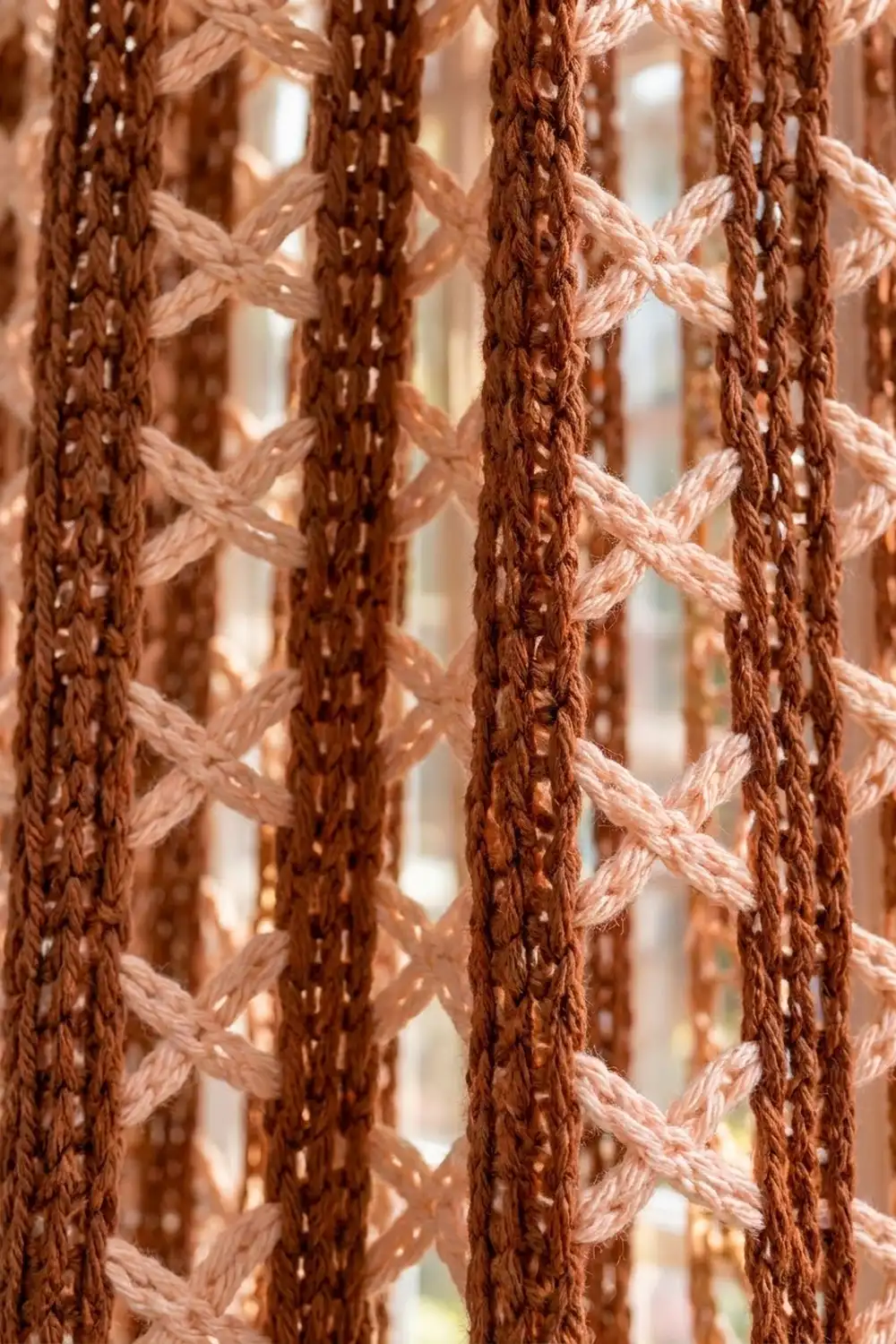
These curtain panels have a warm, airy lattice. Rust-brown columns run from the rod to the floor, and blush-peach X-stitches fill the open slots between them. In daylight the openings glow, and the panels cast a soft crisscross shadow pattern across the room.
The design uses just two colors: terracotta rust for the solid columns and border, and pale blush for the crosses. The style sits between modern boho and vintage cottage. It looks good with natural wood, linen, and brass hardware, and the open structure lets in plenty of light while still softening the view.
The pattern uses US crochet terms. Each finished panel measures 39.5 in (100.3 cm) wide by 81.5 in (207.0 cm) long, and you make two matching panels to hang side by side.
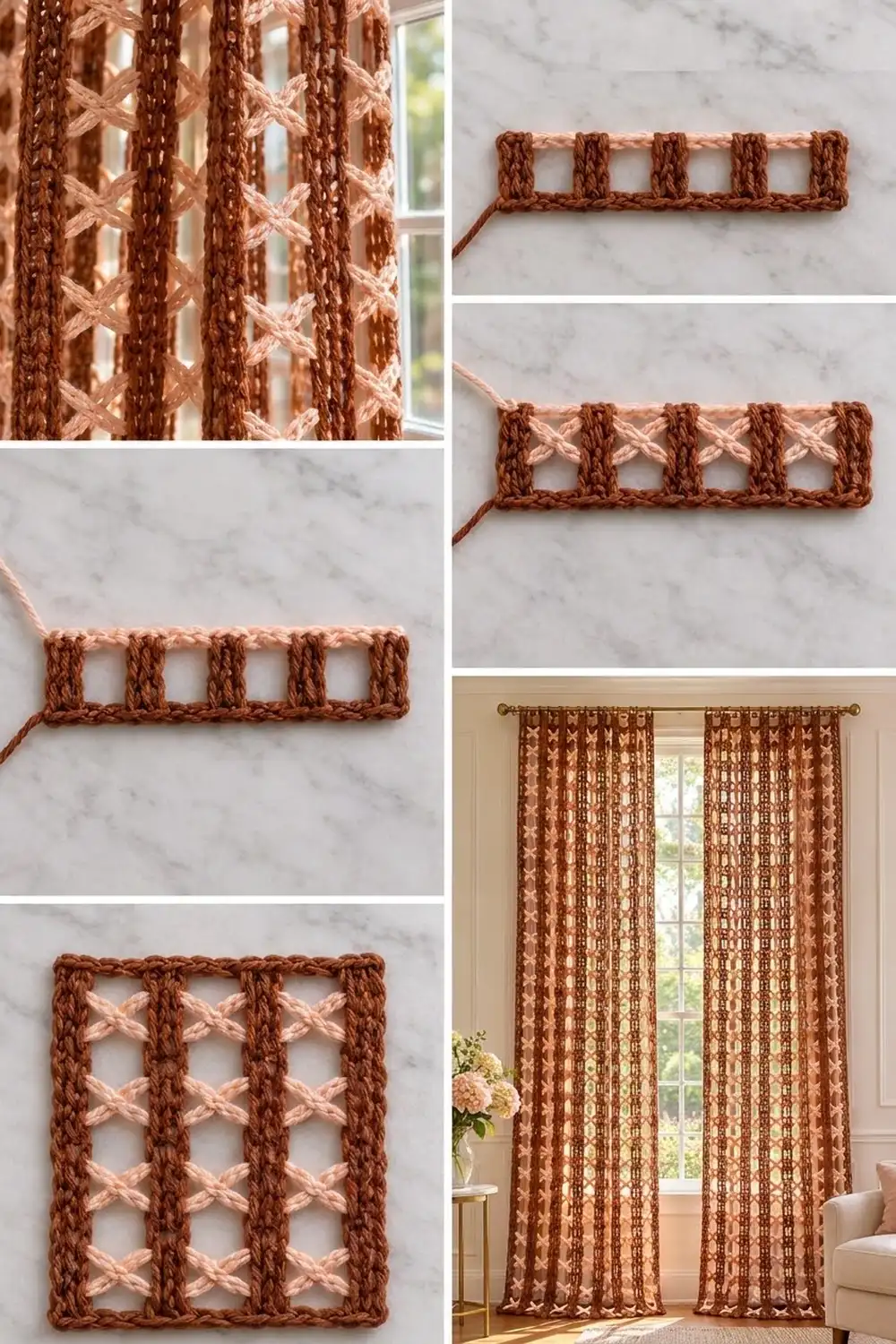
Each panel is worked sideways in one piece. Your rows run the full length of the curtain, so every row becomes a vertical line when the panel hangs. Two rows of rust double crochet make each column, and one row of blush Long Crosses makes each lattice slot. Two rounds of rust single crochet frame the panel at the end. No joining is required.
Finished Size and Construction
- Finished size (each panel): 39.5 in (100.3 cm) wide x 81.5 in (207.0 cm) long
- Skill level: Intermediate
- Terminology: US crochet terms
- Yarn weight: Worsted (#4)
- Hook: 5.0 mm (H-8)
- Number of pieces: 2 separate panels, not joined
- Layout: Two panels hung side by side on one rod
- Piece size before border: 38.5 in (97.8 cm) wide x 80.5 in (204.5 cm) long
- Border depth: 0.5 in (1.3 cm) on every side (2 rounds of sc)
- Columns per panel: 16 rust columns with 15 blush lattice slots
Materials
Choose a smooth worsted yarn in a cotton/acrylic blend, about 200 yd (183 m) per 100 g. Cotton blends drape well and stretch less under their own weight than pure acrylic, which matters for a long hanging piece. Fuzzy or very splitty yarns will blur the crosses.
- Color A, Rust: 1,600 g, 3,200 yd (2,926 m) total for both panels (800 g, 1,600 yd / 1,463 m per panel)
- Color B, Blush: 550 g, 1,100 yd (1,006 m) total for both panels (275 g, 550 yd / 503 m per panel)
Tools:
- 5.0 mm (H-8) crochet hook
- Tapestry needle
- Locking stitch markers
- Tape measure
- Rust-proof pins and a large blocking surface (a clean floor covered with towels works)
- 20 curtain clip rings (10 per panel)
The quantities include a margin of about 10–15 percent for your gauge swatch and for differences in tension. Buy all of each color from the same dye lot.
Abbreviations (US Terms)
- ch: chain
- sl st: slip stitch
- sc: single crochet
- dc: double crochet
- tr: treble crochet
- dtr: double treble crochet
- st(s): stitch(es)
- sk: skip
- sp: space
- rep: repeat
- beg: beginning
Special stitch: Long Cross (LX), worked over 6 sts
- Yo 3 times, insert hook in next st, and pull up a loop (5 loops on hook). Yo and draw through 2 loops (4 loops on hook).
- Sk the next 4 sts. Yo, insert hook in the next st, and pull up a loop (6 loops on hook). [Yo and draw through 2 loops] 5 times (1 loop on hook). The two lower legs are now joined into one tall stitch.
- Ch 4. Yo twice, insert hook through the 2 strands at the center crossing point where the legs meet, and pull up a loop. [Yo and draw through 2 loops] 3 times. This makes the upper arm.
The top of one LX gives you 6 positions to work into: the top of the joined legs (1), the 4 chains (4), and the top of the tr arm (1).
Gauge and Checkpoints
Gauge:
- 16 dc = 4 in (10.2 cm) across
- 8 dc rows = 4 in (10.2 cm), so each dc row is 0.5 in (1.3 cm) tall
- 1 LX row = 1.5 in (3.8 cm) tall
- 1 LX plus one ch-2 gap = 8 sts = 2 in (5.1 cm)
Test piece first: Ch 36 and work Rows 1–5 of the pattern below with 34 sts instead of 322. Your LX row will have 4 crosses: work the * repeat 3 times instead of 39 (rep from * 2 more times). Block the swatch lightly before you measure.
- Width along the rows: 34 sts = 8.5 in (21.6 cm)
- Height across 5 rows: 0.5 + 0.5 + 1.5 + 0.5 + 0.5 = 3.5 in (8.9 cm)
If your swatch is too big, go down 0.5 mm in hook size. If it is too small, go up 0.5 mm. If only the LX row is too tall or too short, keep the same hook and change how firmly you pull up the loops in step 1 of the stitch.
Checkpoints on the real panel (measured flat, across the rows):
- After Row 2: 1 in (2.5 cm)
- After Row 5: 3.5 in (8.9 cm)
- After Row 23: 18.5 in (47.0 cm)
- After Row 47: 38.5 in (97.8 cm)
- Row length at any point: 80.5 in (204.5 cm)
Stay within 0.25 in (0.6 cm) of each checkpoint before you carry on.
Panel Pattern
The panel is worked sideways. Call the edge where Row 1 begins Side A and the opposite edge Side B. Rust is carried up Side A and never cut. Blush is cut after every LX row. The border will cover the carried strand and the tails later.
Foundation: With Rust, ch 324.
Row 1 (Rust): Dc in the 4th ch from the hook and in each ch across. Turn. (322 sts; the 3 skipped ch count as 1 dc)
If a long chain makes your edge tight, you can work 322 foundation dc (fdc) instead. The count stays the same.
Row 2 (Rust): Ch 3 (counts as dc), then dc in each st across, ending in the top of the turning ch. You end at Side A. Drop Rust but do not cut it. Turn. (322 sts)
Row 3 (Blush, LX row): Join Blush with a sl st in the first st. Ch 5 (counts as dtr), ch 1, sk next st, LX over next 6 sts, *ch 2, sk 2, LX over next 6 sts; rep from * 38 more times, ch 1, sk next st, dtr in last st. Fasten off Blush, leaving a 6 in (15.2 cm) tail.
(40 LX. Count: 1 dtr + 1 ch + 240 LX positions + 78 ch + 1 ch + 1 dtr = 322 sts)
Row 4 (Rust): Do not turn. Pick up the Rust strand waiting at Side A. Insert your hook in the top of the beg ch-5 and pull up a Rust loop. Ch 3 (counts as dc). Dc in each ch and in each st top across, working into the chains themselves rather than around them. (322 sts)
Row 5 (Rust): Turn. Ch 3 (counts as dc), then dc in each st across. You end at Side A. Drop Rust. Turn. (322 sts)
Rows 6–47: Rep Rows 3–5 fourteen more times. (Every row: 322 sts)
After Row 47 you have 16 rust columns and 15 blush lattice rows. Each column is two dc rows, which read as two parallel strands. Each LX row hangs as a vertical slot filled with stacked Xs, and the ch-2 gaps leave small openings between the crosses. Do not fasten off Rust; go straight on to the border.
Why this works: You start every Blush row from Side A with the same face toward you, so all the Xs slant the same way. Picking up Rust without turning keeps the carried strand on one edge only, where the border hides it.
Make All Pieces
Make 2 identical panels. Each panel uses 800 g (1,600 yd / 1,463 m) of Rust and 275 g (550 yd / 503 m) of Blush.
Hanging layout (front view):
[ Panel 1 ][ window ][ Panel 2 ]
  16 cols              16 cols
  39.5 in              39.5 in
The panels stay separate, so there is no joining step. Work the second panel with the same hook and check the same gauge checkpoints so the pair matches.
Border
Border gauge: 4 sc per inch (2.5 cm) along every edge. Each sc round adds 0.25 in (0.6 cm) of depth.
Round 1 (Rust): Do not turn. Ch 1. Rotate the panel and work along the row ends of Side A:
- Side A: Work 2 sc in the end of each dc row and 6 sc around the post of each LX row. That is 16 columns x 4 sc + 15 slots x 6 sc = 64 + 90 = 154 sc. Crochet over the carried Rust strand and the Blush tails as you go.
- Corner: Ch 2.
- Long edge, foundation side: Work 1 sc in the base of each foundation st. 322 sc
- Corner: Ch 2.
- Side B: Work 154 sc as on Side A, crocheting over the Blush tails. 154 sc
- Corner: Ch 2.
- Long edge, Row 47 side: Work 1 sc in each st. 322 sc
- Corner: Ch 2. Sl st to the first sc to join.
(Round 1 total: 952 sc + 4 corner ch-2 sps)
Round 2 (Rust): Ch 1. Sc in each sc around, and work (sc, ch 2, sc) in each corner ch-2 sp. Sl st to the first sc to join. Fasten off.
- Short sides: 154 sts worked 1 per sc + 2 corner sc = 156 sc each
- Long sides: 322 sts worked 1 per sc + 2 corner sc = 324 sc each
These side counts include each side’s 2 corner sc. The ch-2 corner spaces are counted separately.
(Round 2 total: 960 sc + 4 corner ch-2 sps)
Why the math works: Along the rows, the body has 4 sts per inch (322 sts = 80.5 in). Across the rows, it takes 4 row-end sc per inch (154 sc = 38.5 in). Because the border matches that gauge on every side, the edges neither flare nor pull in. The two rounds add 0.5 in (1.3 cm) per side, so the panel finishes at 38.5 + 1 = 39.5 in (100.3 cm) wide and 80.5 + 1 = 81.5 in (207.0 cm) long.
Final Blocking
- Weave in any remaining ends inside the border, never across an open slot.
- Soak the panel in cool water with a little wool wash for 15 minutes. Press the water out gently, without wringing.
- Roll the panel in towels to remove more moisture.
- Lay it flat with the columns vertical and pin it to 39.5 in (100.3 cm) x 81.5 in (207.0 cm).
- Use a long ruler to straighten each rust column. Gently open every X so its tips touch both neighboring columns.
- Let it dry completely, which takes 24–48 hours. Repeat for the second panel, then lay the two side by side and compare them.
Final Quality-Control Checklist
- Every row has 322 sts, and every LX row has 40 crosses.
- Each panel has 16 rust columns and 15 blush slots.
- All the Xs slant the same way.
- Round 2 has 156 sc on each short side and 324 sc on each long side.
- Each panel measures 39.5 in (100.3 cm) x 81.5 in (207.0 cm).
- The two panels match within 0.5 in (1.3 cm) in each direction.
- No tails or carried strands show across the openings.
Troubleshooting
- The Xs look floppy or droopy: You are pulling up the LX loops too long. Keep each yo snug and the center arm firm.
- The Xs don’t reach the next column: The LX row is too short. Pull up the first loop a little taller, or use a hook 0.5 mm larger for the Blush rows only.
- The panel is wider than the checkpoint: Your dc rows are too tall. Tighten your tension, or check your gauge again on a fresh swatch.
- The long edges ripple: The border has too many stitches. Recount Round 1 to 322 sc per long side.
- Side A puckers: The carried Rust strand is too tight. Leave a little slack each time you pick it up.
- The panel grows when hung: Worsted dc relaxes under its own weight. Block the panel, hang it for a day, then measure it. If it has grown too much, take out one LX repeat per row when you make the next panel and adjust the counts to match.
- Hanging: Space 10 clip rings about 4.4 in (11.2 cm) apart along the short top edge.
Care
Hand wash in cool water, or machine wash on a gentle cycle inside a large mesh bag. Dry flat and reshape the Xs while the panel is damp. Never hang a wet panel, because the weight will stretch it.
Final Notes
The measurement chain is simple. At 16 dc = 4 in (10.2 cm), 322 sts make an 80.5 in (204.5 cm) row. Sixteen columns at 1 in (2.5 cm) plus 15 slots at 1.5 in (3.8 cm) add up to 38.5 in (97.8 cm). A 0.5 in (1.3 cm) border then finishes each panel at 39.5 in (100.3 cm) x 81.5 in (207.0 cm). Check your gauge at each stage and keep your crosses consistent, and the two panels will hang as a matching pair.
Happy crocheting!