

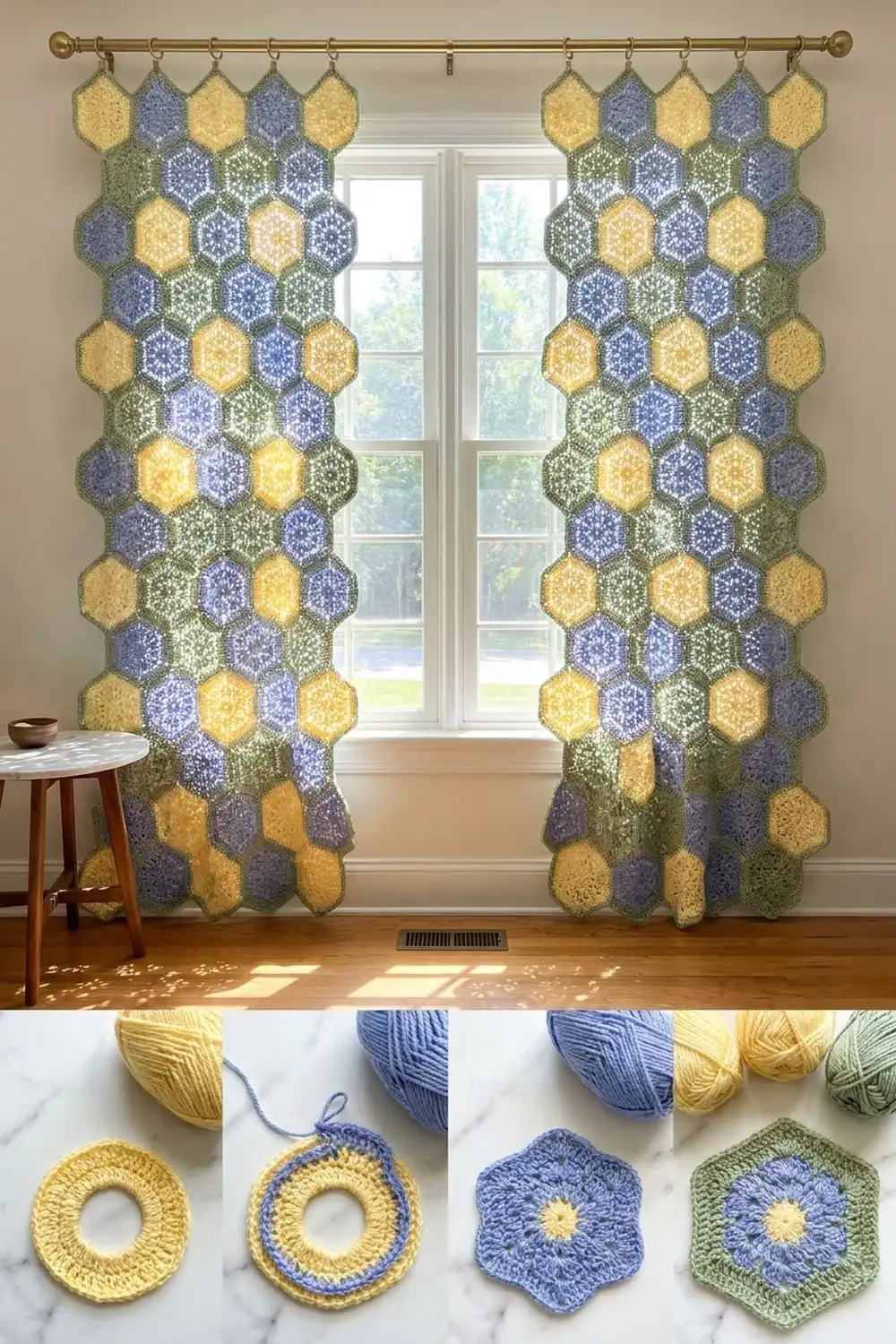
This curtain panel is a honeycomb of small hexagons. Each one holds a five-petal blue flower with a soft yellow center inside an airy green lattice frame. Hung in a sunny window, the open spaces let light through, and the flowers still stand out from across the room.
The panel uses three colors: periwinkle blue for the petals, butter yellow for the centers, and sage green for the frames and border. The look is light and cottage-garden. Work it in DK cotton so the long panel hangs straight and keeps its shape.
All instructions use US crochet terms. One panel measures about 39 in (99.1 cm) wide and 84 in (213.4 cm) long after the border, measured at the outermost points. The pattern is written for one panel; make two for a pair, as shown.
The construction is simple:
– Crochet 168 identical hexagons per panel.
– Whipstitch them into 21 offset rows of 8.
– Work a two-round single crochet border that follows the scalloped outline.
– Clip curtain rings to the 8 hexagon points along the top edge.
Finished Size and Construction
- Finished size (one panel): about 39 in x 84 in (99.1 cm x 213.4 cm)
- Skill level: Intermediate (easy motif, large assembly)
- Terminology: US
- Yarn weight: DK (#3) cotton
- Hook: 4 mm (G-6)
- Number of pieces: 168 hexagons per panel, 336 for a pair
- Layout: 21 rows of 8 hexagons, with even rows shifted half a hexagon to the right
- Piece size: 4.5 in (11.4 cm) flat side to flat side, 5.2 in (13.2 cm) point to point, 2.6 in (6.6 cm) per side
- Size before border: 38.25 in x 83.2 in (97.2 cm x 211.3 cm)
- Border depth: about 0.4 in (1.0 cm)
Materials
Choose a smooth mercerized or soft-spun DK cotton with about 115 m per 50 g. Cotton keeps the hexagon points crisp and stretches less than acrylic over a long drop. Buy each color from a single dye lot if you can, because small color differences show clearly in a repeating grid.
For a pair of panels:
- Yellow (centers): 400 g, about 920 m
- Blue (petals): 1,150 g, about 2,645 m
- Green (frames, joining, border): 2,050 g, about 4,715 m
Tools:
- 4 mm (G-6) crochet hook
- Tapestry needle
- Stitch markers
- Rust-proof pins and a large blocking surface
- Measuring tape
- 16 curtain clip rings (8 per panel)
All quantities include a margin of roughly 10 to 15 percent for gauge differences and test swatches.
Abbreviations (US Terms)
- ch: chain
- sl st: slip stitch
- sc: single crochet
- hdc: half double crochet
- dc: double crochet
- sp: space
- st(s): stitch(es)
- sk: skip
- sc2tog: single crochet 2 together
- sc3tog: single crochet 3 together
- BLO: back loop only
Corner fan: (2 dc, ch 2, 2 dc) all worked in the same stitch. The fan starts in one stitch near the flower and spreads outward, so it forms the small green wedge that fills each hexagon corner.
Gauge and Checkpoints
Gauge: 20 dc and 10 rows = 4 in (10.2 cm) in DK cotton with a 4 mm hook.
Make and measure one complete hexagon before making the rest. Check it at each stage:
- After Round 1: the yellow ring is about 1 in (2.5 cm) across.
- After Round 3: the flower is about 3.25 in (8.3 cm) across.
- After Round 5: about 3.75 in (9.5 cm) flat side to flat side.
- After Round 6: 4.5 in (11.4 cm) flat side to flat side and 5.2 in (13.2 cm) point to point.
If your hexagon is more than 1/8 in (0.3 cm) too big, go down a hook size. If it is too small, go up a hook size. Small errors add up: 1/8 in (0.3 cm) per hexagon adds about 1 in (2.5 cm) across a row of 8.
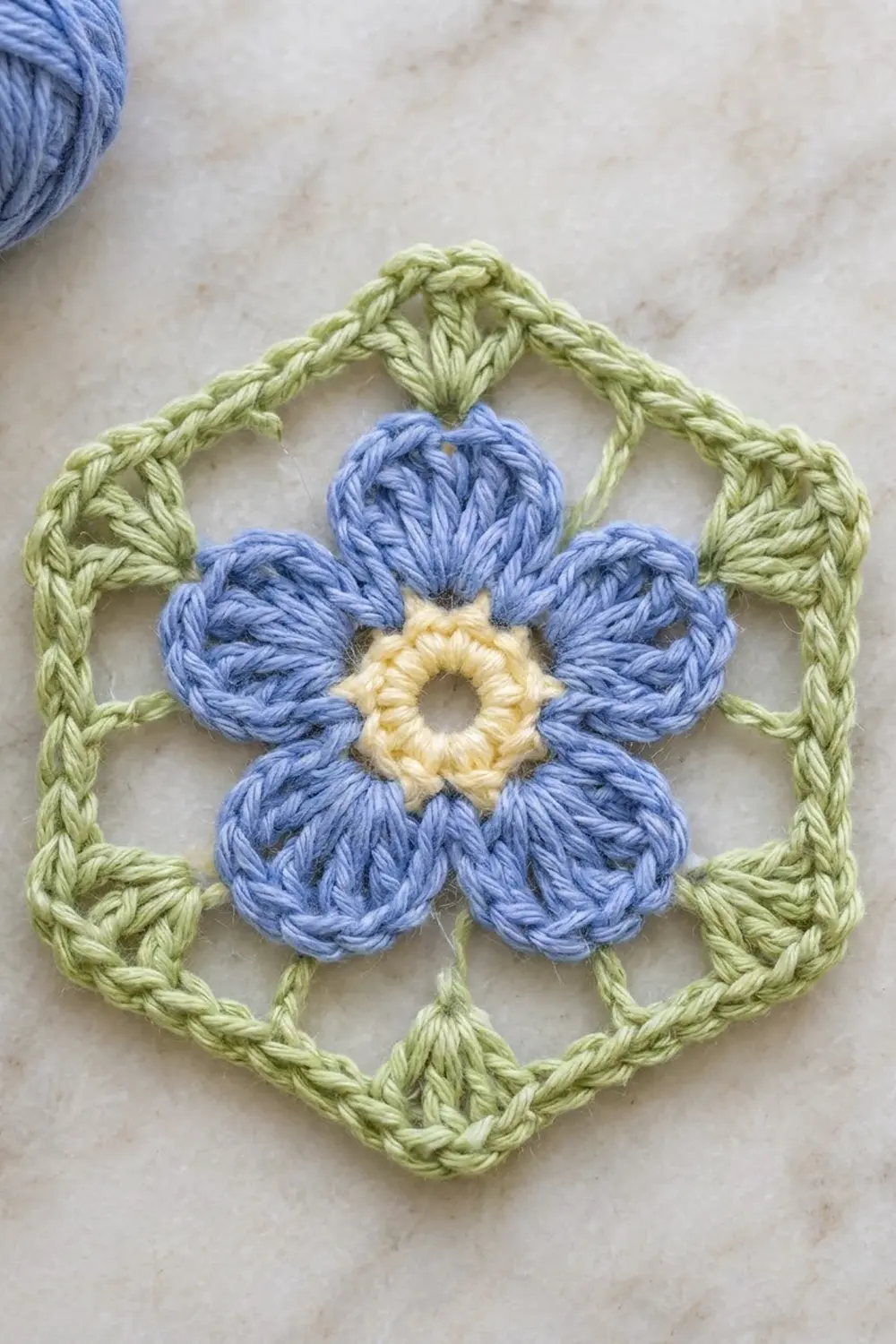
Hexagon Motif (make 168 per panel)
Round 1 (yellow): Ch 5, sl st to the first ch to form a ring. Ch 1, work 15 sc in the ring, sl st to the first sc. Fasten off. (15 sc)
Round 2 (blue): Join blue in any sc. Ch 1, sc in the same st, ch 8, sk 2 sc. Sc in next sc, ch 8, sk 2 sc; repeat from * 3 more times. Sl st to the first sc. (5 sc, 5 ch-8 loops)*
These 5 loops are the open petal outlines. Check: 5 sc worked plus 10 sc skipped equals the 15 sc of Round 1.
Round 3 (blue): (Hdc, 10 dc, hdc) in next ch-8 loop, sl st in next sc; repeat from * 4 more times, working the last sl st into the joining sc. Fasten off. (5 petals of 12 sts = 60 sts; sl sts are not counted)*
Round 4 (green): Join green with sc in the first hdc of any petal. Ch 7, sk next 9 sts, sc in next st; repeat from * 4 more times. Ch 7, sk 9 sts, sl st to the first sc. (6 sc, 6 ch-7 sps)*
Skip the sl sts between petals and don’t count them. Check: 6 sc plus 54 skipped sts equals 60. The 6 sc become the 6 corners, and the ch-7 chords leave open windows around the flower.
Round 5 (green): Ch 3 (counts as dc), then (dc, ch 2, 2 dc) in the same sc for the first corner fan. *Ch 2, 3 dc in next ch-7 sp, ch 2, corner fan in next sc; repeat from * 4 more times. Ch 2, 3 dc in the last ch-7 sp, ch 2, sl st to the top of the beginning ch-3.
Round 5 count: 42 dc (6 fans of 4 dc plus 6 groups of 3 dc), 6 corner ch-2 sps and 12 side ch-2 sps.
Round 6 (green): Sl st in next dc, sl st in corner ch-2 sp. Ch 3 (counts as dc), ch 2, dc in the same sp. Dc in next 2 dc, 2 dc in next ch-2 sp, dc in next 3 dc, 2 dc in next ch-2 sp, dc in next 2 dc, (dc, ch 2, dc) in next corner ch-2 sp. Repeat from * 4 more times, then work from * to ** once more. Sl st to the top of the beginning ch-3. Fasten off. (78 dc, 6 corner ch-2 sps)*
Per side: 1 + 2 + 2 + 3 + 2 + 2 + 1 = 13 dc between corner ch-2 sps. In this pattern, “per side” means these 13 dc only; the corner ch-2 sps are counted separately. Check: 13 dc x 6 sides = 78 dc.
Weave in all ends now, on the wrong side. Then lightly steam or pin each hexagon so the points are sharp before joining.
Make All Pieces
Per panel: 168 hexagons. For a pair: 336 hexagons. Each hexagon uses all three colors (yellow for Round 1, blue for Rounds 2–3, green for Rounds 4–6). For each panel, that means 168 yellow centers, 168 blue flowers and 168 green frames.
Hold each hexagon with its points at the top and bottom and its flat sides at the left and right. Layout (H = hexagon):
Row 1:  H H H H H H H H
Row 2:   H H H H H H H H
Row 3:  H H H H H H H H
Row 4:   H H H H H H H H
...
Row 21: H H H H H H H H
The 11 odd rows sit flush left, and the 10 even rows shift half a hexagon to the right. Row 1 is the top edge.
Joining
Method: Whipstitch through the BLO with green yarn. Place the pieces right side up with the edges butted together flat.
Stitch-to-stitch logic: Every seam joins one 13-dc side to another 13-dc side. Start in the second ch of the corner ch-2 sp. Work 1 wrap through each of the 13 pairs of dc, then end in the first ch of the next corner ch-2 sp. That makes 15 wraps per seam. Never skip a dc or wrap the same one twice.
Order:
- Join the 8 hexagons of each row through their vertical sides: 7 seams per row, 147 seams per panel.
- Join each row to the next along the slanted sides. Each odd-row hexagon meets the even-row hexagons below-left and below-right wherever they exist. That makes 15 seams per pair of rows and 300 seams per panel.
Total: 447 seams per panel.
Tension: Pull each wrap just snug enough to close the gap. Loosen if the seams pucker, and tighten if the edges gap. Lay the work flat every few rows and compare it with the layout grid.
Size checkpoint: After 3 rows, the joined strip should be 38.25 in (97.2 cm) wide and 13 in (33.0 cm) tall: 5.2 in (13.2 cm) for one hexagon’s height plus 2 rows x 3.9 in (9.9 cm), the vertical distance from one row to the next. The full joined panel should measure 38.25 in x 83.2 in (97.2 cm x 211.3 cm).
Border
Border gauge: 5 sc = 1 in (2.5 cm). This matches the dc gauge of the sides, so 13 sc lie flat along a 2.6 in (6.6 cm) side.
The outline is scalloped, so the border follows it. There are three kinds of spots along the edge:
- Exposed side: 13 dc. Work 1 sc in each dc.
- Point: a corner ch-2 sp between two exposed sides of the same hexagon. Work 3 sc in it.
- Valley: the spot where two hexagons meet on the edge. Work sc2tog over the two corner ch-2 sps (1 st).
The panel has 114 exposed sides, 60 points (including the 4 panel corners) and 54 valleys.
Round 1 (green): Join with sc in the first dc after the top-left corner point. Work around the whole panel as described above, with 3 sc in each of the 4 panel corners. Sl st to the first sc.
Stitch counts by edge (corners not included):
- Top edge: 16 sides x 13 = 208 sc, plus 8 points x 3 = 24, plus 7 valleys x 1 = 7. 239 sts.
- Right edge: 41 sides x 13 = 533 sc, plus 20 points x 3 = 60, plus 20 valleys = 20. 613 sts.
- Bottom edge: 239 sts, worked like the top.
- Left edge: 613 sts, worked like the right.
- Corners: 4 x 3 = 12 sts.
Round 1 total: 1,716 sts.
Round 2 (green): Ch 1, sc in each st around. Work 3 sc in the center sc of each 3-sc point group, and work sc3tog centered on each valley st. Sl st to the first sc. Fasten off.
Round 2 count: 1,716 sts worked 1 per st, plus 60 x 2 added at points, minus 54 x 2 removed at valleys = 1,728 sts.
Why the math works: Each exposed side gets exactly its own 13 stitches, with nothing added at the seams, so the border is the same length as the edge. The 3 sc at each point give an outward corner the extra length it needs. The decreases at the valleys remove length an inward corner cannot hold, so the scallops stay flat. The two rounds add about 0.4 in (1.0 cm) all around, bringing the panel to about 39 in x 84 in (99.1 cm x 213.4 cm).
Final Blocking
- Soak the panel in cool water for 15 minutes. Roll it in a towel and press out the water gently; do not wring.
- Lay it flat on a blocking surface, right side up.
- Pin the 4 panel corners to 39 in x 84 in (99.1 cm x 213.4 cm).
- Pin each top and bottom point, spacing them 4.5 in (11.4 cm) apart.
- Pin the side scallops so the edges run straight down the panel.
- Ease each flower open and straighten the green frame sides.
- Let it dry completely, then unpin.
- Clip the 8 rings to the 8 top points and hang.
Final Quality-Control Checklist
- Every hexagon has 78 dc and 6 corner ch-2 sps.
- Every flower has 5 petals of even fullness.
- In every frame, a fan fills each of the 6 corners.
- Rows alternate between flush left and shifted right.
- All 447 seams lie flat with no gaps.
- Border Round 2 has 1,728 sts.
- The panel measures about 39 in x 84 in (99.1 cm x 213.4 cm).
- All ends are woven in and trimmed.
Troubleshooting
- Petals cup: Loosen your dc in Round 3, or go up one hook size for Round 3 only.
- Hexagon looks round: Pull the Round 4 ch-7 chords firm and block the corners to points.
- Sides bow inward: Check that each Round 5 side ch-2 sp got 2 dc in Round 6.
- Panel is too wide: Your hexagons are oversized. Recheck your gauge before making more.
- Border ruffles at the points: Work 2 sc instead of 3 in the center sc of each Round 2 point.
- Border cups at the valleys: Your sc3tog is too tight. Work sc2tog instead.
Care
Hand wash, or machine wash on a gentle cool cycle inside a laundry bag, then lay flat and reshape to dry. Do not tumble dry, which can shrink the cotton and distort the points.
Final Notes
Each measurement builds on the one before. 13 dc per side gives a 2.6 in (6.6 cm) side and a 4.5 in (11.4 cm) hexagon. Eight hexagons plus the half-hexagon offset make the panel 38.25 in (97.2 cm) wide. One hexagon height plus 20 more rows at 3.9 in (9.9 cm) each makes it 83.2 in (211.3 cm) long. The 0.4 in (1.0 cm) border brings the panel to about 39 in x 84 in (99.1 cm x 213.4 cm). Check your first hexagon carefully and the rest will follow.
Happy crocheting!