

These lace curtain panels are built from small square motifs. Each one has a bright orange wheel with twelve spokes, framed by a teal lace setting. When you join the motifs, the teal frames merge into an open grid. Light passes through the arches around each wheel, and the orange wheels show up clearly against the window.
The palette is just two colors: a warm marigold orange and a soft dusty teal. The style is vintage boho with a modern edge. Each wheel has a small open center, twelve cluster spokes and a solid rim. Teal arches and corner posts square the wheel off so it can be joined in straight lines.
This pattern uses US crochet terms. Each finished panel measures 37 in wide x 82 in long (94.0 cm x 208.3 cm) after the border and blocking. The pattern makes a pair of panels.
Construction is simple. You crochet each motif in the round: four orange rounds for the wheel, then two teal rounds that square it off. Next you join the motifs into a grid of 8 x 18 with slip stitch seams. A three-round teal border finishes each panel.
Finished Size and Construction
- Finished size (each panel): 37 x 82 in (94.0 x 208.3 cm)
- Skill level: Intermediate
- Terminology: US
- Yarn weight: DK (light, #3) cotton
- Hook: 4.0 mm (G-6)
- Number of pieces: 288 motifs total, 144 per panel
- Layout per panel: 8 motifs wide x 18 motifs tall
- Motif size: 4.5 in (11.4 cm) square
- Panel size before border: 36 x 81 in (91.4 x 205.7 cm)
- Border depth: 0.5 in (1.3 cm) on each edge
Materials
Choose a smooth DK cotton or cotton blend, ideally mercerized. Mercerized cotton gives crisp spokes and drapes well at a window. It also doesn’t stretch over time the way acrylic can. The quantities below assume about 125 m per 50 g (2.5 m per gram).
- Color A, Marigold Orange: 800 g (2,000 m)
- Color B, Dusty Teal: 900 g (2,250 m)
Both quantities include a margin of about 15% for gauge differences, swatching and weaving in ends. Buy all of each color from one dye lot if you can.
Tools:
– 4.0 mm (G-6) crochet hook
– Tapestry needle
– Stitch markers
– Scissors
– Measuring tape
– Blocking mats or a large clean carpet with towels, plus rust-proof pins
– Spray bottle
– Optional: 10 curtain clip rings per panel for hanging
Abbreviations (US Terms)
- ch – chain
- sl st – slip stitch
- sc – single crochet
- dc – double crochet
- tr – treble crochet
- sp(s) – space(s)
- st(s) – stitch(es)
- BLO – back loop only
- rev sc – reverse single crochet (crab stitch): sc worked from left to right
- RS / WS – right side / wrong side
- rep – repeat
Special stitches
- Cluster (CL): *Yarn over twice, insert hook in the stitch, yarn over and pull up a loop, [yarn over, pull through 2 loops] twice; rep from * once more in the same stitch. Yarn over and pull through all 3 loops on the hook.
- Beginning cluster (beg CL): Ch 3. Then work one leg of a cluster in the same stitch, leaving 2 loops on the hook. Yarn over and pull through both loops.
Gauge and Checkpoints
Make one full motif before you start on the rest. Block it lightly, then measure.
- After Round 1: the ring measures 1 in (2.5 cm) across.
- After Round 2: the spokes measure 2.75 in (7.0 cm) from tip to tip.
- After Round 4: the wheel measures 3.5 in (8.9 cm) across.
- After Round 6: the square measures 4.5 in (11.4 cm) on each side, with 20 sc per side.
The whole design depends on this last number, 20 sc in 4.5 in (11.4 cm), which works out to about 4.44 sc per inch.
Motif too big: Go down to a 3.75 mm hook.
Motif too small: Go up to a 4.5 mm hook.
Your motif should be within 1/4 in (0.6 cm) of 4.5 in (11.4 cm). If it’s off by 1/4 in (0.6 cm), the error builds to 2 in (5.1 cm) across 8 motifs. Check the size again every 20 motifs or so, because tension often changes as you settle into the pattern.
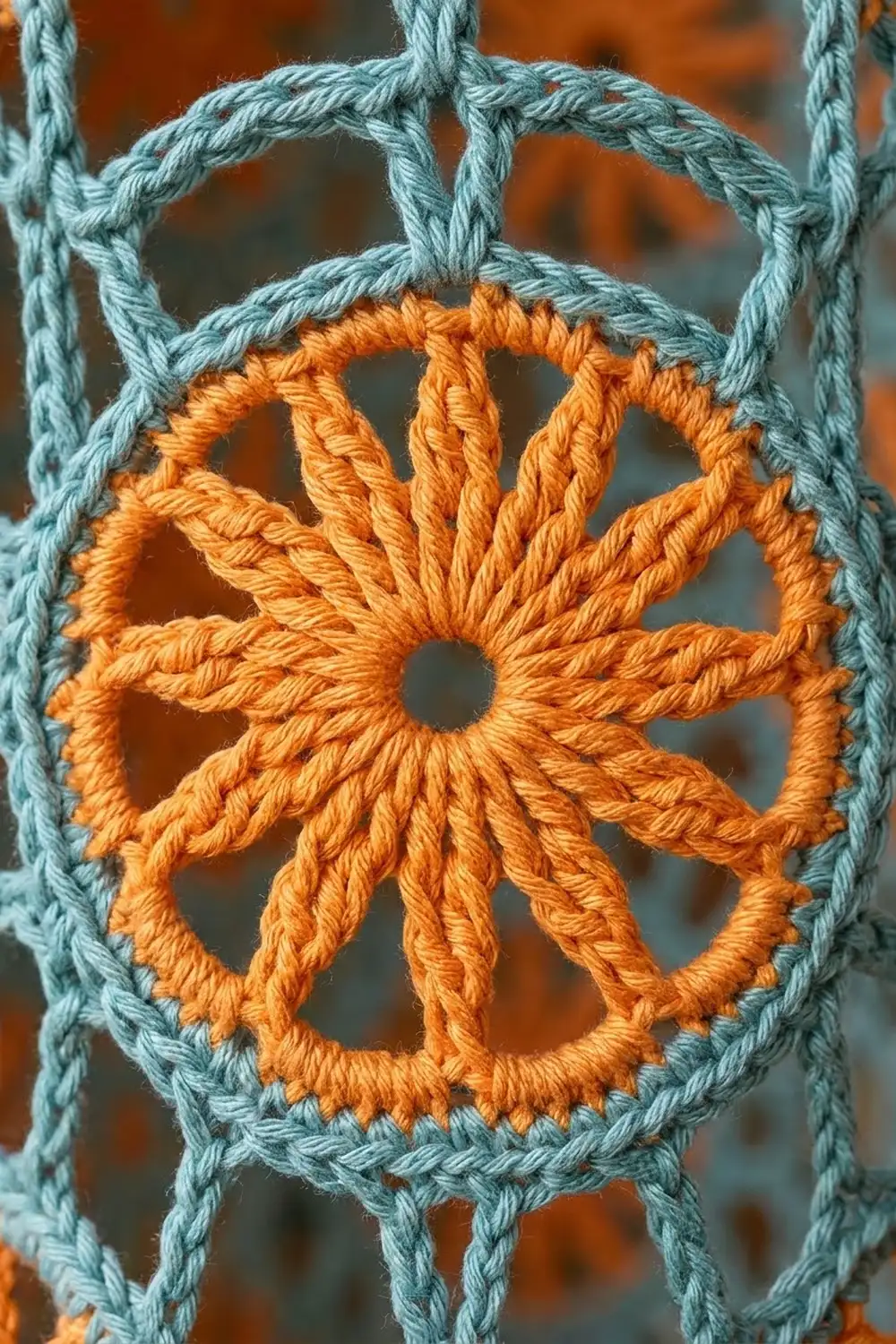
Motif (make 288)
Wheel (Color A, Marigold Orange)
Round 1: Ch 6, sl st to the first ch to form a ring. Ch 1, then work 24 sc in the ring. Sl st to the first sc. (24 sc)
Round 2 (spokes): Beg CL in the same st, ch 3, skip next sc. CL in next sc, ch 3, skip next sc; rep from * 10 more times. Sl st to the top of the beg CL. (12 CL, 12 ch-3 sps)*
Round 3: Ch 1. Sc in the top of the CL, 4 sc in the next ch-3 sp; rep from * around. Sl st to the first sc. (12 x 5 = 60 sc)*
Round 4: Ch 1, sc in each st around. Sl st to the first sc. (60 sc) Fasten off Color A.
This round firms up the rim so the wheel keeps its round shape inside the lace frame.
Square Frame (Color B, Dusty Teal)
Round 5: Join Color B with a sl st in any sc. Ch 7 (counts as tr + ch 3), tr in the same st. This makes the first corner.
*Ch 3, skip 2 sts, dc in next st, ch 3, skip 3 sts, sc in each of next 2 sts, ch 3, skip 3 sts, dc in next st, ch 3, skip 2 sts, (tr, ch 3, tr) in next st; rep from * 2 more times.
Ch 3, skip 2 sts, dc in next st, ch 3, skip 3 sts, sc in each of next 2 sts, ch 3, skip 3 sts, dc in next st, ch 3, skip the last 2 sts. Sl st to the 4th ch of the beg ch-7.
(8 tr, 8 dc, 8 sc, 4 corner ch-3 sps, 16 side ch-3 sps)
Check the math: Each quarter uses 1 corner st + 14 side sts (2 + 1 + 3 + 2 + 3 + 1 + 2) = 15 sts, and 4 x 15 = 60. The two sc sit at the middle of each side. The dc and tr get taller toward the corners, which pushes the circle out into a square and leaves open arches between the wheel and the frame.
Round 6: Sl st into the corner ch-3 sp. Ch 1, (sc, ch 2, sc) in the same sp.
Along the side: sc in the tr, 3 sc in the next ch-3 sp, sc in the dc, 3 sc in the next ch-3 sp, sc in each of the next 2 sc, 3 sc in the next ch-3 sp, sc in the dc, 3 sc in the next ch-3 sp, sc in the tr. (18 sc)* Then (sc, ch 2, sc) in the corner sp.
Rep from * around, leaving out the last corner group, which you already made at the start. Sl st to the first sc and fasten off.
(80 sc and 4 corner ch-2 sps)
Stitches per side: Each side has 20 sc: 1 corner sc + 18 side sc + 1 corner sc. The corner ch-2 sps are not counted as stitches. Total: 4 x 20 = 80 sc. ✓
Weave in all ends on the WS as you go, so they don’t pile up at the end.
Make All Pieces
- Panel 1: 144 motifs
- Panel 2: 144 motifs
- Total: 288 motifs (Color A wheels, Color B frames)
Every motif is the same, so the layout only needs to keep the RS facing up. Each panel is arranged like this (M = motif):
Col:  1  2  3  4  5  6  7  8
R1    M  M  M  M  M  M  M  M   <- top edge
R2    M  M  M  M  M  M  M  M
...   (rows 3 to 17 repeat)
R18   M  M  M  M  M  M  M  M   <- bottom edge
That’s 8 columns x 18 rows = 144 motifs, or 36 x 81 in (91.4 x 205.7 cm).
Joining
Method: Slip stitch seam through the back loops, with Color B.
- Join each column first. Place two motifs RS together with the edges lined up.
- Using Color B, sl st through both corner ch-2 sps. Then sl st through the BLO of each matching pair of sc, corner sc to corner sc. That’s 20 sl sts, one for each of the 20 sc on each side.
- Sl st through the next pair of corner ch-2 sps. Without fastening off, line up the next motif and keep going until you’ve joined 18 motifs into a column.
- Make 8 columns. Join the columns along their long edges the same way. Each long seam has 18 x 20 = 360 stitch pairs, plus a sl st through each pair of corner ch-2 sps where motifs meet.
Stitch-to-stitch logic: Each seam pairs 20 stitches with 20 stitches. No stitches are added or skipped, so the grid stays square and the seams don’t widen the panel.
Tension: Make your sl sts loose, about as tall as one sc is wide. If you slip stitch tightly, the seams pucker and the panel narrows. If you tend to pull tight, go up to a 4.5 mm hook just for joining.
Size check: Measure after joining one column. It should be 81 in (205.7 cm) long. Two joined columns should be 9 in (22.9 cm) wide. If you’re more than 1 in (2.5 cm) off on the column length, loosen or tighten your seams before you go on.
Border
Border gauge: 4.44 sc per inch, the same gauge as the motif edges.
Starting counts along the panel edges:
– Top and bottom: 8 motifs x 20 sc = 160 sc
– Long sides: 18 motifs x 20 sc = 360 sc
At the seams along the outer edges, skip both ch-2 sps. You don’t work into them. The only ch-2 sps you work into are the 4 outer corners of the panel.
Round 1: With RS facing, join Color B in any outer corner ch-2 sp. Ch 1, (sc, ch 2, sc) in the same sp. Sc in each sc along the edge, and work (sc, ch 2, sc) in each outer corner sp. Sl st to the first sc.
– Top and bottom: 160 + 2 corner sc = 162 sc
– Long sides: 360 + 2 corner sc = 362 sc
– Total: 1,048 sc
Round 2: Sl st into the corner sp. Ch 1, (sc, ch 2, sc) in the same sp. Sc in each sc, with (sc, ch 2, sc) in each corner sp. Sl st to the first sc.
– Top and bottom: 162 + 2 = 164 sc
– Long sides: 362 + 2 = 364 sc
– Total: 1,056 sc
Round 3 (crab stitch): Ch 1. Rev sc in each sc, with (rev sc, ch 1, rev sc) in each corner sp. Sl st to the first st and fasten off.
– Top and bottom: 164 + 2 = 166 sts
– Long sides: 364 + 2 = 366 sts
– Total: 1,064 sts
Why the math works: The border starts with exactly 20 sc for every 4.5 in (11.4 cm), the same density as the motifs. So the edges won’t ruffle or draw in. You only add stitches at the 4 corners, 2 per corner in each round, and that’s just enough to turn the corner flat. The three rounds add 0.5 in (1.3 cm) on each edge. The panel grows from 36 x 81 in (91.4 x 205.7 cm) to 37 x 82 in (94.0 x 208.3 cm).
Final Blocking
- Lay the panel out flat with the RS up. Because it’s so long, you may need to block it in two halves.
- Pin the 4 corners first, to 37 x 82 in (94.0 x 208.3 cm) overall.
- Pin the outer edge every 4.5 in (11.4 cm), at each seam, so every motif lines up square.
- Gently stretch each wheel round and pin the spoke tips if they lean.
- Mist the panel until damp, but not soaked.
- Leave it until it’s completely dry, at least 24 hours.
- Unpin and measure. Repeat for the second panel, and match its measurements to the first.
Final Quality-Control Checklist
- Every motif has 12 spokes and a 60-sc rim.
- Every motif side has 20 sc.
- All seams are flat, with no puckering at the intersections.
- Each panel has exactly 8 x 18 motifs.
- Border counts: 166 sts on the top and bottom, 366 on each long side.
- Each panel measures 37 x 82 in (94.0 x 208.3 cm).
- Both panels match in length to within 1 in (2.5 cm).
- All ends are woven in securely on the WS.
Troubleshooting
- Wheel cups: You worked the Round 3 sc too tightly. Add a fifth sc in each ch-3 sp, then skip one sc in Round 4 to get back to 60.
- Wheel ruffles: Your clusters are too tall. Pull the yarn-overs snug, or go down a hook size for Round 2 only.
- Frame isn’t square: Your corner tr sts are too short. Make sure to yarn over twice.
- Wrong count in Round 6: Count each side between the corner sps. You need 18 sc there, plus 1 corner sc at each end.
- Seams pucker: Rework them with looser sl sts or a bigger hook.
- Border waves: You’ve added stitches along the sides. Recount for 162/362 after Round 1.
- Panels differ in length: Block the shorter panel to match. Cotton will stretch to fill a gap of up to 1 in (2.5 cm).
Care
Hand wash cool or machine wash on a gentle cycle in a mesh laundry bag, then lay flat to dry. Re-block lightly so the wheels stay round.
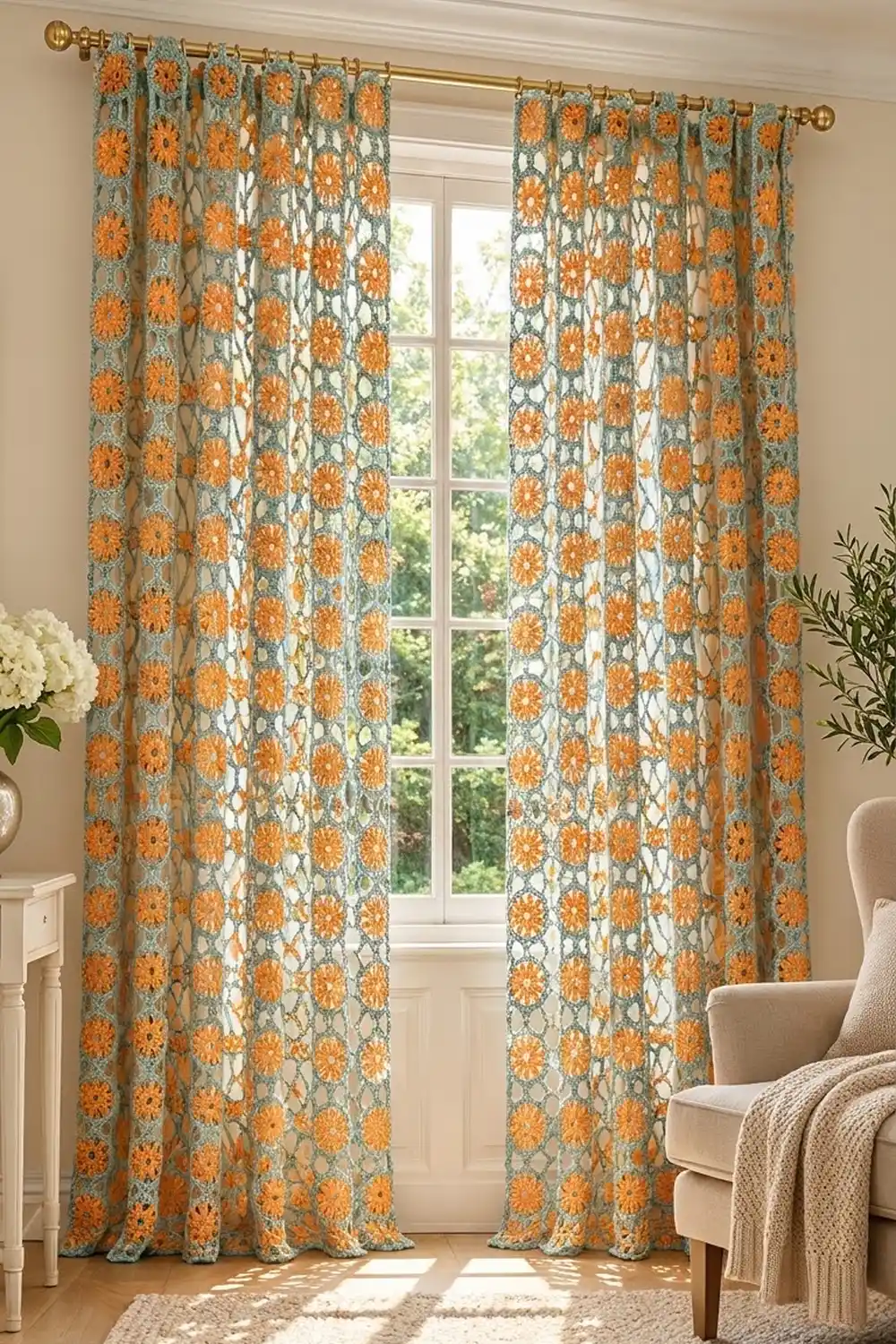
Final Notes
The measurement chain is short and easy to check. The wheel is 3.5 in (8.9 cm) across. The squared motif is 4.5 in (11.4 cm) with 20 sc per side. Each panel is 8 x 18 motifs and measures 36 x 81 in (91.4 x 205.7 cm) before the border. The three-round border brings it to 37 x 82 in (94.0 x 208.3 cm). If your first motif hits 4.5 in (11.4 cm), everything after that will fit.
Happy crocheting!