
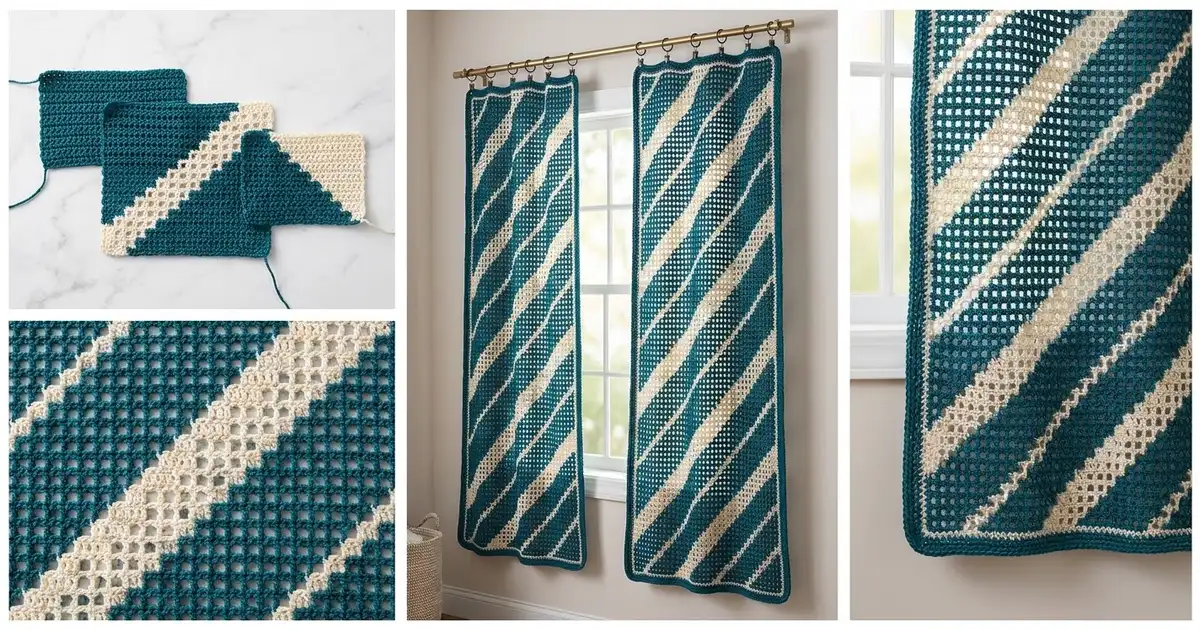
This curtain panel pairs a deep teal filet mesh with cream stairstep stripes. Daylight passes through the open squares, and the cream bars run diagonally down the full length of the panel. It works well as a window treatment for a living room, bedroom or sunroom.
The design uses two colors: teal for the open mesh, the edge posts and the border, and cream for the solid blocks. Each cream bar is 4 squares wide and moves 2 squares sideways every row. That gives the stepped diagonal look without any complicated shaping.
The pattern uses US crochet terms. One finished panel measures 37 x 80 in (94.0 x 203.2 cm), including the border. The photo shows a pair, so make two identical panels. They are hung side by side and are never joined.
Each panel is worked flat in one piece, row by row, from the bottom up. You start with a solid teal foundation row and work 156 rows of colorwork mesh. You finish with a solid teal top row, then add a 3-round teal border that ends in reverse single crochet.
Finished Size and Construction
- Finished size (one panel): 37 x 80 in (94.0 x 203.2 cm)
- Skill level: Intermediate
- Terminology: US
- Yarn weight: DK (3), cotton
- Hook: 4.0 mm (G-6)
- Number of pieces: 1 per panel, worked in one piece. The pair shown is 2 identical panels that are not joined.
- Layout: 72 squares wide x 158 rows tall
- Square size: 0.5 x 0.5 in (1.3 x 1.3 cm)
- Size before border: 36 x 79 in (91.4 x 200.7 cm)
- Border depth: 0.5 in (1.3 cm) on every edge, 3 rounds
Materials
Yarn: Use a smooth, combed or mercerized DK cotton of about 230 m per 100 g. Cotton gives crisp squares, blocks well and hangs straight without stretching too much. Avoid fuzzy or very elastic yarns, because they blur the mesh.
For one panel:
– Teal (main color): 500 g, about 1,150 m
– Cream (contrast color): 360 g, about 830 m
For the pair:
– Teal: 1,000 g, about 2,300 m
– Cream: 720 g, about 1,660 m
All quantities include a margin of about 15% for the gauge swatch, tails and small differences in tension.
Tools:
– 4.0 mm (G-6) crochet hook
– 7 yarn bobbins or small yarn butterflies for the cream
– Stitch markers
– Tapestry needle
– Scissors
– Tape measure
– Rust-proof blocking pins and a spray bottle
– 12 curtain clip rings per panel, for hanging
Abbreviations (US Terms)
- ch – chain
- sl st – slip stitch
- sc – single crochet
- dc – double crochet
- rev sc – reverse single crochet (crab stitch)
- sk – skip
- sp – space
- st(s) – stitch(es)
- bl – block
- RS / WS – right side / wrong side
- rep – repeat
Special stitches:
- Space (sp): The way you work it depends on what is below:
- Over a block: ch 2, sk 2 dc, dc in next dc.
- Over a space: ch 2, dc in next dc.
- Block (bl): The way you work it depends on what is below:
- Over a block: dc in each of next 3 dc.
- Over a space: 2 dc in ch-2 sp, dc in next dc.
- Square count: Each square is 3 sts. The ch-3 at the start of each row counts as the first dc. A full row is therefore 1 + (72 x 3) = 217 sts.
- Carrying yarn: Lay the unused strand along the tops of the stitches below and work over it, so the new stitches enclose it.
Gauge and Checkpoints
Gauge: 12 squares (37 sts) and 12 rows = 6 x 6 in (15.2 x 15.2 cm) in the filet pattern after blocking. One square is 0.5 in (1.3 cm) wide and 0.5 in (1.3 cm) tall.
Work a test piece first.
- With teal, ch 39.
- Row 1: dc in 4th ch from hook and in each ch across. You now have 37 sts (12 blocks).
- Work Rows 2–7 of the Color Plan below twice, using one 12-square repeat.
- Block the swatch, then measure the 12 pattern rows.
Use the swatch to check two things: the squares should come out square, and the carried strands should not show.
- If the swatch is too big: go down to a 3.75 mm hook.
- If it is too small: go up to a 4.5 mm hook.
- If the width is right but the rows are short: pull up the first loop of each dc slightly taller, rather than changing hooks.
Checkpoints for the panel (measured flat, unblocked, within about 0.5 in / 1.3 cm):
| After row | Width | Height |
|---|---|---|
| Row 1 | 36 in (91.4 cm) | – |
| Row 25 | – | 12.5 in (31.8 cm) |
| Row 61 | – | 30.5 in (77.5 cm) |
| Row 121 | – | 60.5 in (153.7 cm) |
| Row 158 | 36 in (91.4 cm) | 79 in (200.7 cm) |
Color Plan (12-Square Repeat)
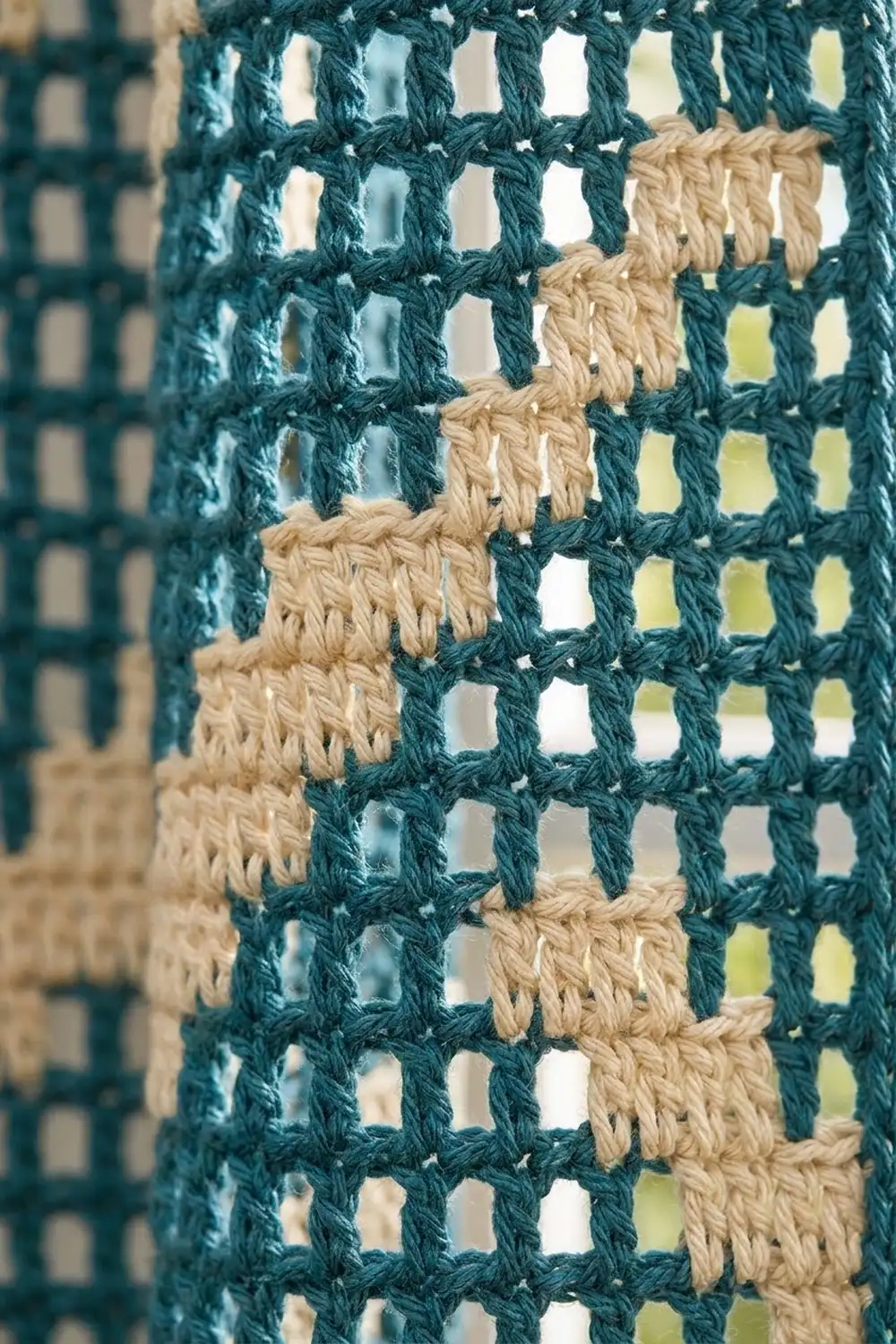
Number the squares in each repeat 1 to 12, reading from right to left with the RS facing. Each row, the cream bar of 4 squares moves 2 squares to the left.
- Row A: cream squares 1–4
- Row B: cream squares 3–6
- Row C: cream squares 5–8
- Row D: cream squares 7–10
- Row E: cream squares 9–12
- Row F: cream squares 11–12, plus squares 1–2 of the next repeat
How the yarns travel:
- Teal is a continuous strand. It is always carried inside the cream blocks, so it reaches every row end without being cut.
- Cream uses one bobbin per bar. No more than 7 bobbins are in use at once, in Row F.
- On RS rows: pick up each bobbin 2 squares before its bar and carry it across those 2 squares. It lies on top of the cream blocks below, so it blends in. Work the 4 blocks, then carry the bobbin across the next 2 teal spaces. On the following WS row, those 2 spaces become cream blocks, which hide the strand completely.
- On WS rows: each bobbin is already waiting at the start of its bar, so no carrying is needed.
Panel Instructions
Foundation: With teal, ch 219.
Row 1 (WS): Dc in 4th ch from hook (the skipped 3 ch count as the first dc) and in each ch across. Turn.
Count: 217 sts, 72 blocks, all teal.
Mark the next row as the RS.
Row 2 (RS, Row A): Ch 3. [4 bl in cream, 8 sp in teal]; rep from * 5 more times. Turn.
– Join a new cream bobbin at the start of each of the 6 bars.
– After each bar, carry the cream across the next 2 spaces.
– Count: 217 sts, 24 bl, 48 sp.*
Row 3 (WS, Row B): Ch 3. [6 sp, 4 bl, 2 sp]; rep from * 5 more times. Turn.
– Count: 217 sts, 24 bl, 48 sp.*
Row 4 (RS, Row C): Ch 3. [4 sp, 4 bl, 4 sp]; rep from * 5 more times. Turn.
– Carry each bobbin 2 squares before its bar and 2 squares after it.
– Count: 217 sts, 24 bl, 48 sp.*
Row 5 (WS, Row D): Ch 3. [2 sp, 4 bl, 6 sp]; rep from * 5 more times. Turn.
– Count: 217 sts, 24 bl, 48 sp.*
Row 6 (RS, Row E): Ch 3. [8 sp, 4 bl]; rep from * 5 more times. Turn.
– Carry each bobbin 2 squares before its bar.
– After each bar, carry 2 squares, except after the last bar, which ends at the left edge.
– Count: 217 sts, 24 bl, 48 sp.*
Row 7 (WS, Row F): Ch 3. [2 bl, 8 sp, 2 bl]; rep from * 5 more times. Turn.
– The 2 blocks at the end of one repeat and the 2 blocks at the start of the next form a single 4-square bar.
– Join a new cream bobbin for the last 2 blocks of the row, at the right edge.
– After this row, cut the bobbin that worked the 2 left-edge blocks, leaving a 6 in (15.2 cm) tail.
– Count: 217 sts, 24 bl, 48 sp.*
Rows 8–157: Rep Rows 2–7 another 25 times, for 26 repeats in total.
– From now on, the Row A bar that starts at the right edge needs no carry before it.
– Every other bar is carried 2 squares before its blocks.
– Check your progress against the measurement checkpoints as you go.
At the end of Row 157, cut every cream bobbin, leaving 6 in (15.2 cm) tails.
Row 158 (RS): With teal, ch 3, then work 72 bl across. Do not fasten off.
Count: 217 sts, 72 blocks, all teal.
Weave in all the cream tails now, inside cream blocks of the same color.
Border
Border gauge: 6 sc = 1 in (2.5 cm) along every edge.
- Top and bottom edges: 217 sc. The 216 sts that make up the 72 squares measure 36 in (91.4 cm), and the extra stitch is the edge post.
- Long sides: 3 sc for each 0.5 in (1.3 cm) dc row-end. That is 3 x 158 = 474 sc, which measures 79 in (200.7 cm).
Because both directions use the same 6 sc per inch, the edges lie flat without ruffling or cupping.
Rnd 1: Continue in teal with the RS facing. Ch 1 and turn the work to go down the left side.
1. Work 3 sc in each row-end down the left side (474 sc), then ch 1.
2. Sc in the base of each Row 1 stitch along the bottom (217 sc), then ch 1.
3. Work 3 sc in each row-end up the right side (474 sc), then ch 1.
4. Sc in each st across Row 158 (217 sc), then ch 1.
5. Sl st to the first sc.
Count: 1,382 sc plus 4 corner ch-1 sps.
Rnd 2: Ch 1. Sc in each sc around, and work (sc, ch 1, sc) in each corner sp. Sl st to the first sc.
Count: 476 sc on each long side and 219 sc on each short side, for 1,390 sc plus 4 corner ch-1 sps.
Rnd 3: Ch 1. Working from left to right, rev sc in each sc and 2 rev sc in each corner sp. Sl st to the first st and fasten off.
Count: 1,390 rev sc plus 8 corner rev sc = 1,398 sts.
These 3 rounds add 0.5 in (1.3 cm) on each edge. That brings the panel from 36 x 79 in (91.4 x 200.7 cm) to 37 x 80 in (94.0 x 203.2 cm).
Final Blocking
- Weave in all remaining tails along the teal posts or inside the border.
- Soak the panel in cool water with a little wool wash for 15 minutes.
- Press out the water gently in towels. Do not wring.
- Lay the panel flat on blocking mats or a clean sheet on the floor.
- Pin the corners to 37 x 80 in (94.0 x 203.2 cm).
- Pin the long edges about every 4 in (10.2 cm), keeping the border straight.
- Check that the squares are square, and that the diagonal stripes run in straight lines.
- Let the panel dry completely before you unpin it.
- Clip the rings evenly across the top border, with one ring at each corner.
Final Quality-Control Checklist
- [ ] Every row has 217 sts, or 72 squares.
- [ ] Each row has 24 cream blocks and 48 teal spaces.
- [ ] The cream bars move 2 squares per row, always in the same direction.
- [ ] No carried cream shows through any teal space.
- [ ] Teal does not peek through the cream blocks enough to break the color.
- [ ] The edge posts are teal on both sides.
- [ ] The border counts are 219 / 476 sc in Rnd 2 and 1,398 sts in Rnd 3.
- [ ] The panel measures 37 x 80 in (94.0 x 203.2 cm).
- [ ] For a pair, both panels match to within 0.5 in (1.3 cm).
Troubleshooting
- The squares are taller than they are wide: Go down a hook size, or work your dc stitches a little shorter.
- The panel is narrowing: You may be missing the final dc into the turning ch-3. Count to 217 at the end of every row.
- A cream strand shows inside an open space: That strand was probably carried on a WS row. Unpick it and carry it only on RS rows, as the Color Plan describes.
- The bobbins tangle: Turn the work clockwise on one row and counterclockwise on the next. Untwist the bobbins every few rows.
- The border ruffles: Use 2 sc per row-end on a few rows, spread evenly along the side. Re-count so the side total stays as close to 474 as possible.
- The border pulls in: Work Rnd 2 with a 4.5 mm hook.
Care
Hand wash in cool water, or machine wash on a gentle cycle inside a large mesh bag. Lay flat to dry and reshape while damp. Do not hang it wet, because the weight of the water will stretch the panel.
Final Notes
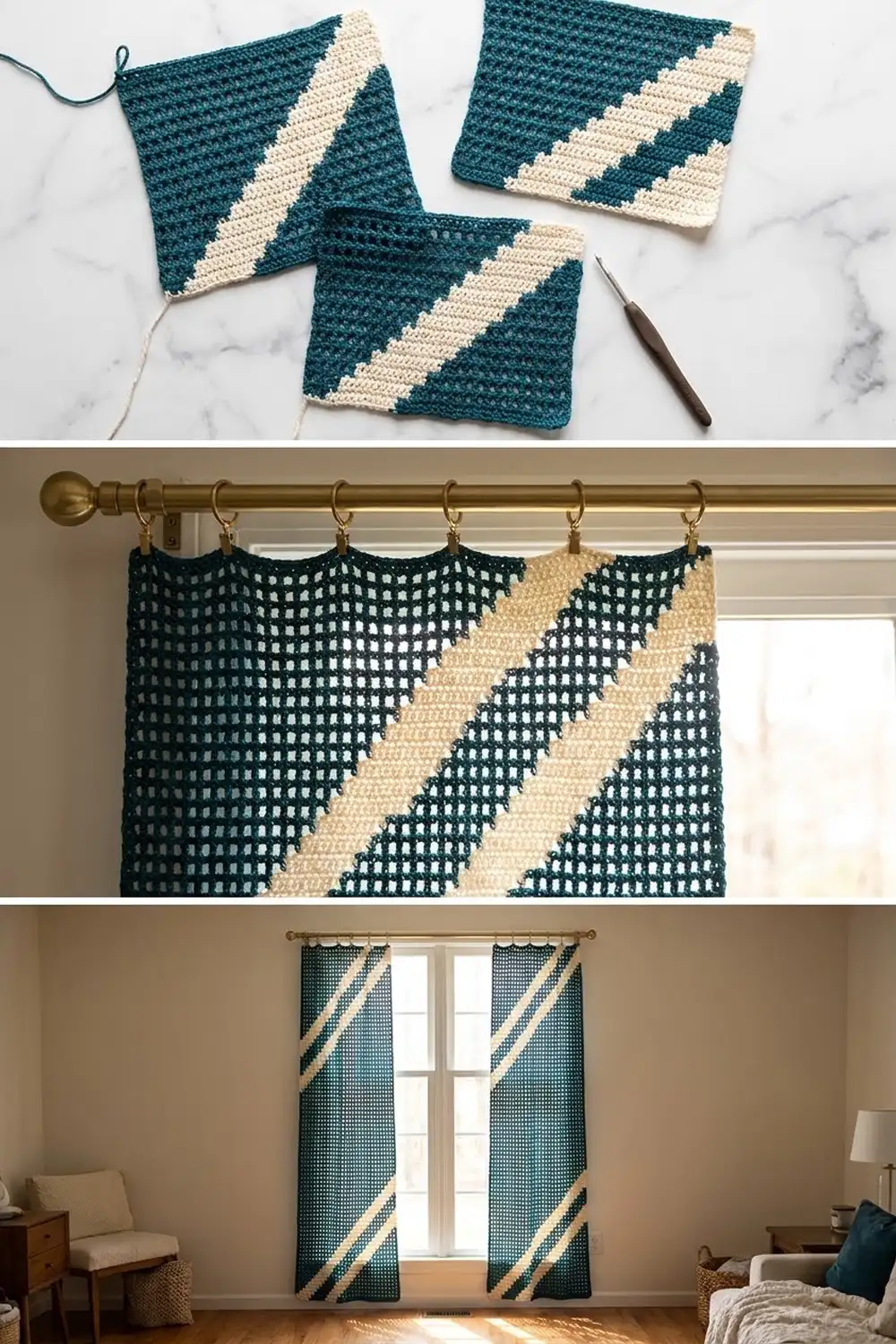
The measurements are linked from start to finish, and each one sets up the next:
- A square of 0.5 in (1.3 cm), made from 3 sts, gives 72 squares = 36 in (91.4 cm) across.
- 158 rows give 79 in (200.7 cm) of length.
- The 6 sc per inch border fits both directions, so the edges stay flat.
- Three border rounds add 0.5 in (1.3 cm) on each edge, for a finished panel of 37 x 80 in (94.0 x 203.2 cm).
If your test piece matches the gauge, the panel follows. Make two for a pair, and enjoy the light coming through the mesh.
Happy crocheting!