

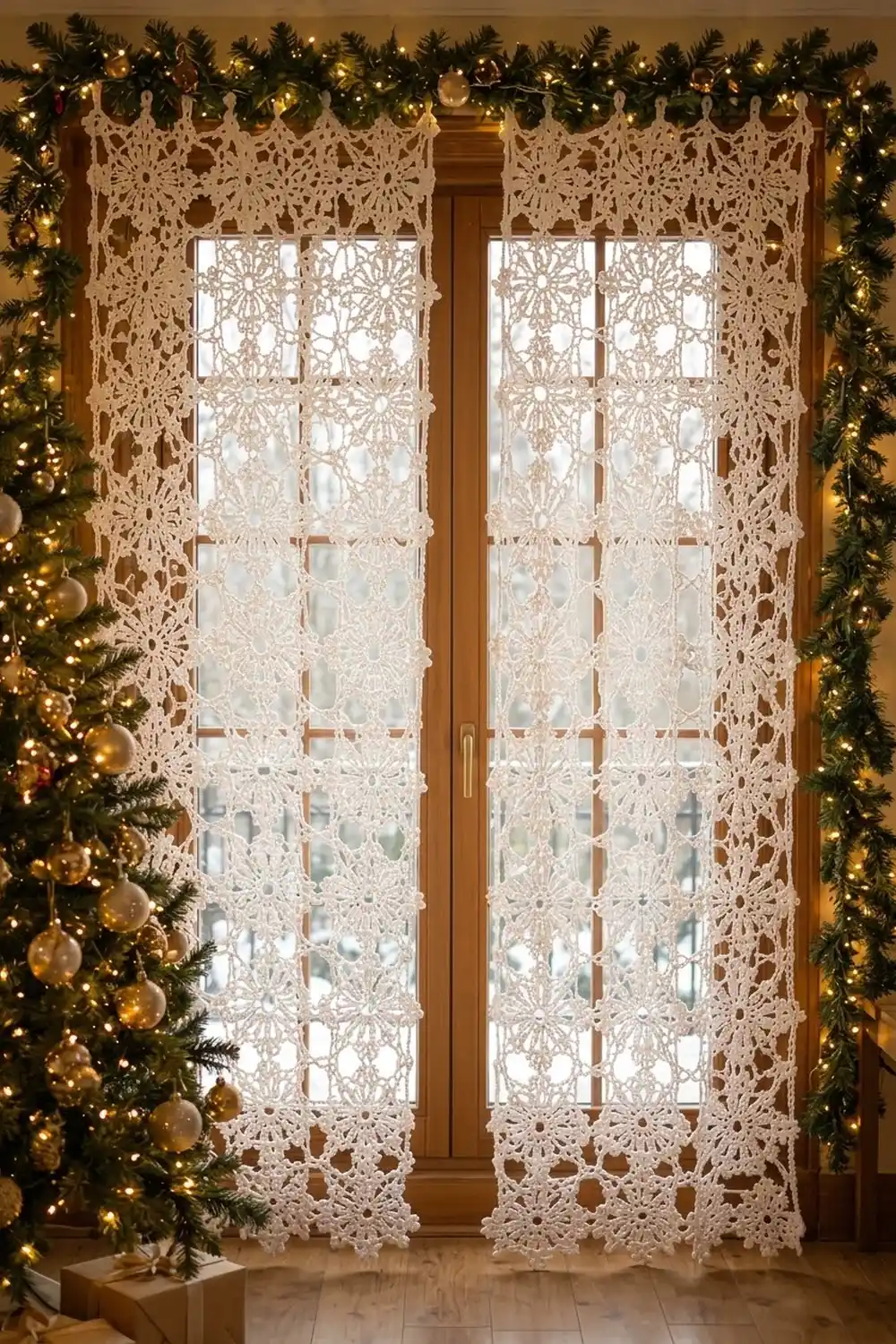
These curtains turn a pair of glass French doors into a soft wall of lace. Each panel is made from large round doily motifs joined into a neat grid. Light coming through the glass shows off every spoke, petal and open loop.
The pair is worked in one cream or off-white cotton. The look is classic doily lace with a wintry, snowflake feel. They suit a door frame trimmed with holiday garland and ornaments, but they work all year.
This pattern uses US crochet terms. Each finished panel measures 24 in wide x 61 in tall (61.0 x 154.9 cm). That includes a 1 in (2.5 cm) scalloped top edging.
You make 10 round motifs per panel, each 12 in (30.5 cm) across. They are joined as you go on their last round, in a grid 2 motifs wide and 5 motifs tall. A two-row shell edging across the top gives each panel a scalloped finish.
Finished Size and Construction
- Finished size (each panel): 24 x 61 in (61.0 x 154.9 cm)
- Skill level: Intermediate
- Terminology: US
- Yarn weight: DK / light worsted (#3) cotton
- Hook: 4.0 mm (G-6)
- Number of pieces: 2 panels, 10 motifs each (20 motifs total)
- Layout per panel: 2 motifs wide x 5 motifs tall
- Motif size: 12 in (30.5 cm) across, blocked
- Size before border: 24 x 60 in (61.0 x 152.4 cm)
- Border depth: 1 in (2.5 cm), top edge only
Materials
Choose a smooth mercerized cotton or cotton blend. It shows stitches clearly, blocks crisply and sags less than acrylic when hanging. Avoid fuzzy or textured yarns, because they blur the open loops.
- Cream (one color): 650 g, about 1,495 m (1,635 yd) of DK cotton. That is roughly 13 balls of 50 g / 115 m (126 yd).
Each motif uses about 28 g and each top edging about 10 g, for 580 g in total. The quantity above includes a margin of about 12% for swatching and tension differences. Buy all the yarn from one dye lot.
Tools:
– 4.0 mm (G-6) crochet hook, plus 3.75 mm and 4.5 mm hooks in case you need to adjust gauge
– Tapestry needle
– Stitch markers
– Blocking mats and rustproof pins
– Spray bottle
– Tape measure
– 12 curtain clip rings (6 per panel) for hanging
Abbreviations (US Terms)
- ch – chain
- sl st – slip stitch
- sc – single crochet
- dc – double crochet
- tr – treble crochet
- sp – space
- st(s) – stitch(es)
- rep – repeat
Special stitches:
– V-shell: (2 dc, ch 2, 2 dc) in the same space.
– Tr-shell: (3 tr, ch 3, 3 tr) in the same space.
– Petal: (5 dc, ch 3, 5 dc) in the same ch-loop.
– Joining loop: ch 4, sl st into the matching ch-9 loop of the finished motif next to it, ch 4. This takes the place of one ch-9 loop and is the same length.
– Edging shell: 5 dc in the same stitch.
Gauge and Checkpoints
Make one complete motif and block it before you start the rest. Every measurement in the curtain comes from this one piece.
- After Round 4: 4 in (10.2 cm) across
- After Round 7: 8 in (20.3 cm) across
- After Round 10, blocked: 12 in (30.5 cm) across
- Edging gauge: 4.5 sc per 1 in (2.5 cm) along Row 1
If Round 4 measures more than 4.25 in (10.8 cm), switch to a 3.75 mm hook. If it measures less than 3.75 in (9.5 cm), switch to a 4.5 mm hook. Measure again at Round 7 before you finish the motif.
Small errors add up fast. With five motifs stacked, being off by 0.5 in (1.3 cm) per motif makes the panel 2.5 in (6.4 cm) too long or short.
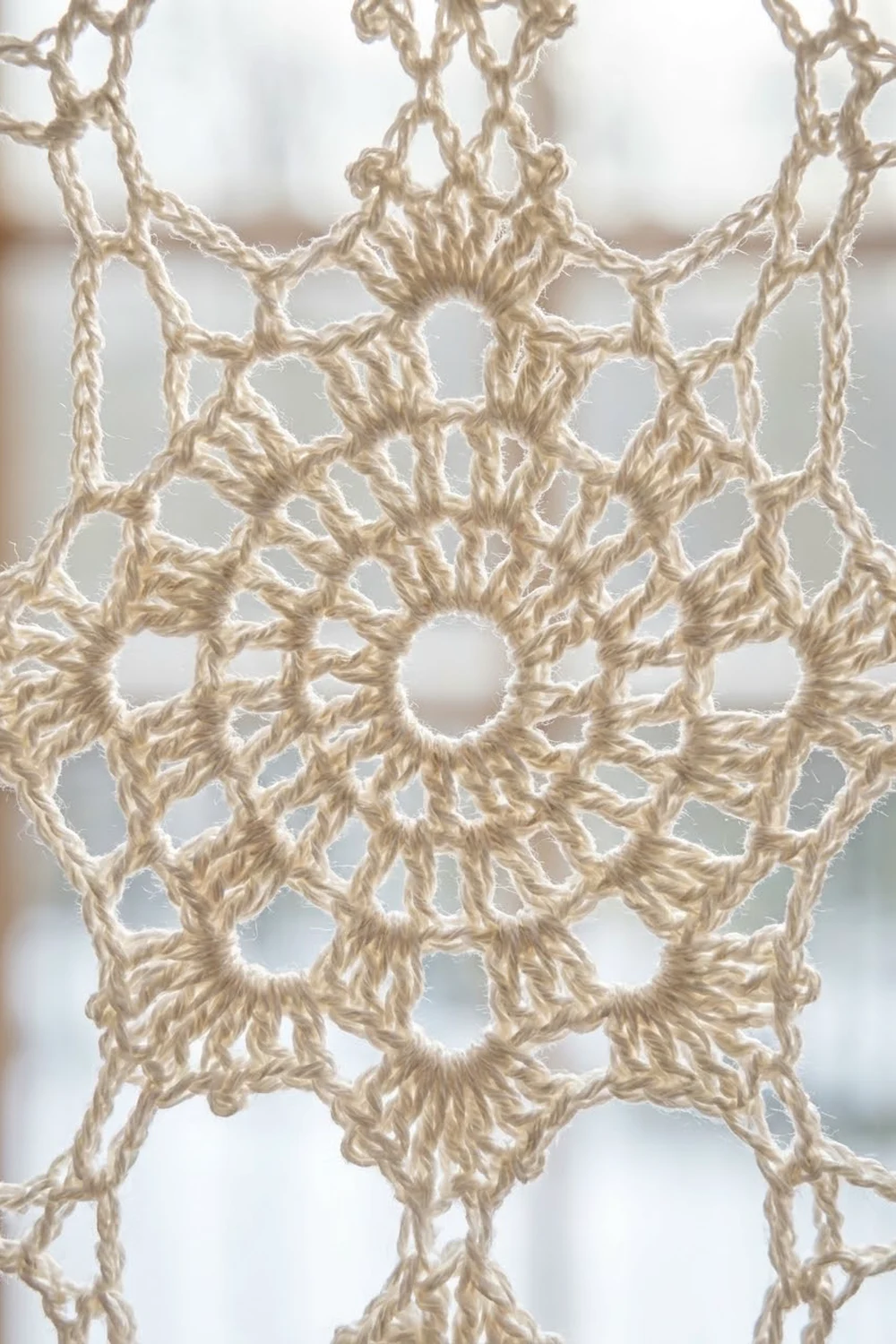
Motif (Make 20)
Make a magic ring.
Round 1: Ch 3 (counts as dc throughout), 11 dc in ring, sl st to top of ch-3. (12 dc)
Round 2: Ch 3, dc in same st, ch 2, 2 dc in next dc, ch 2; rep from * 10 more times, sl st to top of ch-3. (24 dc, 12 ch-2 sps)*
Round 3: Sl st in next dc and into ch-2 sp, ch 3, (dc, ch 2, 2 dc) in same sp, ch 1, V-shell in next ch-2 sp, ch 1; rep from * 10 more times, sl st to top of ch-3. (12 V-shells: 48 dc, 12 ch-2 sps, 12 ch-1 sps)*
Round 4: Sl st in next dc and into ch-2 sp, ch 4 (counts as tr), (2 tr, ch 3, 3 tr) in same sp, ch 2, sc in next ch-1 sp, ch 2, tr-shell in next V-shell ch-2 sp, ch 2, sc in next ch-1 sp, ch 2; rep from * 10 more times, sl st to top of ch-4. (12 tr-shells: 72 tr, 12 sc)*
Checkpoint: 4 in (10.2 cm).
Round 5: Sl st across to first ch-3 sp, ch 1, sc in sp, ch 9, sc in next tr-shell ch-3 sp, ch 9; rep from * 10 more times, sl st to first sc. (12 sc, 12 ch-9 loops)*
Round 6: Sl st into first ch-9 loop, ch 3, (4 dc, ch 3, 5 dc) in same loop, petal in next ch-9 loop; rep from * 10 more times, sl st to top of ch-3. (12 petals: 120 dc, 12 ch-3 sps)*
Round 7: Sl st across to first ch-3 sp, ch 1, sc in sp, ch 7, sc in gap between this petal and the next, ch 7, sc in next ch-3 sp, ch 7, sc in next gap between petals, ch 7; rep from * 10 more times, sl st to first sc. (24 sc, 24 ch-7 loops)*
Checkpoint: 8 in (20.3 cm).
Round 8: Sl st in first 3 ch of next loop, ch 1, sc in same loop, ch 8, sc in next ch-7 loop, ch 8; rep from * 22 more times, sl st to first sc. (24 sc, 24 ch-8 loops)*
Round 9: Sl st into first ch-8 loop, ch 3, (2 dc, ch 3, 3 dc) in same loop, (3 dc, ch 3, 3 dc) in next ch-8 loop; rep from * 22 more times, sl st to top of ch-3. (144 dc, 24 ch-3 sps)*
Round 10: Sl st across to first ch-3 sp, ch 1, sc in sp, ch 9, sc in next ch-3 sp, ch 9; rep from * 22 more times, sl st to first sc. (24 sc, 24 ch-9 loops)* Fasten off.
Work the first motif exactly as written. On every later motif, use joining loops in Round 10 wherever it meets a finished motif (see Joining).
Checkpoint: block to 12 in (30.5 cm).
Make All Pieces
- Cream: 20 motifs total, 10 per panel
Layout for each panel (2 wide x 5 tall), numbered in joining order:
- ROW 1: CREAM (1) CREAM (2)
- ROW 2: CREAM (3) CREAM (4)
- ROW 3: CREAM (5) CREAM (6)
- ROW 4: CREAM (7) CREAM (8)
- ROW 5: CREAM (9) CREAM (10)
Row 1 is the top of the panel, where the edging goes.
Joining
Join as you go on Round 10. Think of the 24 ch-9 loops as four sides of 6 loops each: 2 joining loops in the middle of each side, then 4 free loops before the next side. That gives 4 x (2 + 4) = 24 loops.
Two motifs that touch share 2 loops. The 2 loops at 3 o’clock on the left motif join the 2 loops at 9 o’clock on the right motif. The 2 loops at 6 o’clock on an upper motif join the 2 loops at 12 o’clock on the motif below.
Stitch-to-stitch logic: When you reach a loop that meets a finished motif, work a joining loop instead of ch 9. Then sc in the next ch-3 sp as usual. Join your first loop of the pair to the first matching loop and your second to the second, so the pair lies flat with no twist.
- Motif 2 joins at its left side to the right side of Motif 1 (2 loops).
- Motif 3 joins at its top to the bottom of Motif 1.
- Motif 4 joins to Motif 3 at its left and to Motif 2 at its top (4 loops).
- Continue the same way through Motif 10.
Each panel has 5 side-to-side joins and 8 top-to-bottom joins. That is 13 joins and 26 joined loops.
Tension: Keep the 4 chains on each side of the sl st at the same tension as a normal ch-9. Tight joins pull the motifs into ovals. Loose joins let the panel stretch under its own weight.
The open diamond-shaped spaces where four motifs meet are part of the design. Leave them open.
Size checkpoint: Laid flat, the joined panel should measure 24 x 60 in (61.0 x 152.4 cm). Each column of 5 motifs should be 60 in (152.4 cm) long.
Border (Top Scalloped Edging)
The edging goes across the top of each panel only. The sides and bottom keep the natural curves of the motifs.
Border gauge: 4.5 sc per 1 in (2.5 cm), the edging gauge from the checkpoints above.
On each Row 1 motif, the top arc is 8 ch-9 loops. These are the 2 unused top joining loops plus 3 loops on each side. The arc runs 120 degrees, from 10 o’clock to 2 o’clock.
Row 1: With the right side facing, join yarn in the first top-arc loop of Motif 1. Ch 1, 7 sc in same loop, 7 sc in each of next 7 loops (56 sc). Ch 9 for the bridge. Work 7 sc in each of the 8 top-arc loops of Motif 2 (56 sc). Turn. (56 + 9 + 56 = 121 sts)
Row 2: Ch 1, sc in first sc, skip 2 sts, edging shell in next st, skip 2 sts, sc in next st; rep from * 19 more times. (20 shells, 21 sc)* Fasten off.
Work into the bridge chains just like any other stitch.
Why the math works:
– A 120-degree arc of a 12 in (30.5 cm) circle is 12.6 in (32.0 cm) long. At 4.5 sc per in, it takes 56.5 sc to cover, so 56 sc lies flat.
– The straight gap between the two arc ends is 1.6 in (4.1 cm). The 9-ch bridge is 2 in (5.1 cm) long, so it dips in a slight curve that matches the scallops.
– Row 2 uses a 6-stitch repeat plus 1: 6 x 20 + 1 = 121, exactly the Row 1 count.
– Rows 1 and 2 add 1 in (2.5 cm) of height, taking the panel from 60 in to 61 in (152.4 to 154.9 cm). The width stays 24 in (61.0 cm).
Repeat for the second panel.
Final Blocking
- Weave in all ends through solid stitches, not through the open chain loops.
- Soak each panel in cool water with a little wool wash for 15 minutes.
- Gently press out the water, then roll the panel in a towel. Do not wring it.
- Lay it flat on blocking mats and shape it to 24 x 61 in (61.0 x 154.9 cm).
- Pin the center of every ch-9 loop along the outer edges, then the tip of every edging shell.
- Check that each motif is a 12 in (30.5 cm) circle and that the joins line up in straight columns.
- Let it dry completely before unpinning, usually 24 hours.
Final Quality-Control Checklist
- 20 motifs, each 12 in (30.5 cm) after blocking
- 24 ch-9 loops on Round 10 of each motif
- Every join uses exactly 2 loops, with no twists
- Each panel is 2 x 5 motifs and 24 x 60 in (61.0 x 152.4 cm) before edging
- Edging Row 1 has 121 sts and Row 2 has 20 shells
- Finished panel is 24 x 61 in (61.0 x 154.9 cm)
- All ends are secure and hidden
Troubleshooting
- Motif cups or ruffles: Check your counts on Rounds 6 and 9. Cupping means too few stitches or tight chains. Ruffling means extra stitches or loose chains.
- Motifs come out oval: The joining loops are pulling. Redo them with chains at your normal ch-9 tension.
- Panel too long after hanging: Cotton relaxes over time. Re-block it, and use the smaller hook for any motifs you still have to make.
- Edging waves or pulls: Recount Row 1. If you get more than 4.5 sc per in, add 1 sc to each end loop of each arc. Then change the bridge length so the total is still a multiple of 6 plus 1.
- Joins twist: You joined the second loop of the pair first. Undo it and reverse the order.
Care
Hand wash in cool water, roll in a towel and dry flat. Pin back to 24 x 61 in (61.0 x 154.9 cm) if needed, and never hang the curtains wet, because the weight will stretch them.
Final Notes
The whole curtain depends on one chain of measurements. Round 4 measures 4 in (10.2 cm), Round 7 measures 8 in (20.3 cm), and the blocked motif measures 12 in (30.5 cm). Two motifs give 24 in (61.0 cm) of width, and five give 60 in (152.4 cm) of length. The top edging adds 1 in (2.5 cm), for a finished panel of 24 x 61 in (61.0 x 154.9 cm).
Get the first motif right and the rest will follow. Space 6 clip rings evenly across the top shells of each panel, hang the pair on your French doors and let the light do the rest.
Happy crocheting!