

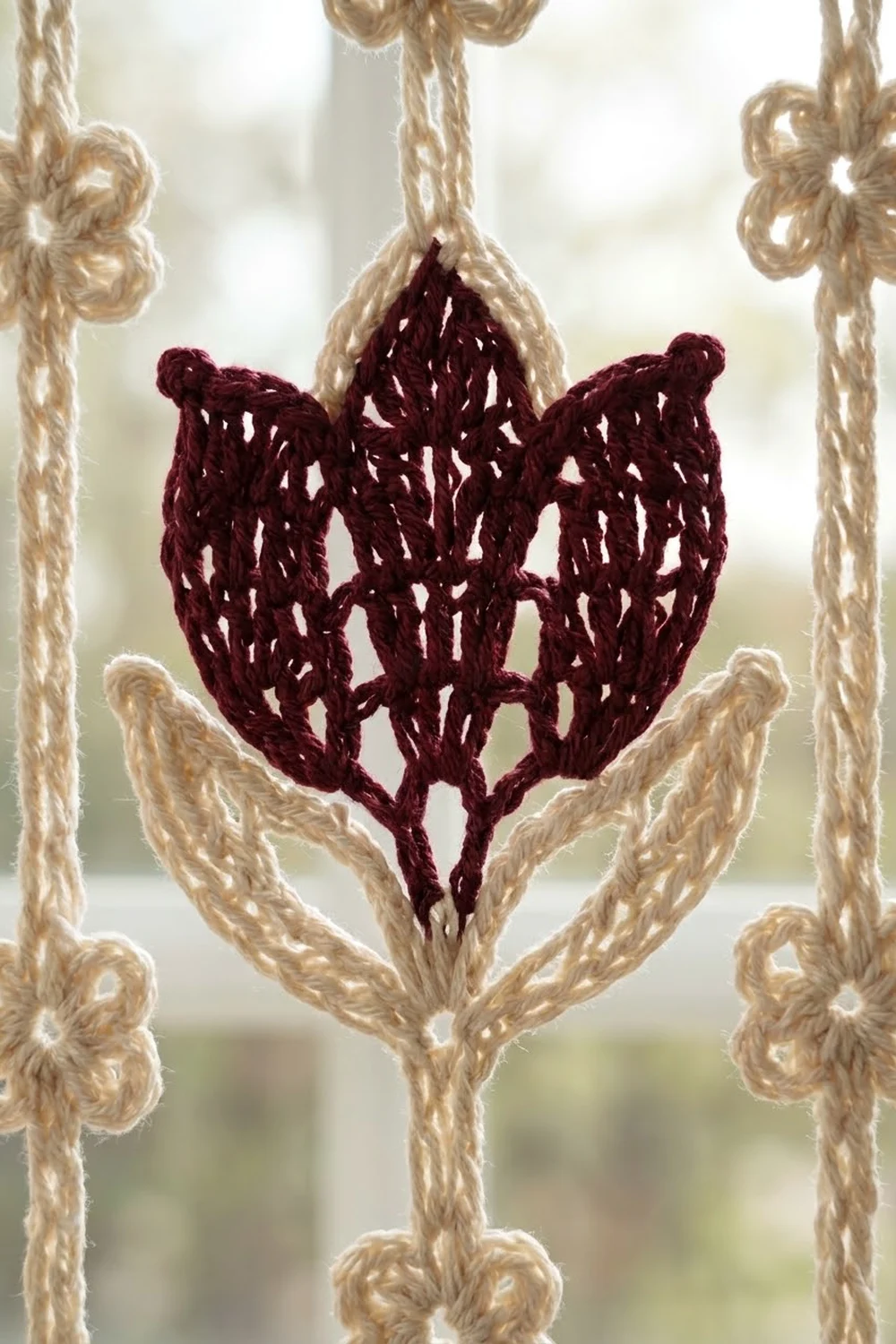
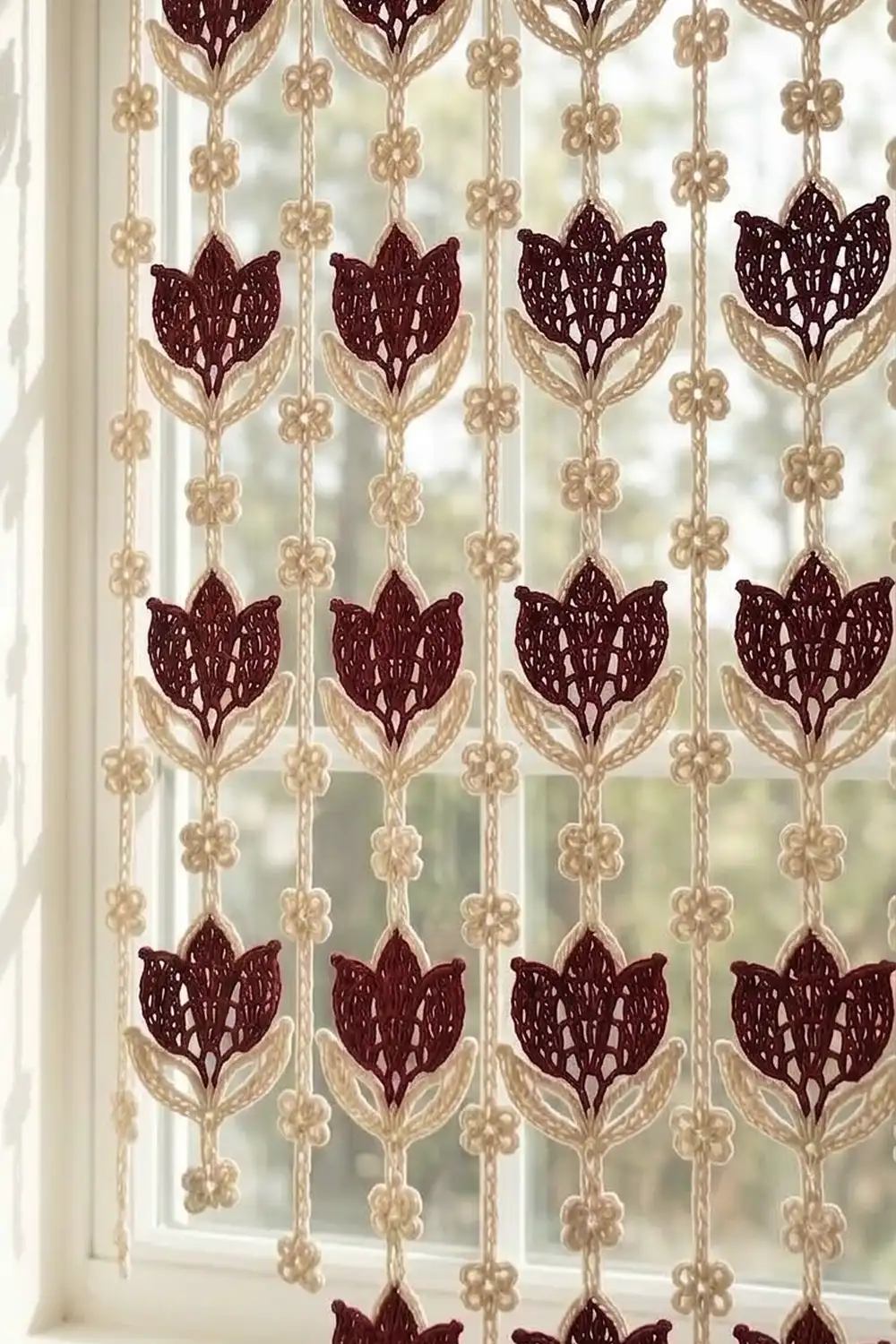
This lace curtain has deep wine-red tulips layered on cream leaves. The tulips hang in neat vertical columns. Between them run slim cream strands dotted with small openwork quatrefoils. You can hang it flat in a window or on a wall. Light passes through every chain space, so each stitch reads crisply.
There are only two colors. The tulip petals are burgundy. Everything else is cream: the quatrefoils, leaves, stems, strands and header.
The pattern uses US crochet terms. The finished curtain measures 27 in (68.6 cm) wide at the header, 28 in (71.1 cm) at the widest tulip row, and 50 in (127.0 cm) long.
You make the motifs separately. Then you chain each strand from the bottom up, catching the motifs as you go. Last, you join all 9 strands into a sc header that folds into a rod pocket.
Finished Size and Construction
- Finished size: 27 in (68.6 cm) wide at header, 28 in (71.1 cm) at widest, 50 in (127.0 cm) long
- Skill level: Intermediate
- Terminology: US
- Yarn weight: DK / light worsted (#3) cotton
- Hook: 3.5 mm (E-4)
- Number of pieces: 20 tulip units (5 crocheted parts each), 104 quatrefoils, 9 strands, 1 header
- Layout: 9 vertical strands, tulip (T) and flower (F) alternating: T F T F T F T F T
- Piece size: quatrefoil 1.5 in (3.8 cm); tulip unit 4 in (10.2 cm) wide × 6 in (15.2 cm) tall
- Size before border: 28 in (71.1 cm) × 48 in (121.9 cm), strands only
- Border depth: 2 in (5.1 cm), a 4 in (10.2 cm) header folded in half
Materials
Choose a smooth mercerized or combed cotton of about 110 m per 50 g. Cotton gives crisp stitch definition and resists stretching. Avoid fuzzy or elastic yarns, because long strands grow under their own weight.
- Cream: 240 g / 530 m
- Burgundy: 75 g / 165 m
These quantities include a margin of about 15% for swatching and tails.
Tools: 3.5 mm (E-4) hook, tapestry needle, rust-proof pins, foam blocking boards, spray bottle, tape measure, stitch markers, and a rod up to 1 in (2.5 cm) in diameter.
Abbreviations (US Terms)
ch chain · sl st slip stitch · sc single crochet · hdc half double crochet · dc double crochet · tr treble crochet · sp space · st(s) stitch(es) · rep repeat
Picot: ch 3, sl st in 3rd ch from hook.
Join points: each motif has one top join point and one bottom join point. The strand is slip-stitched into these points only, and the chain between them runs behind the motif.
Gauge and Checkpoints
Header gauge: 20 sc and 20 rows = 4 in (10.2 cm), which is 5 sc and 5 rows per 1 in (2.5 cm).
Chain gauge: 6 ch = 1 in (2.5 cm), measured on a relaxed chain.
Test first: make and block one quatrefoil and one complete tulip unit before anything else.
Checkpoints:
– Quatrefoil: 1.5 in (3.8 cm) tip to tip
– Center petal: 3.5 in (8.9 cm)
– Side petal: 2.75 in (7.0 cm)
– Leaf: 2.5 in (6.4 cm)
– Flower: 3.5 × 3.5 in (8.9 × 8.9 cm)
– Tulip unit: 4 × 6 in (10.2 × 15.2 cm)
– One 72-ch strand repeat: 12 in (30.5 cm)
Too big by more than 0.25 in (0.6 cm)? Go down to a 3.25 mm hook. Too small? Go up to 3.75 mm. Check your chain gauge separately. Many crocheters chain tighter than they sc and need a larger hook for the strands only.
Quatrefoil (Make 104, Cream)
Ch 4, sl st in first ch to form a ring.
Rnd 1: Ch 1, 8 sc in ring, sl st in first sc. (8 sc)
Rnd 2: *Ch 4, skip next sc, sl st in next sc; rep from * 3 more times, working the last sl st into the first sc of Rnd 1. (4 ch-4 loops)
Rnd 3: In each ch-4 loop work (sc, hdc, 3 dc, hdc, sc); sl st in first sc. Fasten off. (4 petals of 7 sts, 28 sts)
The open ring and chain loops make the lacy center.
Join points: the middle dc of one petal is the top point. The middle dc of the opposite petal is the bottom point.
Tulip Petals (Burgundy)
Each petal is worked around both sides of a foundation chain. The ch-1 spaces between the tall stitches form the openwork veins. The 1st ch from the hook is the tip and the last ch is the base.
Center Petal (Make 20)
Ch 20.
Side A: Sc in 2nd ch from hook, hdc in next ch, dc in next ch, [ch 1, skip next ch, tr in next ch] 6 times, ch 1, skip next ch, dc in next ch, hdc in next ch, (sc, ch 2, sc) in last ch.
Side B: Working in the free loops of the foundation chain: hdc in next ch, dc in next ch, ch 1, skip next ch, [tr in next ch, ch 1, skip next ch] 6 times, dc in next ch, hdc in next ch, sc in next ch.
Tip: (Sc, picot, sc) around the skipped tip ch, sl st in first sc. Fasten off, leaving a 12 in (30.5 cm) tail.
Count: 11 sts and 7 ch-1 sps per side + 2 sc at base + 2 sc at tip = 26 sts and 14 ch-1 sps.
Side Petal (Make 40)
Ch 16.
Side A: Sc in 2nd ch from hook, hdc in next ch, dc in next ch, [ch 1, skip next ch, tr in next ch] 4 times, ch 1, skip next ch, dc in next ch, hdc in next ch, (sc, ch 2, sc) in last ch.
Side B: Hdc in next ch, dc in next ch, ch 1, skip next ch, [tr in next ch, ch 1, skip next ch] 4 times, dc in next ch, hdc in next ch, sc in next ch.
Tip: (Sc, picot, sc) around the skipped tip ch, sl st in first sc. Fasten off.
Count: 9 sts and 5 ch-1 sps per side + 4 sc = 22 sts and 10 ch-1 sps.
Assemble the Flower
Place one side petal behind each side of the center petal. Overlap the bases and angle the tips outward until the flower measures 3.5 in (8.9 cm) wide × 3.5 in (8.9 cm) tall. Sew the bases together with the long tail, then tack each side petal to the center petal halfway up.
Leaf Pair with Stem (Make 20, Cream)
Leaf (Make 40)
Ch 15.
Side A: Sc in 2nd ch from hook, hdc in next ch, dc in next ch, [ch 1, skip next ch, dc in next ch] 4 times, ch 1, skip next ch, hdc in next ch, (sc, ch 2, sc) in last ch.
Side B: Hdc in next ch, ch 1, skip next ch, [dc in next ch, ch 1, skip next ch] 4 times, dc in next ch, hdc in next ch, sc in next ch.
Tip: Work as for the side petal.
Count: 8 sts and 5 ch-1 sps per side + 4 sc = 20 sts and 10 ch-1 sps.
Join Leaves and Work Stem
Lay two leaves in a V with the bases overlapping and the tips 4 in (10.2 cm) apart. Join cream with a sl st through both base ch-2 sps. Ch 7, then sc in 2nd ch from hook and in the next 5 ch, working back toward the leaves. Fasten off. (6 sc; stem 1 in / 2.5 cm)
Bottom join point: the skipped ch at the free end of the stem.
Layer the Tulip Unit
Center the flower over the leaf junction and sew it on with burgundy. The unit should measure 4 in (10.2 cm) × 6 in (15.2 cm).
Top join point: the picot at the tip of the center petal.
Before joining, pin every motif to its checkpoint size, mist it and let it dry.
Make All Pieces
Cream: 104 quatrefoils, 40 leaves, 20 stems
Burgundy: 20 center petals, 40 side petals
Each tulip strand uses 4 tulip units and 8 quatrefoils, so the 5 tulip strands use 20 units and 40 quatrefoils. Each flower strand uses 16 quatrefoils, so the 4 flower strands use 64. That makes 40 + 64 = 104 quatrefoils.
Layout grid (strands left to right, top down; each grid row = 3 in / 7.6 cm):
STRAND:  1     2     3     4     5     6     7     8     9
ROW 1:   TULIP QUAT  TULIP QUAT  TULIP QUAT  TULIP QUAT  TULIP
ROW 2:   TULIP QUAT  TULIP QUAT  TULIP QUAT  TULIP QUAT  TULIP
ROW 3:   QUAT  QUAT  QUAT  QUAT  QUAT  QUAT  QUAT  QUAT  QUAT
ROW 4:   QUAT  QUAT  QUAT  QUAT  QUAT  QUAT  QUAT  QUAT  QUAT
Repeat Rows 1–4 three more times: 16 rows, 48 in (121.9 cm).
One tulip unit fills Rows 1–2 of its column.
Joining
Each strand is a cream chain worked from the bottom up. It is slip-stitched into each motif’s bottom and top join points, and the chain between those points runs behind the motif. At 6 ch per 1 in (2.5 cm), the chain behind each motif matches its height: 9 ch for a quatrefoil and 36 ch for a tulip unit. This keeps the motifs flat, neither puckered nor stretched.
Tulip strand (make 5): Join cream with a sl st in the bottom join point of a quatrefoil. Ch 9, sl st in its top join point; ch 6, sl st in bottom join point of next quatrefoil; ch 9, sl st in its top join point; ch 6, sl st in bottom join point of a tulip unit; ch 36, sl st in its top join point; ch 6*, sl st in bottom join point of next quatrefoil. Rep from * 2 more times, then rep from * to ** once. Fasten off, leaving an 8 in (20.3 cm) tail. The last ch is the top loop.
Each repeat is 9 + 6 + 9 + 6 + 36 + 6 = 72 ch = 12 in (30.5 cm). Four repeats = 288 ch = 48 in (121.9 cm).
Flower strand (make 4): Join cream in the bottom join point of a quatrefoil. Ch 9, sl st in its top join point; ch 9*, sl st in bottom join point of next quatrefoil. Rep from * 14 more times, then rep from * to ** once. Fasten off as for the tulip strand.
Each repeat is 18 ch = 3 in (7.6 cm). Sixteen repeats = 288 ch = 48 in (121.9 cm), the same as the tulip strands.
Tension: Keep every chain even and open. Tight chains make the motifs bow, and loose chains let them sag.
Size checkpoint: Hang each strand by its top loop. It should measure 48 in (121.9 cm), within 0.5 in (1.3 cm). Lay the strands side by side and check that the tulips line up across the columns.
Border (Header Band)
The header is a flat sc band worked across the strand tops, then folded into a rod pocket.
Border gauge: 5 sc and 5 rows per 1 in (2.5 cm). This is the sc gauge, not the chain gauge used for the strands.
Each strand owns a 15-st section of the header, 3 in (7.6 cm) wide: 9 strands × 15 sts = 135 sts. Each strand attaches at the middle stitch of its section, with 7 sts on either side.
Foundation: With cream, ch 136.
Row 1 (joining row): Sc in 2nd ch from hook and in each ch across. At sts 8, 23, 38, 53, 68, 83, 98, 113 and 128, insert the hook through the foundation ch and the top loop of the next strand, then complete the sc through both. Attach the strands in the order T F T F T F T F T. (135 sc)
Rows 2–20: Ch 1, turn, sc in each sc across. (135 sc)
Counts per side: 135 sts along the top and bottom edges, and 20 rows along each side edge.
Fold and seam: Fold Rows 11–20 to the back. Whipstitch each Row 20 stitch to the matching Row 1 stitch, one to one (135 to 135). Leave the sides open for the rod.
Why the math works:
– Width: 135 sc ÷ 5 sc per in = 27 in (68.6 cm).
– Overhang: the strand centers are 3 in (7.6 cm) apart, and the outer ones sit 1.5 in (3.8 cm) from each edge. The 4 in (10.2 cm) tulip units therefore extend 0.5 in (1.3 cm) past each edge, so the widest row is 28 in (71.1 cm).
– Depth: 20 rows ÷ 5 rows per in = 4 in (10.2 cm), which folds to 2 in (5.1 cm).
– Length: 48 in (121.9 cm) + 2 in (5.1 cm) = 50 in (127.0 cm).
Final Blocking
- Weave in all tails along the backs of the strands or motifs.
- Lay the curtain face down on foam boards.
- Pin the header straight at 27 in (68.6 cm).
- Pin each strand straight so the strands run parallel.
- Pin out the petal, leaf and quatrefoil tips.
- Mist until damp and let dry completely.
- Hang the curtain on its rod for 24 hours so the strands settle at 48 in (121.9 cm).
Final Quality-Control Checklist
- Header is 27 in (68.6 cm) × 2 in (5.1 cm), with 135 sts per row
- 9 strands attached at sts 8, 23, 38, 53, 68, 83, 98, 113 and 128, in the order T F T F T F T F T
- Every strand is 48 in (121.9 cm)
- 20 tulip units and 104 quatrefoils are in place, and the tulips are aligned
- Chains lie flat behind the motifs, and the tails are hidden
Troubleshooting
- Motifs bow: The chain behind them is too short. Redo it looser or with a larger hook.
- Motifs sag: The chain behind them is too long. Recount it (9 or 36 ch).
- Strands differ in length: Measure each repeat, which should be 12 in (30.5 cm) or 3 in (7.6 cm), and redo any that are off.
- Header narrower than 27 in (68.6 cm): Rework it with a larger hook.
- Quatrefoils twist: Make sure you join at opposite petals.
- Petals look solid: Check that you skip a ch before each tr.
Care
Hand wash in cool water with mild soap, roll in a towel to remove water, and dry flat or on the rod. Do not tumble dry.
Final Notes
Here is the measurement chain. Each strand repeat is 72 ch = 12 in (30.5 cm) and holds 1.5 in (3.8 cm) quatrefoils and 4 × 6 in (10.2 × 15.2 cm) tulip units, so every strand is 288 ch = 48 in (121.9 cm). The 9 strands sit 3 in (7.6 cm) apart on a 135-st header that is 27 in (68.6 cm) wide and folds to 2 in (5.1 cm). The result is a 27 × 50 in (68.6 × 127.0 cm) curtain. If every checkpoint matches, the whole piece will too.
Optional: for a wider window, add strands in T F pairs and 30 header sts per pair. Each pair adds 6 in (15.2 cm).
Happy crocheting!