

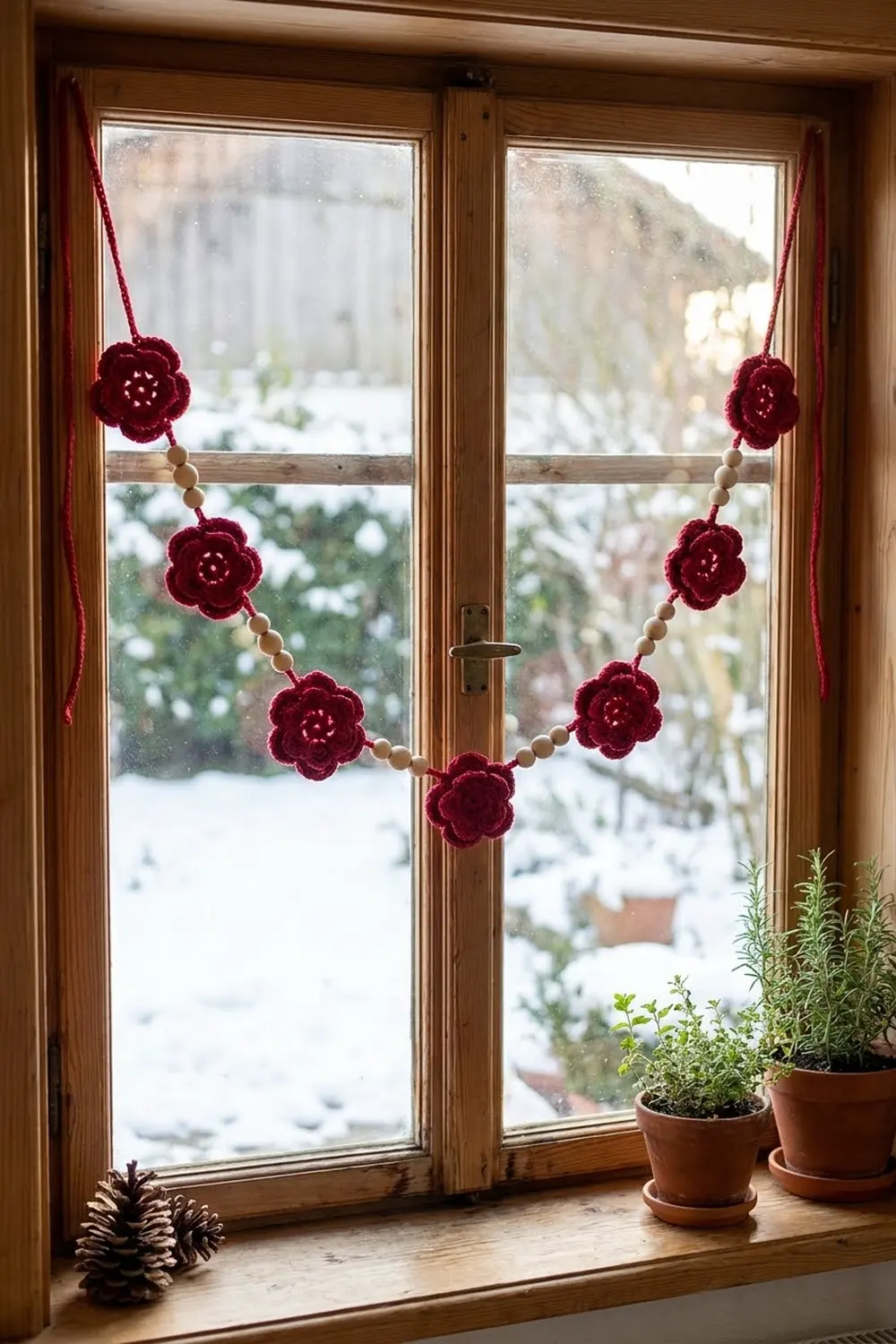
The Cranberry Bloom Flower Garland is a string of seven bright red layered flowers. A slim crocheted chain cord connects them, with a natural wooden bead between each pair. It looks cheerful and handmade, and it brightens a winter window, mantel, or shelf.
Every flower is worked in one cranberry-red cotton. Each one has a small dc center with an open eye and three tiers of five rounded petals. The tiers are stacked directly behind each other, so each flower looks full and almost rose-like. The pale wood beads give a soft, Scandinavian-style contrast.
This pattern uses US crochet terms throughout. Each flower measures 3.5 in (8.9 cm) across. The garland is 47.4 in (120.4 cm) long between its hanging loops and 51.4 in (130.6 cm) from loop tip to loop tip.
Construction is simple. You work each flower in the round, building every new petal tier on chain loops anchored behind the tier before it. Then you string the beads onto the yarn and crochet one continuous chain cord. You slip stitch each flower onto the cord at two petal tips as you go, so there is no sewing.
Finished Size and Construction
- Finished size: 47.4 in (120.4 cm) between hanging loops; 51.4 in (130.6 cm) overall
- Skill level: Easy-intermediate (back post stitches, working behind a round)
- Terminology: US crochet terms
- Yarn weight: DK (weight 3) cotton
- Hook: 3.5 mm (E-4)
- Number of pieces: 7 flowers + 1 chain cord with 8 beads
- Layout: one straight row: bead, flower, bead, flower … ending with a bead
- Piece size: each flower 3.5 in (8.9 cm) across
- Size before border (flower section, first bead to last bead): 41.4 in (105.2 cm)
- Border depth (end lead at each side): 3 in (7.6 cm), plus a 4 in (10.2 cm) hanging loop
Materials
Yarn advice: Use a smooth, mercerized or combed cotton in DK weight. Cotton gives the petals crisp edges and holds their cupped shape after blocking. Acrylic also works, but the petals will be softer and flatter.
- Cranberry red: 40 g / 96 m (one 50 g ball is enough)
Each flower uses about 10 m (about 4 g). The cord uses about 6 m (about 2.5 g). The quantity above includes a margin of roughly 20% for your gauge swatch and tails.
Tools and notions:
- 3.5 mm (E-4) crochet hook
- 8 natural wooden beads, 5/8 in (1.6 cm), with a hole of at least 1/8 in (0.3 cm)
- Tapestry needle
- Big-eye beading needle or dental floss threader (for stringing beads)
- Scissors
- Stitch markers
- Ruler or tape measure
- Blocking mat, rust-proof pins, and a spray bottle
Abbreviations (US Terms)
- MR – magic ring
- ch – chain
- sl st – slip stitch
- sc – single crochet
- hdc – half double crochet
- dc – double crochet
- st(s) – stitch(es)
- rep – repeat
- BPsc (back post single crochet): Insert the hook from back to front to back around the post of the stitch you’re told to use. Yarn over and pull up a loop, then yarn over and pull through both loops. Here it anchors each petal loop behind the tier in front.
- Bead-ch (bead chain): Slide one pre-strung bead up against the hook. Yarn over beyond the bead and pull through. The bead is now locked inside that chain.
Gauge and Checkpoints
Gauge is not critical for a garland, but it sets the flower size and the spacing. Make one complete flower first and measure it before you make the rest.
Flower checkpoints (measure flat, across the widest point):
- After Round 1: 1 in (2.5 cm)
- After Round 2: 1.75 in (4.4 cm)
- After Round 4: 2.75 in (7.0 cm)
- After Round 6: 3.5 in (8.9 cm)
Cord gauge: 5 ch = 1 in (2.5 cm), measured relaxed on a flat surface.
If your flower is too big: Go down to a 3.25 mm (D-3) hook, or chain more tightly in Rounds 3 and 5.
If your flower is too small: Go up to a 3.75 mm (F-5) hook.
If your chain is too long or short: Adjust your tension first. If that isn’t enough, add or remove 1 ch on each side of the bead in every spacer.
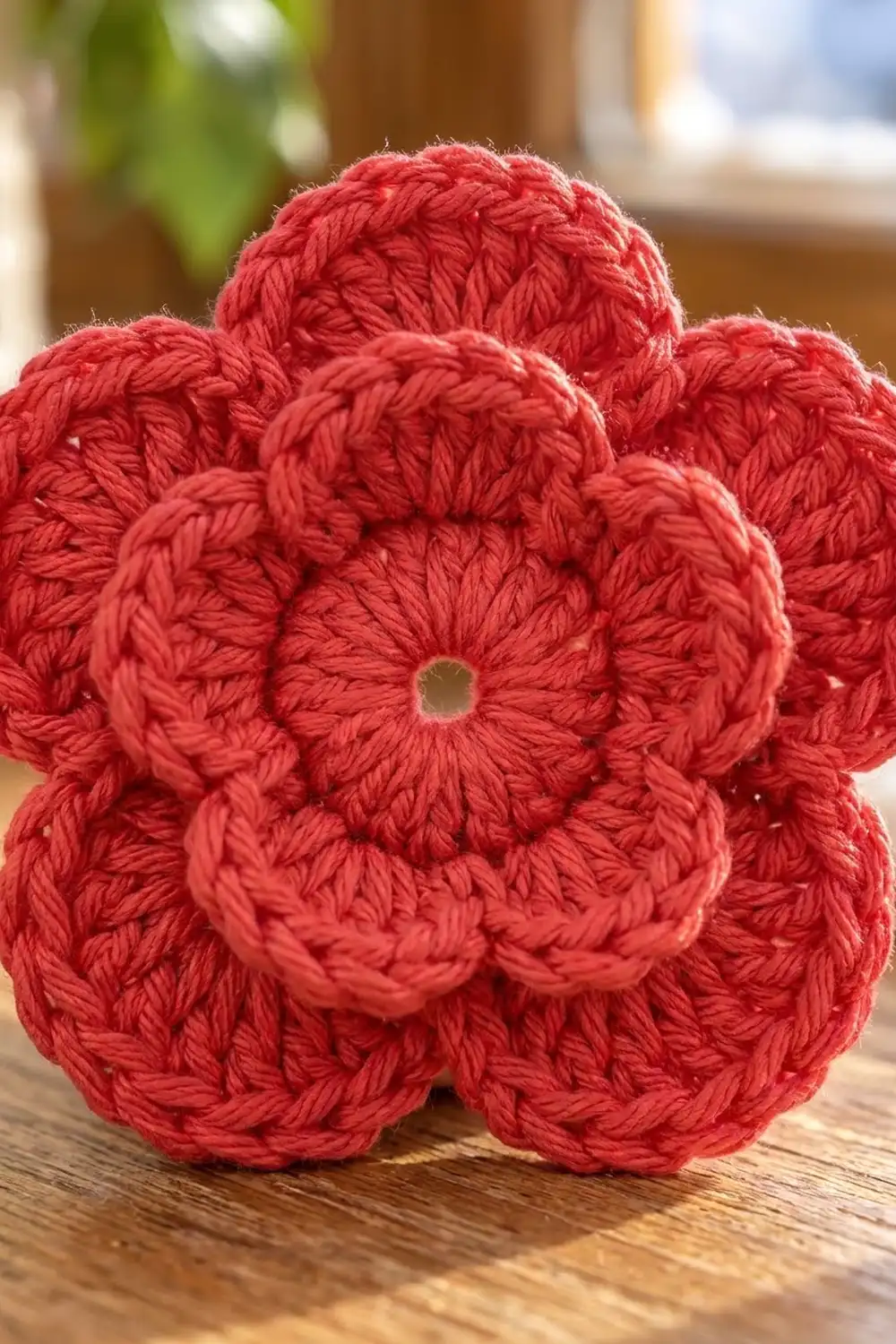
Flower (Make 7)
Work in joined rounds with the right side facing you. Do not turn.
Round 1 (center): Make an MR. Ch 2 (does not count as a st), work 15 dc into the ring. Pull the tail until a small eye about 1/8 in (0.3 cm) wide remains. Sl st to the first dc. (15 dc)
Round 2 (inner petals): Ch 1. Sc in next st, 5 dc in next st, sc in next st. Rep from * 4 more times. Sl st to the first sc. (10 sc + 25 dc = 35 sts; 5 petals of 7 sts)
Each petal uses 3 of the 15 base stitches, and 15 / 3 = 5 petals exactly.
Round 3 (first loop round): Fold the Round 2 petals toward you so you can see the back of Round 1. BPsc around the post of the Round 1 dc that holds the first sc of Round 2. Ch 5, pass behind one petal, BPsc around the post of the Round 1 dc that holds the first sc of the next petal. Rep from * 3 more times. Ch 5, sl st to the first BPsc. (5 BPsc + 5 ch-5 loops)
Each loop spans exactly one petal, so the next tier sits directly behind the inner petals.
Round 4 (middle petals): Sl st into the first ch-5 loop. Ch 1. In each ch-5 loop work (sc, hdc, 7 dc, hdc, sc). Sl st to the first sc. (10 sc + 10 hdc + 35 dc = 55 sts; 5 petals of 11 sts)
Round 5 (second loop round): Fold Round 4 forward. BPsc around the post of the first Round 3 BPsc. Ch 7, BPsc around the post of the next Round 3 BPsc. Rep from * 3 more times. Ch 7, sl st to the first BPsc. (5 BPsc + 5 ch-7 loops)
Round 6 (outer petals): Sl st into the first ch-7 loop. Ch 1. In each ch-7 loop work (sc, hdc, 11 dc, hdc, sc). Sl st to the first sc. (10 sc + 10 hdc + 55 dc = 75 sts; 5 petals of 15 sts)
Fasten off, leaving a 4 in (10.2 cm) tail. Weave in all ends on the back.
Petal tip: The tip of each outer petal is the 6th of its 11 dc, which is also the 8th stitch of the 15-stitch petal. You will join the cord here, so mark the tips of two neighboring petals on each flower now.
Make All Pieces
- Cranberry red flowers: 7
- Wooden beads: 8
- Chain cord: 1, made in the joining step
Check every flower against the 3.5 in (8.9 cm) checkpoint before you start the cord. Flowers that differ by more than 1/4 in (0.6 cm) will look uneven when hung.
Layout grid (left to right):
ROW 1: LOOP – LEAD – BEAD – FLOWER 1 – BEAD – FLOWER 2 – BEAD – FLOWER 3 – BEAD – FLOWER 4
       – BEAD – FLOWER 5 – BEAD – FLOWER 6 – BEAD – FLOWER 7 – BEAD – LEAD – LOOP
There is one bead before Flower 1 and one after every flower: 1 + 7 = 8 beads.
Joining (Chain Cord)
Method: The cord is one continuous chain. Each flower is attached with a sl st at the tips of two neighboring outer petals. Between those two tips the chain runs straight across the top of the flower, so the flower hangs flat and does not spin.
Prepare: Thread all 8 beads onto the working yarn with the beading needle. Push them about 2 yd (1.8 m) down the yarn.
Left end: Ch 20, sl st into the first ch to form the hanging loop. Ch 15 (left lead).
Bead: Work 1 bead-ch.
Flower repeat (work 7 times):
- Ch 8.
- Hold the flower right side facing you, with the two marked tips at the top. Sl st into the tip st of the left marked petal.
- Ch 10.
- Sl st into the tip st of the right marked petal.
- Ch 8.
- Work 1 bead-ch.
Right end: Ch 15 (right lead). Ch 20, sl st into the 20th ch from the hook to form the hanging loop. Fasten off and weave in the ends.
Stitch-to-stitch logic: On a 3.5 in (8.9 cm) flower, the tips of two neighboring petals are about 2 in (5.1 cm) apart. At 5 ch per inch, 10 ch also equals 2 in (5.1 cm). The chain therefore lies straight and flat between the tips, without pulling the petals together or sagging.
Spacer math: Each flower repeat uses 8 + 10 + 8 = 26 ch. Seven repeats use 7 × 26 = 182 ch, which is 182 / 5 = 36.4 in (92.5 cm). The 8 beads at 5/8 in (1.6 cm) each add 5 in (12.7 cm). The flower section is 36.4 + 5 = 41.4 in (105.2 cm).
Tension advice: Keep the chains even and slightly relaxed. Tight chains curl and make the garland too short. If the cord twists, let it hang freely for a minute before you attach the next flower.
Size checkpoint: After Flower 2 and its bead, measure from the first bead to the third bead. It should be about 12.3 in (31.2 cm): 52 ch = 10.4 in (26.4 cm), plus 3 beads = 1.9 in (4.8 cm). If you are off by more than 1/2 in (1.3 cm), adjust your tension or the spacer chains before you continue.
Border (Hanging Loops and End Leads)
A garland has no fabric border. Its “border” is the lead and hanging loop at each end. They give the garland a clean finish and let it hang from two hooks.
Border gauge: 5 ch = 1 in (2.5 cm), the same as the cord.
Left side: 20 ch loop + 15 ch lead = 35 ch.
Right side: 15 ch lead + 20 ch loop = 35 ch.
Why the math works:
- Each lead is 15 / 5 = 3 in (7.6 cm), so the two leads add 6 in (15.2 cm).
- The flower section of 41.4 in (105.2 cm) plus 6 in (15.2 cm) gives 47.4 in (120.4 cm) between the loops.
- Each 20 ch loop is 4 in (10.2 cm) around. Folded flat, it extends 2 in (5.1 cm) past the end of the lead.
- The two loops add 4 in (10.2 cm), for 51.4 in (130.6 cm) overall.
Total chain count: 35 + 182 + 35 = 252 ch, plus 8 bead-ch.
Because both sides use the same 35 ch, the garland is symmetrical and hangs evenly from two points.
Final Blocking
- Lay the garland flat on the blocking mat, right side up.
- Mist each flower until damp, but not soaking.
- Pin each flower to a 3.5 in (8.9 cm) circle. Put one pin at the tip of each outer petal.
- Push the middle and inner petals gently toward the center so they cup upward.
- Straighten the cord. Pin it every 4 in (10.2 cm) without stretching it.
- Let everything dry completely, usually 6 to 12 hours.
- Unpin and hang. Lift any flattened petals with your fingers.
Final Quality-Control Checklist
- Every flower has 75 sts in Round 6 and 5 equal outer petals.
- Every flower measures 3.5 in (8.9 cm) across after blocking.
- The petal tiers are stacked directly behind each other, not shifted.
- Each center eye is about 1/8 in (0.3 cm) and neatly closed.
- There are 7 flowers and 8 beads, with one bead at each end of the flower section.
- Each flower is joined at the tips of two neighboring petals, with a straight 10 ch between them.
- Both ends have a 15 ch lead and a 20 ch loop.
- The garland measures 47.4 in (120.4 cm) between loops.
- All ends are woven in on the back.
Troubleshooting
Petal tiers don’t line up: Your anchors are in the wrong place. Each Round 3 BPsc must go around the Round 1 dc that holds the first sc of a petal. Each Round 5 BPsc must go around a Round 3 BPsc.
Outer petals ruffle: Your ch-7 loops are too tight. Chain more loosely, or work 10 dc instead of 11 in each Round 6 petal (5 petals of 14 sts = 70 sts).
Outer petals look flat and stretched: Your loops are too loose. Chain more tightly or go down a hook size.
Beads won’t slide: The holes are too small. Use beads with holes of at least 1/8 in (0.3 cm).
Flower hangs tilted: The two join points are not on neighboring petals. Undo and rejoin at two neighboring tips.
Cord sags between flowers: Your chain is loose. Remove 1 ch on each side of the bead in the flower repeat.
Center hole is too large: Pull the magic ring tail tighter before weaving it in.
Care
Hand wash in cool water with a mild detergent, then press out the water and lay flat to dry, reshaping the petals. Store the garland flat or loosely coiled so the flowers keep their shape.
Final Notes
Here is the full measurement chain. Round 1 is 1 in (2.5 cm), Round 2 is 1.75 in (4.4 cm), Round 4 is 2.75 in (7.0 cm), and Round 6 is 3.5 in (8.9 cm). At 5 ch per inch, each 26 ch flower repeat is 5.2 in (13.2 cm). Seven repeats plus 8 beads make a 41.4 in (105.2 cm) flower section. Two 3 in (7.6 cm) leads bring it to 47.4 in (120.4 cm), and two hanging loops bring it to 51.4 in (130.6 cm) overall.
If your first flower and first two spacers measure correctly, the rest of the garland will too. Hang it in a sunny window and enjoy the red blooms all season.
Happy crocheting!