

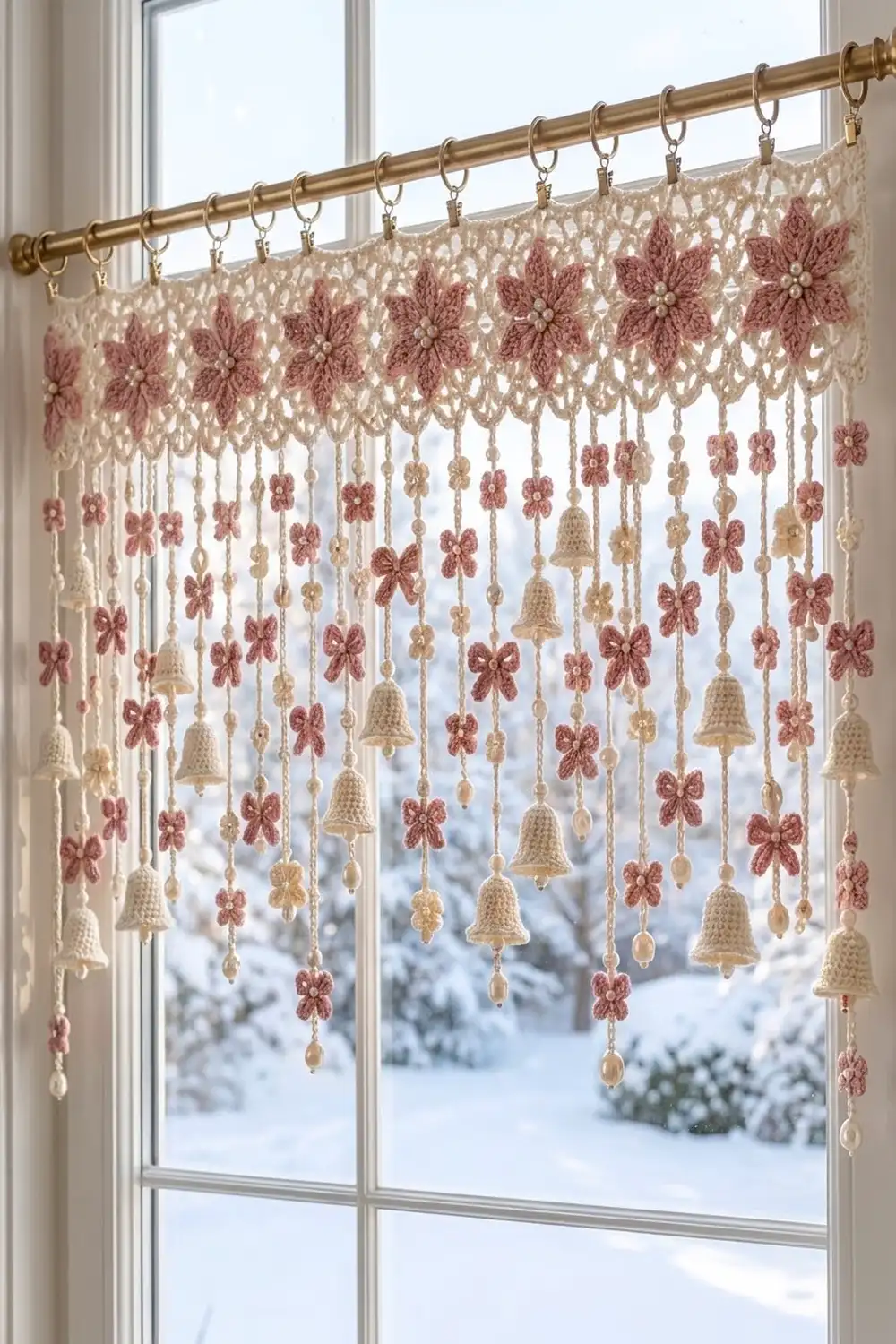
This valance turns a plain window into something soft and festive. A lace band of cream square motifs runs across the top, and each motif carries a blush pink 8-petal flower with a cluster of pearls at its center. Below the band, 19 chain strands hang in two lengths, decorated with pearls, small flowers, bows, and little cream bells.
There are only two yarn colors: cream for the lace, cords, bells, and small flowers, and dusty blush for the large flowers, small flowers, and bows. Pearl beads add shine. The style is romantic and wintry without using red or green, so it can stay up from December into early spring.
The pattern uses US crochet terms. The finished curtain is 41 in (104.1 cm) wide and 36.5 in (92.7 cm) long, measured from the top edge to the bottom of the longest strand. The lace band alone is 6.5 in (16.5 cm) deep.
Construction is simple. You make 8 lace squares and sew a flower to each one, join the squares in one row, and work a 3-round border that ends in scallops. Then you chain the strands from the scallop points and attach the small pieces as you go.
Finished Size and Construction
- Finished size: 41 in (104.1 cm) wide × 36.5 in (92.7 cm) long
- Skill level: Intermediate
- Terminology: US
- Yarn weight: DK (#3), cotton or cotton blend
- Hook: 3.5 mm (E/4)
- Number of pieces: 8 lace motifs, 8 large flowers, 29 bells, 29 small blush flowers, 28 small cream flowers, 29 bows
- Layout: 1 row of 8 motifs, with 19 strands below
- Piece size: 5 in (12.7 cm) square
- Size before border: 40 in × 5 in (101.6 cm × 12.7 cm)
- Border depth: 0.5 in (1.3 cm) at the top and sides, 1 in (2.5 cm) at the bottom
- Strand lengths: 30 in (76.2 cm) long and 24 in (61.0 cm) short, alternating
Materials
Use a smooth, mercerized DK cotton or cotton blend of about 230 m per 100 g. Cotton shows lace stitches clearly, keeps the petals crisp, and doesn’t sag as much as acrylic on long strands.
- Cream: 300 g (690 m)
- Dusty blush pink: 200 g (460 m)
Both amounts include a margin of about 25% for gauge swatches and tails.
Tools and notions:
– 3.5 mm (E/4) crochet hook
– Tapestry needle and a sharp sewing needle
– Cream sewing thread
– 40 pearl beads, 6 mm (large flower centers)
– 57 pearl beads, 4 mm (small flower centers)
– 123 pearl beads, 8 mm (strand spacers and scallop drops)
– 29 pearl beads, 10 mm (bell clappers)
– Stitch markers, tape measure, blocking mats, and rust-proof pins
– Curtain rod with 9 clip rings
Abbreviations (US Terms)
- ch – chain
- sl st – slip stitch
- sc – single crochet
- hdc – half double crochet
- dc – double crochet
- tr – treble crochet
- MR – magic ring
- sp – space
- st(s) – stitch(es)
Special stitch – Picot: ch 3, then sl st in the 3rd ch from the hook.
Gauge and Checkpoints
Make one complete motif before anything else. It’s your gauge swatch.
- Gauge: about 4.6 sc = 1 in (2.5 cm) in the last motif round
- Checkpoint 1: After Round 3, the lace ring measures about 3 in (7.6 cm) across.
- Checkpoint 2: The finished motif measures 5 in (12.7 cm) square after light blocking.
- Checkpoint 3: After joining, the strip measures 40 in × 5 in (101.6 cm × 12.7 cm).
- Checkpoint 4: After the border, the band measures 41 in × 6.5 in (104.1 cm × 16.5 cm).
If your motif is larger than 5.25 in (13.3 cm), go down half a hook size. If it’s smaller than 4.75 in (12.1 cm), go up half a size. Use the same hook for every piece so the strands and the band match.
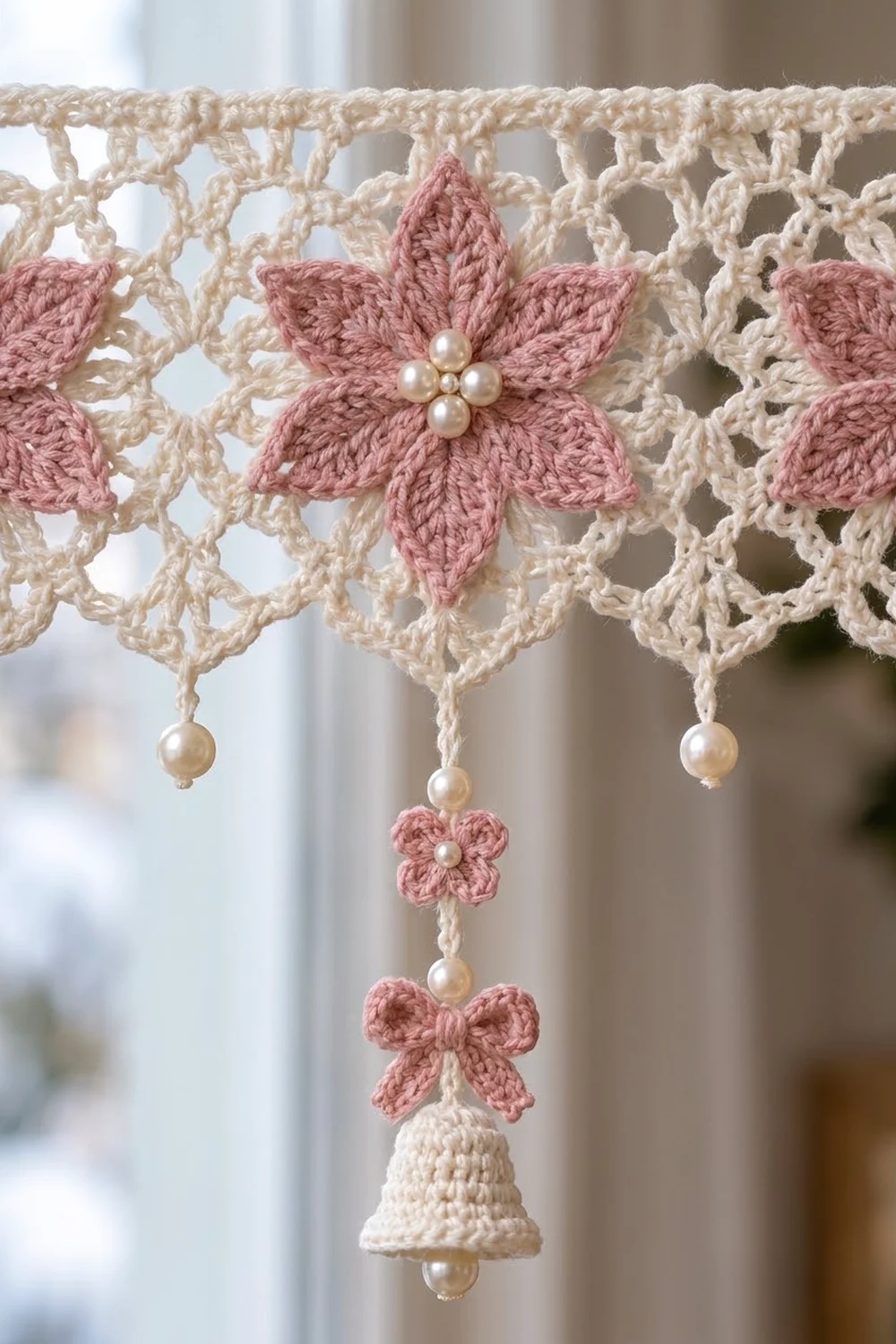
Lace Motif (make 8, cream)
Round 1: MR, ch 1, 12 sc in the ring. Join with a sl st to the first sc. (12 sc)
Round 2: Ch 5 (counts as dc + ch 2). [Dc in the next sc, ch 2] 11 times. Join to the 3rd ch of the beginning ch-5. (12 dc, 12 ch-2 sps)
Round 3: Sl st into the first ch-2 sp, ch 1, sc in the same sp. [Ch 5, sc in the next ch-2 sp] 11 times, ch 5. Join to the first sc. (12 sc, 12 ch-5 loops)
These open loops form the lace ring around the flower.
Round 4 (squaring round): Sl st into the first ch-5 loop. Ch 3 (counts as dc), 2 dc in the same loop, ch 3, 3 dc in the same loop. This is the first corner. Then work ch 3, sc in the next loop, ch 5, sc in the next loop, ch 3. Work (3 dc, ch 3, 3 dc) in the next loop, ch 3, sc in the next loop, ch 5, sc in the next loop, ch 3. Repeat from * 2 more times. Join to the top of the beginning ch-3. (24 dc, 8 sc, 4 corner ch-3 sps)*
Round 5 (conversion round): Ch 1. Work sc in each dc and each sc, 3 sc in each side ch-3 sp, and 5 sc in each ch-5 sp. In each corner ch-3 sp, work 3 sc; the middle sc is the corner stitch. Join to the first sc.
Between corner groups, each side has 3 + 3 + 1 + 5 + 1 + 3 + 3 = 19 sc. Add the outer sc of each corner group and the two corner stitches, and every side has 23 sts. That count includes both corner sts.
Round total: 4 × (19 + 3) = 88 sc.
Fasten off and weave in the ends.
Large Flower (make 8, blush)
Round 1: MR, ch 1, 8 sc. Join. (8 sc)
Round 2: Ch 1, sc in the first sc, ch 3, [sc in the next sc, ch 3] 7 times. Join. (8 sc, 8 ch-3 sps)
Round 3 (petals): In each ch-3 sp work (sc, hdc, dc, tr, picot, tr, dc, hdc, sc). Join. (8 petals, 64 sts plus 8 picots)
The tr pair makes each petal widest at the middle, and the picot gives it a pointed tip. The flower measures about 3 in (7.6 cm) across.
Assembly: Sew the flower to the center of a motif so the petal tips rest over the Round 3 loops. Stitch through Round 1 of both pieces and tack down each petal tip. Sew five 6 mm pearls in a tight cluster at the flower’s center.
Bell (make 29, cream)
Round 1: MR, 6 sc. Pull the ring closed, but leave a small hole about 0.25 in (0.6 cm) wide for the cord. (6)
Round 2: 2 sc in each st. (12)
Round 3: Sc in each st. (12)
Round 4: [Sc in the next st, 2 sc in the next st] 6 times. (18)
Rounds 5–7: Sc in each st. (18)
Round 8: [Sc in the next 2 sts, 2 sc in the next st] 6 times. (24)
Round 9: Sc in each st. (24)
Round 10: [Sc in the next 3 sts, 2 sc in the next st] 6 times. (30)
Round 11 (flare rim): [Sc in the next 4 sts, 2 sc in the next st] 6 times. This is 30 sts worked one per stitch, plus 6 added = 36. Join with a sl st and fasten off.
The bell is about 2 in (5.1 cm) tall, and the mouth is about 2.25 in (5.7 cm) across.
Small Flowers
Blush (make 29): MR, [ch 3, 2 dc, ch 3, sl st] 5 times into the ring. Pull closed. (5 petals)
Cream (make 28): MR, [ch 2, 2 hdc, ch 2, sl st] 5 times into the ring. Pull closed. (5 rounded petals)
Sew a 4 mm pearl to the center of each flower. Blush flowers are about 1.25 in (3.2 cm) across, and cream flowers are about 1 in (2.5 cm).
Bow (make 29, blush)
Row 1: Ch 11, sc in the 2nd ch from the hook and in each ch across. (10 sc)
Rows 2–5: Ch 1, turn, sc in each st. (10 sc)
Fasten off, leaving a 12 in (30.5 cm) tail.
For the tails, ch 12 and fasten off. Fold this chain in half and place it behind the center of the rectangle. Wrap the long tail tightly 6 times around the center through both layers to pinch it into a bow. The bow is 2.2 in (5.6 cm) wide and about 1.1 in (2.8 cm) tall. Keep the tail for sewing.
Make All Pieces
| Piece | Color | Quantity |
|---|---|---|
| Lace motif | Cream | 8 |
| Large flower | Blush | 8 |
| Bell | Cream | 29 |
| Small flower | Blush | 29 |
| Small flower | Cream | 28 |
| Bow | Blush | 29 |
Band layout (1 row):
ROW 1: M M M M M M M M
Strand layout (scallops 1–37, left to right):
Scallop:  1  3  5  7  9 11 13 15 17 19 21 23 25 27 29 31 33 35 37
Strand:   A  B  A  B  A  B  A  B  A  B  A  B  A  B  A  B  A  B  A
Strand A is the long strand (10 total), and Strand B is the short strand (9 total). Even-numbered scallops each get one pearl drop.
Joining
Sew all 8 flowers onto their motifs before joining, while the pieces are small and easy to handle.
Method: Hold two motifs wrong sides together with their edges lined up. With cream, join with a sl st through the back loops of both corner sts. Work 1 sl st through each pair of matching back loops, 23 sts to 23 sts, ending at the opposite corners. Fasten off. Join all 7 seams this way, keeping the top corners lined up.
Tension: Keep your sl sts as loose as the motif sc. A tight seam pulls the band into a curve. If the seams pucker, rework them with a hook half a size larger.
Checkpoint: The strip should measure 40 in × 5 in (101.6 cm × 12.7 cm).
Border
Border gauge: The border also uses 4.6 sc per 1 in (2.5 cm). Each motif side has 23 sts, so the top edge has 8 × 23 = 184 sts. That’s 184 ÷ 4.6 = 40 in (101.6 cm), which matches the strip exactly, so the border lies flat without ruffling or pulling. No stitches are added at the seams; each seam’s two corner sts are already part of the 184.
Round 1 (conversion round): Join cream in the top-right corner st. Sc in each st around, with 3 sc in each of the 4 outer corner sts. Join.
The strip has 2 × 184 + 2 × 23 − 4 shared corners = 410 sts. Round 1 has 410 worked one per stitch, plus 8 added at the corners = 418 sc. Counting each new middle corner sc on both sides it touches:
– Top and bottom: 184 + 2 = 186 sts each
– Sides: 23 + 2 = 25 sts each
– Check: 186 + 186 + 25 + 25 − 4 = 418
Round 2: Ch 1. Sc in each st across the top (186 sc) and down the first side (23 sc between the corners). For the bottom, sc in the corner st, then ch 5, skip 4 sts, sc in the next st. Repeat from * 36 more times; the last sc lands in the other bottom corner. Sc up the second side (23 sc) and join.
The bottom works because 186 − 1 = 185 = 37 × 5, giving 37 ch-5 loops anchored by 38 sc. The round total is 186 + 23 + 23 + 38 = 270 sc plus 37 ch-5 loops.
Round 3: Ch 1. Sl st in each st across the top and the first side. Along the bottom, work (sc, hdc, dc, picot, dc, hdc, sc) in each ch-5 loop, with a sl st in each anchor sc between loops. Sl st up the second side and join. (37 scallops, each with 6 sts plus a picot)
Fasten off. Sew one 8 mm pearl below the picot of every even-numbered scallop (2, 4, … 36), for 18 drops.
Checkpoint: The band measures 41 in × 6.5 in (104.1 cm × 16.5 cm).
Strands
Each strand is worked as a cream chain cord straight down from a picot, at about 5 ch per 1 in (2.5 cm). Use sewing thread to sew pearls through the cord. Use the yarn tails to sew flowers and bows to the cord.
Mid-strand bells: At the bell position, pull up a long loop and remove the hook. Push the hook up through the bell’s mouth and out the top hole, catch the loop, and draw it down through the bell. Continue chaining. The next 10 ch run inside the bell. Sew a 10 mm pearl to the cord at the 10th ch so it hangs at the mouth as the clapper.
End bells: Fasten off, leaving a 6 in (15.2 cm) tail. Thread the tail down through the bell’s top hole and tie a 10 mm pearl to it so the pearl sits at the mouth. Knot securely.
Strand A (long, make 10): Join at the picot, ch 150 for 30 in (76.2 cm). Attach pieces at these chain counts:
– Pearls at ch 10, 30, 50, 70, 100, and 120
– Blush flowers at ch 20 and 110
– Bows at ch 40 and 130
– Cream flower at ch 60
– Bell threaded at ch 85
– End bell at ch 150
Strand B (short, make 9): Join at the picot, ch 120 for 24 in (61.0 cm). Attach pieces at these chain counts:
– Pearls at ch 10, 30, 50, 70, and 90
– Cream flowers at ch 20 and 80
– Blush flower at ch 40
– Bow at ch 60
– End bell at ch 120
Final Blocking
- Wet the band, then gently squeeze it in a towel.
- Pin the band to 41 in × 6.5 in (104.1 cm × 16.5 cm), with a pin in each corner and each seam.
- Pin out every petal tip and every scallop picot.
- Hang the strands over the edge of a table or chair back so they dry straight under their own weight.
- Let everything dry completely, then remove the pins.
Final Quality-Control Checklist
- 8 motifs, each 5 in (12.7 cm) square with 23 sts per side
- Every flower stitched down at the center and at all 8 petal tips
- All 7 seams flat, with no puckering
- Border Round 1 = 418 sc, Round 2 = 37 loops, Round 3 = 37 scallops
- 19 strands, alternating A and B, starting and ending with A
- 29 bells, each with a secure pearl clapper
- All pearls sewn through the cord, not just through one loop
Troubleshooting
- Band curves upward: The seams or border are too tight. Rework them with a larger hook.
- Scallops don’t fit evenly: Recount the Round 1 bottom edge; it must have exactly 186 sts.
- Petals curl: Block them pinned flat, or use one size smaller hook for Round 3 of the flower.
- Strands twist: Pin them while blocking and let them dry hanging.
- Bell won’t stay open: Stiffen it lightly with diluted fabric glue, or stuff it with tissue while it dries.
- Strands stretch over time: Re-measure after a week of hanging and pull out a few ch at the end bell if needed.
Care
Spot clean when you can. If needed, hand wash gently in cool water, then reshape and lay the curtain flat or hang it to dry. Don’t use a dryer.
Final Notes
The measurements build on each other:
– A gauge of 4.6 sc per 1 in (2.5 cm) makes a 23-st motif side measure 5 in (12.7 cm).
– Eight motifs make a 40 in (101.6 cm) strip with 184 sts along the top.
– The border adds 0.5 in (1.3 cm) at each side and the top and 1 in (2.5 cm) at the bottom, for a 41 in × 6.5 in (104.1 cm × 16.5 cm) band.
– Strands of 30 in (76.2 cm) and 24 in (61.0 cm) bring the full length to 36.5 in (92.7 cm).
If each checkpoint matches, the finished curtain will hang straight and even.
Happy crocheting!