

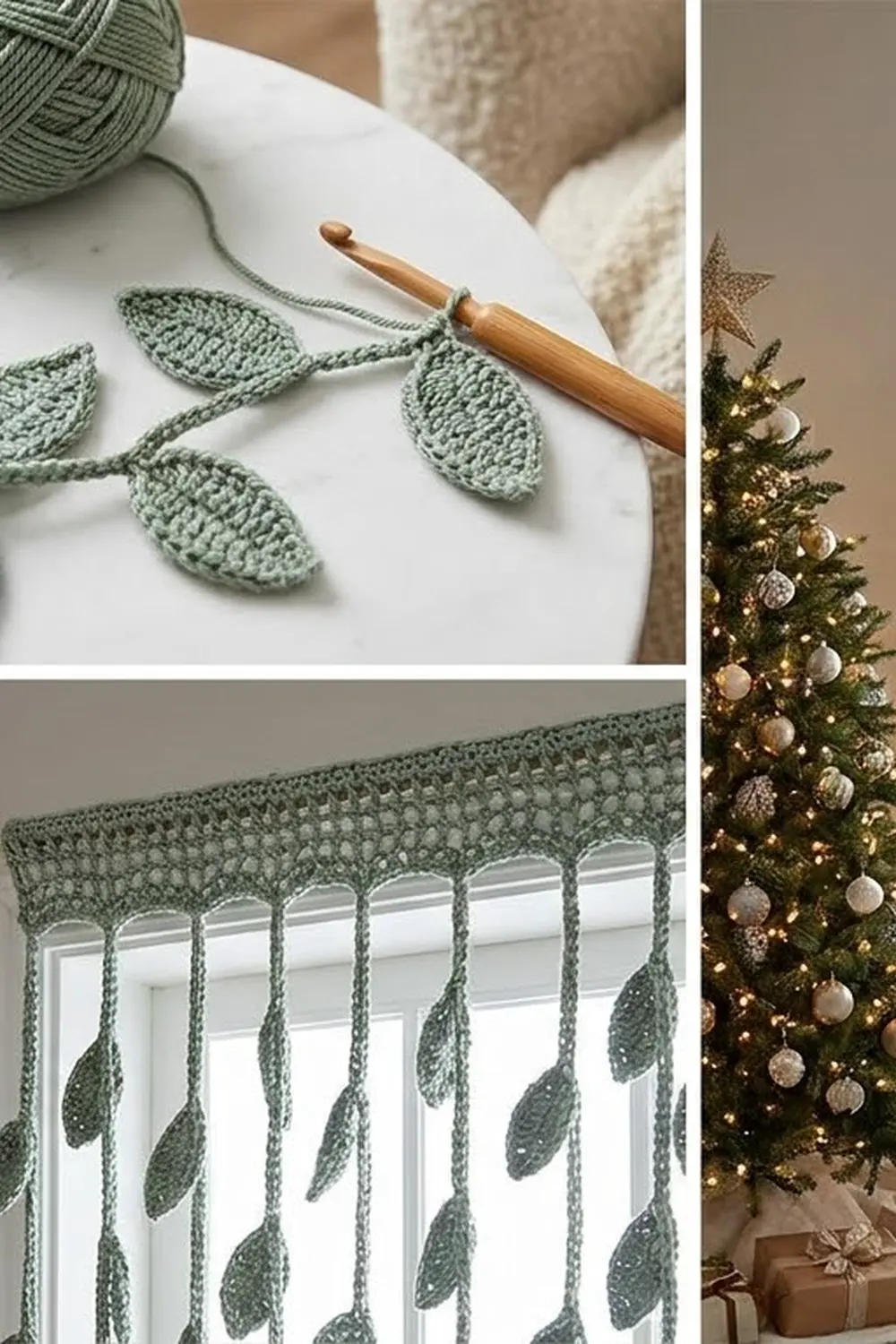
This curtain is made of long, trailing vines in soft sage green. Each strand is a firm, cord-like stem with small pointed leaves on alternating sides. The strands hang from a lacy mesh header, so light comes through and the curtain looks like greenery growing down the window.
The whole curtain uses one color, a muted sage green. That keeps the look calm and natural, and it fits a holiday room, a boho space, or a simple neutral home. The leaves have a raised center vein and a small picot tip, so they look slightly real without being fussy.
The pattern uses US crochet terms. The finished curtain is 35 in (88.9 cm) wide and about 76 in (193.0 cm) long: a 4 in (10.2 cm) header band plus nine strands that each hang 72 in (182.9 cm).
Construction is simple and repetitive. You chain the stem downward and work a leaf at the end of every 2 in (5.1 cm) segment. Then you slip stitch back up the stem to firm it. After that, you make a filet-mesh header band, stitch the strands to its back, and finish the header with a picot border.
Finished Size and Construction
- Finished size: 35 in (88.9 cm) wide × about 76 in (193.0 cm) long
- Skill level: Advanced beginner
- Terminology: US crochet terms
- Yarn weight: DK (3), cotton or cotton blend
- Hook: 4.0 mm (US G-6)
- Number of pieces: 10 (9 vine strands + 1 header band)
- Layout: 9 strands in one row, 4 in (10.2 cm) apart center to center, 1.5 in (3.8 cm) in from each side edge
- Piece size: each strand 72 in (182.9 cm) long with 35 leaves; each leaf 2.25 in × 1 in (5.7 cm × 2.5 cm)
- Size before border: header band 34 in × 3 in (86.4 cm × 7.6 cm)
- Border depth: 0.5 in (1.3 cm) on all four sides of the header
Materials
Choose a smooth DK cotton or cotton blend. Cotton gives crisp leaves and a stem that hangs straight. Avoid fuzzy or very stretchy yarns, since long strands stretch under their own weight.
Yarn (one color):
- Sage Green: 300 g / 720 m (about 787 yd)
- 9 strands: about 207 g / 495 m (about 23 g / 55 m per strand)
- Header band and border: about 46 g / 110 m
These quantities include a margin of roughly 15% for gauge differences and swatching.
Tools:
- 4.0 mm (US G-6) crochet hook
- Tapestry needle
- Scissors
- 9 locking stitch markers
- Tape measure
- Blocking mats, rust-proof pins, and a spray bottle
- Curtain rod or tension rod, up to 0.75 in (1.9 cm) in diameter
Abbreviations (US Terms)
- ch – chain
- sl st – slip stitch
- sc – single crochet
- hdc – half double crochet
- dc – double crochet
- st(s) – stitch(es)
- sp – space
- sk – skip
- RS / WS – right side / wrong side
Special stitches:
- Back bump: the ridge of loops on the back of a chain. Working into the back bumps leaves the neat chain “V”s facing out.
- Picot-sc: sc in the next st, ch 3, sl st in the top of the sc just made.
- Surface sl st: with the working yarn held behind the work, insert the hook from front to back through the fabric, pull up a loop, and draw it through the loop on the hook.
Gauge and Checkpoints
Stem gauge: 10 ch, after the slip-stitch return pass = 2 in (5.1 cm).
Header gauge: 18 sts and 8 dc mesh rows = 4 in (10.2 cm). Sc rows measure 0.25 in (0.6 cm) each.
Make a test piece first. Make a short sample strand with 5 segments and 4 leaves. It takes about 15 minutes and shows you how your tension compares.
Checkpoints:
- One leaf: 2.25 in (5.7 cm) long and 1 in (2.5 cm) wide at the widest point
- 5 stem segments: 10 in (25.4 cm)
- Full strand: 72 in (182.9 cm) from the base of the hanging loop to the stem tip
- Header Row 1: 34 in (86.4 cm) wide
- Header after Row 7: 3 in (7.6 cm) tall
- Header after border: 35 in × 4 in (88.9 cm × 10.2 cm)
If your work is too big: go down to a 3.75 mm (US F-5) hook. If it is too small: go up to a 4.5 mm (US 7) hook. Change the hook, not the stitch counts, so the strand spacing math stays correct.
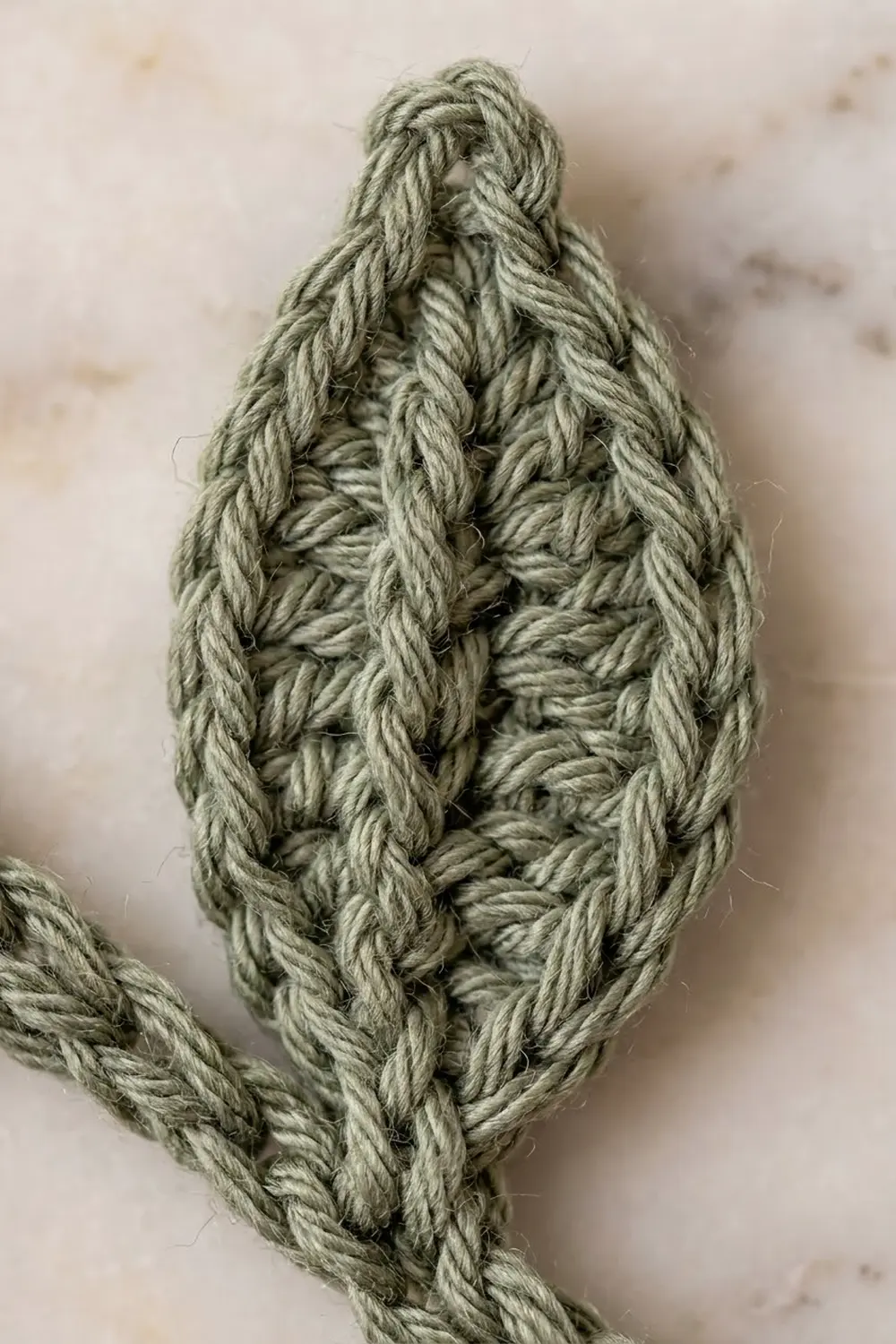
Vine Strand (make 9)
Each strand is worked in two passes. Pass 1 travels down, building the stem and leaves. Pass 2 travels back up the stem with slip stitches, turning the plain chain into a firm, rounded cord.
Hanging Loop
Ch 10, sl st in the first ch made to form a ring. This is the hanging loop.
Pass 1: Stem and Leaves
Stem segment: Ch 10.
Leaf:
- Ch 11.
- Side A: Sc in 2nd ch from hook, hdc in next ch, dc in next 5 ch, hdc in next ch, sc in next ch, sl st in last ch (10 sts). You are now at the base of the leaf.
- Side B: Rotate the work. Working in the free loops on the other side of the same chain: sl st in first ch, sc in next ch, hdc in next ch, dc in next 5 ch, hdc in next ch, sc in next ch (10 sts).
- Tip: Ch 2, sl st in the skipped tip ch.
- Vein: Work 10 surface sl sts down the center of the leaf, between Side A and Side B, ending at the base.
- Sl st in the last stem ch made (the 10th ch of the segment).
Leaf total: 20 edge sts + tip + 10 vein sl sts.
Alternating the leaves: flip the strand over before each new leaf. Odd-numbered leaves will sit on one side of the stem and even-numbered leaves on the other.
Work the strand:
- Repeat (stem segment, leaf) 35 times.
- Work 1 final stem segment (ch 10) for the tail.
Stem total: 36 segments × 10 ch = 360 stem ch. Leaf total: 35 leaves.
Pass 2: Firming the Stem
Do not fasten off. Turn and sl st in the back bump of each stem ch all the way back up to the hanging loop: 360 sl sts. Skip the leaf chains and just pass each leaf as you reach it. Sl st in the base of the hanging loop and fasten off. Weave in both ends along the stem.
Checkpoint: 360 stem ch at 5 ch per inch = 72 in (182.9 cm). Measure the strand while it hangs, not laid flat, because cotton relaxes under its own weight.
Header Band
Ch 154.
Row 1 (RS): Sc in 2nd ch from hook and in each ch across, turn. (153 sc)
Row 2: Ch 4 (counts as dc + ch 1), sk next sc, dc in next sc, ch 1, sk next sc, dc in next sc; repeat from * across, turn. (77 dc + 76 ch-1 sps = 153 sts)
Rows 3–6: Ch 4 (counts as dc + ch 1), dc in next dc, ch 1, dc in next dc; repeat from * across, working the last dc in the 3rd ch of the turning ch-4, turn. (77 dc + 76 ch-1 sps = 153 sts)
Row 7: Ch 1, sc in each dc and each ch-1 sp across, working the last sc in the 3rd ch of the turning ch-4. (77 + 76 = 153 sc)
Do not fasten off.
Checkpoint: 153 sts ÷ 4.5 sts per inch = 34 in (86.4 cm). Height: 2 sc rows × 0.25 in + 5 dc rows × 0.5 in = 3 in (7.6 cm).
Make All Pieces
All pieces use the same color.
- Sage Green: 9 vine strands, 35 leaves each (315 leaves total)
- Sage Green: 1 header band body, 153 sts × 7 rows
Each strand attaches to one stitch of Row 1. The layout is symmetrical, so you can count from either end.
HEADER BAND, foundation edge at bottom
ROW 1 STITCH:  5    23   41   59   77   95   113  131  149
STRAND:        S1   S2   S3   S4   S5   S6   S7   S8   S9
The positions are 18 sts apart. 18 sts ÷ 4.5 sts per inch = 4 in (10.2 cm). Stitch 77 is the exact center of 153 sts, and 4 sts remain outside the first and last strands on each side.
Joining
Method: sew each hanging loop flat to the WS of the header body, then let the stem hang straight down over the foundation edge.
- Place a marker in Row 1 at stitches 5, 23, 41, 59, 77, 95, 113, 131, and 149.
- Turn the header WS up.
- Lay a strand with its hanging loop over Rows 1–2, centered on the marked stitch. The base of the loop sits right at the foundation edge.
- With a tapestry needle and a 12 in (30.5 cm) length of yarn, whipstitch around the loop 6 times. Catch only the back strands of the header sts so nothing shows on the RS.
- Repeat for all 9 strands.
Stitch-to-stitch logic: sew one strand at each marked stitch and never between stitches. That keeps every strand exactly 18 sts from its neighbors.
Tension: pull each whipstitch snug, but do not pull the header in. The foundation edge must stay straight.
Checkpoint: the header should still measure 34 in (86.4 cm) wide, with 32 in (81.3 cm) between strands S1 and S9.
Border
Border gauge: each border round adds 0.25 in (0.6 cm). Two rounds = 0.5 in (1.3 cm) on every side.
Rnd 1: Ch 1, turn so the RS faces you. Sc in each st across Row 7 (153 sc), ch 2 for the corner. Along the row ends, work 1 sc in each sc row end and 2 sc in each dc row end (12 sc), ch 2. Working in the free loops of the foundation ch, sc in each ch across (153 sc), ch 2. Work 12 sc up the second short end, ch 2, sl st in the first sc.
Rnd 1 count: 153 + 12 + 153 + 12 = 330 sc, plus 4 corner ch-2 sps (not counted as sts).
Work the bottom edge in front of the stitched loops. The stems simply pass behind the border.
Rnd 2: Ch 1. (Sc in next 2 sts, picot-sc in next st) across the side; (sc, ch 2, sc) in the corner ch-2 sp; repeat from * around, sl st in the first sc. Fasten off.
Rnd 2 count:
- Long sides: 153 sts each (51 picots per side)
- Short sides: 12 sts each (4 picots per side)
- Corners: 2 sc each (8 sc total)
- Total: 330 + 8 = 338 sc and 110 picots
Why the math works: the picot repeat is 3 sts. 153 ÷ 3 = 51 and 12 ÷ 3 = 4, so every side ends on a full repeat. The 2 corner sc sit in the ch-2 sps, outside the side counts, so nothing is counted twice. The border adds 0.5 in (1.3 cm) to each edge: 34 + 0.5 + 0.5 = 35 in (88.9 cm) wide, and 3 + 0.5 + 0.5 = 4 in (10.2 cm) tall.
Final Blocking
- Lay the header RS up on blocking mats.
- Pin it to 35 in × 4 in (88.9 cm × 10.2 cm), with pins in every corner and every 4 in (10.2 cm) along the long edges.
- Open each picot with a pin tip.
- Lay each strand out straight in sections, pinning the stem every 6 in (15.2 cm).
- Pin each leaf to 2.25 in × 1 in (5.7 cm × 2.5 cm), with one pin at the tip.
- Mist everything with water until damp, not soaked.
- Leave everything until completely dry, usually about 24 hours.
- Unpin and hang the curtain for another 24 hours before your final length check.
Final Quality-Control Checklist
- 9 strands, each with 35 leaves and a 2 in (5.1 cm) tail below the last leaf
- Leaves alternate sides along the full stem
- Every leaf has a visible center vein and a pointed tip
- Each strand measures 72 in (182.9 cm) when hanging
- Header body has 153 sts per row and 7 rows
- Strands sewn at stitches 5, 23, 41, 59, 77, 95, 113, 131, and 149
- Border has 51 picots on each long side and 4 on each short side
- Finished header measures 35 in × 4 in (88.9 cm × 10.2 cm)
- All ends woven in securely
Troubleshooting
Strands twist into a spiral. Work Pass 2 into the back bumps every time, not the top loops. Pin the stem straight when blocking.
Leaves curl or cup. Your dc stitches are too tight. Loosen them slightly, or block the leaves flat while damp.
All leaves sit on one side. You forgot to flip the work before each leaf. Ease each leaf to the correct side during blocking.
Strands are different lengths. Count the stem segments; each strand needs 36. Hang all strands for 24 hours before comparing lengths.
Header ruffles along the bottom. The whipstitches are too tight. Remove them and resew with gentler tension.
Header is too narrow or too wide. Recheck your header gauge and change hook size. Keep 153 sts.
Short ends of the border flare. Work those 12 sc with a hook one size smaller, keeping the count the same.
Care
Hand wash in cool water with mild soap, roll in a towel to remove water, and dry flat. Re-pin the leaves lightly if they lose their shape.
Final Notes
Here is the full measurement chain. A 10-ch stem segment measures 2 in (5.1 cm), and 36 segments give a 72 in (182.9 cm) strand with 35 leaves. The header body has 153 sts for 34 in (86.4 cm) and 7 rows for 3 in (7.6 cm). Strands sit 18 sts, or 4 in (10.2 cm), apart. The 0.5 in (1.3 cm) border brings the header to 35 in × 4 in (88.9 cm × 10.2 cm), and the full curtain hangs about 76 in (193.0 cm).
To hang the curtain, weave your rod in and out of every other ch-1 sp in Row 4. To change the length, add or remove one segment and one leaf for every 2 in (5.1 cm).
Happy crocheting!