

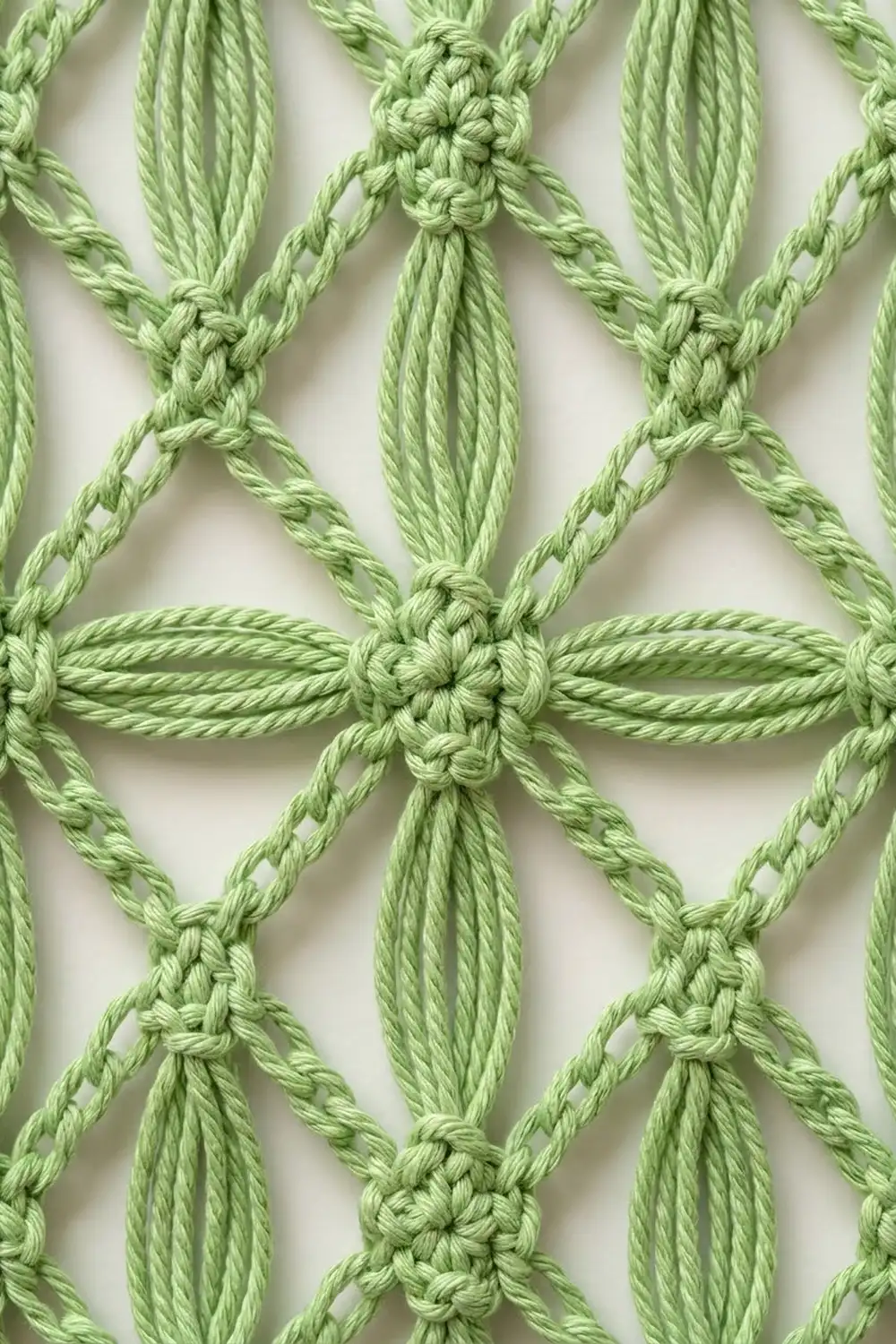
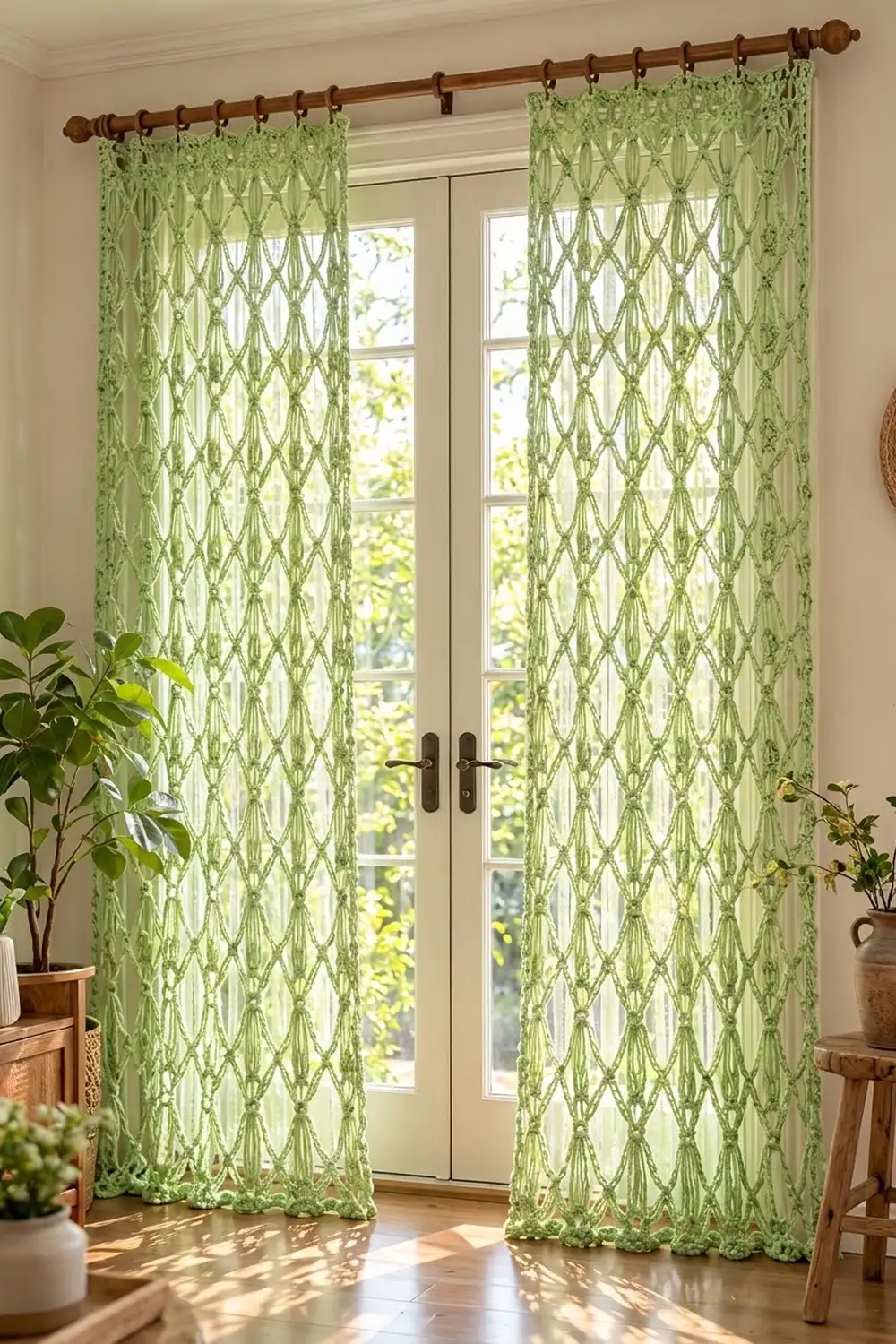
This lace curtain is airy and a little bit botanical. Tall columns of eye-shaped spindles run down the panel, broken up by small popcorn knots. Diagonal chain strands link each column to its neighbors through extra knots between the columns, which builds a clean diamond lattice that filters light without blocking it.
The sample is worked in a soft sage green cotton. That color reads fresh in daylight and calm in the evening. The design suits farmhouse, boho and Scandinavian rooms, and it works well on French doors, as in the photo, or on a tall window.
The pattern uses US crochet terms. Each finished panel measures 31.25 x 83.75 in (79.4 x 212.7 cm) after blocking. You make two identical panels for a pair. They hang separately, so there is no joining.
Construction overview: each panel starts with a single crochet foundation row and a setup row of knots. After that, a 2-row pattern repeats: a spindle row, then a knot row. A single crochet row finishes the body, and two rounds of single crochet border frame the edges. Clip rings attach along the top.
Finished Size and Construction
- Finished panel size: 31.25 x 83.75 in (79.4 x 212.7 cm)
- Skill level: Intermediate
- Terminology: US crochet terms
- Yarn weight: Aran / heavy worsted (#4) cotton
- Hook: 5.0 mm (H-8)
- Number of pieces: 2 separate panels (each panel is one piece)
- Layout: 2 panels side by side on one rod, not joined
- Panel body size before border: 30.25 x 82.75 in (76.8 x 210.2 cm)
- Border depth: 0.5 in (1.3 cm) on every edge
- Pattern repeat: 12 stitches wide = 3 in (7.6 cm); 2 rows tall = 3 in (7.6 cm)
Materials
Yarn: Use a smooth, firmly twisted cotton or cotton blend in aran weight, about 170 m per 100 g. Mercerized or combed cotton gives the clearest definition on the spindles and knots. Avoid fuzzy yarns, because fuzz hides the lattice.
- Sage green: 700 g (1,190 m) per panel; 1,400 g (2,380 m) for the pair
These quantities include a margin of about 10% for the gauge swatch and small differences in tension.
Tools:
- 5.0 mm (H-8) crochet hook
- Tapestry needle
- Stitch markers (at least 4)
- Scissors
- Measuring tape
- Blocking mats or a clean towel, and rust-proof pins
- 22 curtain clip rings (11 per panel)
Abbreviations (US Terms)
- ch – chain
- sc – single crochet
- dc – double crochet
- tr – treble crochet
- sl st – slip stitch
- st(s) – stitch(es)
- sp – space
- rep – repeat
- RS / WS – right side / wrong side
Special stitches
- Knot (K) – 4-dc popcorn: Work 4 dc in the same st or sp. Drop the loop from your hook, insert the hook from front to back into the top of the first dc, pick up the dropped loop and pull it through. Ch 1 to close. The closing ch-1 is the top of the Knot.
- Beginning Knot (beg K): Ch 3 (counts as the first dc), then work 3 dc in the same st. Drop the loop, insert the hook into the top of the ch-3, pull the dropped loop through and ch 1.
- Spindle (Sp) – 4-tr cluster: *Yarn over twice, insert the hook in the st, pull up a loop, (yarn over, pull through 2 loops) twice; rep from * 3 more times in the same st (5 loops on hook). Yarn over and pull through all 5 loops. The four long legs bow apart to make the eye shape.
- Beginning Spindle (beg Sp): Ch 4 (counts as the first leg), then work a 3-tr cluster in the same st (4 loops on hook). Yarn over and pull through all 4 loops.
Gauge and Checkpoints
Base gauge: 16 sc = 4 in (10.2 cm), measured on Row 1.
Pattern gauge: 1 pattern repeat (one spindle row plus one knot row) = 3 in (7.6 cm) tall, measured hanging after blocking.
Test swatch first. Ch 26. Work Row 1 (25 sc) and Row 2. Then work Rows A and B twice, and finish with a sc row worked the same way as Row 57. The swatch has 2 horizontal repeats and 3 Knots per knot row. Block it and let it hang to dry.
- Swatch width: 6.25 in (15.9 cm)
- Swatch height: 7.75 in (19.7 cm)
If the swatch is too big, go down 0.5 mm. If only the spindle rows are too tall, wrap the yarn more firmly on your tr legs. If it is too small, go up 0.5 mm. On a 84 in (213.4 cm) panel, a small error adds up fast, so take time to get the swatch right.
Body checkpoints (lay the panel flat, measure without stretching, and add about 3% for the hanging drop):
- After Row 2: 1.5 in (3.8 cm) tall, 30.25 in (76.8 cm) wide
- After Row 8: 10.5 in (26.7 cm)
- After Row 20: 28.5 in (72.4 cm)
- After Row 38: 55.5 in (141.0 cm)
- After Row 56: 82.5 in (209.6 cm)
- After Row 57: 82.75 in (210.2 cm)
Panel Pattern (Make 2)
Foundation: Ch 122.
Row 1 (WS): Sc in the 2nd ch from the hook and in each ch across. Turn. (121 sc)
The panel is 10 repeats wide. Columns sit on sts 1, 13, 25 and so on up to st 121, which makes 11 columns. The crossing points sit halfway between them, on sts 7, 19 and so on, which makes 10 crossings.
Row 2 (RS, setup knot row): Beg K in the first st. Ch 5, skip 5 sts, K in the next st (crossing), ch 5, skip 5 sts, K in the next st (column); rep from * 9 more times. Turn.
(21 Knots: 11 column Knots + 10 crossing Knots; 20 ch-5 sps)*
Row 3 (WS, Row A – spindle row): Beg Sp in the top of the first K. Ch 4, sc in the next ch-5 sp, ch 4, skip the crossing K, sc in the next ch-5 sp, ch 4, Sp in the top of the next column K; rep from * 9 more times. Turn.
(11 Spindles, 20 sc, 30 ch-4 sps)*
The middle ch-4 sp of each repeat sits directly above the crossing Knot. That middle space is what keeps the diamonds lined up.
Row 4 (RS, Row B – knot row): Beg K in the top of the first Sp. Ch 5, skip the next ch-4 sp, K in the middle ch-4 sp (crossing), ch 5, skip the next ch-4 sp, K in the top of the next Sp (column); rep from * 9 more times. Turn.
(21 Knots, 20 ch-5 sps)*
Rows 5–56: Rep Rows 3–4 another 26 times. That makes 27 pattern repeats in total. Every odd row is Row A and every even row is Row B.
- Each Row A count: 11 Sp, 20 sc, 30 ch-4 sps
- Each Row B count: 21 K, 20 ch-5 sps
Row 57 (WS, finishing row): Ch 1, sc in the top of the first K. 5 sc in the next ch-5 sp, sc in the next K, 5 sc in the next ch-5 sp, sc in the next K; rep from * 9 more times. Do not fasten off.
(1 + (12 x 10) = 121 sc)*
Row 57 has the same count as Row 1, so the top and bottom edges of the panel match exactly.
Make Both Panels
- Panel A: 700 g (1,190 m) sage green
- Panel B: 700 g (1,190 m) sage green
Buy all the yarn from one dye lot. Work both panels with the same hook and, if you can, in the same sitting, so the gauge stays the same.
ROD  ==========================================
     | Panel A        |    | Panel B        |
     | 31.25 x 83.75  |    | 31.25 x 83.75  |
     | in (79.4 x     |    | in (79.4 x     |
     | 212.7 cm)      |    | 212.7 cm)      |
The panels hang separately and are not joined.
Border
Border gauge: 16 sc = 4 in (10.2 cm), the same as the base gauge. Along the side edges, work 5 sc into each knot row end and 7 sc into each spindle row end. That spacing matches 4 sc per inch to the row heights: 1.25 in (3.2 cm) per knot row and 1.75 in (4.4 cm) per spindle row.
Corner rule: Each corner gets 3 sc in one corner stitch, and the middle sc of the three is the corner stitch. Every per-side count below includes both of that side’s corner stitches.
Round 1 (RS): Ch 1, turn so the RS faces you. Work along the top edge (Row 57): 3 sc in the first st, sc in each of the next 119 sts, 3 sc in the last st.
Next, work down the side: 5 sc in the end of Row 56, then alternate 7 sc in each Row A end and 5 sc in each Row B end. Finish the side with 5 sc in the end of Row 2. That gives 329 sc between the corners.
Work the bottom edge into the foundation ch: 3 sc in the first ch, sc in each of the next 119 ch, 3 sc in the last ch. Work the second side the same way as the first (329 sc), and join with a sl st to the first sc.
- Top and bottom: 123 sts per side (corner + 1 + 119 + 1 + corner)
- Left and right: 333 sts per side (corner + 1 + 329 + 1 + corner)
- Round total: 908 sc
Round 2 (RS): Ch 1, sc in each st around, with 3 sc in each corner st. Join with a sl st and fasten off.
- Top and bottom: 125 sts per side
- Left and right: 335 sts per side
- Round total: 916 sc
Why the math works: The side count of 329 sc covers rows 2 to 56: 5 + (27 x 7) + (27 x 5) = 329. Rows 1 and 57 end in the corner stitches, so they are counted with the top and bottom edges.
At 4 sc per inch:
- Round 2 top edge: 125 / 4 = 31.25 in (79.4 cm). That is the 30.25 in (76.8 cm) body plus 0.5 in (1.3 cm) on each side.
- Round 2 side edge: 335 / 4 = 83.75 in (212.7 cm). That is the 82.75 in (210.2 cm) body plus 0.5 in (1.3 cm) at the top and at the bottom.
Final Blocking
- Weave in all the ends along the solid sc rows or the border, not through the open net.
- Soak each panel in cool water with a little wool wash for 15 minutes.
- Press out the water gently. Don’t wring. Roll the panel in towels to remove more water.
- Lay it flat and pin it to 31.25 x 83.75 in (79.4 x 212.7 cm). Pin a straight line down each column so the spindles stay vertical.
- Open each diamond with your fingers, and plump the Knots so they sit round.
- Let the panel dry completely. Cotton can take 24 hours or more.
- If it drops after hanging, rewet it lightly and let it dry on the rod. Its own weight will even out the lattice.
Final Quality-Control Checklist
- Rows 1 and 57 each have 121 sc.
- Every Row A has 11 Spindles, and every Row B has 21 Knots.
- All 11 columns run straight from the bottom edge to the top.
- The crossing Knots stack in straight vertical lines halfway between the columns.
- Round 2 counts are 125 / 335 / 125 / 335 sts per side.
- Each panel measures 31.25 x 83.75 in (79.4 x 212.7 cm).
- The two panels are within 0.5 in (1.3 cm) of each other in length.
- There are 11 clip rings per panel, one at each corner and then every 12 sts, which is 3 in (7.6 cm) apart and lined up with the columns.
Troubleshooting
- The spindles look like flat fans: You worked the legs into different sts. All 4 legs must go into the same Knot top.
- The Knots are flat: Close each popcorn by pulling the dropped loop through the first dc, not by working a plain cluster.
- The diamonds lean to one side: Check that each crossing K in Row B sits in the middle ch-4 sp, not in the first one.
- The panel is narrowing: You may be skipping the last K or Sp at the end of a row. Count the columns (11) every few rows.
- The side border ripples: Use 6 sc per spindle row end instead of 7, and recheck Round 1 against your own row heights.
- The panel is too long after hanging: Remove one 2-row repeat for each 3 in (7.6 cm) of extra length before you work the border.
Care
Hand wash or machine wash on a cool delicate cycle inside a mesh laundry bag, then lay flat or rehang to dry. Don’t tumble dry, because heat can shrink cotton and pull the lattice out of shape.
Final Notes
Each measurement in this pattern builds on the one before:
- The base gauge is 16 sc = 4 in (10.2 cm).
- The 121-st foundation makes the body 30.25 in (76.8 cm) wide.
- 27 two-row repeats of 3 in (7.6 cm) each, plus the setup and finishing rows, make the body 82.75 in (210.2 cm) long.
- Two border rounds add 0.5 in (1.3 cm) on every edge.
- Each finished panel is 31.25 x 83.75 in (79.4 x 212.7 cm).
If you check your swatch and the body checkpoints, the two panels will match each other and hang straight from the rod.
Happy crocheting!