

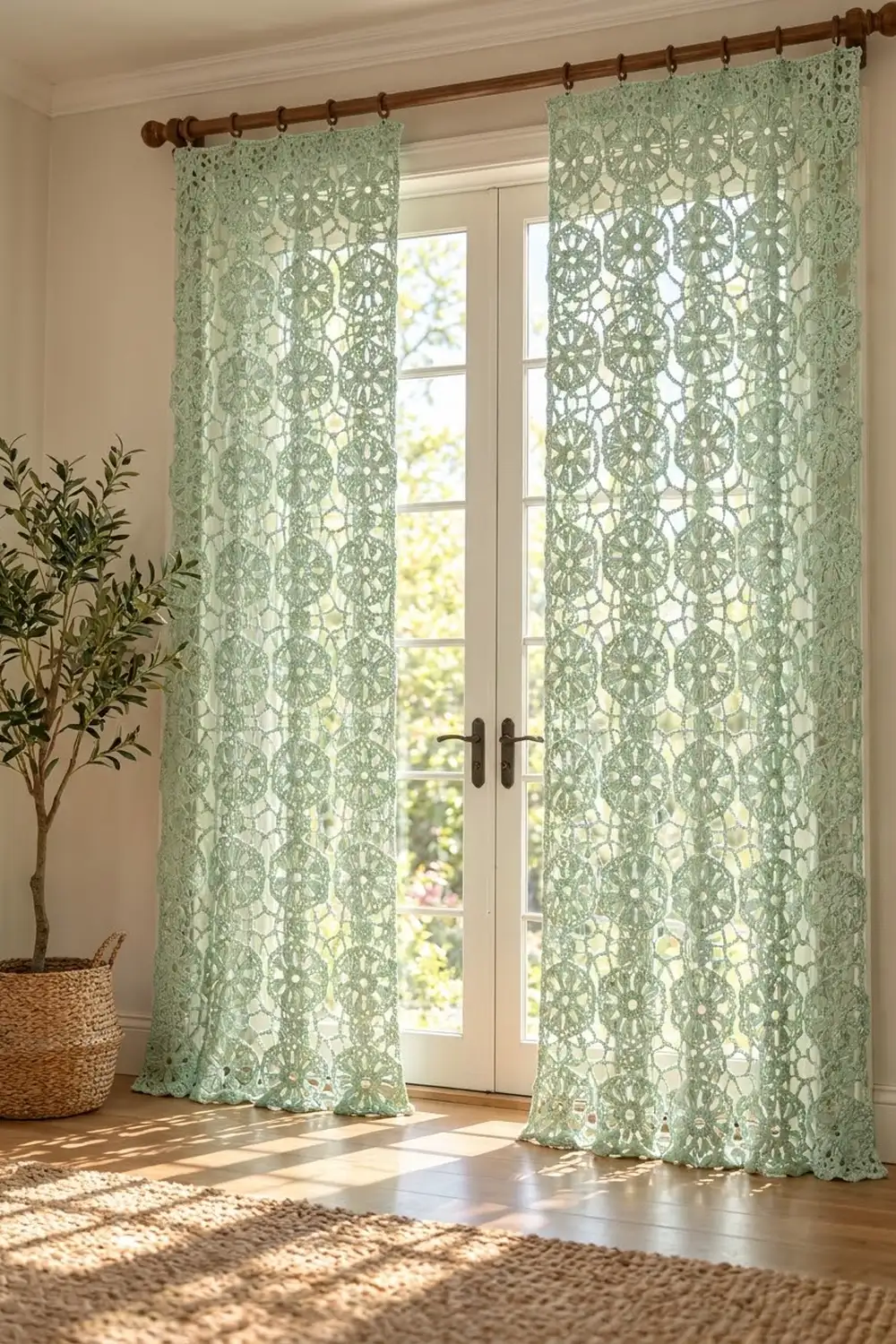
The Seafoam Bloom curtain is a light, airy window panel made of joined hexagon flowers. Each motif has a small open center, a solid ring of double crochet, and six petals of double crochet that open toward the points. When daylight comes through, the panel reads like a soft honeycomb of mint-green blossoms.
The pattern uses a single color, a calm seafoam green in mercerized cotton. Cotton holds the lace texture crisply and drapes well at window length. The style is cottage-meets-modern: simple in color and detailed in texture.
This pattern uses US crochet terms. One finished panel measures 46.3 in (117.6 cm) wide along the top and bottom edges, 49.8 in (126.5 cm) across the widest side points, and 80.1 in (203.5 cm) tall. Make two panels for a pair.
To build it, you crochet full hexagons in the round and half hexagons in rows. You then join them in nine offset columns and finish with a two-round single crochet border. The half hexagons give each panel a straight top and bottom edge.
Finished Size and Construction
- Finished panel size: 46.3 in (117.6 cm) wide at top/bottom edge, 49.8 in (126.5 cm) at widest points, 80.1 in (203.5 cm) tall
- Skill level: Intermediate
- Terminology: US
- Yarn weight: DK / light worsted (#3), cotton
- Hook: 4.0 mm (G-6)
- Number of pieces per panel: 113 full hexagons + 8 half hexagons
- Layout: 9 columns; odd columns hold 13 full hexagons, even columns hold 1 half + 12 full + 1 half
- Full hexagon size: 7 in (17.8 cm) point to point, 6.1 in (15.5 cm) flat to flat, 3.5 in (8.9 cm) per side
- Half hexagon size: 7 in (17.8 cm) long edge, 3.05 in (7.7 cm) tall
- Size before border: 45.5 in (115.6 cm) at top edge, 49 in (124.5 cm) at widest points, 79.3 in (201.4 cm) tall
- Border depth: 0.4 in (1.0 cm)
Materials
Choose a smooth mercerized cotton or cotton blend in DK weight, about 105 m per 50 g. Smooth yarn shows off the stitch definition. A fuzzy yarn would blur the petals and fill the lace holes.
Yarn, per panel (Seafoam green):
– Full hexagons: 113 × 12 g (25 m) = 1,356 g
– Half hexagons: 8 × 6 g (12.6 m) = 48 g
– Joining and border: about 100 g
– Total with margin: 1,650 g (about 3,465 m), or 33 balls of 50 g
– For a pair: 3,300 g (about 6,930 m), or 66 balls
The quantities include a margin of about 10% for gauge differences, swatching, and weaving in ends. Buy all the yarn from one dye lot.
Tools:
– 4.0 mm (G-6) crochet hook
– Tapestry needle
– Stitch markers
– Rust-proof pins and blocking mats
– Spray bottle
– Measuring tape
– 12–14 curtain clip rings per panel
Abbreviations (US Terms)
- ch – chain
- sl st – slip stitch
- sc – single crochet
- dc – double crochet
- sp(s) – space(s)
- st(s) – stitch(es)
- RS / WS – right side / wrong side
Special stitch – Corner (in Round 5): (dc, ch 3, dc) in the same stitch.
Special stitch – Corner group (in Round 6): (2 dc, ch 2, 2 dc) in the same ch-3 space.
Gauge and Checkpoints
Make one full hexagon before anything else, then block it. Gauge is measured on the finished motif:
- Motif gauge: 17 sc per side = 3.5 in (8.9 cm); 7 in (17.8 cm) point to point after blocking.
Checkpoints:
– After Round 2: disk 2.25 in (5.7 cm) across
– After Round 4: about 4.5 in (11.4 cm) across the fans
– After Round 6: 6.5 in (16.5 cm) point to point
– After Round 7: 7 in (17.8 cm) point to point, 3.5 in (8.9 cm) per side
If your motif is too big, go down 0.25–0.5 mm in hook size. If it is too small, go up 0.25–0.5 mm. Even 0.25 in (0.6 cm) of error per motif adds up to more than 3 in (7.6 cm) over 13 motifs, so match gauge before you continue.
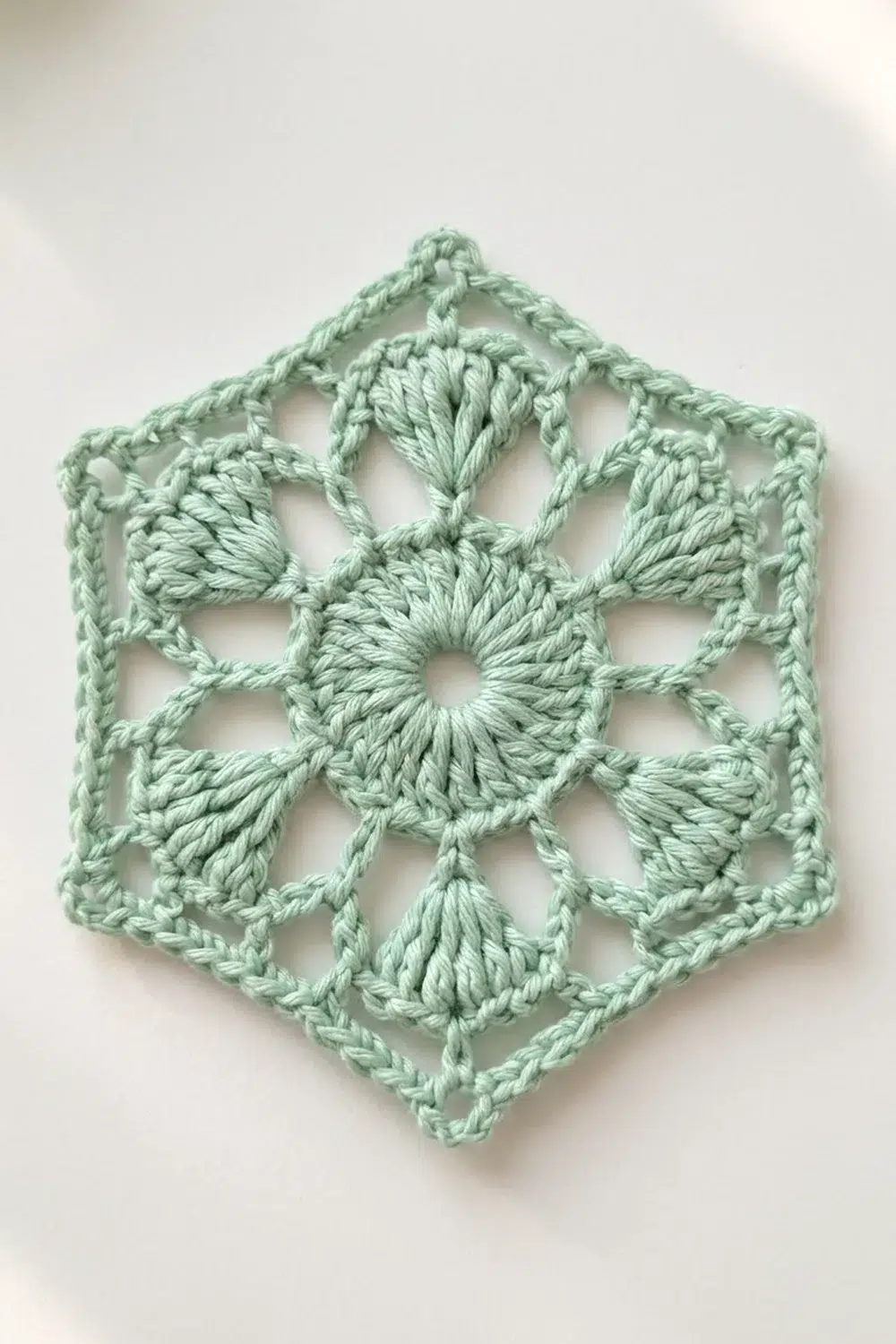
Full Hexagon (Make 113 per panel)
Foundation: Ch 5, sl st to the first ch to form a ring.
Round 1: Ch 3 (counts as dc), 23 dc in ring, sl st to top of ch-3. (24 dc)
Round 2: Ch 3 (counts as dc), dc in same st, dc in next st, 2 dc in next st, dc in next st; repeat from * 10 more times, sl st to top of ch-3. (36 dc)
Round 3: Ch 1, sc in same st, ch 5, skip 5 sts, sc in next st; repeat from * 4 more times, ch 5, skip 5 sts, sl st to first sc. (6 sc, 6 ch-5 loops; 6 × 6 = 36 sts used)
Round 4 (Fans): Sl st into first ch-5 loop, ch 3 (counts as dc), 6 dc in same loop, ch 2, sc in next sc, ch 2, 7 dc in next ch-5 loop; repeat from * 4 more times, ch 2, sc in next sc, ch 2, sl st to top of ch-3. (42 dc in 6 fans, 6 sc, 12 ch-2 sps)
Round 5 (Lattice and corners): Sl st in next 3 dc so that you are in the center (4th) dc of the fan. Ch 6 (counts as dc + ch 3), dc in same st. Ch 4, sc in next sc, ch 4, Corner in center dc of next fan; repeat from * 4 more times, ch 4, sc in next sc, ch 4, sl st to 3rd ch of ch-6. (12 dc, 6 sc, 6 ch-3 corner sps, 12 ch-4 sps)
The fans now sit under the six points. The sc spokes point to the middle of each flat side.
Round 6 (Solid band): Sl st in first ch-3 sp, ch 3 (counts as dc), (dc, ch 2, 2 dc) in same sp. Dc in next dc, 4 dc in ch-4 sp, dc in sc, 4 dc in ch-4 sp, dc in next dc, Corner group in next ch-3 sp; repeat from * 4 more times, dc in next dc, 4 dc in ch-4 sp, dc in sc, 4 dc in ch-4 sp, dc in next dc, sl st to top of ch-3. (90 dc: 6 × 11 between corners + 6 × 4 in corners; 15 dc per side; 6 ch-2 sps)
Round 7 (Edge): Ch 1, sc in first 2 dc, (sc, ch 2, sc) in ch-2 sp, sc in next 15 dc, (sc, ch 2, sc) in next ch-2 sp; repeat from * 4 more times, sc in last 13 dc, sl st to first sc. Fasten off. (102 sc; 17 sc per side, including the sc on each side of the corners; 6 ch-2 corner sps)
Check: 6 sides × 17 = 102. ✓
Half Hexagon (Make 8 per panel)
The half hexagon is worked in turned rows. Each row matches half of a full round, so the three outer sides match the full motif exactly.
Foundation: Ch 5, sl st to form a ring.
Row 1: Ch 3 (counts as dc), 12 dc in ring. Turn. (13 dc)
Row 2: Ch 3 (counts as dc, worked in first st), 2 dc in next st, dc in next st; repeat from * 5 more times. Turn. (19 dc)
Row 3: Ch 5 (counts as dc + ch 2), skip 2 sts, sc in next st, ch 5, skip 5 sts, sc in next st; repeat from * once more, ch 2, skip 2 sts, dc in top of turning ch. Turn. (2 dc, 3 sc, 2 ch-5 loops, 2 ch-2 sps)
Row 4: Ch 3 (counts as dc), 3 dc in ch-2 sp, ch 2, sc in sc, ch 2, 7 dc in ch-5 loop, ch 2, sc in sc, ch 2, 7 dc in ch-5 loop, ch 2, sc in sc, ch 2, 3 dc in turning-ch sp, dc in 3rd ch of turning ch. Turn. (22 dc: half fan 4 + 7 + 7 + half fan 4; 3 sc)
Row 5: Ch 3 (counts as dc), ch 4, sc in sc, ch 4, Corner in center dc of fan, ch 4, sc in sc, ch 4, Corner in center dc of next fan, ch 4, sc in sc, ch 4, dc in top of turning ch. Turn. (6 dc, 3 sc, 6 ch-4 sps, 2 ch-3 sps)
Row 6: Ch 3 (counts as dc), 2 dc in first st, 4 dc in ch-4 sp, dc in sc, 4 dc in ch-4 sp, dc in next dc, Corner group in ch-3 sp, dc in next dc, 4 dc in ch-4 sp, dc in sc, 4 dc in ch-4 sp, dc in next dc, Corner group in ch-3 sp, dc in next dc, 4 dc in ch-4 sp, dc in sc, 4 dc in ch-4 sp, 3 dc in top of turning ch. Turn. (45 dc; 15 per side; 2 ch-2 sps)
Row 7: Ch 1, 2 sc in first dc, sc in next 14 dc, (sc, ch 2, sc) in ch-2 sp, sc in next 15 dc, (sc, ch 2, sc) in ch-2 sp, sc in next 14 dc, 2 sc in top of turning ch. Fasten off. (51 sc; 17 per side)
Check: 3 sides × 17 = 51. ✓ The straight edge is made of row ends and gets its stitches in the border.
Make All Pieces
Per panel, Seafoam green:
– Full hexagons: 113 (5 odd columns × 13 = 65, plus 4 even columns × 12 = 48)
– Half hexagons: 8 (4 even columns × 2)
Turn every hexagon so that it has a flat top and bottom, with points at the left and right. Even columns sit half a motif lower than odd columns.
Layout (F = full, H = half; columns C1–C9):
 C1  C2  C3  C4  C5  C6  C7  C8  C9
 F   H   F   H   F   H   F   H   F
 F   F   F   F   F   F   F   F   F
 ... (rows continue) ...
 F   F   F   F   F   F   F   F   F
     H       H       H       H
 Odd columns: 13 F
 Even columns: H + 12 F + H
Put the half hexagons with the long straight edge facing out: up at the top of the panel and down at the bottom.
Joining
Method: Flat slip-stitch seam from the WS, worked through the back loops only. One sl st joins one pair of matching sc.
Step 1 – Columns. Join the hexagons in each column flat side to flat side. Each seam is 17 sts to 17 sts, sliding the hook through both ch-2 corner sps at each end. Odd columns have 12 seams. Even columns have 13 seams, because each half hexagon’s flat middle side joins the top or bottom side of the end full hexagon.
Step 2 – Columns to columns. Join column 1 to column 2 along the zigzag edge. Each slanted side joins its neighbor 17 sts to 17 sts. Where three motifs meet, sl st through all the ch-2 corner sps that meet there. Continue across until all 9 columns are joined.
Tension: Keep your slip stitches as loose as the motif sc. Tight seams pull the panel narrower and pucker the lace. If needed, go up one hook size for joining.
Checkpoint: Before the border, lay the panel flat. It should measure 45.5 in (115.6 cm) across the top, 49 in (124.5 cm) at the widest side points, and 79.3 in (201.4 cm) tall. Each column is 79.3 in tall: 13 × 6.1 in, or 3.05 + 12 × 6.1 + 3.05 in.
Border
Border gauge: 17 sc = 3.5 in (8.9 cm), the same as the motif edge.
Round 1: With the RS facing, join yarn at the top-left corner. Work sc in each stitch around:
- Top edge (221 sc): On each of the 5 odd-column hexagons, sc in each of the 17 top-side sc (85 sc). Along each of the 4 half-hexagon straight edges, work 34 sc in the row ends (136 sc). Per half of the edge, that is 1 sc in Row 7 end, 3 sc in each end of Rows 6, 5, 4 and 3, and 2 sc in each end of Rows 2 and 1, for 17 per half. Skip the ch-2 corner sps where a full hexagon meets a half hexagon. 85 + 136 = 221.
- Each side edge (442 sc): Column 1 (or column 9) has 13 hexagons × 2 outer slanted sides × 17 sc. At each of the 13 outer points, ch 2 across the corner sp. At each of the 12 valleys, skip the joined corner sps and add nothing.
- Bottom edge (221 sc): Mirror the top edge.
- Panel corners: Ch 2 across each of the 4 corner sps.
Sl st to first sc. (1,326 sc: 221 + 442 + 221 + 442; 30 ch-2 sps: 4 corners + 26 side points)
Round 2: Ch 1, sc in each sc around, 3 sc in each ch-2 sp. Sl st to first sc and fasten off. (1,416 sc: 1,326 + 30 × 3)
Why the math works: Every edge stitch comes from a motif’s own count of 17 per side, or 34 per half-hexagon edge, and nothing is added at the seams. So the border has the same 4.86 sc per inch as the motifs: 221 sc ÷ 45.5 in = 4.86. That means the edges lie flat without ruffling or cupping. The 3 sc in each corner and point give the extra stitches needed to turn the corner.
Final Blocking
- Weave in all ends along the solid dc bands, where they hide best.
- Wet the panel in cool water, gently press out the water, and roll it in towels.
- Lay it flat on mats, RS up.
- Pin the top edge straight at 46.3 in (117.6 cm).
- Pin the sides to 80.1 in (203.5 cm), pinning each outer point to 49.8 in (126.5 cm) wide.
- Open each motif’s center ring and pull each fan gently toward its point.
- Mist again if needed and let it dry completely before unpinning.
- Attach clip rings evenly along the top edge, about 3.5–4 in (8.9–10.2 cm) apart.
Final Quality-Control Checklist
- Every full motif has 102 sc, and every half motif has 51 sc
- All 6 fans sit under the points, not under the flat sides
- Seams are flat, with no visible ridges on the RS
- Top and bottom edges are straight and measure 46.3 in (117.6 cm)
- Height is 80.1 in (203.5 cm) on both sides
- Border Round 2 count is 1,416 sc
- No loose ends show through the lace
- For a pair, both panels match within 0.5 in (1.3 cm)
Troubleshooting
Motif cups: Round 6 is too tight. Go up a hook size for Rounds 6–7.
Motif ruffles: Too many stitches, or loose chains in Round 5. Recount Round 6 (15 dc per side) and tighten your ch-4s.
Fans lean sideways: Your Corner was not placed in the 4th (center) dc. Check your sl st count at the start of Round 5.
Half hexagon doesn’t fit: Recount Row 7, which should have 17 per side, and check that Rows 1–2 are 13 and 19 dc.
Top edge waves: You worked too many sc in the half-hexagon row ends. Go back to exactly 34 per half hexagon.
Panel sags in length: Cotton relaxes with weight. Block on a flat surface and don’t hang the panel while it is damp.
Care
Hand wash cool, or machine wash in a mesh bag on a delicate cycle. Dry flat and reblock lightly if the points lose their shape.
Final Notes
The whole curtain comes down to one number: 17 sc per side at 3.5 in (8.9 cm). That makes each motif 7 in (17.8 cm) point to point and 6.1 in (15.5 cm) flat to flat. Thirteen motifs stacked give 79.3 in (201.4 cm). Nine offset columns give 45.5 in (115.6 cm) across the top. Two border rounds add 0.4 in (1.0 cm) on every side, for a finished 46.3 × 80.1 in (117.6 × 203.5 cm) panel. If you match the first motif, the rest will fit.
Happy crocheting!