

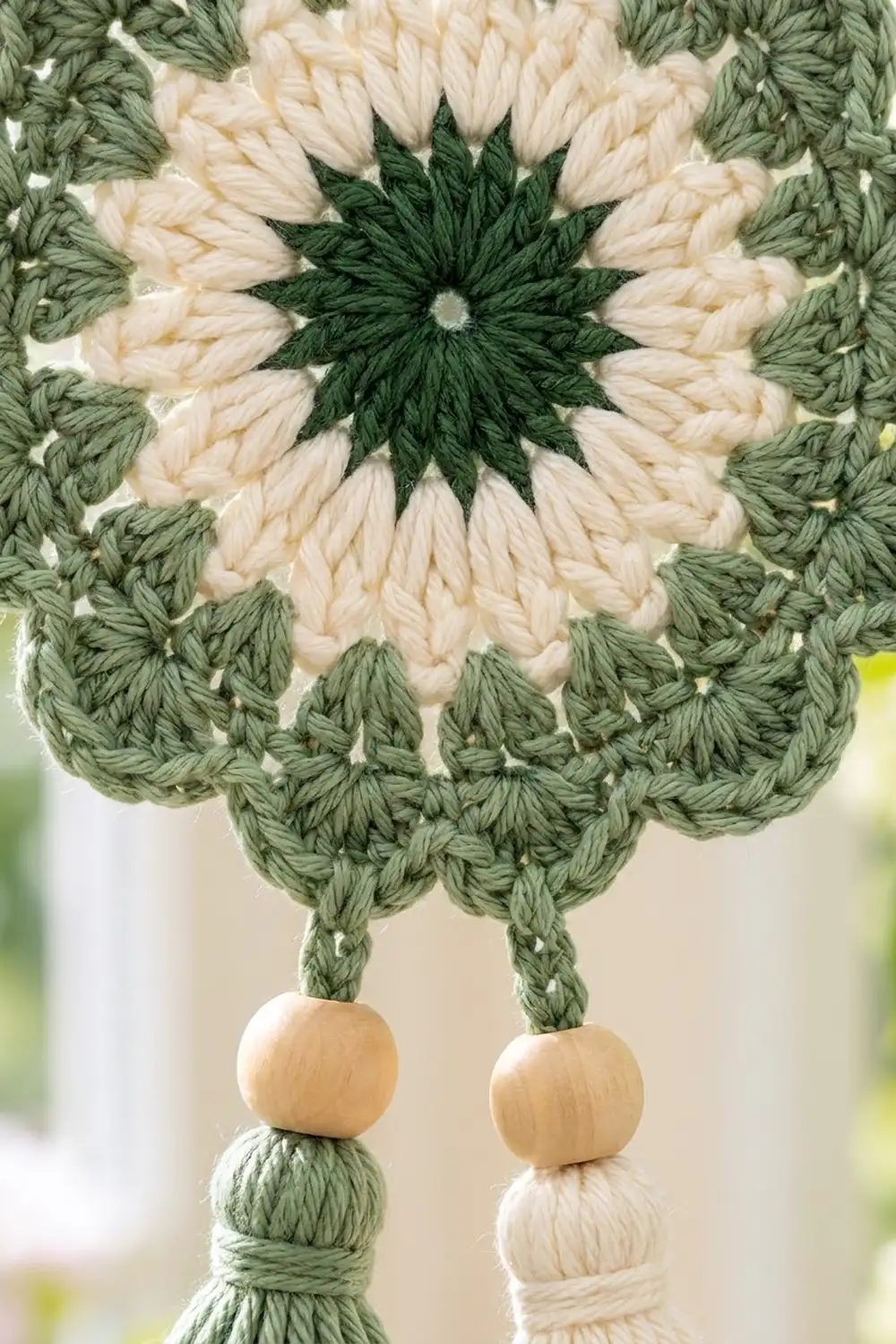
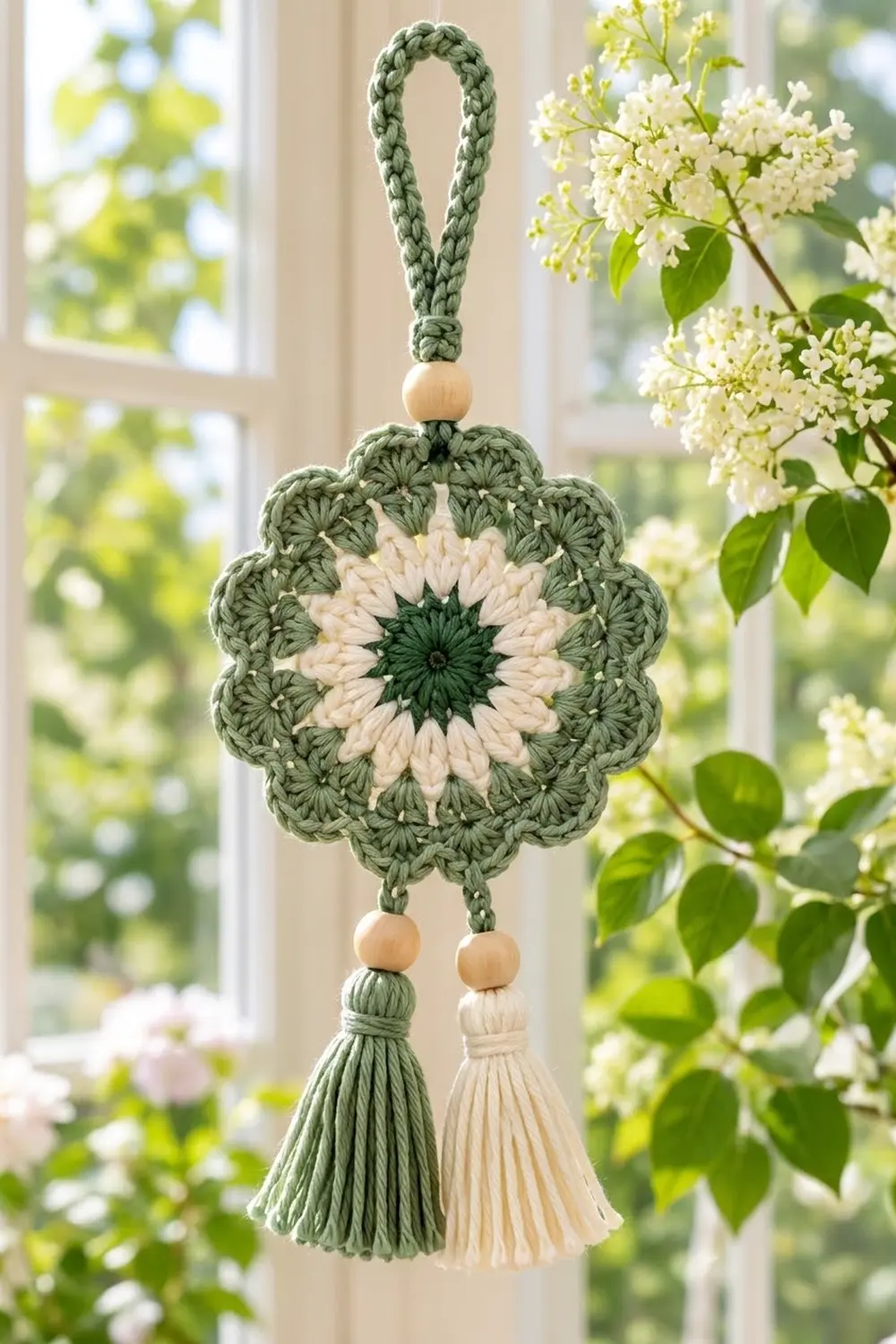
The Sage Blossom Mandala is a small, calm wall hanging built from one round motif. It has a deep forest-green center, a ring of 16 cream petals and a soft sage scalloped edge. A slip-stitch cord loop, three natural wooden beads and two plump tassels make it a hanging you can put in a window, on a wall hook or on a door handle.
The colors are three greens and a cream: dark forest green, sage green and warm cream. The style is boho and botanical, quiet enough for a neutral room and fresh enough for spring. All instructions use US crochet terms.
The finished motif is 4.75 in (12.1 cm) across. The full hanging, from the top of the loop to the tassel ends, is about 12.75 in (32.4 cm) long.
Construction is simple. You work the motif in five joined rounds, changing color for the center, petals and outer rounds. The last round is the scalloped border. Then you make one hanging cord and two short tassel cords, add beads, make two tassels and sew everything to the back of the motif.
Finished Size and Construction
- Finished motif size: 4.75 in (12.1 cm) diameter
- Total hanging length: about 12.75 in (32.4 cm)
- Skill level: Easy / advanced beginner
- Terminology: US crochet terms
- Yarn weight: DK (light worsted, #3), cotton or cotton blend
- Hook: 4.0 mm (US G-6)
- Number of pieces: 1 motif, plus 3 cords and 2 tassels as trims
- Layout: single motif, loop at top, two tassels at bottom
- Motif size before border: 3.75 in (9.5 cm) diameter after Round 4
- Border depth: 0.5 in (1.3 cm), one scallop round
Materials
Choose a smooth, mercerized or matte cotton in DK weight. Cotton holds the scallops crisp, blocks flat and makes tassels that hang straight. Avoid fuzzy yarns, because they hide the petal shapes.
- Color A, dark forest green: 3 g, about 7 m (center)
- Color B, cream: 10 g, about 23 m (petals and one tassel)
- Color C, sage green: 20 g, about 46 m (outer rounds, all cords and one tassel)
Quantities include a margin of about 20% for gauge swatches, tails and tassel trimming.
Tools:
- 4.0 mm (US G-6) crochet hook
- 3 natural wooden beads, 12 mm, with holes large enough for two strands of yarn
- Tapestry needle
- Scissors
- Stiff card 3.25 in (8.3 cm) tall, for tassels
- Rust-proof pins and a blocking mat or folded towel
- Spray bottle with water
Abbreviations (US Terms)
- ch – chain
- sl st – slip stitch
- sc – single crochet
- dc – double crochet
- st(s) – stitch(es)
- sp – space
- sk – skip
- beg – beginning
- rep – repeat
Special stitches:
- 3-dc cluster (cl): *Yarn over, insert hook in indicated st, yarn over and pull up a loop, yarn over and pull through 2 loops; rep from * 2 more times in the same st (4 loops on hook), yarn over and pull through all 4 loops.
- Beg cluster (beg cl): Ch 3, then work a 2-dc cluster in the same st (as above, but only 2 times, then pull through all 3 loops). Together these count as 1 cluster.
- Shell: 7 dc worked in the same st.
Gauge and Checkpoints
Gauge: 18 dc = 4 in (10.2 cm) worked flat with a 4.0 mm hook. Because this is a round motif, the round checkpoints below are a better test than a flat swatch.
Work Rounds 1 to 3 first and measure on a flat surface before you go on. Measure straight across the center from edge to edge.
| After round | Diameter |
|---|---|
| Round 1 | 1.1 in (2.8 cm) |
| Round 2 | 2 in (5.1 cm) |
| Round 3 | 3 in (7.6 cm) |
| Round 4 | 3.75 in (9.5 cm) |
| Round 5 (border) | 4.75 in (12.1 cm) |
Too big? Change to a 3.5 mm hook and start again. Too small? Change to a 4.5 mm hook.
Rippling means your tension is loose or you added stitches by mistake; count again. Cupping means your tension is tight; relax your grip or go up a hook size. A slight cup in Round 3 often flattens after Round 4, so check again once Round 4 is done.
Motif Pattern
All rounds are worked with the right side facing. Do not turn.
Round 1 – Center (Color A, dark forest green)
Make a magic ring.
Ch 3 (counts as first dc), work 15 dc into the ring. Pull the ring tight. Sl st to the top of the beg ch-3.
Stitch count: 16 dc.
Fasten off and leave a 6 in (15.2 cm) tail. Checkpoint: 1.1 in (2.8 cm). The disc should be solid, with only a tiny hole in the middle.
Round 2 – Petals (Color B, cream)
Join Color B with a sl st in any dc.
Beg cl in the same st, ch 2. *Cl in next dc, ch 2; rep from * 14 more times. Sl st to the top of the beg cl.
Stitch count: 16 clusters and 16 ch-2 sps.
Fasten off. Each cluster is one pointed cream petal, and the ch-2 spaces make the V-shaped gaps between them. Checkpoint: 2 in (5.1 cm).
Round 3 – Petal Wedges (Color C, sage)
Join Color C with a sl st in any ch-2 sp.
Ch 3 (counts as first dc), 2 dc in the same sp. Work 3 dc in each remaining ch-2 sp around (15 more sps). Sl st to the top of the beg ch-3.
Stitch count: 48 dc (16 groups of 3).
Do not fasten off. The 3-dc groups sit in the V-gaps and form sage wedges between the cream petal tips. The tips of the clusters show between the groups. Checkpoint: 3 in (7.6 cm).
Round 4 – Solid Band (Color C, sage)
This is a growth round.
Ch 3 (counts as first dc), dc in the next 2 sts, 2 dc in the next st. *Dc in the next 3 sts, 2 dc in the next st; rep from * 10 more times. Sl st to the top of the beg ch-3.
Stitch count: 60 dc. That is 12 repeats of 5 stitches each, made by adding 1 stitch to every 4 stitches of Round 3.
Do not fasten off. Checkpoint: 3.75 in (9.5 cm). This is the motif size before the border.
Border – Scalloped Edge (Round 5, Color C)
Border gauge: each scallop takes 5 stitches of Round 4 and measures about 1.25 in (3.2 cm) along the outer edge after blocking.
Round 5: Ch 1. Sc in the first st, sk 1 st, shell (7 dc) in the next st, sk 1 st, sc in the next st. *Sc in the next st, sk 1 st, shell in the next st, sk 1 st, sc in the next st; rep from * 10 more times. Sl st to the first sc.
Stitch count: this round trims the edge into scallops. It uses 36 of the 60 Round 4 stitches and skips 24. You work 24 sc one-for-one into existing stitches, then add 12 shells of 7 dc each (84 dc). The total is 24 + 84 = 108 sts, which makes 12 scallops.
Fasten off and weave in all ends on the wrong side.
Why the math works: each repeat uses exactly 5 stitches: sc, skip, shell stitch, skip, sc. Round 4 has 60 stitches, and 60 ÷ 5 = 12, so the repeat fits exactly with no leftover stitches. Two sc meet at each join between scallops, which gives a neat, deep notch. Each shell of 7 dc is wide enough to flare into a round scallop without ruffling. The border adds 0.5 in (1.3 cm) all around, so the diameter grows from 3.75 in (9.5 cm) to 4.75 in (12.1 cm).
Cords, Beads and Tassels
Hanging Loop Cord (Color C)
Ch 46. Sl st in the back bump of the 2nd ch from the hook and in the back bump of each ch across.
Stitch count: 45 sl sts. The cord measures about 8 in (20.3 cm). Fasten off and leave 8 in (20.3 cm) tails at both ends.
Fold the cord in half. With a separate 12 in (30.5 cm) strand of Color C, wrap tightly 5 times around both layers, 3 in (7.6 cm) below the fold. This closes off the loop. Thread the wrap tails through the wrapping with a needle so they are hidden.
Thread both cord ends through one wooden bead and slide the bead up under the wrap.
Tassel Cords (Color C), make 2
Ch 7. Sl st in the back bump of the 2nd ch from the hook and in each ch across.
Stitch count: 6 sl sts per cord, about 1 in (2.5 cm) long. Leave a 6 in (15.2 cm) tail at both ends. Thread one wooden bead onto each cord.
Tassels, make 1 in Color C and 1 in Color B
- Wrap yarn 25 times around the 3.25 in (8.3 cm) card.
- Slide a 6 in (15.2 cm) tie strand under the wraps at the top edge of the card and knot it tightly. Also tie the bottom end of one tassel cord into this knot.
- Cut the wraps along the bottom edge of the card.
- Wrap a 12 in (30.5 cm) strand 5 times around the tassel, 0.5 in (1.3 cm) below the top, and knot it. Bury the ends inside the tassel.
- Trim the ends evenly so the tassel is 3 in (7.6 cm) long.
Slide each bead down onto the top of its tassel.
Attaching
Hold the motif with the right side facing and pick one scallop as the top center.
- Top loop: Sew both cord ends to the back of the 4th dc of the top scallop so the bead sits right above the edge. Secure the ends well, because this point carries all the weight.
- Tassels: On the opposite side, find the bottom scallop (6 scallops away from the top). Sew one tassel cord to the sc notch on each side of it, about 1.2 in (3 cm) apart. Put the sage tassel on the left and the cream tassel on the right.
Final Blocking
- Weave in any loose ends before blocking.
- Lay the motif face up on a blocking mat or folded towel.
- Spray it evenly until damp, but not dripping.
- Pat it flat with your palms, keeping the center disc level.
- Pin it to a 4.75 in (12.1 cm) circle. Put one pin at the center of each scallop (12 pins) and nudge each scallop into a rounded arc.
- Shape the cream petals with your fingertips so each point faces straight out from the center.
- Leave it to dry completely, about 4 to 6 hours.
- Steam the tassels lightly and comb them straight with your fingers. Trim again if needed.
Final Quality-Control Checklist
- Round 1 has 16 dc and the center hole is tight.
- Round 2 has 16 cream petals, evenly spaced.
- Round 3 has 48 dc in 16 groups of 3, one in every V-gap.
- Round 4 has 60 dc and lies flat at 3.75 in (9.5 cm).
- Round 5 has 12 scallops and 108 stitches.
- The blocked motif measures 4.75 in (12.1 cm) across.
- The top bead sits right above the top scallop and the loop is 3 in (7.6 cm) long.
- The tassels are 3 in (7.6 cm) long, even and evenly trimmed.
- The full hanging measures about 12.75 in (32.4 cm).
- No ends show on the right side.
Troubleshooting
The petals lean to one side. Your ch-2 spaces may be too tight. Make each chain the same height as the cluster’s first loop.
The motif cups after Round 3. Your tension is tight. Finish Round 4 and check again, or go up a hook size.
The edge ruffles. Check that you skipped 1 stitch on both sides of every shell and have 12 scallops. If your tension is loose, use 6 dc per shell instead of 7.
There are 11 or 13 scallops. Round 4 does not have 60 stitches. Undo the border and count again.
The hanging tilts. The loop is not sewn at the exact top center. Move it to the middle dc of the scallop directly opposite the gap between the tassels.
The tassel cord won’t go through the bead. Use a bead with a larger hole, or pull the cord through with a loop of thread.
The tassels look thin. Use 30 wraps instead of 25.
Care
Hand wash in cool water, press out the water gently in a towel and dry flat, pinning it back into shape if needed. Comb the tassels with your fingers while they are damp.
Final Notes
The measurement chain is easy to follow. A 16-stitch center measures 1.1 in (2.8 cm), and the petals bring it to 2 in (5.1 cm). The wedges bring it to 3 in (7.6 cm), and the 60-stitch band brings it to 3.75 in (9.5 cm). Twelve 5-stitch scallop repeats bring the finished motif to 4.75 in (12.1 cm). Add a 3 in (7.6 cm) loop, the beads, short cords and 3 in (7.6 cm) tassels, and the finished hanging is about 12.75 in (32.4 cm) long.
Check your size at each round, block the scallops carefully, and you will have a small, lasting piece of sage-and-cream calm for any window.
Happy crocheting!