

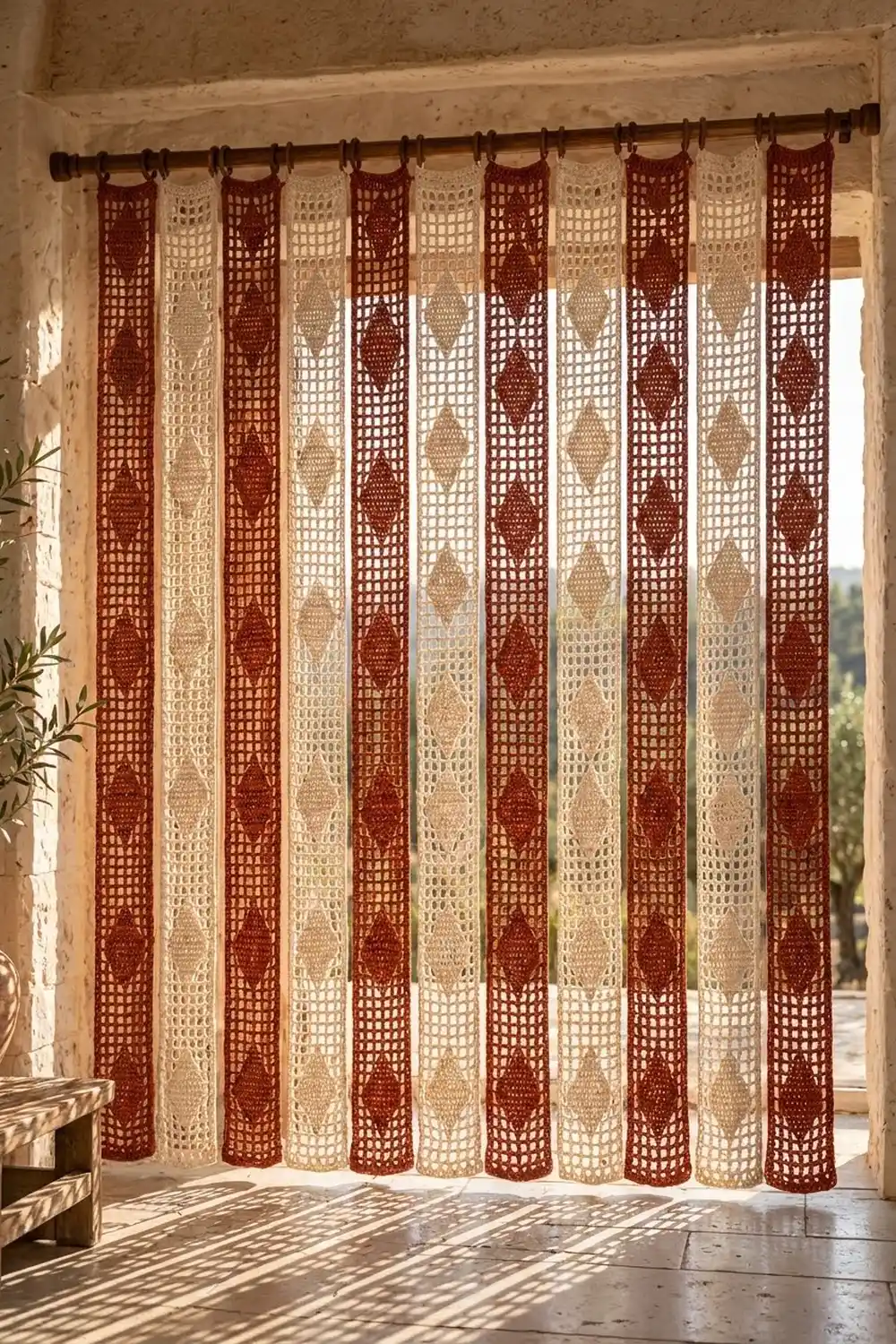
This strip curtain is made of long, airy filet mesh panels, each with a column of solid diamonds down the center. Sunlight shows through the open squares, and the filled diamonds show up as soft, warm shapes. It looks relaxed, earthy, and a little Mediterranean.
The curtain alternates five rust (terracotta) strips with five natural cream strips. Every strip is crocheted in a single color, so you never carry yarn or change colors partway through.
This pattern uses US crochet terms. Each finished strip measures 5.9 in (15.0 cm) wide and 68.9 in (175.0 cm) long after the border. Hung with 1 in (2.5 cm) gaps between them, the ten strips cover about 68 in (172.7 cm) of rod.
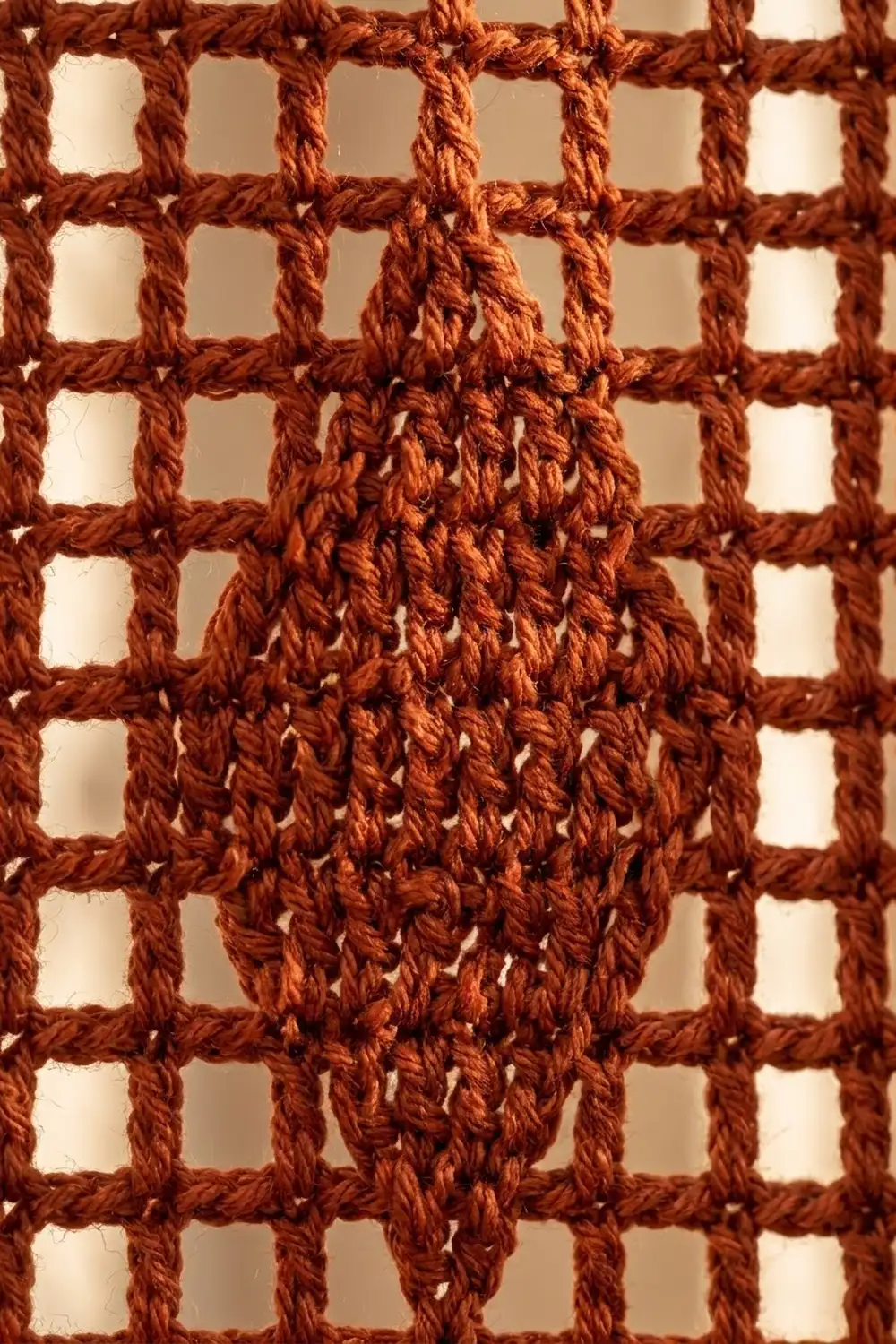
Each strip is worked flat in rows of double crochet filet mesh, 9 squares wide. Diamonds are charted into the mesh as solid blocks. One round of single crochet neatens all four edges, and two chain loops at the top corners hang the strip from curtain rings. The strips are not seamed together.
Finished Size and Construction
- Finished strip size: 5.9 x 68.9 in (15.0 x 175.0 cm)
- Skill level: Easy to intermediate (you’ll need to read a simple filet layout)
- Terminology: US crochet terms
- Yarn weight: DK / light (#3) cotton
- Hook: 4.0 mm (US G-6)
- Number of pieces: 10 separate strips (5 rust, 5 cream)
- Layout: 10 strips side by side in alternating colors, not joined
- Piece size before border: 9 meshes x 114 rows = 5.4 x 68.4 in (13.7 x 173.7 cm)
- Border depth: 1 round of sc, about 0.25 in (0.6 cm) on each edge
- Motif: 10 diamonds per strip, each 7 meshes wide and 7 rows tall, 4.2 x 4.2 in (10.7 x 10.7 cm)
Materials
Use a smooth, mercerized or combed cotton in DK weight. Cotton holds the square grid crisply, stretches less than acrylic when hanging, and handles sun and washing well. Avoid fuzzy or very splitty yarns, because they blur the mesh.
Yarn (based on DK cotton at about 115 m per 50 g):
- Rust / terracotta: 500 g (1150 m), for 5 strips
- Natural cream: 500 g (1150 m), for 5 strips
Each strip uses about 85 g (about 195 m). The quantities above include a margin for your gauge swatch, small tension differences, and the hanging loops.
Tools:
- 4.0 mm (US G-6) crochet hook
- Tapestry needle
- Locking stitch markers
- Measuring tape
- Rust-proof pins and a long blocking surface (foam mats or a clean towel on the floor)
- 20 curtain rings, 2 per strip, and a curtain rod about 72 in (182.9 cm) long
Abbreviations (US Terms)
- ch: chain
- sl st: slip stitch
- sc: single crochet
- dc: double crochet
- sk: skip
- sp: space
- st(s): stitch(es)
Filet stitch definitions:
- Beginning (beg) ch-5: Ch 5 (counts as dc + ch 2), sk first 2 sts or ch-2 sp, dc in next dc. This makes mesh 1, which is always open.
- Open mesh (OM): Ch 2, sk 2 sts (or the ch-2 sp), dc in next dc.
- Block over open mesh (B): 2 dc in next ch-2 sp, dc in next dc.
- Block over block (B): Dc in each of next 2 dc, dc in next dc.
- Open mesh over block (OM): Ch 2, sk next 2 dc, dc in next dc.
The last dc of every row goes into the 3rd ch of the previous row’s beg ch-5. In Row 2, that’s the 3rd of the 7 skipped foundation chains.
Each row has 28 working stitches: 10 dc posts plus 9 two-stitch fillings, either ch-2 spaces or pairs of dc. A block swaps a ch-2 for 2 dc, so the count stays at 28 in every row.
Gauge and Checkpoints
Gauge: 10 meshes x 10 rows = 6 in (15.2 cm) square in filet mesh. One mesh is 0.6 x 0.6 in (1.5 x 1.5 cm).
Square meshes matter most here. If they come out tall and narrow, the diamonds will look stretched, so measure height as well as width.
Test one strip first. Work Rows 1 through 15 (four open rows, one diamond, four open rows) and measure before committing to all ten strips.
- After Row 4: 5.4 in (13.7 cm) wide, 2.4 in (6.1 cm) tall
- After Row 11 (first diamond): 6.6 in (16.8 cm) tall; the diamond is 4.2 in (10.7 cm) wide
- After Row 55 (fifth diamond): 33.0 in (83.8 cm) tall
- After Row 114: 68.4 in (173.7 cm) tall
- After border: 5.9 x 68.9 in (15.0 x 175.0 cm)
If your strip is too big, go down to a 3.75 mm hook. If it’s too small, go up to a 4.5 mm hook. If the width is right but rows run tall, pull each dc up a little less and keep the ch-2 snug. Over 114 rows, an extra 0.05 in (0.1 cm) per row adds 5.7 in (14.5 cm) of length.
The Strip
Make the whole strip in one color, turning at the end of every row. The first and last meshes of every row are always open, so you’ll never start or end a row with a block.
Foundation: Ch 32.
Row 1 (open): Dc in 8th ch from hook. The 7 skipped chs count as dc + ch 2 + 2 skipped chs, which makes mesh 1. Ch 2, sk 2 ch, dc in next ch. Repeat from * to * 8 times. Turn. (9 OM; 28 sts)
Rows 2-4 (open): Beg ch-5, OM 8 times. Turn. (9 OM; 28 sts)
Diamond Rows
Number the meshes 1 to 9 across the row; the beg ch-5 always makes mesh 1. The diamond is symmetrical, so these instructions read the same in both directions.
Row 5: Beg ch-5, OM 3 times, B 1 time (mesh 5), OM 4 times. Turn. (1 block, 8 OM; 28 sts)
Row 6: Beg ch-5, OM 2 times, B 3 times (meshes 4-6), OM 3 times. Turn. (3 blocks, 6 OM; 28 sts)
Row 7: Beg ch-5, OM 1 time, B 5 times (meshes 3-7), OM 2 times. Turn. (5 blocks, 4 OM; 28 sts)
Row 8: Beg ch-5, B 7 times (meshes 2-8), OM 1 time. Turn. (7 blocks, 2 OM; 28 sts)
Row 9: Repeat Row 7. (5 blocks; 28 sts)
Row 10: Repeat Row 6. (3 blocks; 28 sts)
Row 11: Repeat Row 5. (1 block; 28 sts)
For each mesh, use the definition that matches what’s below it: block over open, block over block, or open over block.
Repeat Section
Rows 12-15 (open): Repeat Row 2 four times. (9 OM; 28 sts)
Rows 16-110: Repeat Rows 5-15 eight more times, then work Rows 5-11 once more. This gives 10 diamonds in total, with 4 open rows between each pair. Diamond number k sits in Rows (11k − 6) to 11k, so the 10th diamond is in Rows 104-110.
Rows 111-114 (open): Repeat Row 2 four times. (9 OM; 28 sts)
Don’t fasten off. Continue straight into the border.
Row check: 4 open + (10 diamonds x 7 rows) + (9 gaps x 4 rows) + 4 open = 4 + 70 + 36 + 4 = 114 rows. At 0.6 in (1.5 cm) per row, that’s 68.4 in (173.7 cm).
Make All Pieces
Make 10 identical strips:
- Rust: 5 strips
- Cream: 5 strips
Layout on the rod, viewed from inside the room (R = rust, C = cream):
| R | C | R | C | R | C | R | C | R | C |
  1   2   3   4   5   6   7   8   9  10
Keep a tally of finished strips by color. Measure every strip at Row 55 so all ten end up the same length.
Joining
The strips are not joined to each other. They hang free, so they can move and light can pass between them.
The rod is their only shared connection. Each strip gets 2 hanging loops (made in the Border section) and 2 rings. Spacing:
- Strip width: 5.9 in (15.0 cm)
- Gap between strips: 1 in (2.5 cm)
- Total width: (10 x 5.9 in) + (9 x 1 in) = 59 + 9 = 68 in (172.7 cm)
Tension advice: Work the hanging loops at the same tension as your foundation chain. Tight loops are hard to fit over the rings, and loose ones make strips hang at slightly different heights.
Size checkpoint: Before hanging, lay all ten blocked strips side by side. Their lengths should match within 0.5 in (1.3 cm).
Border
Border gauge: On the short edges, work 1 sc per stitch. On the long edges, work 2 sc around each dc row-end post. A dc row is 0.6 in (1.5 cm) tall, and 2 sc fill that height without ruffling or pulling in.
Round 1: With the last row still on your hook, ch 1, turn.
- Top edge: 3 sc in first dc (corner), 2 sc in next ch-2 sp, sc in next dc 8 times, 2 sc in last ch-2 sp, 3 sc in 3rd ch of beg ch-5 (corner). Count: 28 sts worked 1 per stitch + 4 extra corner sc = 32 sc. This total already includes both 3-sc corner groups.
- First long edge: Working down the side, 2 sc around each row-end post of Rows 114 to 1 = 114 x 2 = 228 sc.
- Bottom edge: Working into the foundation chain: 3 sc in first ch (corner), 2 sc in next ch-2 sp, sc in base of next dc 8 times, 2 sc in last ch-2 sp, 3 sc in last ch (corner). Count: 28 + 4 = 32 sc.
- Second long edge: 2 sc around each row-end post of Rows 1 to 114 = 228 sc.
Join with sl st to the first sc. Round total: 32 + 228 + 32 + 228 = 520 sc.
The corner groups are counted only with the short edges. The long edges have no corner stitches, so nothing is counted twice.
Hanging loops: Sl st in the next sc, which is the center of the first top corner group. Ch 12, then sl st in the same sc to make a loop about 1.5 in (3.8 cm) long. Sl st in each sc across the top edge to the center sc of the second corner group. Ch 12 and sl st in the same sc. Fasten off and weave in the ends.
Why the math works: The strip is 28 sts across, and 28 sc plus 4 corner extras turn the corners without cupping. The long edge has 114 rows x 2 sc = 228 sc over 68.4 in (173.7 cm). That’s about 3.3 sc per inch (1.3 per cm), which matches the height of 2 sc beside one dc. The single round adds 0.25 in (0.6 cm) to each edge: 5.4 + 0.5 = 5.9 in (15.0 cm), and 68.4 + 0.5 = 68.9 in (175.0 cm).
Final Blocking
- Weave in all ends along solid sc or block stitches, never across open meshes.
- Soak each strip in cool water for 15 minutes, then gently squeeze out the water. Don’t wring it.
- Roll the strip in a towel to remove more water.
- Lay it flat on a long blocking surface and pin it to 5.9 x 68.9 in (15.0 x 175.0 cm).
- Pin both long edges every 3 in (7.6 cm) in straight lines, using a measuring tape as a guide.
- Nudge each mesh square into shape with your fingers, especially the open squares around the diamond points.
- Let it dry completely, then unpin it.
- Block all ten strips to the same pin lines so the lengths match.
Final Quality-Control Checklist
- Every row has 28 sts and 9 meshes.
- Each strip has 114 rows and 10 diamonds.
- Each diamond is 7 rows tall, with blocks in rows of 1, 3, 5, 7, 5, 3, 1, centered on mesh 5.
- There are 4 open rows before the first diamond, between each pair of diamonds, and after the last diamond.
- The border round has 520 sc: 32 + 228 + 32 + 228.
- Each strip measures 5.9 x 68.9 in (15.0 x 175.0 cm) after blocking.
- Each strip has 2 hanging loops at the top corners, each 1.5 in (3.8 cm) long.
- You have 5 rust and 5 cream strips, all the same length within 0.5 in (1.3 cm).
Troubleshooting
The diamond is off-center. You probably counted blocks from the wrong mesh. Remember that the beg ch-5 is mesh 1.
The edge stitches gap or slant. Make sure the final dc of each row goes into the 3rd ch of the beg ch-5, not into the ch-2 space.
The strip is getting narrower. You may be skipping the last dc. Count the 10 dc posts every few rows.
The long edges ruffle after the border. Your sc are too loose. Go down half a hook size for the border only, or work 3 sc in every 2 row ends.
The long edges pull in. Loosen your tension, or go up half a hook size for the border.
Strips hang at different lengths. Re-block the long one shorter and the short one longer.
A strip stretches a lot when hung. Some cotton grows under its own weight. Hang each strip for a day before final measuring, then re-block if needed.
Care
Hand wash in cool water with mild detergent, then dry flat and re-pin to the blocked size. Take the strips off the rod before washing so the hanging loops don’t stretch.
Final Notes
The measurement chain is simple and repeats all the way down. One mesh is 0.6 in (1.5 cm) square. Nine meshes give 5.4 in (13.7 cm) of width, and 114 rows give 68.4 in (173.7 cm) of length. One sc border round brings each strip to 5.9 x 68.9 in (15.0 x 175.0 cm). Ten strips with 1 in (2.5 cm) gaps fill about 68 in (172.7 cm) of rod.
If you hit gauge on the first 15 rows, the rest of the strip will follow. Check Row 55 on every strip and block all ten to the same pins, and your curtain will hang straight and even.
Happy crocheting!