

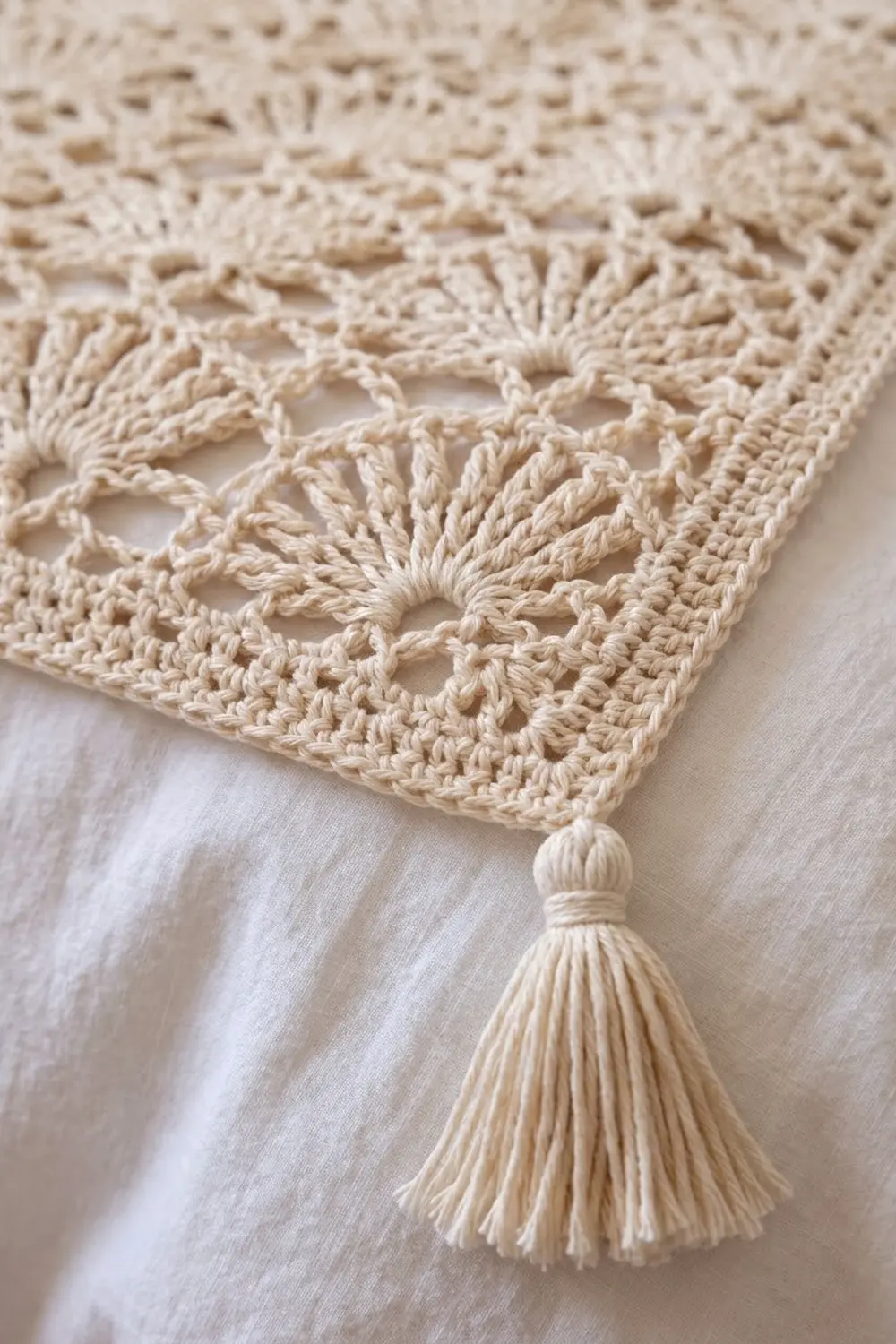
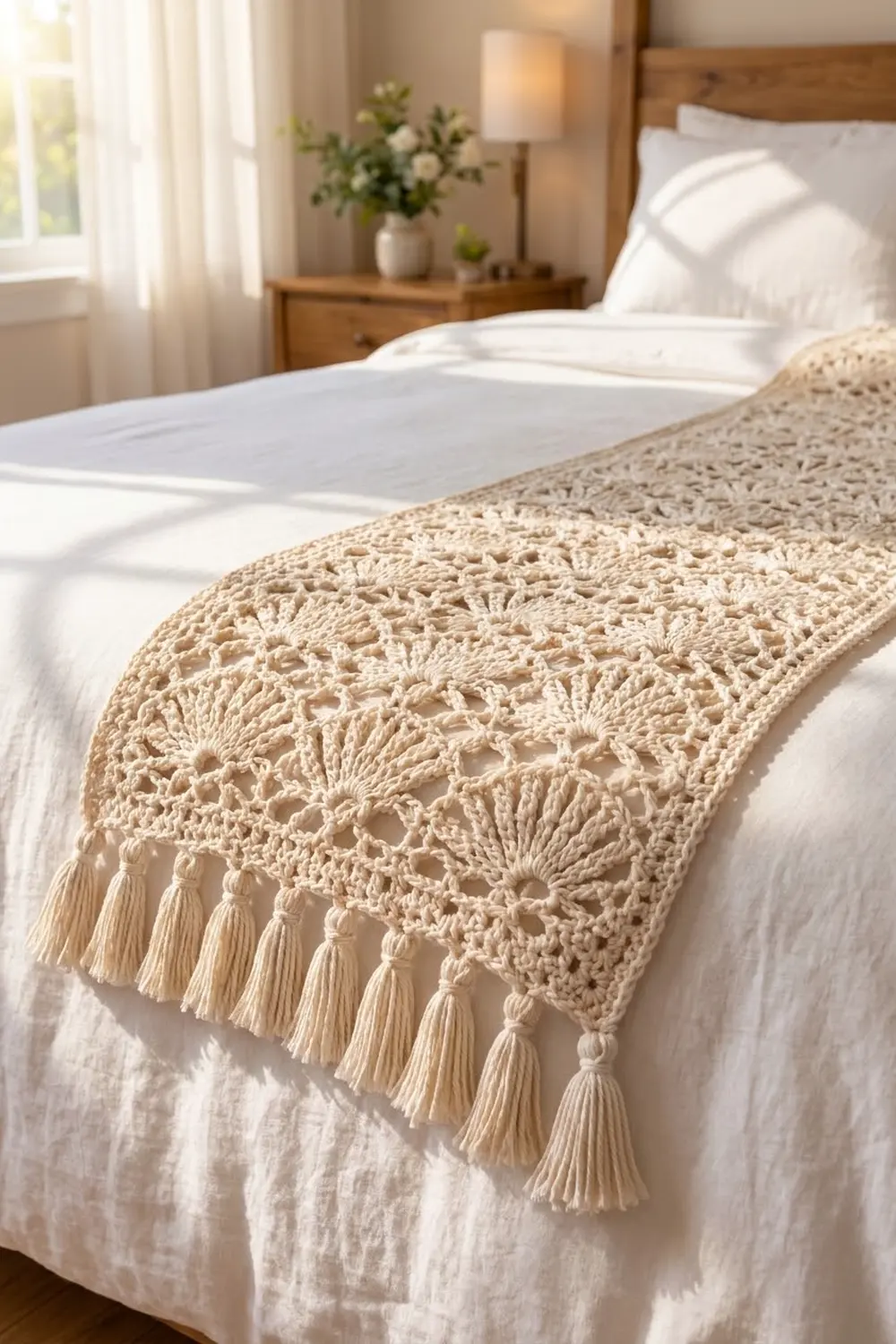
This bed runner is a long cream rectangle covered in fan lace that looks like seashells. Rows of airy fans alternate with rows of chain arches, and each fan row is shifted half a fan to the side. A solid band of double crochet frames the lace, and a row of chunky tassels hangs over the foot of the bed.
The design uses one color, a soft cream cotton, so the lace stands out. It suits farmhouse, coastal, or neutral bedrooms and looks good on a white duvet.
The runner is worked in one piece, flat, in rows that run along its length. A border is worked around all four sides, and the tassels are tied to one long edge. Finished size is 17.75 in (45.1 cm) wide by 60.5 in (153.7 cm) long, not counting the tassels. The pattern uses US crochet terms throughout.
Construction overview: chain the full length, work the fan lace for 30 rows, add a leveling row, crochet a 3-round border, then add 21 tassels.
Finished Size and Construction
- Finished size: 17.75 in x 60.5 in (45.1 cm x 153.7 cm), not counting the tassels
- Tassel length: 4 in (10.2 cm)
- Skill level: Intermediate
- Terminology: US crochet terms
- Yarn weight: DK (light, #3) cotton
- Hook: 4.0 mm (G-6)
- Number of pieces: 1
- Layout: one rectangle with rows running lengthwise
- Body size before border: 15.25 in x 58 in (38.7 cm x 147.3 cm)
- Border depth: 1.25 in (3.2 cm) on each side
Materials
Yarn advice: Choose a smooth, mercerized or combed DK cotton. Cotton holds the fan shapes crisply and blocks flat. Avoid fuzzy yarns, because they blur the lace.
- Cream / ecru: 550 g, about 1,155 m (1,263 yd), which is eleven 50 g balls of 105 m (115 yd) each
- Body: about 400 g, 840 m
- Border: about 55 g, 116 m
- Tassels: about 45 g, 95 m
These quantities include a margin of roughly 10% for gauge differences and swatching.
Tools:
– 4.0 mm (G-6) crochet hook
– 4.5 mm (7) hook for the foundation chain (optional)
– Tapestry needle
– Sharp scissors
– Stitch markers
– A stiff piece of card 4.5 in (11.4 cm) tall for winding tassels
– Measuring tape
– Blocking mats and rust-proof pins
– Spray bottle
Abbreviations (US Terms)
- ch – chain
- sl st – slip stitch
- sc – single crochet
- dc – double crochet
- st(s) – stitch(es)
- sp – space
- rep – repeat
- RS / WS – right side / wrong side
Special stitches
- Fan: 9 dc in the same stitch. In the instructions, the dc of a fan are numbered 1 to 9 in working order.
- Half fan: 5 sts in one stitch at the row edge, either (ch 3, 4 dc) at the start of a row or 5 dc at the end. The ch 3 counts as a dc.
Gauge and Checkpoints
Gauge (blocked):
– One fan repeat (8 foundation chains) = 2 in (5.1 cm) wide
– 4 pattern rows = 2 in (5.1 cm) tall, so each row averages 0.5 in (1.3 cm)
– Border: 4 sc or 4 dc = 1 in (2.5 cm)
Test swatch first. Ch 34. Work Row 1, then Rows 2–5 twice, then Row 2 once more and the leveling row (Row 31 instructions). Use 4 repeats wherever the main pattern says 29 or 28. Block the swatch. It should measure 8 in (20.3 cm) wide by 5.25 in (13.3 cm) tall.
If your swatch is too big, go down 0.5 mm in hook size. If it is too small, go up 0.5 mm. Being 0.25 in (0.6 cm) off across the 8 in swatch adds up to almost 2 in (5.1 cm) over the full length, so match gauge carefully.
Body checkpoints (lightly stretched):
– After Row 1: 58 in (147.3 cm) long
– After Row 5: 2.5 in (6.4 cm) tall
– After Row 13: 6.5 in (16.5 cm)
– After Row 21: 10.5 in (26.7 cm)
– After Row 29: 14.5 in (36.8 cm)
– After Row 30: 15 in (38.1 cm)
– After Row 31: 15.25 in (38.7 cm)
Runner Body
The fan multiple is 8 chains plus 1, plus 1 extra chain for turning. This runner has 29 repeats.
Foundation: With the 4.5 mm hook (optional), ch 234 (8 x 29 + 2). Switch to the 4.0 mm hook. A long, tight chain is the most common reason the bottom edge comes out shorter than the rows above it.
Row 1 (RS): Sc in 2nd ch from hook. Skip 3 ch, fan in next ch, skip 3 ch, sc in next ch. Rep from * across. Turn.
Count: 29 fans and 30 sc, for 291 sts.
Row 2 (WS, arch row): Ch 5 (counts as dc + ch 2). Sc in dc 3 of next fan, ch 3, skip dc 4–6, sc in dc 7, ch 2, skip dc 8–9, dc in next sc. Ch 2. Rep from * across, ending the last rep at *. Turn.
Count: 30 dc (including the turning ch), 58 sc, 29 ch-3 arches, 58 ch-2 sps.*
Row 3 (RS, offset fan row): Ch 3 (counts as dc), 4 dc in the same st, which is the first half fan. Sc in next ch-3 arch, fan in next dc. Rep from * 27 more times. Sc in last ch-3 arch, then work 5 dc in 3rd ch of the turning ch for the second half fan. Skip all ch-2 sps on this row. Turn.
Count: 28 fans, 2 half fans, 29 sc, for 291 sts.
Row 4 (WS, offset arch row): Ch 1, sc in first dc, ch 2, skip 1 dc, sc in next dc, ch 2, skip 2 dc, dc in next sc. Ch 2, sc in dc 3 of next fan, ch 3, skip dc 4–6, sc in dc 7, ch 2, skip dc 8–9, dc in next sc. Rep from * 27 more times. Ch 2, skip 2 sts, sc in next dc, ch 2, skip 1 dc, sc in top of turning ch. Turn.
Count: 29 dc, 60 sc, 28 ch-3 arches, 60 ch-2 sps.
Row 5 (RS): Ch 1, sc in first sc, fan in next dc. Sc in next ch-3 arch, fan in next dc. Rep from * 27 more times. Sc in last sc. Turn.
Count: 29 fans and 30 sc, for 291 sts, the same as Row 1.
Row 5 puts the fans back in their Row 1 positions, so the shells alternate every other fan row.
Rows 6–29: Rep Rows 2–5 six more times. In total, Rows 2–5 have now been worked 7 times.
Row 30: Rep Row 2.
Row 31 (RS, leveling row): Ch 1, sc in first dc. Sc in ch-2 sp, sc in sc, 3 sc in ch-3 arch, sc in sc, sc in ch-2 sp, sc in next dc. Rep from * across. The last sc goes in the 3rd ch of the turning ch. Fasten off.
Count: 1 + (8 x 29) = 233 sc.
This count matches the 233 chains that Row 1 was worked into, so both long edges start the border with the same number of stitches.
Border
Border gauge: 4 sts = 1 in (2.5 cm) on every side. Along the short edges, each pattern row is 0.5 in (1.3 cm) tall, so work 2 sc per row end.
In the counts below, the corner stitch is the middle sc of each 3-sc corner group. A Round 1 side count includes both of its corner stitches. In Rounds 2 and 3, a side count is the dc between two corner ch-2 sps.
Round 1 (RS): Join yarn with sc in the 2nd st of Row 31, then sc in each of the next 230 sts, for 231 sc.
– 3 sc in the last st (corner).
– Work 60 sc down the short edge, 2 per row end of Rows 30 to 1.
– 3 sc in the corner foundation ch.
– Sc in the free loop of each of the next 231 foundation chains.
– 3 sc in the last foundation ch (corner).
– 60 sc up the second short edge.
– 3 sc in the first st of Row 31. Join with sl st to the first sc.
Counts:
– Each long side: 235 sc (corner + 1 + 231 + 1 + corner)
– Each short side: 64 sc (corner + 1 + 60 + 1 + corner)
– Total: 594 sc. Check: 4 corners x 3 = 12, plus 2 x 231, plus 2 x 60, gives 594.
Round 2: Ch 3 (counts as dc). Dc in each sc up to the next corner sc. (2 dc, ch 2, 2 dc) in the corner sc, then dc in each sc up to the next corner sc. Rep from * 2 more times. Work (2 dc, ch 2, 2 dc) in the last corner sc, dc in each remaining sc, and join to the top of ch 3.
Counts:
– Each long side: 237 dc (2 + 233 + 2)
– Each short side: 66 dc (2 + 62 + 2)
– Total: 606 dc and 4 ch-2 corner sps. Check: 594 + (4 corners x 3 extra) = 606.
Round 3: Sl st in each dc up to the first corner ch-2 sp, then sl st into the sp. Ch 3, (dc, ch 2, 2 dc) in the same sp. Dc in each dc to the next corner, then (2 dc, ch 2, 2 dc) in each corner sp. Continue around and join. Fasten off.
Counts:
– Each long side: 241 dc (2 + 237 + 2)
– Each short side: 70 dc (2 + 66 + 2)
– Total: 622 dc and 4 ch-2 corner sps
Why the math works:
– At 4 sts per inch, the 241 dc of a long side measure 60.25 in (153.0 cm). The two corner ch-2 sps bring that to the 60.5 in (153.7 cm) finished length.
– The 70 dc of a short side measure 17.5 in (44.5 cm), and the corners bring that to 17.75 in (45.1 cm).
– Adding 4 sts per side per round makes each corner grow by exactly the border depth, so the corners lie flat instead of cupping.
Tassels (make 21)
- Wind yarn 8 times around the 4.5 in (11.4 cm) card. Each wrap is about 9 in (22.9 cm) of yarn, so 8 wraps give 16 strands of 4.5 in (11.4 cm) once cut.
- Slip a 12 in (30.5 cm) tie strand under the wraps at the top and knot it tightly. Cut the loops at the bottom.
- Wrap an 18 in (45.7 cm) strand 0.5 in (1.3 cm) below the top about 8 times. Knot it and bury the ends inside the tassel.
- Trim the tassel to 4 in (10.2 cm).
Placement: Choose one long edge to be the lower (hanging) edge. On Round 3, count from the first dc after a corner. Tie a tassel through dc 1, 13, 25, and so on, every 12th dc, ending at dc 241. That makes 21 tassels spaced 3 in (7.6 cm) apart. Thread the tie ends through the stitch, knot them firmly on the WS, and bury them in the tassel.
Final Blocking
- Weave in all ends before blocking, but leave the tails long until the piece is dry.
- Soak the runner in cool water with a little wool wash for 15 minutes. Gently squeeze the water out. Do not wring.
- Roll the runner in a towel to remove excess water.
- Lay it flat on blocking mats and pin it to 17.75 in x 60.5 in (45.1 cm x 153.7 cm), pinning along the border every 2 in (5.1 cm).
- Pin each ch-3 arch upward so the fans open into rounded shells.
- Mist the tassels and comb the strands straight with your fingers.
- Let it dry completely, usually 24–48 hours. Then unpin it and trim the tails.
Final Quality-Control Checklist
- [ ] Row 31 has 233 sc, the same as the foundation chain stitches
- [ ] Round 1 has 594 sc: 235 per long side and 64 per short side
- [ ] Round 3 has 622 dc: 241 per long side and 70 per short side
- [ ] Each corner has a ch-2 sp and lies flat
- [ ] Fans alternate positions every fan row and the edges are straight
- [ ] There are 21 tassels, 3 in (7.6 cm) apart, each 4 in (10.2 cm) long
- [ ] Blocked size is 17.75 in x 60.5 in (45.1 cm x 153.7 cm)
- [ ] No ends show on the RS
Troubleshooting
The bottom edge is shorter than the rows above it. The foundation chain is too tight. Restart with a hook 0.5–1 mm larger for the chain only.
The fans ruffle or the edges wave. Your dc are too loose compared with your chains. Tighten the dc, or check that you are skipping exactly 3 chains on each side of every fan.
You have the wrong number of fans in Row 3 or Row 5. Count the ch-3 arches in the row below. Every ch-3 arch gets exactly one sc, and every dc post gets one fan or half fan.
The short edges pull in. Make sure you work 2 sc per row end in Round 1. If they still pull, use a slightly looser tension on those sides.
The corners cup. Check that each corner has (2 dc, ch 2, 2 dc) in it and that you didn’t skip the first dc after a corner.
The tassels look uneven. Wind them over the same card with the same tension, and trim them all together after blocking.
Care
Hand wash cold or machine wash on a gentle cycle in a laundry bag, then lay flat to dry and reshape. Don’t hang it while wet, because the weight of the cotton will stretch the lace.
Final Notes
Every measurement depends on the gauge, so check it in order:
1. A fan repeat is 2 in (5.1 cm) wide, so 29 repeats give 58 in (147.3 cm) of length.
2. Each row is 0.5 in (1.3 cm) tall, so 30 rows plus the leveling row give 15.25 in (38.7 cm) of width.
3. The 233 sts on each long edge and 60 sts on each short edge give the border its exact counts.
4. Three border rounds add 1.25 in (3.2 cm) on each side, for a finished size of 17.75 in x 60.5 in (45.1 cm x 153.7 cm).
5. Twenty-one tassels every 3 in (7.6 cm) finish the edge that hangs over the foot of the bed.
Happy crocheting!