

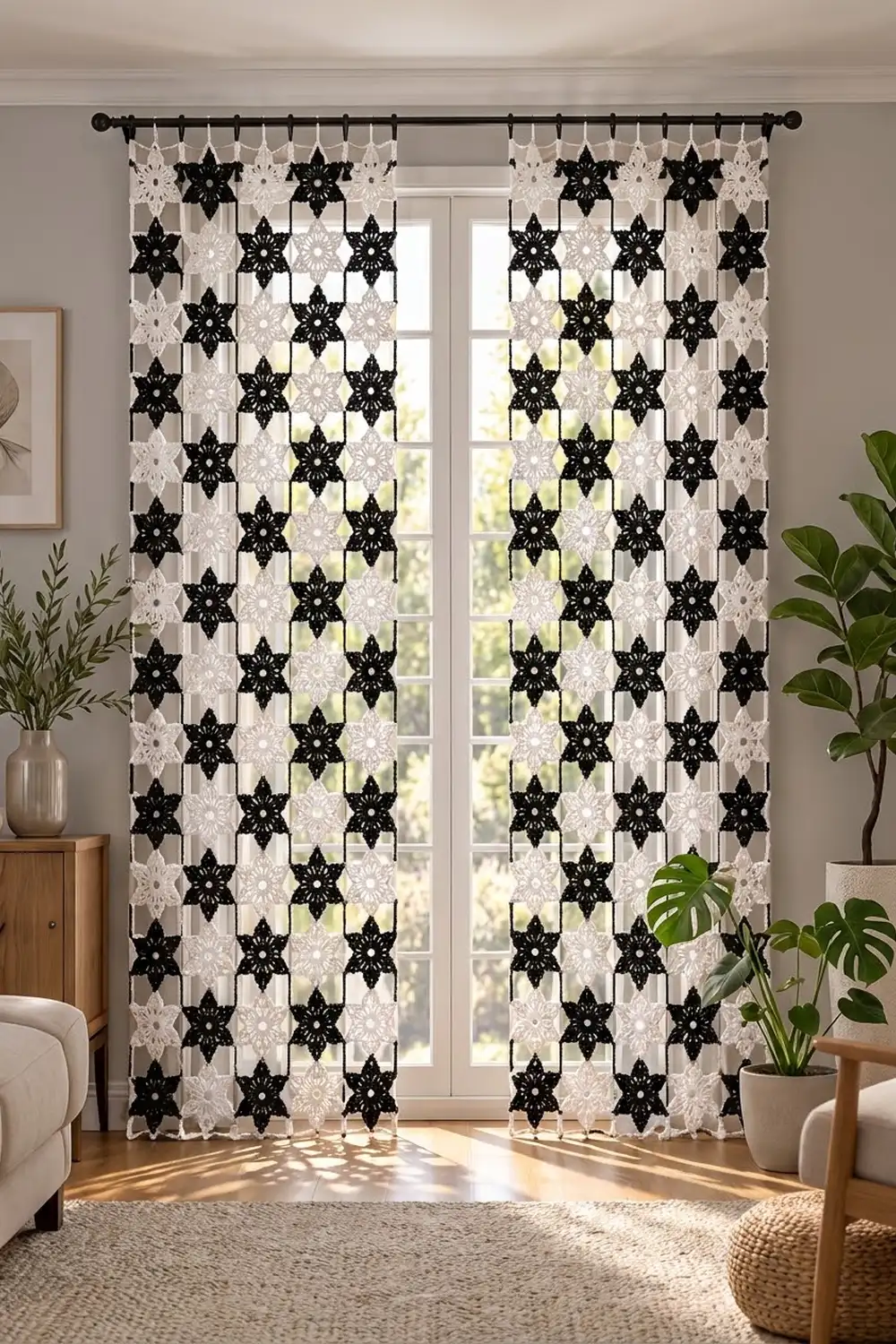
The Midnight Frost Star Curtain is a lacy window panel made from six-pointed star motifs joined at their tips. Solid black stars and solid white stars alternate in a checkerboard. The panel reads as a crisp graphic pattern while soft light still comes through the open spaces between the points.
Each star has a small open center, a ring of lacy chain spokes, and six pointed tips finished with a neat single crochet edge and a chain-3 point. For extra contrast, you can swap any white star for an optional two-tone version with a white center, black points, and a white outline.
This pattern uses US crochet terms. One finished panel measures 29.75 in (75.6 cm) wide and 81.5 in (207.0 cm) long including the header, not counting the hanging loops. Make two panels for a standard pair, about 59.5 in (151.1 cm) wide in total.
Construction is easy to follow. You crochet one complete star, then join every following star as you go on its last round, connecting tip to tip. A short single crochet header goes across the top of the panel and ends with one hanging loop above each top-row star.
Finished Size and Construction
- Finished panel size: 29.75 in x 81.5 in (75.6 cm x 207.0 cm), plus hanging loops
- Skill level: Intermediate
- Terminology: US crochet terms
- Yarn weight: DK / light worsted cotton (weight 3)
- Hook: 3.5 mm (E-4)
- Number of pieces: 112 star motifs per panel (224 for a pair)
- Layout: 7 stars across x 16 stars down, black and white checkerboard
- Single star size: 5 in (12.7 cm) tip to tip vertically, 4.25 in (10.8 cm) across the side tips
- Size before border: 29.75 in x 80 in (75.6 cm x 203.2 cm)
- Border (header) depth: 1.5 in (3.8 cm), top edge only
Materials
Choose a smooth mercerized or combed cotton in DK weight, about 115 m per 50 g. Cotton gives the points crisp definition, holds its shape while hanging, and washes well. Avoid fuzzy yarns, which blur the spokes and points.
Per panel:
- White: 400 g (about 920 m)
- Black: 400 g (about 920 m)
For a pair of panels: 800 g white (about 1,840 m) and 800 g black (about 1,840 m).
These amounts include a margin of about 15% for gauge differences, swatching, and tails. The white amount also covers the header.
Tools:
- 3.5 mm (E-4) crochet hook
- Tapestry needle
- Scissors
- Stitch markers
- Tape measure
- Blocking mats and rust-proof pins
- Spray bottle
Abbreviations (US Terms)
- ch – chain
- sl st – slip stitch
- sc – single crochet
- hdc – half double crochet
- dc – double crochet
- tr – treble crochet
- dtr – double treble crochet: yarn over 3 times, insert hook, pull up a loop, [yarn over, pull through 2 loops] 4 times
- sp – space
- st(s) – stitch(es)
- RS – right side
Special stitch – Join Tip (JT): In the ch-3 tip space of the star you are finishing, work sc, then ch 1. Remove the hook, insert it from front to back into the ch-3 tip space of the neighboring star, pick up the dropped loop, and pull it through. Ch 1, then sc in the same tip space of the current star. The ch 1, join, ch 1 replaces the ch-3, so stitch counts stay the same.
Gauge and Checkpoints
Make one complete star before anything else. Block it lightly and measure it, because 112 motifs will multiply any small error.
Measurement checkpoints for one star:
- After Round 1: 1.25 in (3.2 cm) across
- After Round 2: 2.25 in (5.7 cm) across
- After Round 3: 3.5 in (8.9 cm) from tip to opposite tip
- After Round 4: 4.5 in (11.4 cm) from tip to opposite tip
- After Round 5: 5 in (12.7 cm) from top tip to bottom tip, 4.25 in (10.8 cm) across the side tips
If your star is too big: go down to a 3.25 mm hook, or check that you aren’t pulling your tr stitches extra tall.
If your star is too small: go up to a 3.75 mm hook. If each star is just 0.25 in (0.6 cm) too short, the panel ends up about 4 in (10.2 cm) shorter over 16 rows.
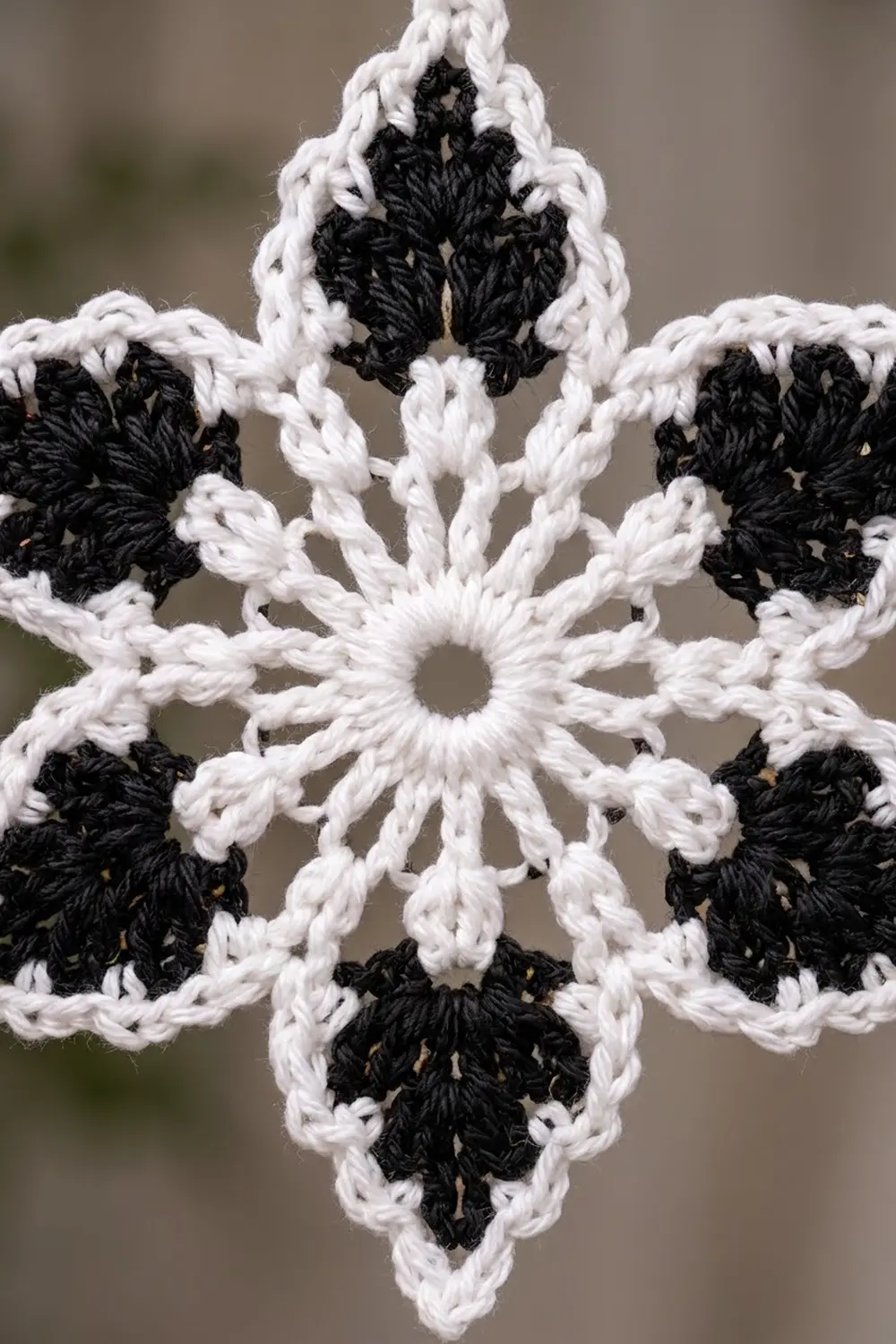
Star Motif
Make each star in one color, unless you are making the optional two-tone star described after Round 5. Leave a 6 in (15.2 cm) tail at the start and end.
Round 1: Ch 6, sl st in first ch to form a ring. Ch 3 (counts as dc), 17 dc in ring, sl st in top of beginning ch-3. (18 dc)
Round 2 (spokes): Ch 5 (counts as dc and ch 2), [dc in next dc, ch 2] 17 times, sl st in 3rd ch of beginning ch-5. (18 dc, 18 ch-2 sps)
These 18 dc are the spokes. Every third spoke becomes a valley between two points, which gives 6 sections of 3 spaces each.
Round 3 (point bases): Ch 1, sc in same st as join (first valley). 2 dc in next ch-2 sp, (2 tr, ch 3, 2 tr) in next ch-2 sp, 2 dc in next ch-2 sp*, sc in next dc; repeat from * 4 more times, then from * to ** once, sl st in first sc.
Each section has 1 sc, 2 dc, 4 tr, and 2 dc. (54 sts: 6 sc, 24 dc, 24 tr; plus 6 ch-3 tips)
Round 4 (points): Ch 1, sc in same sc. Hdc in next dc, dc in next dc, tr in next 2 tr, (2 tr, ch 3, 2 tr) in ch-3 sp, tr in next 2 tr, dc in next dc, hdc in next dc*, sc in next sc; repeat from * 4 more times, then from * to ** once, sl st in first sc.
This is a conversion round: 54 sts worked 1 per existing st + 24 extra tr at the tips = 78 sts (13 per point), plus 6 ch-3 tips. The sc valleys stay low while the tr build each point outward.
Round 5 (edging): Ch 1 (does not count). *Sc in next 6 sts, (sc, ch 3, sc) in ch-3 sp, sc in next 6 sts, sl st in next sc (valley); repeat from * 5 more times. The last sl st goes in the sc at the base of the beginning ch-1. Fasten off.
This is also a conversion round: 78 sts worked 1 per existing st (72 sc and 6 sl st) + 12 extra sc at the tips = 90 sts (15 per point), plus 6 ch-3 tips. The sl st in each valley keeps the inner corners sharp and deep.
Optional two-tone star: Work Rounds 1–2 in white. Fasten off and join black for Rounds 3–4. Fasten off and join white in any valley for Round 5. You get black filled points with a white center and a white outline. It uses about 4 g white and 2 g black, which the margin already covers. Use it in place of any white star.
Make All Pieces
Per panel, make 56 white stars (A) and 56 black stars (B), for 112 stars in total. For a pair, make 112 white and 112 black, or 224 in total.
Layout per panel, 7 across and 16 down:
Row 1:  B A B A B A B
Row 2:  A B A B A B A
Row 3:  B A B A B A B
Row 4:  A B A B A B A
...repeat this 2-row pattern...
Row 15: B A B A B A B
Row 16: A B A B A B A
Odd rows have 4 black and 3 white stars (8 rows = 32 B + 24 A). Even rows have 3 black and 4 white stars (8 rows = 24 B + 32 A). Totals: 56 B and 56 A.
Joining
Join as you go on Round 5. Finish the first star completely. For every star after that, work Rounds 1–4 on their own, then connect the star during Round 5.
Tip names: Hold a star with one tip pointing straight up. Going clockwise, call the tips T1 (top), T2 (upper right), T3 (lower right), T4 (bottom), T5 (lower left), and T6 (upper left).
Joining logic:
- Star to its left neighbor: the new star’s T6 joins the neighbor’s T2, and the new star’s T5 joins the neighbor’s T3.
- Star to the star above: the new star’s T1 joins the T4 of the star above.
- Every other tip gets the normal (sc, ch 3, sc).
Work each join with JT. Every connection is one tip to one tip, so each stitch goes into exactly one ch-3 space and no stitches are added or removed. Round 5 still has 90 sts per star.
Build row 1 from left to right. Then add row 2 one star at a time, joining each star to the star above and to its left neighbor. An interior star ends up joined at all 6 tips. The open diamonds between the stars are part of the design.
Tension advice: Keep the ch 1 on each side of the join relaxed but not loose. Tight joins pucker the points, and loose joins let the panel stretch as it hangs.
Size checkpoint: After row 1, the strip should measure 29.75 in (75.6 cm) from the outer T6 to the outer T2. After every 4 rows, check that the length has grown by 20 in (50.8 cm).
Border (Header)
The side and bottom edges stay as natural star points. Only the top gets a header, which carries the weight of the panel.
Border gauge: 18 sc = 4.25 in (10.8 cm), which is exactly one star width, and 14 rows of sc = 3 in (7.6 cm). Crochet a small white swatch to confirm.
Row 1 (RS): With RS facing, join white with a sl st in T6 of the top-left star. Ch 5 (counts as dtr). Ch 7, 3 sc in ch-3 sp of T1, ch 7, dtr in the join between this star and the next (insert the hook under the join sl st); repeat from * 5 more times. For the last star: ch 7, 3 sc in T1, ch 7, dtr in the ch-3 sp of the outer T2.
Each star contributes exactly 18 sts (7 ch + 3 sc + 7 ch + 1 dtr), and the opening dtr anchors the left edge. 7 x 18 + 1 = 127 sts.
Row 2: Ch 1, turn. Sc in each dtr, ch, and sc across. (127 sc)
Rows 3–6: Ch 1, turn, sc in each sc across. (127 sc)
Row 7 (loops): Ch 1, turn, sc in first sc. Sc in next 9 sc, ch 20, sl st in the last sc made, sc in next 9 sc; repeat from * 6 more times. Fasten off. (127 sc + 7 loops)
The 10th stitch of each 18-st unit sits above the middle sc of T1, so each loop is centered over a top-row star. The loops fit a rod up to 1.25 in (3.2 cm) in diameter.
Why the math works: Each star is 4.25 in (10.8 cm) wide and contributes 18 header sts. At a gauge of 18 sc = 4.25 in (10.8 cm), the header matches the motif row star by star. The one extra edge stitch adds only a fraction of an inch, which disappears in blocking. Seven rows of sc give the 1.5 in (3.8 cm) header depth.
Final Blocking
- Weave in all ends securely along the backs of stitches, never across open spaces.
- Soak the panel in cool water for 15 minutes, then gently press out the water. Do not wring.
- Roll the panel in towels to remove extra moisture.
- Lay it flat on blocking mats. If space is limited, work one section at a time.
- Pin the header straight first, at 29.75 in (75.6 cm) wide.
- Pin each star’s tips so each star measures 5 in (12.7 cm) tall and 4.25 in (10.8 cm) across.
- Check the total length: 81.5 in (207.0 cm) from the top of the header to the bottom tips.
- Let it dry completely before you unpin it.
Final Quality-Control Checklist
- Every star has 6 sharp points and a deep valley at each sl st.
- Round 5 has 90 sts per star, with JT in place of the ch-3 at each join.
- Black and white stars alternate in a true checkerboard.
- Each interior star is joined at all 6 tips.
- The header has 127 sts with 7 evenly spaced loops.
- The panel measures 29.75 in x 81.5 in (75.6 cm x 207.0 cm).
- Ends are woven in and invisible from both sides.
Troubleshooting
Points curl or cup: Your tr stitches are too short. Pull up a taller loop, or block the points flat.
Star ripples: Recheck Round 3. Every third spoke should get a sc, and no spaces should be skipped.
Valleys look shallow: Make sure Round 5 has a sl st in each valley, not a sc.
Panel leans sideways: A tip is probably joined in the wrong place. Check that T6 and T5 always join the left neighbor’s T2 and T3.
Header ruffles: You worked extra sts into the chains. Recount to 127.
Header pulls in: Loosen your ch-7 spans, or go up half a hook size for Row 1.
Care
Hand wash in cool water with mild detergent and dry flat. Wash a test swatch first to make sure the black does not bleed into the white.
Final Notes
The measurement chain is simple. One star measures 5 in x 4.25 in (12.7 cm x 10.8 cm), 7 stars across give 29.75 in (75.6 cm), and 16 stars down give 80 in (203.2 cm). The 127-stitch header matches the star width one unit at a time and adds 1.5 in (3.8 cm), for a finished panel of 29.75 in x 81.5 in (75.6 cm x 207.0 cm). If your first star measures right, the whole curtain will too.
Happy crocheting!