

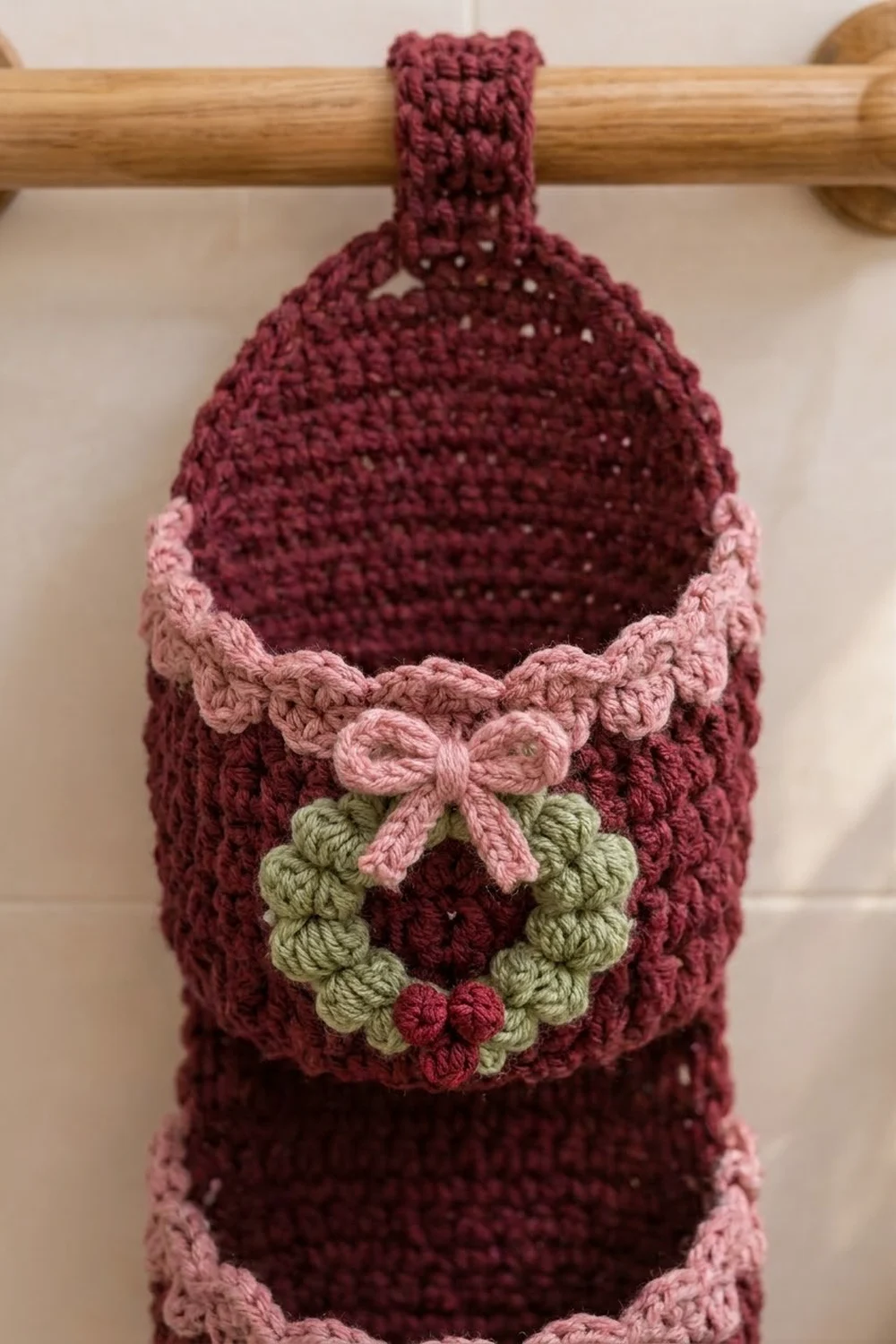
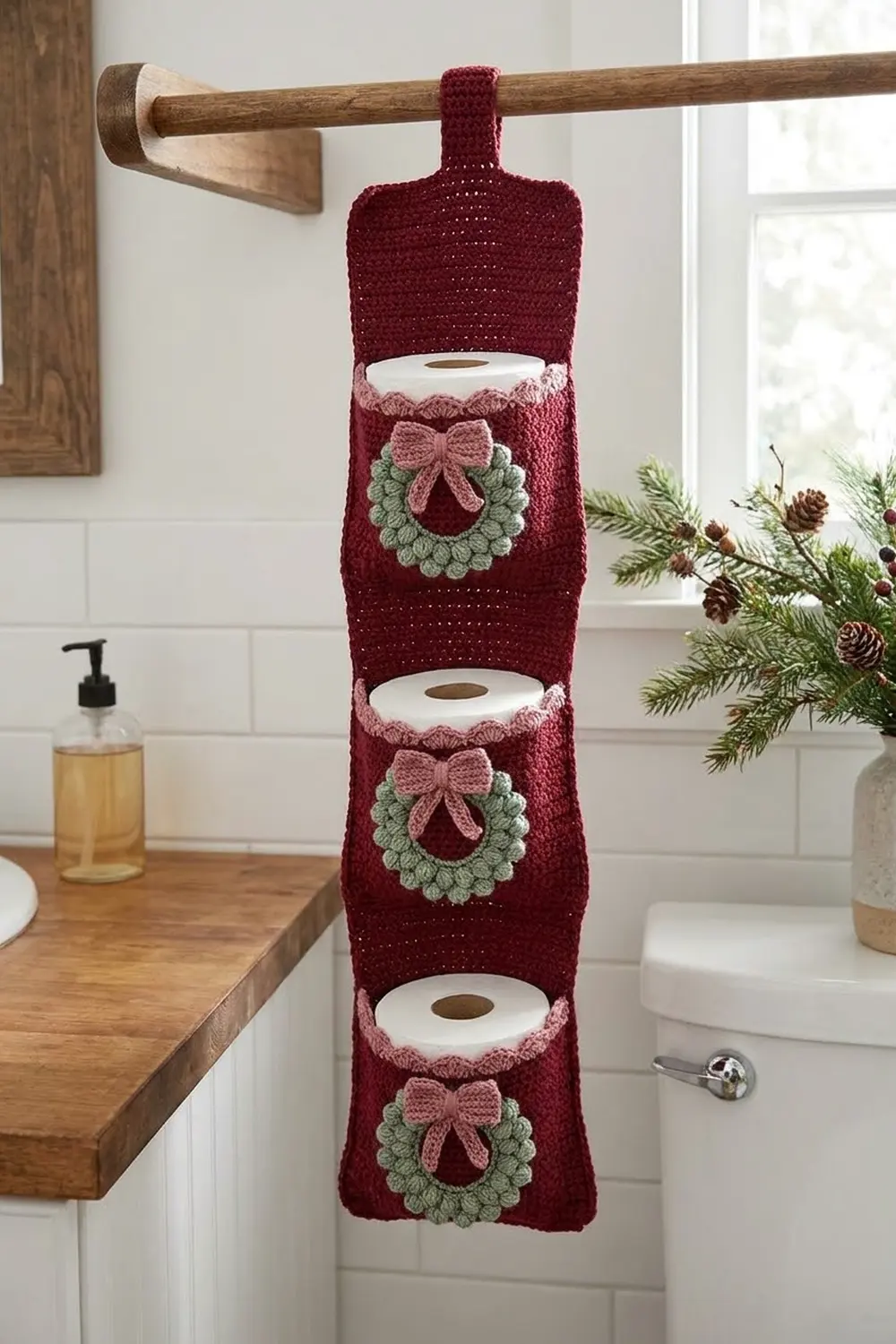
This hanging holder stores three spare rolls in a narrow strip of wall space and looks good doing it. Three round pockets in deep burgundy hang one above the other from a single back panel. Each pocket has a dusty pink scalloped rim and a small sage green wreath with a pink bow and burgundy berries.
The palette is warm and festive without the usual bright red and green. It suits a guest bathroom for the holidays and is calm enough to leave up all winter. The fabric is dense single crochet, so the pockets keep their shape when they’re empty.
The pattern uses US crochet terms. The finished holder is about 21.5″ (54.6 cm) long and about 5″ (12.7 cm) wide at the pockets. Each pocket fits a standard roll about 4.25″ (10.8 cm) wide and 4″ (10.2 cm) tall.
Construction is simple. You work a flat back panel in rows, finishing with a tapered strap that folds into a hanging loop. Each pocket starts as a flat circle and then gets straight walls. You sew the appliqués on, sew each pocket to the panel, and finish every rim with a two-round pink trim.
Finished Size and Construction
- Finished size: 21.5″ (54.6 cm) long x about 5″ (12.7 cm) wide
- Skill level: Easy intermediate
- Terminology: US crochet terms
- Yarn weight: Worsted (#4)
- Hook: 5 mm (H-8)
- Number of pieces: 1 back panel, 3 pockets, 3 wreaths, 3 bows, 3 bow tails, 9 berries
- Layout: 3 pockets stacked vertically on 1 panel, 1.75″ (4.4 cm) gap between pockets
- Pocket size: base about 4.75-5″ (12.1-12.7 cm) across, circumference 15.4″ (39.1 cm)
- Pocket height before trim: 3″ (7.6 cm)
- Trim (border) depth: 0.75″ (1.9 cm), for a finished pocket height of 3.75″ (9.5 cm)
Materials
Use a smooth worsted-weight cotton or cotton blend so the stitches stay crisp and the pockets stand up. Acrylic works too but gives a softer pocket. The amounts below assume about 183 m per 100 g.
- Burgundy (main color, A): 120 g, about 220 m
- Dusty pink (B): 25 g, about 46 m
- Sage green (C): 15 g, about 27 m
All quantities include a margin of roughly 30% for your gauge test and seaming.
Tools:
- 5 mm (H-8) crochet hook
- Stitch markers (at least 4)
- Tapestry needle
- Scissors
- Sewing pins or locking clips
- Optional: three 4.5″ (11.4 cm) circles of plastic canvas to stiffen the pocket bases
Abbreviations (US Terms)
- ch – chain
- sl st – slip stitch
- sc – single crochet
- dc – double crochet
- inc – 2 sc in the same stitch
- sc2tog – single crochet 2 together
- BLO – back loop only
- st(s) – stitch(es)
- rnd – round
Puff stitch: (Yo, insert hook in st, yo and pull up a loop to the height of a dc) 3 times; 7 loops on hook. Yo and pull through all 7 loops, then ch 1 to lock it.
Bobble: (Yo, insert hook in st, yo and pull up a loop, yo and pull through 2 loops) 4 times; 5 loops on hook. Yo and pull through all 5 loops.
Gauge and Checkpoints
Gauge: 14 sc x 16 rows (or rnds) = 4″ (10.2 cm) in sc with the 5 mm hook.
Make one complete pocket before you start the panel. It’s the best gauge test because the pocket has to fit a real roll.
- After base Rnd 9: the flat circle measures about 4.75-5″ (12.1-12.7 cm) across.
- After wall Rnd 21: the wall is 3″ (7.6 cm) tall above the base edge and a roll drops in with a little ease.
- After trim: total pocket height is 3.75″ (9.5 cm).
- Panel after Row 8: 4″ (10.2 cm) wide and 2″ (5.1 cm) long.
Too big? Go down to a 4.5 mm hook. Loose pockets sag and the rolls tilt.
Too small? If the roll won’t go in, go up to a 5.5 mm hook. Don’t add stitches, because the trim needs exactly 54.
Back Panel
Use A.
Row 1: Ch 15, sc in 2nd ch from hook and in each ch across, turn. (14 sc)
Rows 2-66: Ch 1, sc in each st across, turn. (14 sc)
Checkpoint: 4″ (10.2 cm) wide x 16.5″ (41.9 cm) long.
Taper:
Row 67: Ch 1, sc2tog, sc in next 10 sts, sc2tog, turn. (12 sts)
Row 68: Ch 1, sc2tog, sc in next 8 sts, sc2tog, turn. (10 sts)
Row 69: Ch 1, sc2tog, sc in next 6 sts, sc2tog, turn. (8 sts)
Row 70: Ch 1, sc2tog, sc in next 4 sts, sc2tog, turn. (6 sts)
The taper adds 1″ (2.5 cm).
Strap:
Rows 71-94: Ch 1, sc in each st across, turn. (6 sc)
The strap is 1.75″ (4.4 cm) wide and 6″ (15.2 cm) long. Fasten off and leave a 12″ (30.5 cm) tail.
Loop: Fold the top 2″ (5.1 cm) of the strap to the back. Whipstitch Row 94 to the back of the strap, then sew both side edges of the fold together. This makes a closed loop with a 4″ (10.2 cm) circumference, enough to slip over a towel bar or hook. The visible strap is now 4″ (10.2 cm), so the panel’s total length is 16.5 + 1 + 4 = 21.5″ (54.6 cm).
Pocket (Make 3)
Use A. Work in continuous rounds and move a marker up to the first stitch of each round.
Base:
Rnd 1: 6 sc in a magic ring. (6)
Rnd 2: Inc in each st around. (12)
Rnd 3: (Sc 1, inc) 6 times. (18)
Rnd 4: (Sc 2, inc) 6 times. (24)
Rnd 5: (Sc 3, inc) 6 times. (30)
Rnd 6: (Sc 4, inc) 6 times. (36)
Rnd 7: (Sc 5, inc) 6 times. (42)
Rnd 8: (Sc 6, inc) 6 times. (48)
Rnd 9: (Sc 7, inc) 6 times. (54)
Checkpoint: the base lies flat and measures 4.75-5″ (12.1-12.7 cm) across. If you’re using plastic canvas, trim it to 4.5″ (11.4 cm) now.
Walls:
Rnd 10 (turning round): Sc in BLO of each st around. (54 + 0 added = 54)
The unused front loops leave a neat ridge, so the wall turns up sharply.
Rnds 11-21: Sc in each st around. (54)
Sl st in the next st and fasten off. Weave in the tail. The wall is now 12 rounds, or 3″ (7.6 cm), tall. Drop in the plastic canvas circle, if you’re using one.
Appliqués
Wreath (make 3, C):
Ch 10, sl st to the first ch to form a ring.
Rnd 1: Ch 1, work 20 sc into the ring, sl st to the first sc. (20)
Rnd 2: Ch 1, (puff in next st, sl st in next st) 10 times. (10 puffs + 10 sl sts = 20 sts)
Fasten off with a long tail. Push the puffs to the right side. The wreath measures about 2″ (5.1 cm) across with a small open center.
Bow (make 3, B):
Ch 16, sl st to the first ch to form a ring.
Rnd 1: Ch 1, sc in each ch around, sl st to the first sc. (16)
Fasten off with a 12″ (30.5 cm) tail. Flatten the ring into a double layer and wrap the tail tightly around the center 6 times to pinch it. This gives you two open loops about 2.25″ (5.7 cm) wide.
Bow tails (make 3, B): Ch 9 and fasten off. Fold the chain in half into a V and stitch the fold behind the bow’s center wrap.
Berries (make 9, A): Ch 3, work 1 bobble in the 3rd ch from hook, ch 1 to close, and fasten off. Each berry is about 0.5″ (1.3 cm).
Placement on each pocket: Lay the pocket seam-side to the back. Center the wreath on the front, opposite the back, with its top 0.5″ (1.3 cm) below the last wall round. Sew it down through Rnd 1 only, so the puffs stay raised. Stitch the bow over the top of the wreath at 12 o’clock with the tails falling over the wreath. Sew 3 berries in a tight triangle over the bottom of the wreath at 6 o’clock.
Make All Pieces
- A (burgundy): 1 back panel, 3 pockets, 9 berries
- B (pink): 3 bows, 3 bow tails, plus the trim on 3 pockets (worked after joining)
- C (sage): 3 wreaths
Layout (top to bottom):
        [ LOOP ]
        [ STRAP ]   rows 71-94
        [ TAPER ]   rows 67-70
   [ panel only ]   1.75" (4.4 cm)
   [ POCKET 3   ]   base at row 45
   [   gap      ]   1.75" (4.4 cm)
   [ POCKET 2   ]   base at row 23
   [   gap      ]   1.75" (4.4 cm)
   [ POCKET 1   ]   base at row 1
Joining
Use A and a tapestry needle with whipstitch. Pin each pocket in place before sewing.
Choose the back section: On each pocket, count the 14 front loops left free by Rnd 10, directly opposite the wreath, and mark both ends. Those 14 stitches match the 14 stitches across the panel. The cylinder flattens slightly against the panel along this section.
Base seam: Hold the pocket’s 14 marked front loops against the 14 stitches of the panel row where the pocket sits. Join them 1 to 1. Pocket 1 goes on Row 1, Pocket 2 on Row 23 and Pocket 3 on Row 45. Rows 1, 23 and 45 are 22 rows, or 5.5″ (14.0 cm), apart.
Side seams: Sew the wall stitch column at each marker up the matching panel edge. Wall rounds and panel rows are both 4 per inch, so join them 1 to 1: Rnds 10-21 go to 12 panel rows. For Pocket 1 that’s Rows 1-12, for Pocket 2 Rows 23-34, and for Pocket 3 Rows 45-56.
Tension: Pull each stitch snug but not tight. Pulled seams pucker the panel and narrow the pocket opening.
Checkpoint: Each pocket’s top edge sits 3″ (7.6 cm) above its base row. The panel should still hang flat at 4″ (10.2 cm) wide between pockets.
Border: Pink Rim Trim
Work this on each pocket after joining, with B. The trim is the same as the main gauge: 14 sc = 4″ (10.2 cm). One scallop repeat covers 6 stitches, about 1.7″ (4.3 cm).
Join B to the stitch at one back marker on Rnd 21.
Rnd 22: Ch 1, sc in each st around, sl st to the first sc. (54 worked 1 per existing st + 0 added = 54)
Rnd 23 (scallops): Ch 1, sc in the first st, skip 2 sts, 5 dc in next st, skip 2 sts, sc in next st. Repeat from * 8 more times, omitting the final sc on the last repeat, and sl st to the first sc. (9 sc + 9 shells of 5 dc = 54 sts)
Fasten off and weave in the ends.
Why the math works: Each repeat uses exactly 6 stitches (sc, skip 2, shell, skip 2), and 54 ÷ 6 = 9. The ninth shell lands right before the starting sc, so the scallops close evenly with no half shell at the back. Rnd 22 adds 0.25″ (0.6 cm) and the scallops add 0.5″ (1.3 cm), for 0.75″ (1.9 cm) of trim. Pocket height goes from 3″ (7.6 cm) to 3.75″ (9.5 cm).
Each finished pocket ends 3.75″ (9.5 cm) above its base row. The next base is 5.5″ (14.0 cm) up, so each gap is 5.5 − 3.75 = 1.75″ (4.4 cm). Above Pocket 3, the panel runs from 14.75″ (37.5 cm) to 16.5″ (41.9 cm), another 1.75″ (4.4 cm).
Final Blocking
- Lightly mist the whole holder with water, or steam it from 1″ (2.5 cm) away. Don’t press the puffs or berries.
- Lay the panel flat and pin it to 4″ (10.2 cm) wide and 21.5″ (54.6 cm) long.
- Stuff each pocket with a dry roll, or a rolled towel the same size, to shape the cylinders.
- Pin each scallop point upward and outward so the rim flares evenly.
- Shape the bow loops with your fingers so they open into rounded loops.
- Let everything dry completely, about 12-24 hours, before you hang it.
Final Quality-Control Checklist
- Panel is 4″ (10.2 cm) wide with straight edges and no extra or missing stitches.
- Total length is 21.5″ (54.6 cm) with the loop closed securely.
- Each pocket has 54 stitches in every wall round and 9 even scallops.
- Each pocket wall is 3″ (7.6 cm) before trim and 3.75″ (9.5 cm) after.
- Gaps between pockets are all 1.75″ (4.4 cm).
- Wreaths are centered on the fronts with bows at 12 o’clock and berries at 6 o’clock.
- All tails are woven in on the wrong side.
- A roll goes into and comes out of each pocket easily.
Troubleshooting
Base is cupping: Your tension is tight. Go up a hook size for the base rounds only.
Base is ruffling: Check the increase counts. Every base round should add exactly 6 stitches.
Wall flares out: You’re working loosely after Rnd 10. Go down 0.5 mm for the walls.
Scallops don’t close evenly: Rnd 22 probably has more or fewer than 54 stitches. Recount and fix that round first.
Holder tilts forward: The rolls pull the pockets away from the panel. Add plastic canvas bases and check that both side seams cover all 12 rounds.
Puffs disappear into the wreath: Push them through to the right side before you sew the wreath down, and stitch only through Rnd 1.
Care
Hand wash in cool water with mild soap, then reshape and lay flat to dry. Take out any plastic canvas inserts before washing.
Final Notes
The measurement chain is simple. Gauge of 14 sc = 4″ (10.2 cm) gives a 54-stitch pocket with a 15.4″ (39.1 cm) circumference that fits a standard roll. Twelve wall rounds make 3″ (7.6 cm), and the trim adds 0.75″ (1.9 cm). Bases placed 22 rows apart leave even 1.75″ (4.4 cm) gaps. The 66-row panel, 1″ (2.5 cm) taper and 4″ (10.2 cm) visible strap bring the total to 21.5″ (54.6 cm). If one pocket matches the checkpoints, the rest of the holder will too.
Happy crocheting!