

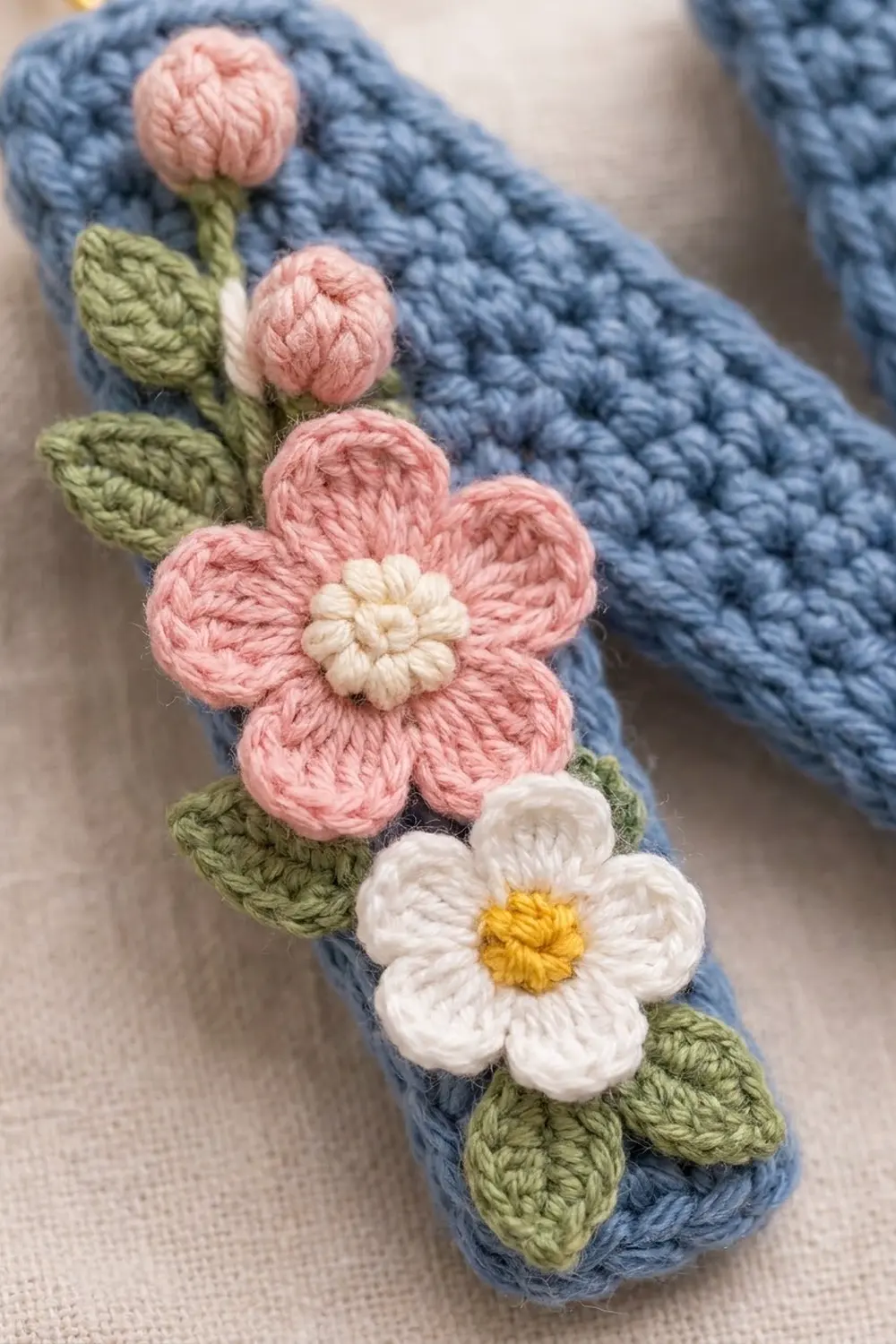
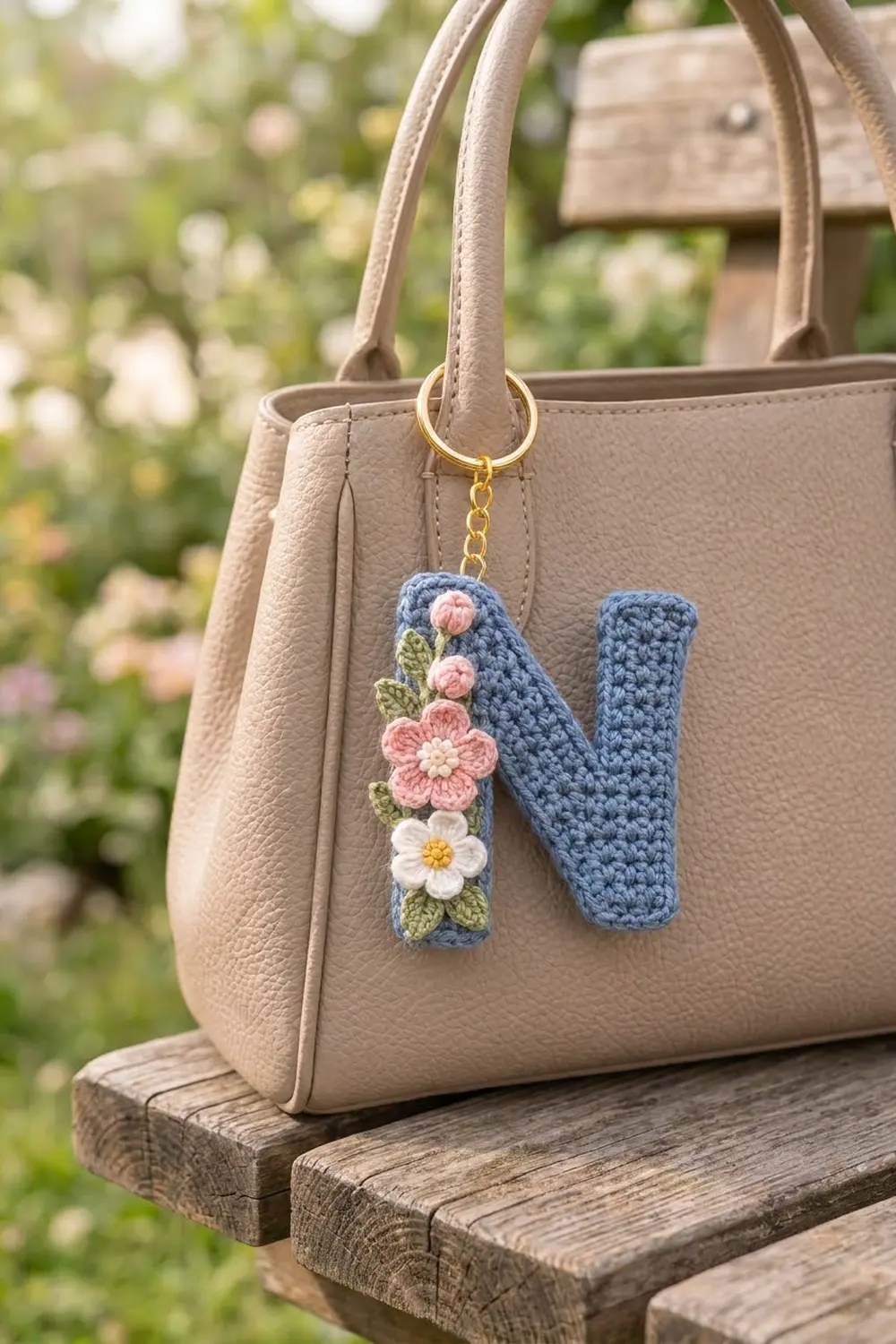
This keychain is a chunky capital “N” in soft denim blue, with a column of little flowers running down its left stem. Two pink bobble buds sit at the top, then a pink flower with a cream center, then a white flower with a yellow center. Green leaves peek out from behind each flower.
The style is sweet and tidy: dense single crochet for a firm base, plus small, raised appliqués that stand out against the plain blue. It makes a good personalized gift, and it looks great hanging from a bag handle. All terms in this pattern are US crochet terms.
The finished letter measures 4.8 in (12.2 cm) tall and 3.7 in (9.4 cm) wide, including the border.
The letter is one piece worked in rows that run from the top of the letter to the bottom. You work the left stem first, then shift a diagonal strip downward 2 stitches per row, then extend a chain upward to build the right stem. A single border round finishes the outline. Then you make the buds, flowers and leaves separately, sew them on, and add the keyring hardware.
Finished Size and Construction
- Finished size: 4.8 in x 3.7 in (12.2 cm x 9.4 cm)
- Skill level: Advanced beginner to intermediate
- Terminology: US crochet terms
- Yarn weight: DK (#3) cotton
- Hook: 3.25 mm for the letter, 3.0 mm for the appliqués
- Number of pieces: 1 letter base plus 10 small appliqués (2 buds, 2 flowers, 6 leaves)
- Layout: Single letter, with the appliqués stacked down the left stem
- Letter size before border: 4.4 in x 3.3 in (11.2 cm x 8.4 cm)
- Border depth: 1 round of sc, about 0.2 in (0.5 cm) on each side
Materials
Use a smooth mercerized or combed cotton in DK weight. Cotton holds its shape and stands up well to life as a keychain. Acrylic will work, but it gives a softer, floppier letter.
- Denim blue: 12 g / 28 m
- Pink: 3 g / 7 m
- Green: 3 g / 7 m
- White: 2 g / 5 m
- Cream: 1 g / 2 m
- Yellow: 1 g / 2 m
All quantities include a margin of about 20% for your gauge swatch and tails.
Tools:
– 3.25 mm and 3.0 mm crochet hooks
– Tapestry needle
– 4 locking stitch markers
– Gold split keyring, 1 in (2.5 cm)
– Short gold chain, 4 links (about 1 in / 2.5 cm)
– 8 mm gold jump ring and 2 flat-nose pliers
– Pins, blocking board, spray bottle
Abbreviations (US Terms)
- ch – chain
- sl st – slip stitch
- sc – single crochet
- hdc – half double crochet
- dc – double crochet
- sc2tog – single crochet 2 together
- st(s) – stitch(es)
- MR – magic ring
- RS – right side
Special stitch: Bobble (bob). Yarn over, insert hook into the ring, pull up a loop, yarn over, pull through 2 loops. Repeat 4 more times (6 loops on hook). Yarn over and pull through all 6 loops.
Special stitch: sc2tog over a stitch and a row end. Insert hook into the next stitch and pull up a loop. Insert hook into the next row end and pull up a loop. Yarn over and pull through all 3 loops.
Gauge and Checkpoints
With the 3.25 mm hook, 20 sc x 22 rows = 4 in (10.2 cm) in sc worked in rows. That is 5 sts and 5.5 rows per inch.
Work a small swatch first. The letter is a single piece, so your first real checkpoints come early:
- After Row 1: the row of 22 sc measures 4.4 in (11.2 cm) long.
- After Row 5: the left stem is 0.9 in (2.3 cm) wide.
- After Row 13: stem plus diagonal is 2.4 in (6.1 cm) wide.
- After Row 18: the letter is 3.3 in (8.4 cm) wide.
- After the border: 4.8 in x 3.7 in (12.2 cm x 9.4 cm).
If Row 1 is longer than 4.4 in (11.2 cm), go down half a hook size. If it is shorter, go up half a size. Fix gauge here, before you start the diagonal: every later step depends on it.
The Letter Base
Use denim blue and the 3.25 mm hook. The rows run along the height of the letter. Stitch positions are numbered 1 (top of the letter) to 22 (bottom).
Left Stem
Foundation: Ch 23.
Row 1: Sc in 2nd ch from hook and in each ch across. Place a marker in the last sc; this marks the top of the letter. (22 sc)
Odd rows always end at the top and even rows end at the bottom.
Rows 2–5: Ch 1, turn, sc in each st across. (22 sc)
Check: 0.9 in (2.3 cm) wide.
Diagonal
Row 6: Ch 1, turn, sc in the first 8 sts (positions 1–8). Leave the remaining 14 sts unworked. (8 sc)
Row 7: Ch 3. Sc in 2nd ch from hook and in the next ch (2 new sts, positions 9–10). Sc in the next 6 sts. Leave the last 2 sts unworked. (8 sc, positions 3–10)
Row 8: Turn, sl st in the first 2 sts, ch 1 (does not count). Sc in the next 5 sts, then 3 sc in the last st. (8 sc, positions 5–12)
The slip stitches do not count as stitches.
Rows 9, 11, 13: Repeat Row 7. (8 sc each)
Rows 10, 12: Repeat Row 8. (8 sc each)
Every row moves the strip down exactly 2 positions:
– Row 6 covers positions 1–8
– Row 9 covers positions 7–14
– Row 13 covers positions 15–22, the bottom edge
Check: 2.4 in (6.1 cm) wide. Each step is 0.4 in (1.0 cm) lower than the last.
Right Stem
Row 14: Ch 15. Sc in 2nd ch from hook and in each of the next 13 ch (14 sc, positions 1–14). Then sc in each of the 8 sts of Row 13. (22 sc)
Rows 15–18: Ch 1, turn, sc in each st across. (22 sc)
Fasten off.
Check: 4.4 in x 3.3 in (11.2 cm x 8.4 cm). The two stems should match at 5 rows each, and the diagonal should be 8 rows, about 1.5 in (3.8 cm) wide.
Border
Border gauge: One sc per stitch, per chain loop, or per row end. This adds about 0.2 in (0.5 cm) all around.
Round 1: With RS facing, join denim blue at the bottom-left corner, in the first foundation ch (position 22). Ch 1, then work clockwise:
- Left edge: Sc in each of the 22 foundation ch, with 3 sc in the last ch (top-left corner). (24 sc)
- Top of left stem: Sc in each of the 6 row ends of Rows 1–6, with 2 sc in the Row 6 end. (7 sc)
- Upper diagonal edge: Repeat the following 7 times. Each repeat covers the 2 exposed sts of one step and the next row end. (14 sc)
- sc in next st
- sc2tog over the next st and the next row end
- Inner edge of right stem: Sc in each of the 14 ch loops of Row 14’s chain, with 2 sc in the last loop. (15 sc)
- Top of right stem: Sc in each of the 5 row ends of Rows 14–18, with 3 sc in the last (top-right corner). (7 sc)
- Right edge: Sc in each of the 22 sts of Row 18, with 3 sc in the last (bottom-right corner). (24 sc)
- Bottom of right stem: Sc in each of the 6 row ends of Rows 18–13, with 2 sc in the Row 13 end. (7 sc)
- Lower diagonal edge: Repeat the step sequence from section 3 another 7 times. On the odd rows, work into the chain loops of each step. On the even rows, work into the base of each 3-sc fan. (14 sc)
- Inner edge of left stem: Sc in each of the 14 unworked sts of Row 5 (positions 9–22), with 2 sc in the last. (15 sc)
- Bottom of left stem: Sc in each of the 5 row ends of Rows 5–1, with 3 sc in the last (bottom-left corner). (7 sc)
Join with a sl st to the first sc. Total: 134 sc.
Sum check: 24 + 7 + 14 + 15 + 7 + 24 + 7 + 14 + 15 + 7 = 134.
Why the math works:
– An N looks the same when turned 180 degrees, so each border section has an exact twin: 24/24, 7/7, 14/14, 15/15 and 7/7.
– Edges made of stitches and chain loops take 1 sc each, which matches the gauge exactly.
– Each diagonal edge is about 3.1 in (7.9 cm) long. At 14 sc it is drawn in very slightly, which keeps the diagonal crisp rather than wavy.
– Corner increases are worked into each section’s own last unit and are never added twice.
Fasten off and weave in the ends.
Appliqués
Use the 3.0 mm hook. Leave a 8 in (20.3 cm) tail on every piece for sewing.
Buds (make 2, pink)
MR, ch 2, work 1 bobble into the ring, ch 1. Pull the ring tight and fasten off. Thread both tails to the back. Each bud is about 0.4 in (1.0 cm) across.
Pink Flower (make 1)
Round 1: With cream, work 10 sc in a MR. Join with a sl st. (10 sc) Fasten off.
Round 2: Join pink in any st. Work (hdc, 3 dc, hdc) in the next st, then sl st in the next st. Repeat from * 4 more times. (5 petals of 5 sts each, plus 5 sl sts)
Fasten off. The flower is about 1.1 in (2.8 cm) across.
White Flower (make 1)
Round 1: With yellow, work 5 sc in a MR. Join with a sl st. (5 sc) Fasten off.
Round 2: Join white. Work (hdc, 2 dc, hdc) in each st around, then join with a sl st to the first hdc. (5 petals, 20 sts)
Fasten off. The flower is about 0.9 in (2.3 cm) across.
Leaves (make 6, green)
Ch 6. Sc in 2nd ch from hook, hdc in the next ch, dc in the next ch, hdc in the next ch, 3 sc in the last ch. Working along the other side of the chain: hdc, dc, hdc, then sl st in the first ch.
Fasten off. Working along both sides of the chain leaves a visible center vein. Each leaf is about 0.8 in (2.0 cm) long.
Placement
Measure each position down from the top of the letter to the center of the piece:
- Bud 1: 0.7 in (1.8 cm)
- Bud 2: 1.3 in (3.3 cm)
- Pink flower: 2.4 in (6.1 cm)
- White flower: 3.6 in (9.1 cm)
Sew the leaves first. Place one leaf beside each bud, one on each side below the pink flower, and two angled out under the white flower. Then sew the flowers and buds on top so they partly cover the leaf bases.
The left stem with its border is about 1.3 in (3.3 cm) wide, so the pink flower nearly fills it and the leaf tips stick out past the edges.
Use small whip stitches around each flower center and petal base. Do not go all the way through to the back of the letter.
Final Blocking
- Before sewing on the appliqués, mist the letter until it is damp.
- Pin it to 4.8 in x 3.7 in (12.2 cm x 9.4 cm). Put pins at all 4 outer corners and along both stems.
- Straighten the diagonal with 2 pins on each edge.
- Let it dry completely, at least 6 hours.
- Unpin, sew on the appliqués, and lightly re-mist only the petals to settle them.
- Open the jump ring with pliers and thread it through 2 border sts at the top-left corner. Add the chain and keyring, then close the jump ring flush.
Final Quality-Control Checklist
- Letter measures 4.8 in x 3.7 in (12.2 cm x 9.4 cm), within 0.25 in (0.6 cm)
- Both stems are 5 rows wide and the same width
- The diagonal steps evenly, 2 positions per row
- Border count is 134 sc, and the twin sections match
- All appliqués are sewn firmly with no loose petals
- The jump ring is fully closed
- All ends are woven in and hidden
Troubleshooting
- The diagonal leans or curls: Check the counts for Rows 7–13: 8 sc every row. Re-block it with pins along both edges.
- The border ruffles at the corners: You may have worked 3 sc at an inner corner. Only the 4 outer corners get 3 sc.
- The border pulls in along the stems: Your border tension is tight. Loosen it, or go up 0.25 mm for the border only.
- The upper diagonal edge looks lumpy: Work the step stitches into the sl sts themselves, not between them.
- The flowers cup: Press each flower flat under a damp cloth before sewing it on.
- The keyring tears the corner: Thread the jump ring through 2 border sts, not 1.
Care
Spot clean with mild soap and cool water, press out the water in a towel, and dry flat. Avoid the dryer so the flowers keep their shape.
Final Notes
The measurement chain runs like this:
- Gauge is 5 sts and 5.5 rows per inch.
- Row 1 is 4.4 in (11.2 cm) long.
- The left stem is 0.9 in (2.3 cm) wide, and the diagonal 1.5 in (3.8 cm) wide.
- The finished base is 3.3 in (8.4 cm) wide.
- The 134-stitch border brings the letter to 4.8 in x 3.7 in (12.2 cm x 9.4 cm).
If each checkpoint matches, the flowers will fit the stem exactly as shown.
Happy crocheting!